
An immigration lawyer often sees the same problem in different files. The client's declaration is compelling. The family history is credible. The trauma narrative makes sense. But when the case turns on functional impact, the record becomes thin.
A client says they can't concentrate long enough to complete forms, remember dates consistently, care for children without help, or return safely to a setting where they'd have to function independently. Those statements matter, but in contested cases they rarely carry the same weight as structured clinical evidence. USCIS, opposing counsel, and immigration judges tend to ask a harder question: what objective evidence shows that these problems are real, significant, and tied to a condition that affects day-to-day functioning?
That's where a neuropsychological assessment becomes more than a medical exercise. In immigration practice, it can serve as a bridge from subjective experience to objective documentation. It gives the legal team a disciplined way to show how trauma, neurological injury, developmental limitations, or severe psychiatric symptoms affect memory, attention, reasoning, judgment, and other abilities that matter in real life.
In asylum matters, that may help explain fragmented recall without reducing credibility. In VAWA, T visa, or U visa cases, it may help document how abuse or victimization has affected functioning beyond emotional distress alone. In hardship waivers, it can help connect a qualifying relative's condition to practical dependence, safety concerns, and diminished capacity to cope with separation or relocation.
Used well, the assessment doesn't replace testimony. It strengthens it. It gives the attorney language that is clinically grounded, legally useful, and harder to dismiss as exaggeration.
Table of Contents
- Introduction The Bridge from Subjective Trauma to Objective Evidence
- Defining the Neuropsychological Assessment
- The Assessment Process From Referral to Report
- Key Cognitive Domains and What They Reveal
- Interpreting the Results What the Data Means for Your Case
- Strategic Applications in US Immigration Law
- Common Questions and Misconceptions
Introduction The Bridge from Subjective Trauma to Objective Evidence
An attorney preparing an asylum case may have a client who survived detention, assault, or repeated threats, yet struggles to recount events in a linear way. Another lawyer handling a VAWA petition may represent a survivor who appears inconsistent, forgetful, or easily overwhelmed in meetings. In a hardship case, counsel may need to show that a qualifying relative's difficulties are not ordinary stress, but a cognitive and emotional burden that affects work, parenting, medication management, or independent living.
Those are legal problems, not just clinical ones.
A neuropsychological assessment helps when the case needs objective evidence of how a condition affects thinking and functioning. Instead of relying only on self-report, the evaluation uses standardized tasks, clinical interview data, behavioral observations, and professional interpretation to identify whether problems with attention, memory, processing speed, language, or executive functioning are present and whether the pattern fits trauma, neurological illness, psychiatric illness, or some combination.
Practical rule: When the legal theory depends on functional impairment, not just diagnosis, broad emotional descriptions usually aren't enough.
For immigration attorneys, the strategic value is straightforward. The report can corroborate hardship, explain apparent inconsistencies, clarify whether a client can meaningfully participate in proceedings, and translate symptoms into concrete limits that matter under the statute or discretionary framework. It can also help separate genuine neurocognitive compromise from assumptions that a client is evasive, uncooperative, or poorly prepared.
That distinction matters most in high-stakes filings. A well-done assessment can show that what looks like vagueness may reflect trauma-related retrieval problems, slowed processing, dissociation, or impaired executive control. In the legal record, that is a very different story.
Defining the Neuropsychological Assessment
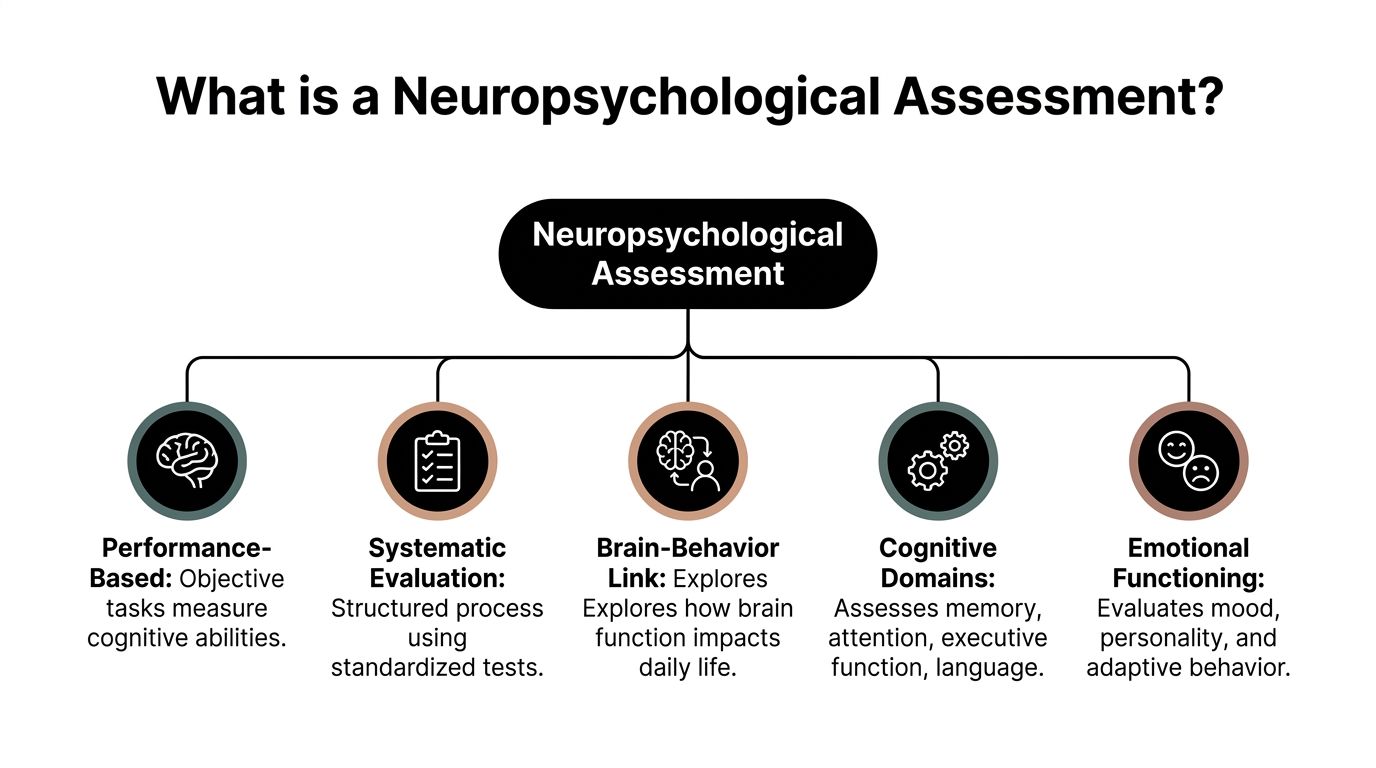
A neuropsychological assessment is a performance-based method that systematically evaluates brain-behavior relationships by testing cognitive domains like memory and attention. It is conducted by clinical neuropsychologists, who are doctoral-level psychologists with specialized fellowship training and who use standardized tools to provide objective evidence of cognitive function, as described in this clinical overview of neuropsychological assessment.
What it is in practical terms
If a standard psychological evaluation is largely an in-depth interview, a neuropsychological assessment is closer to a set of targeted stress tests for different brain functions. The person doesn't just describe their difficulties. They perform tasks that measure how they learn, recall, focus, shift attention, solve problems, understand language, and manage cognitive load.
That matters in legal settings because performance data is often more persuasive than symptom labels alone. Saying “my client has anxiety” tells the adjudicator something. Showing that the client becomes disorganized under multi-step demands, has weak delayed recall, or struggles to sustain attention gives the court or agency a much clearer picture of impairment.
What it is not
It's not the same as a psychiatric medication consult. A psychiatrist typically focuses on diagnosis, symptom course, risk, and medication management.
It's also not the same as a general psychotherapy intake or a broad psychological interview. Those can be useful, but they may not measure cognitive performance in a detailed, standardized way.
A short comparison helps:
| Evaluation type | Primary focus | Typical legal value |
|---|---|---|
| Psychiatric evaluation | Diagnosis, symptoms, medication needs | Helpful for treatment and psychiatric diagnosis |
| General psychological evaluation | Emotional functioning, personality, mental health history | Helpful for trauma, mood, and diagnostic context |
| Neuropsychological assessment | Measured cognitive functioning and brain-behavior relationships | Helpful when the case turns on functioning, capacity, consistency, or objective cognitive evidence |
Why attorneys should care about the distinction
In immigration cases, the question is often not just whether the person is suffering. The question is whether the suffering has led to demonstrable impairment that affects safety, independence, communication, parenting, employability, or ability to participate in proceedings.
That is why “what is a neuropsychological assessment” is not just a definitional question. For lawyers, it's a question about evidentiary fit. When the issue is functional limitation, a tool built to measure function usually works better than one built only to describe distress.
The Assessment Process From Referral to Report
The process is more structured than many clients expect, and that's a good thing. In forensic and immigration contexts, structure protects both reliability and credibility.
Referral and case framing
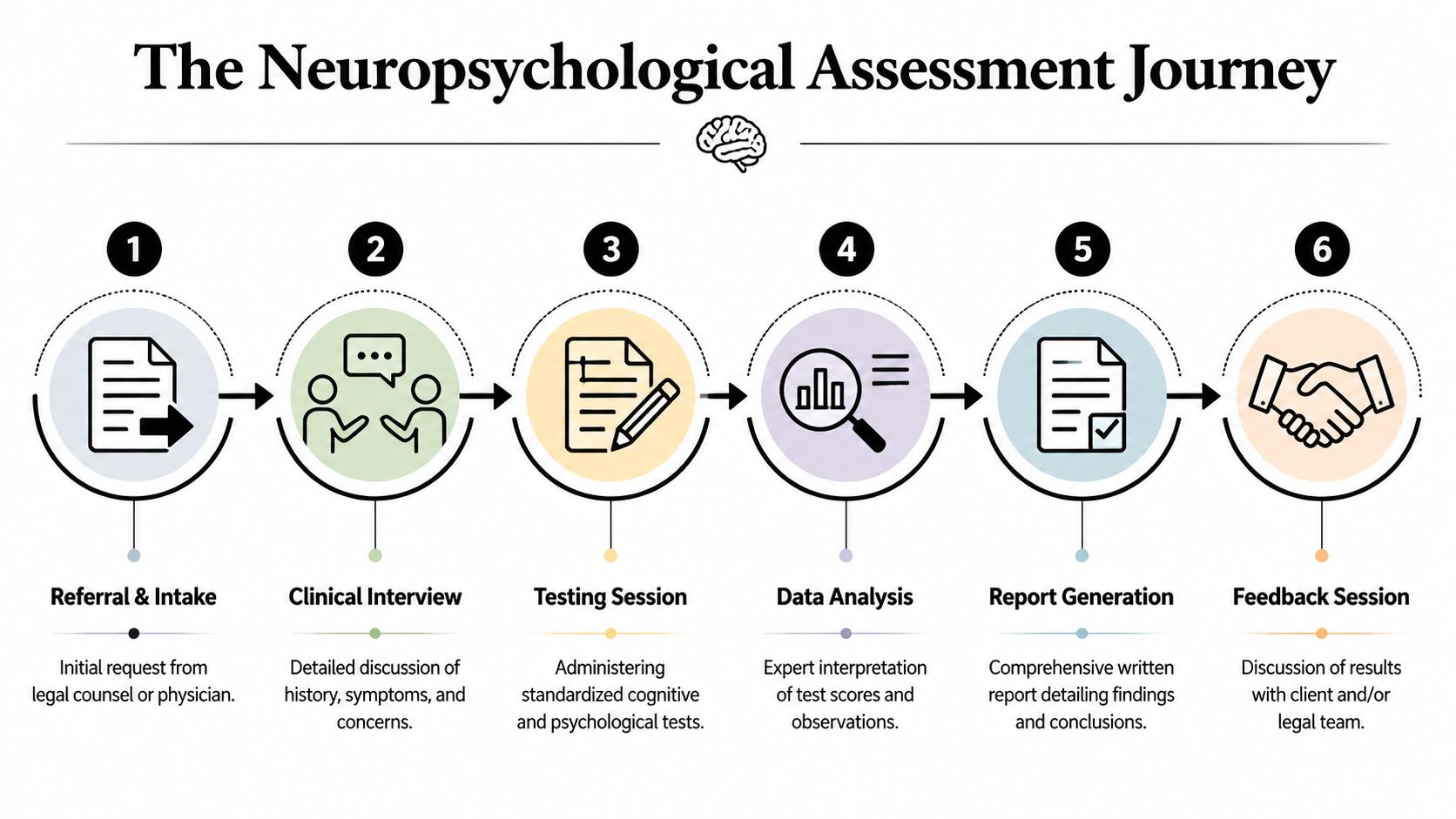
A strong referral starts with a clear legal question. Counsel should identify what the evaluation needs to address. Examples include memory problems after trauma, capacity to understand proceedings, cognitive effects of abuse, or hardship-related impairment in a qualifying relative.
The sharper the referral question, the more useful the final report tends to be. “Assess for trauma” is broad. “Assess whether trauma-related cognitive symptoms affect the client's ability to provide a coherent timeline and function independently” is much better.
For lawyers who want to understand how a finished report is typically structured, reviewing a sample adult neuropsychological evaluation format can help before the referral is made.
Clinical interview and background review
The evaluation usually begins with a detailed interview and record review. The neuropsychologist gathers developmental history, education, medical issues, trauma exposure, psychiatric history, prior treatment, and day-to-day functioning.
This part is not filler. It provides the context needed to interpret test findings correctly. A low score without context can mislead. A low score interpreted alongside trauma history, language background, medical records, and observed behavior is far more useful.
Testing day
A thorough evaluation typically takes up to eight hours, and after testing the neuropsychologist spends approximately two weeks scoring the tests, interpreting the results against normative data, and writing an in-depth report, according to the Brain Injury Association of America's description of the neuropsych evaluation process.
The tasks vary. A person may answer questions, repeat information, solve puzzles, recall material after delays, read, write, respond to visual stimuli, or complete structured problem-solving tasks. The goal is to sample multiple domains rather than rely on one narrow screen.
A short video overview can help clients understand what the day feels like in practice.
Many clients arrive worried that they're being judged on intelligence. They are not. The task is to understand their pattern of functioning, not to rank their worth.
Tele-neuropsychology and validity protections
Remote evaluations can be appropriate, but they require real safeguards. For optimal accuracy in tele-neuropsychological evaluations, strict technical specifications and environmental controls are mandatory, including a recommended laptop or desktop setup, a 360-degree room scan, continuous real-time monitoring, and explicit confirmation that no unauthorized aids are being used, as outlined in these tele-neuropsychological evaluation procedures and technical requirements.
That matters for immigration lawyers working with clients across the country. Remote access is useful only if the process remains defensible. A tele-assessment that ignores privacy, distractions, or unauthorized assistance creates avoidable attack points.
The report attorneys actually need
The final report should do more than list scores. It should explain the referral question, summarize relevant history, describe observed behavior, interpret the cognitive pattern, address validity, and connect findings to everyday functioning. For legal use, clarity matters as much as technical accuracy.
The best reports don't force counsel to translate raw data on their own. They already do part of that work.
Key Cognitive Domains and What They Reveal
Attorneys often hear domain names like attention, memory, or executive function and wonder how those labels connect to case facts. The answer is that each domain reflects a different part of everyday functioning.
Neuropsychological testing is valuable because it can identify specific neurocognitive deficits rather than treating all complaints as the same. It can distinguish Alzheimer dementia from non-dementia with nearly 90% accuracy, and diagnostic rates are similar for separating dementia from psychiatric disorders, according to the American Academy of Family Physicians review of neuropsychological evaluations. That same logic applies broadly in forensic work. Patterns matter.
Attention and processing speed
Attention is the ability to focus, sustain effort, and filter distractions. Processing speed is how efficiently a person takes in and responds to information.
When these are weak, clients may look evasive or unprepared when they're overwhelmed by fast-paced questioning. In legal practice, that can show up as missed details, slow form completion, difficulty following an interpreter, or fatigue during long meetings.
Learning and memory
This domain addresses how a person takes in new information, stores it, and retrieves it later. It matters in cases where the client struggles with dates, sequences, or repeated retelling of traumatic events.
Memory complaints aren't all the same. Some people learn poorly from the start because attention is impaired. Others learn adequately but can't retrieve information efficiently under stress. That distinction can affect how you prepare testimony.
For a related example of how structured assessment clarifies overlapping concentration and memory complaints, this discussion of neuropsychological assessment in ADHD is useful.
Executive functioning and language
Executive functions include planning, organization, mental flexibility, inhibition, judgment, and problem-solving. Language includes comprehension, word retrieval, naming, and verbal expression.
A client with executive dysfunction may miss deadlines, fail to follow multi-step legal instructions, or become unable to manage finances or medication schedules without support. A client with language weaknesses may understand the broad issue but fail when asked precise follow-up questions.
In immigration cases, executive dysfunction is often what turns a diagnosis into a functional argument.
Visuospatial and related skills
These skills help a person understand spatial relationships, interpret visual information, and move through environments. In some cases, weakness here affects driving, independent travel, paperwork accuracy, or managing tasks that require visual organization.
Not every immigration case needs this domain emphasized. But when independent functioning is disputed, it can become highly relevant.
Interpreting the Results What the Data Means for Your Case
A neuropsychological report is only as useful as its interpretation. Lawyers rarely need a stack of unexplained scores. They need a clinically defensible answer to a legal question.
One of the most important points in the literature is that a common complaint about neuropsychological evaluations is their “apparent lack of relevance to practical problems that the patient may be experiencing.” That same source explains that a key role of the neuropsychologist is to translate abstract test scores into functional outcomes such as “Can I go back to work?” or “Can I live by myself?”, as discussed in this NIH article on linking neuropsychological findings to everyday function.

From scores to functional narrative
The report should answer questions like these:
- Can the client follow multi-step instructions without repeated redirection?
- Can the client recall material accurately over time, especially under stress?
- Does the client process information slowly enough that a standard interview format may distort performance?
- Are cognitive symptoms consistent with trauma, neurological compromise, psychiatric illness, or mixed causes?
- What support does the person likely need for work, parenting, independent living, or litigation participation?
Those conclusions come from patterns, not isolated low points. One weak score proves very little. A coherent pattern across history, behavior, and test performance is what carries weight.
Why the evaluator's training matters
In legal settings, the evaluator's qualifications affect how persuasive the report will be. A doctoral-level clinical neuropsychologist brings specialized training in standardized assessment, psychometrics, differential diagnosis, and interpretation of brain-behavior relationships. That expertise is what allows the report to say more than “the client reports memory problems.”
It allows the report to explain whether the data supports those complaints, whether the pattern is internally consistent, and how the deficits are likely to affect real tasks.
How attorneys can use the report
A strong report can support case strategy in several ways:
| Legal use | How the report helps |
|---|---|
| Corroboration | Confirms that reported symptoms have objective cognitive correlates |
| Credibility context | Explains why fragmented recall or disorganization may reflect impairment rather than fabrication |
| Functional hardship evidence | Connects symptoms to parenting, work, safety, or dependence |
| Procedural fairness concerns | Identifies whether the client may need accommodations or slower questioning |
A useful forensic report doesn't stop at diagnosis. It tells the court what the diagnosis means in the person's actual life.
When lawyers ask what is a neuropsychological assessment in practical terms, this is the answer that usually matters most. It is a method for converting clinical data into a functional narrative that a decision-maker can use.
Strategic Applications in US Immigration Law
The legal value of neuropsychological evidence depends on fit. The assessment is strongest when the findings directly support an element of the claim or explain a problem already visible in the record.

Asylum and trauma-based claims
In asylum cases, many clients present with trauma histories that affect concentration, recall, orientation, and emotional regulation. A neuropsychological assessment can help show that inconsistent sequencing or incomplete retrieval does not automatically mean dishonesty.
This is often where clinicians and lawyers need the same language. The lawyer needs to explain credibility concerns. The evaluator can explain whether trauma-related cognitive effects plausibly account for fragmented narrative production, slowed responding, or impaired memory retrieval under stress.
VAWA and T or U visa matters
In these cases, the assessment can help document the impact of extreme cruelty, trafficking, coercion, assault, or other qualifying victimization on daily functioning. That may include problems with concentration, executive control, emotional regulation, and capacity to maintain work or independent living.
What works best is specificity. “The client is traumatized” is less useful than a finding that the client shows measurable weaknesses in attention and executive functioning that interfere with organizing documents, following complex instructions, or making safe decisions under pressure.
Hardship waivers and qualifying relatives
Hardship cases often turn on whether separation or relocation would create consequences beyond ordinary difficulty. Neuropsychological evidence can be persuasive when it documents the cognitive and emotional burden on a qualifying relative and ties that burden to real dependence.
That may involve impaired memory for medication routines, reduced ability to manage household responsibilities, poor tolerance for change, or diminished coping capacity. Those are not abstract symptoms. They are concrete functional limits.
Competency and defensibility
Sometimes the key issue is whether the client can understand the nature of proceedings, assist counsel, or make informed decisions. In those matters, the assessment gives attorneys a firmer basis for raising competency-related concerns or requesting accommodations.
For lawyers working remotely with clients, validity remains essential. Strict tele-neuropsychology protocols, including a 360-degree room scan, continuous monitoring, and confirmation that no unauthorized aids are used, help preserve psychometric integrity in forensic settings, as explained in this discussion of assessment tool validity in legal contexts.
The strategic point is simple. The best neuropsychological evidence doesn't sit beside the legal theory. It fits inside it.
Common Questions and Misconceptions
Is this a pass or fail test
No. A neuropsychological assessment is not an exam you pass by doing well or fail by doing poorly. It is a structured way to understand a person's cognitive profile, including strengths, weaknesses, patterns, and likely functional implications.
A high-functioning client can still show meaningful impairment in one domain. A distressed client can also test within expected limits in certain areas. Both outcomes can be useful if they are interpreted correctly.
Can someone fake the results
This is one of the most common concerns, especially in contested legal matters. The answer is that validity is part of the evaluation itself. Throughout the evaluation, the examiner assesses the validity of your effort using both embedded checks within tests and standalone measures designed to flag inconsistent or low effort. This helps distinguish genuine symptoms like “brain fog” from intentional non-performance, as described in this overview of validity testing in neuropsychological disability evaluations.
What if the client is anxious
Anxiety matters, but it doesn't make testing useless. A skilled evaluator considers emotional distress, behavioral presentation, trauma history, and effort when interpreting performance. The goal is not to pretend anxiety is absent. The goal is to determine how the full pattern fits together.
Clients don't need to perform perfectly. They need to engage honestly so the data can be interpreted responsibly.
If your immigration case needs evidence that connects trauma, abuse, cognitive impairment, or functional limitation to a clear legal argument, Pro Psychological Analysis provides immigration-focused psychological evaluations for asylum, VAWA, T visa, U visa, and hardship matters. The practice works with attorneys to produce evidence-based reports that are clinically rigorous, timely, and aligned with the demands of USCIS and immigration court.