
An attorney has a client whose history is credible on its face, but the testimony keeps slipping. Dates are out of order. Key events come back in fragments. The client looks guarded in one interview, flooded in the next, and flat in the third. On paper, that can look like inconsistency. In practice, it often reflects trauma, cognitive overload, depression, head injury, or some combination of all four.
That's where a neuropsychological evaluation for adults sample becomes useful. Not as a generic mental health attachment, but as a disciplined way to convert symptoms into evidence. A strong report can show that memory weakness, slowed processing, impaired executive control, or trauma-related intrusion errors are clinically coherent findings, not signs that the client is being evasive. For immigration counsel, that distinction matters.
The legal value isn't in sounding medical. It's in showing the court or adjudicator how brain-based and trauma-related impairments affect disclosure, recall, sequencing, concentration, and daily functioning. When the report is written well, it does two jobs at once. It preserves clinical integrity, and it gives counsel language that fits asylum, T visa, U visa, and VAWA theories without distorting the science.
Table of Contents
- Introduction Why This Report Wins Immigration Cases
- Understanding the Neuropsychological Evaluation
- Anatomy of a Report A Section-by-Section Breakdown
- Translating Clinical Findings into Legal Arguments
- Best Practices for Court-Ready Clinical Reports
- How Attorneys Can Maximize the Report's Impact
- The Rise of Virtual Evaluations in Immigration Cases
Introduction Why This Report Wins Immigration Cases
In many immigration matters, the hardest problem isn't proving that something terrible happened. It's proving how that experience changed the client's functioning in ways that affect testimony, behavior, and daily life. A declaration may describe fear, abuse, trafficking, or coercion in powerful terms. But if the client struggles to recount events chronologically, misses appointments, forgets details, or appears detached during interview preparation, the legal record needs more than sympathy. It needs explanation.
A neuropsychological evaluation supplies that explanation with objective structure. It examines domains such as memory, attention, executive functioning, processing speed, and emotional functioning through standardized testing and clinical interpretation. In legal settings, that matters because the report can connect trauma history, neurological injury, or severe psychiatric distress to observable performance patterns. It tells the adjudicator why the client may present as inconsistent while still being truthful.
That reliance on adult neuropsychological assessment is growing. The adult market was valued at approximately $2.5 billion in 2025 and is projected to reach $4 billion by 2033, with 87.6% of normative data studies focusing on adult or elderly populations, which supports the reliability of adult comparison data according to the adult neuropsychological assessment overview at Sachs Center. For immigration attorneys, the practical point is simple. These reports are not fringe materials. They are established tools for measuring cognitive and emotional functioning in adults.
What attorneys usually need from the report
A useful report doesn't just diagnose. It should help you answer questions like these:
- Credibility support: Does trauma, depression, anxiety, or brain injury explain fragmented recall or sequencing problems?
- Functional impact: Can the client follow instructions, keep appointments, manage forms, or tolerate cross-examination?
- Causation: Is there a clinically reasoned link between past abuse, persecution, injury, or coercion and current impairments?
- Legal usability: Does the report clearly state findings in language a judge, officer, or opposing counsel can understand?
A strong report doesn't ask the court to assume trauma explains everything. It shows which symptoms are present, how they were assessed, and why they matter.
Some law firms also underestimate presentation. The report should read as a professional evidentiary document, not as raw therapy notes. Even visual professionalism matters when firms assemble supporting materials, whether in declarations, expert packets, or case overviews. That same discipline shows up in polished case support assets such as this practice overview graphic used by PPA.

Understanding the Neuropsychological Evaluation
A client sits through an asylum interview, tries to answer carefully, and still gives dates out of order, loses the thread, or cannot recall details that seem central to the claim. In that setting, a standard psychological evaluation may confirm trauma symptoms, depression, or anxiety. A neuropsychological evaluation answers a different legal question. It examines how those conditions affect attention, learning, memory, processing speed, language, and executive control in day-to-day functioning and during legal proceedings.

What makes it different from a standard psychological evaluation
The distinction matters because immigration cases often turn on function, not diagnosis alone. A general psychological assessment usually addresses symptom severity, trauma history, mood disturbance, and emotional distress. A neuropsychological evaluation adds performance-based data. It tests whether the person can sustain attention, encode new information, retrieve it after delay, shift between tasks, organize responses, and regulate effort under structured demands.
That difference has direct legal value. In asylum matters, the report may help explain fragmented recall or inconsistency without overstating the point. In T and U Visa cases, it can document how chronic trauma, coercion, assault, or head injury affects concentration, judgment, and the ability to participate in interviews or assist counsel. In VAWA cases, it can show the cognitive and emotional consequences of prolonged abuse in a form that reads as evidence rather than advocacy.
Attorneys do not need a catalog of tests. They need a report that ties measured weaknesses to a legally relevant question.
A simple visual aid, such as this brain function icon for client-facing case materials, can help explain the concept. The evaluation itself has to do the core work. It must document observable limits, rule out obvious alternative explanations, and connect findings to the person's ability to recall events, follow instructions, and tolerate the demands of the case.

Why causation matters in immigration cases
A persuasive report does more than describe low scores or a trauma history. It explains why the pattern of findings is consistent with the claimed history and why other explanations were considered. That is where many reports lose legal force.
Trauma can disrupt encoding and retrieval. Depression can slow processing and weaken concentration. Sleep disturbance, pain, medication effects, limited education, language factors, and prior neurological injury can also affect performance. A careful evaluator separates those possibilities as much as the facts allow and states the limits of the opinion plainly. That restraint makes the opinion stronger, not weaker.
For immigration counsel, the practical question is usually narrow. Does the evaluation explain memory gaps, disorganization, reduced frustration tolerance, poor sequencing, or difficulty assisting with the case in a clinically grounded way? If the answer is yes, the report can support credibility, explain functional impairment, and strengthen the link between the client's history and current limitations.
The best neuropsychological evaluations in immigration work translate clinical findings into usable conclusions. They show what the client can and cannot do, how those limits affect testimony and case preparation, and why the pattern fits the legal theory you are trying to prove.
Anatomy of a Report A Section-by-Section Breakdown
A lawyer receives a 14-page report the night before filing. The diagnosis looks helpful, but its core value is elsewhere. In immigration cases, winning reports are built in layers, and each section needs to do a specific job for the record.
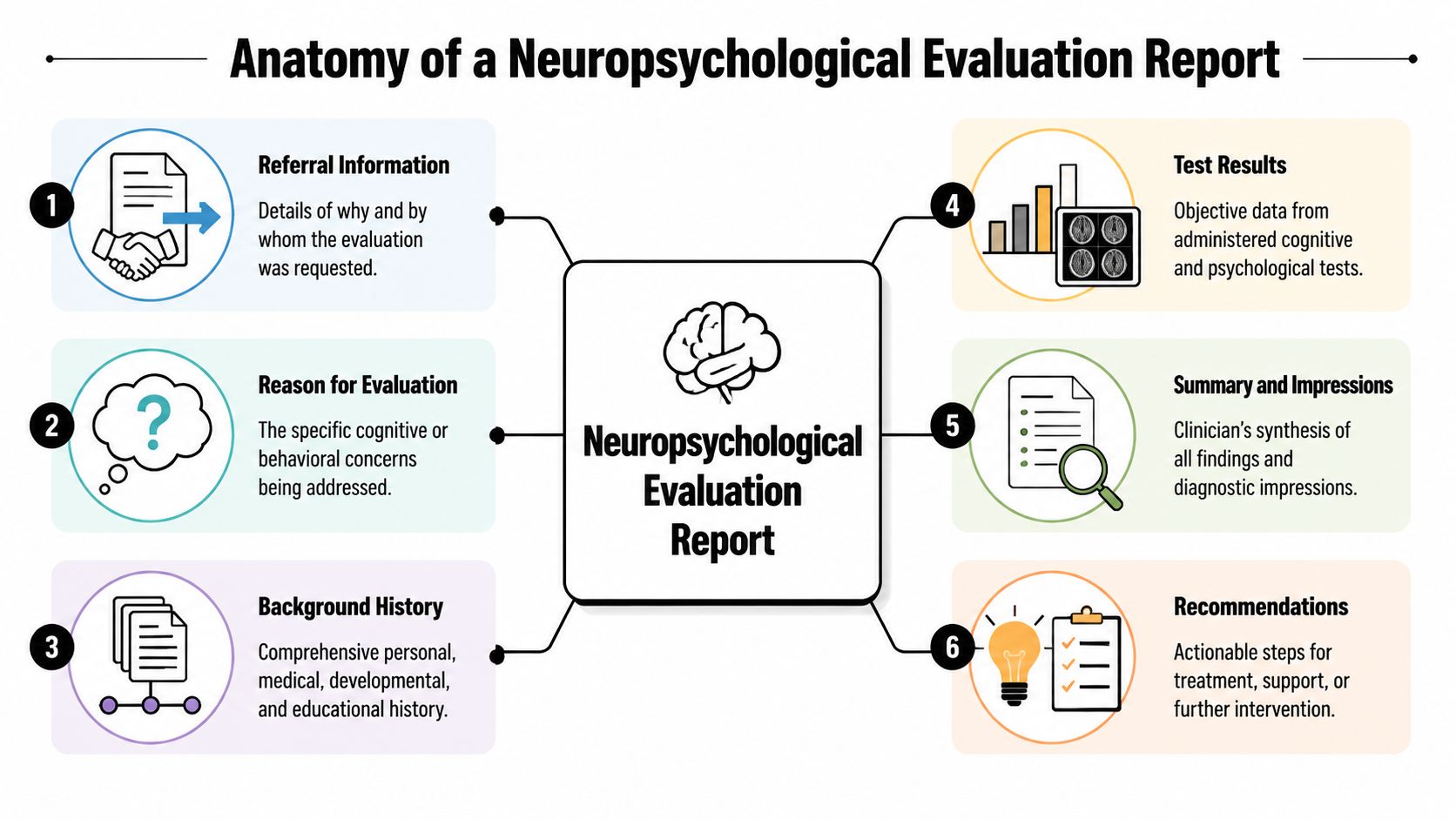
A clinically sound report is not automatically a legally useful one. For asylum, T visa, U visa, and VAWA matters, counsel should read each section with one question in mind. Does this part help explain the client's functioning in a way a judge, officer, or reviewing attorney can use?
Referral question
Sample text
Mr. A was referred for neuropsychological evaluation to assess memory, attention, executive functioning, and emotional factors relevant to his ability to provide a coherent account of past traumatic events and to function effectively in legal proceedings.
The referral question sets the lane for the entire evaluation. If it is broad or generic, the report often drifts into diagnosis without addressing the legal issue that prompted the referral.
In immigration work, the best referral questions are specific. They identify the functions that matter to the case, such as recalling events in sequence, sustaining attention during a long interview, understanding compound questions, or showing the functional impact of abuse, trafficking, or trauma. That focus helps the evaluator choose appropriate measures and helps counsel later cite the report without stretching the opinion beyond what was assessed.
I often see reports that ask only whether the client has PTSD, depression, or cognitive impairment. That may satisfy a treatment setting. It is less useful in litigation. Courts and agencies need to know how the condition affects testimony, disclosure, memory, concentration, and participation in the case.
Background information
Sample text
Reported history includes repeated exposure to interpersonal violence, periods of unstable housing, disrupted education, persistent sleep disturbance, depressed mood, and episodes of dissociation during stress. Client described longstanding difficulty remembering details under pressure and becoming confused when asked to recount events in sequence.
Background history is where the report earns credibility before testing even starts. A thin summary invites attack. A careful history shows the evaluator considered multiple possible influences on performance, including trauma exposure, education, language, psychiatric symptoms, medical issues, medication effects, prior neurological injury, and day-to-day functioning.
For legal use, detail matters more than drama. Dates may be approximate. Records may be incomplete. Family history may be fragmented. A strong report says that plainly and still explains what can be concluded with reasonable clinical confidence.
That trade-off matters. Overstating certainty can make a report easier to challenge. Clear limits usually make it stronger.
Assessment procedures
Sample text
Evaluation consisted of record review, clinical interview, informed consent regarding risks, benefits, and limits of confidentiality, and administration of standardized measures of intellectual functioning, learning and memory, attention, executive functioning, motor speed, and personality validity.
This part should show a disciplined method. Counsel should be able to point to record review, interview data, test selection, language of administration, and any validity procedures without hunting through the appendix or guessing what happened.
A vague description weakens the report fast. “Various tests were administered” tells the court almost nothing. A clear methods section shows that the opinion rests on standardized procedures and clinical judgment, not self-report alone.
Attorneys should look for three features:
| Report feature | Why it matters legally | What weak wording looks like |
|---|---|---|
| Clear list of methods | Shows the opinion is grounded in identifiable procedures | “Various tests were administered” |
| Record review | Shows the evaluator checked consistency against outside information | No mention of records |
| Validity considerations | Helps answer effort and exaggeration challenges | No discussion of reliability |
If government counsel or an adjudicator questions whether the evaluator uncritically accepted the client's account at face value, this section should answer that concern early.
Behavioral observations
Sample text
During testing, the client was cooperative and maintained appropriate effort. Thought processes were goal directed. Affect narrowed when discussing traumatic experiences. Attention fluctuated during lengthy tasks, and the client became visibly slowed when required to shift between rules or hold multiple instructions in mind.
Behavioral observations help the reader understand how the person functioned during the evaluation itself. They can support or complicate the test data, and both possibilities matter.
A useful observations section addresses effort, engagement, pace, frustration tolerance, language fluency, mood presentation, and whether trauma-related material appeared to disrupt performance. In immigration cases, that can be highly probative. A client who appears guarded in an interview may still show clear distress, slowed processing, or disorganized recall under structured testing. Another client may present calmly while formal measures reveal retrieval problems that would predict fragmented testimony.
The report should connect those observations to the rest of the findings. If the client became slower as task demands increased, that should appear again in the interpretation. If dissociation, confusion, or fatigue affected performance, the evaluator should say how much weight to place on the results.
Test results
Attorneys do not need to master every score table. They do need the pattern.
Sample text
Performance showed intact basic verbal reasoning with weaker delayed verbal recall, reduced cognitive flexibility, and slowed processing on tasks requiring divided attention. On a verbal learning measure, long-delay free recall fell well below expectations, suggesting meaningful difficulty retaining and retrieving previously encoded material over time.
The most useful results section translates data into functional meaning. Raw numbers and percentile ranks belong in the report, but legal readers need interpretation tied to real-world demands. Can the client retain instructions? Recall events after a delay? Shift between topics without losing the thread? Stay accurate under pressure?
Patterns matter more than isolated low scores. A profile showing average reasoning with weak delayed retrieval and reduced cognitive flexibility carries a different implication than global low performance across every domain. The first may support a trauma-related explanation for fragmented recall under stress. The second may raise broader questions about education, language, developmental history, severe mood symptoms, or generalized cognitive weakness.
Validity also belongs here. If the data are interpretable, say so clearly. If there were limits related to language, fatigue, pain, dissociation, or inconsistent effort, those limits should be stated in plain terms. From a legal standpoint, that disclosure protects the opinion. It shows the evaluator weighed reliability instead of assuming it.
Interpretation carries the evidentiary value. A score sheet alone rarely moves a case.
Summary diagnostic impressions and functional impact
Sample text
Findings support a profile of trauma-related cognitive inefficiency marked by reduced executive control, impaired retrieval of verbally learned information under delay, and emotional symptoms that likely worsen performance under stress. These deficits are consistent with the client's reported difficulty organizing a chronological narrative, recalling peripheral details, and sustaining attention during interviews.
This section should read like a reasoned opinion, not a list of labels. Diagnosis matters, but function is what usually helps the case. The report should explain how the findings affect disclosure, memory for dates and sequence, tolerance for questioning, ability to assist counsel, and need for accommodations.
The best summaries also distinguish what is well supported from what remains uncertain. In mixed presentations, the evaluator may conclude that trauma, depression, sleep disruption, and prior injury all contribute to the current picture. That does not weaken the report if the functional conclusions remain clear and well tied to the record.
For immigration counsel, practical questions should be answered directly:
- Can the client give a coherent narrative without structured support?
- Does stress predict worse recall, disorganization, or shutdown?
- Are the findings more consistent with trauma-related impairment, mood-related slowing, neurological injury, or a combination?
- What interview or hearing accommodations would improve accuracy?
Recommendations should match the findings. If the client shows slowed processing or executive inefficiency, slower pacing and shorter questions may improve reliability. If delayed retrieval is weak, allowing time, repetition, and cueing may produce a more accurate account. Those details are not extras. They are often the part of the report that counsel can use most effectively in declarations, briefing, and direct examination.
Translating Clinical Findings into Legal Arguments
A client sits for an asylum interview and gives a truthful account that arrives out of order, with gaps around dates, sequence, and duration. An officer may read that as inconsistency. A good neuropsychological report gives counsel a defensible reason for the pattern and a way to present it clearly.

From score patterns to case theory
The legal value of testing is translation. Scores stay in the report. Functional meaning goes into the declaration, brief, affidavit, or direct examination.
If the evaluation shows executive dysfunction, counsel should not leave that point at the level of diagnosis. The argument should explain what the impairment does under legal pressure. The client may lose chronological order, miss the point of compound questions, drift into irrelevant detail, or shut down when asked to switch topics quickly. If delayed retrieval is weak, the person may recall pieces of the event but need structure, pacing, or cueing to give an accurate account.
That shift matters because adjudicators do not decide whether a percentile score is low. They decide whether the record explains behavior that might otherwise look evasive, exaggerated, or unreliable.
A usable translation often sounds like this:
The evaluation provides a clinical basis for the respondent's difficulty recounting traumatic events in a linear and complete manner. Testing and behavioral observations support impairments in executive organization and retrieval under stress. Those findings are consistent with trauma-related cognitive disruption and help explain fragmented testimony without suggesting deception.
That is the difference between attaching a report and using it.
Matching the findings to the legal standard
The strongest reports do more than describe symptoms. They help counsel connect impairment to the legal burden in the case.
In asylum matters, the report often supports credibility and explains why a truthful account may be fragmented. Trauma survivors may retain sensory detail yet struggle with order, dates, and transitions between events. When the report ties that pattern to testing, interview behavior, and history, counsel can argue that apparent inconsistency is clinically expected in trauma, not evidence of fabrication.
In T and U visa cases, the report often does different work. The question is not only what happened, but how the qualifying harm affected functioning. Findings related to concentration, fear conditioning, decision-making, sleep disruption, and dissociation can support arguments about ongoing impairment, difficulty engaging with police or prosecutors, and the need for interview accommodations. That can be particularly useful where the record otherwise risks understating the mental impact of coercion, trafficking, or assault.
The video below offers a useful legal-clinical lens on using evaluation evidence in practice.
VAWA cases usually require more nuance. Many clients present with overlapping trauma symptoms, depression, anxiety, somatic complaints, and cognitive inefficiency. A persuasive report does not overclaim. It identifies what is supported, explains how abuse affected concentration, memory, judgment, daily functioning, and help-seeking, and leaves counsel with language that fits the facts. Judges and officers tend to trust that kind of restraint.
What attorneys should pull from the report
I advise attorneys to extract three things from any evaluation. First, the report should explain the observable problem in plain English. Second, it should tie that problem to clinically supported findings rather than speculation. Third, it should state why the problem matters to testimony, credibility, disclosure, or participation in the case.
For example, “PTSD with depression” is rarely enough by itself. “Under stress, the client becomes slower, less organized, and less able to retrieve details without prompts” is far more useful. So is “the client can provide a coherent account if questions are short, chronological, and asked with time for response.” Those are litigation facts.
That is how clinical evidence becomes legal evidence.
Best Practices for Court-Ready Clinical Reports
Attorneys don't need to become neuropsychologists, but they do need to know what separates a durable report from a fragile one. Court-ready reports are usually easy to spot once you know the markers.
What attorneys should look for before retaining an evaluator
Start with method, not credentials alone. The report should explain what records were reviewed, what tests were used, whether informed consent addressed confidentiality limits, and how the evaluator assessed response validity. If the case may draw skepticism, validity testing isn't optional. It's protection.
Use this checklist when vetting a clinician or reviewing a draft:
- Defined referral question: The report should answer a legal problem, not just describe symptoms.
- Standardized testing: Names of instruments matter. “Memory was assessed” is weaker than identifying the actual battery.
- Behavior linked to function: The evaluator should explain how findings affect interviews, recall, work, caregiving, or daily tasks.
- Validity discussion: Reports should address effort, exaggeration concerns, and interpretability of data.
- Plain-English conclusions: Judges and officers need interpretive statements, not unexplained score sheets.
A legally useful report avoids two extremes. It isn't so technical that no one can use it, and it isn't so simplified that it loses scientific value.
What weak reports usually get wrong
Weak reports often sound certain where the data are thin, or vague where the data are strong. Some list diagnoses without connecting them to the referral issues. Others use broad trauma language but never explain how the client's memory, sequencing, or executive control are affected.
A second common problem is jargon-heavy writing. If the summary says the client has “relative inefficiencies across frontally mediated systems” but never explains what that means in ordinary life, the legal team has to do guesswork. That's risky.
A stronger report usually does three things well:
- It states limits openly.
- It ties findings to behavior the court will recognize.
- It gives recommendations that flow from the actual data.
Attorneys should also be wary of reports that read like advocacy pieces. Clinical neutrality often makes the opinion more persuasive, not less. Judges are more likely to trust an evaluator who sounds measured and disciplined.
How Attorneys Can Maximize the Report's Impact
The best evaluation can still underperform if the legal team uses it passively. The report should shape case preparation long before filing and long after receipt.
Before the evaluation
Preparation starts with the referral. Give the clinician the declaration, key filing theory, relevant records, prior interview issues, and a short memo identifying the legal concerns. Don't send a stack of documents without a question. Ask targeted things like whether trauma-related cognitive symptoms may explain fragmented recall, whether functioning is consistent with coercive control, or whether the client's presentation supports accommodations in interviews and testimony.
Client preparation matters too, but it should be simple. Tell the client the evaluator is not there to trick them and not there to provide immigration legal advice. Explain that some tasks may feel easy and others frustrating. Encourage sleep, food, glasses or hearing aids if used, and honesty about effort and symptoms.
Here's a practical referral framework:
- Case theory first: Identify whether credibility, functional impairment, abuse impact, or causation is the central issue.
- Known trouble points: Note missed details, sequencing problems, dissociation, confusion, or inability to tolerate interviews.
- Records that matter: Send medical records, declarations, police materials, school or work history, and prior evaluations if they exist.
- Language issues: Clarify primary language, interpreter needs, literacy concerns, and educational background.
One useful way to think about branding and coordination is consistency across materials. Firms that maintain a clean evidentiary packet, including visual identifiers such as this PPA logo asset, usually also do better at presenting expert evidence in a coherent way.

After the report arrives
Don't just attach the full report and move on. Pull the decisive findings into the declaration, brief, witness prep, and any cover summary for the officer or court. The summary paragraph often matters most because that's what busy adjudicators read first.
Use the report actively in at least four places:
- In the legal brief: Quote the interpretation, not just the diagnosis.
- In client prep: Adjust your interview style to the findings. Use shorter questions, slower pacing, and breaks if recommended.
- In exhibits: Highlight pages discussing functional impact, validity, and causation.
- In testimony planning: Prepare for likely attacks on inconsistency by grounding the explanation in the report's findings.
If the evaluator may testify, coordinate carefully. The strongest expert testimony is usually restrained, specific, and anchored in the written report. It should explain what the data support, what they don't support, and why the findings matter for the person's ability to disclose and function in a legal setting.
The Rise of Virtual Evaluations in Immigration Cases
A client is three hours from the nearest qualified evaluator, shares a car with relatives, and cannot risk repeated travel without missing work or exposing a controlling partner to the legal case. In that situation, a virtual evaluation is often the difference between having usable expert evidence and having no evaluation in the record at all.

Remote evaluations have become far more common in immigration practice because access problems are real. Adults seeking asylum, T visa, U visa, or VAWA relief may live in rural areas, move frequently, lack transportation, or face safety concerns that make in-person testing unrealistic. For attorneys, the legal question is usually not whether virtual is perfect. The question is whether the evaluator used a method that fits the referral issue, documents the limits clearly, and still produces findings the court can rely on.
That requires judgment. Some parts of a neuropsychological evaluation adapt well to video. Other parts do not. Interview-based trauma assessment, behavioral observations, record review, and many symptom measures can often be completed remotely with appropriate safeguards. Tasks that depend heavily on speeded motor output, hands-on manipulation, visual precision, or tightly controlled testing conditions may need modification, cautious interpretation, or postponement to an in-person setting.
The report should make those decisions visible. A court-ready virtual report states the platform used, who was present, whether the client had privacy, how identity was confirmed, whether an interpreter participated, what distractions occurred, and which procedures were modified or omitted because of remote administration. That level of detail helps attorneys defend the report if DHS or opposing counsel questions reliability.
I tell firms to ask narrower questions before they retain an evaluator. Can the clinician complete the referral remotely for this specific client? Which opinions will rest on interview, records, psychometrics, or behavioral observations? What conclusions are strong enough to support a declaration or brief, and what conclusions should be stated more cautiously because of the format?
Those distinctions matter in immigration cases. In a VAWA matter, remote work may improve safety and access while limiting the examiner's ability to observe certain physical or environmental details. In an asylum case, virtual assessment may still provide persuasive evidence about trauma symptoms, memory disruption, and the clinical reasons a client discloses events inconsistently. In a T or U visa case, it may help document cognitive and emotional effects of exploitation or violence even if some test-based conclusions are appropriately qualified.
A good virtual evaluation does not hide its limits. It explains them, contains them, and still answers the legal referral question with clinical discipline.
If your firm needs immigration-focused evaluations that translate trauma and cognitive findings into clear, court-usable evidence, Pro Psychological Analysis provides specialized assessments for asylum, T visa, U visa, VAWA, and hardship matters, with clinically rigorous reporting, strict confidentiality, and virtual options for clients nationwide.