
An attorney is preparing a waiver or protection case for a client who misses appointments, loses paperwork, struggles to follow timelines, and gives fragmented narratives under stress. Opposing counsel may call that inconsistency. USCIS may read it as weak credibility. Family members may describe the same person as bright, sincere, and chronically disorganized.
That’s where neuropsychological assessment adhd becomes strategically important. In the right case, it turns vague complaints into measurable patterns of attention, executive dysfunction, and functional impairment. It also helps answer a question that matters in immigration law: are these difficulties best explained by a longstanding neurodevelopmental condition, trauma-related cognitive disruption, or both?
For legal partners, the practical issue isn’t whether ADHD exists in the abstract. It’s whether the evaluation produces evidence that is clear, defensible, and useful for the specific immigration relief sought.
Table of Contents
- Why a Neuropsychological Assessment for ADHD Matters in Immigration Law
- Understanding the Purpose and Power of Neuropsychological Testing
- What Happens During the ADHD Assessment Process
- From Clinical Findings to Compelling Legal Evidence
- Navigating Nuances in Immigration and Forensic Cases
- Preparing for a Successful Neuropsychological Evaluation
- Strengthening Your Case with Objective Psychological Evidence
Why a Neuropsychological Assessment for ADHD Matters in Immigration Law
A common immigration file looks like this. The client reports lifelong distractibility, poor organization, impulsive decisions, and chronic difficulty finishing tasks. The record also includes trauma exposure, unstable housing, interrupted education, or domestic violence. Without a careful assessment, those facts get flattened into a loose story about stress.

That simplification hurts cases. In an extreme hardship matter, the legal team may need credible evidence that cognitive impairment affects employment, parenting, medication management, or basic daily functioning. In asylum, T visa, or U visa work, the same symptoms may affect memory consistency, task completion, and the client’s ability to manage a complex legal process.
Adult ADHD isn’t rare. The lifetime prevalence among U.S. adults ages 18 to 44 is 4.4%, with males at 5.4% and females at 3.2%, according to NIMH ADHD statistics. For attorneys, that means some clients will arrive with a real but undiagnosed condition that is already shaping how they present, comply, and testify.
Why legal teams need more than symptom descriptions
Symptom lists alone usually don’t carry enough weight. A client saying “I can’t focus” is easy for a skeptical reviewer to discount. A clinician documenting a pattern of deficits, developmental history, informant data, and observed impairment gives the record a different quality.
Three legal functions matter most:
- Credibility support: Objective findings can explain why a client appears inconsistent without assuming deception.
- Hardship documentation: The report can connect cognitive limitations to concrete problems in work, self-care, communication, and case participation.
- Differential diagnosis: The evaluator can address whether symptoms fit ADHD, trauma-related cognitive disruption, depression, anxiety, or a combination.
Practical rule: If ADHD is central to the legal theory, the report must do more than diagnose. It must explain how the condition affects functioning in the exact domains the case depends on.
When the assessment changes the strategy
Not every immigration case needs a full battery. But when the file contains longstanding executive dysfunction, complicated trauma history, or questions about reliability, neuropsychological assessment often shifts the case from advocacy language to evidence language.
That difference matters because immigration adjudicators don’t just read conclusions. They look for reasoning.
Understanding the Purpose and Power of Neuropsychological Testing
Neuropsychological testing is best understood as a cognitive stress test. It doesn’t read thoughts, and it doesn’t produce a diagnosis from one score. It places the brain under structured demands and measures how a person attends, inhibits impulses, shifts set, learns, recalls, organizes, and sustains effort.
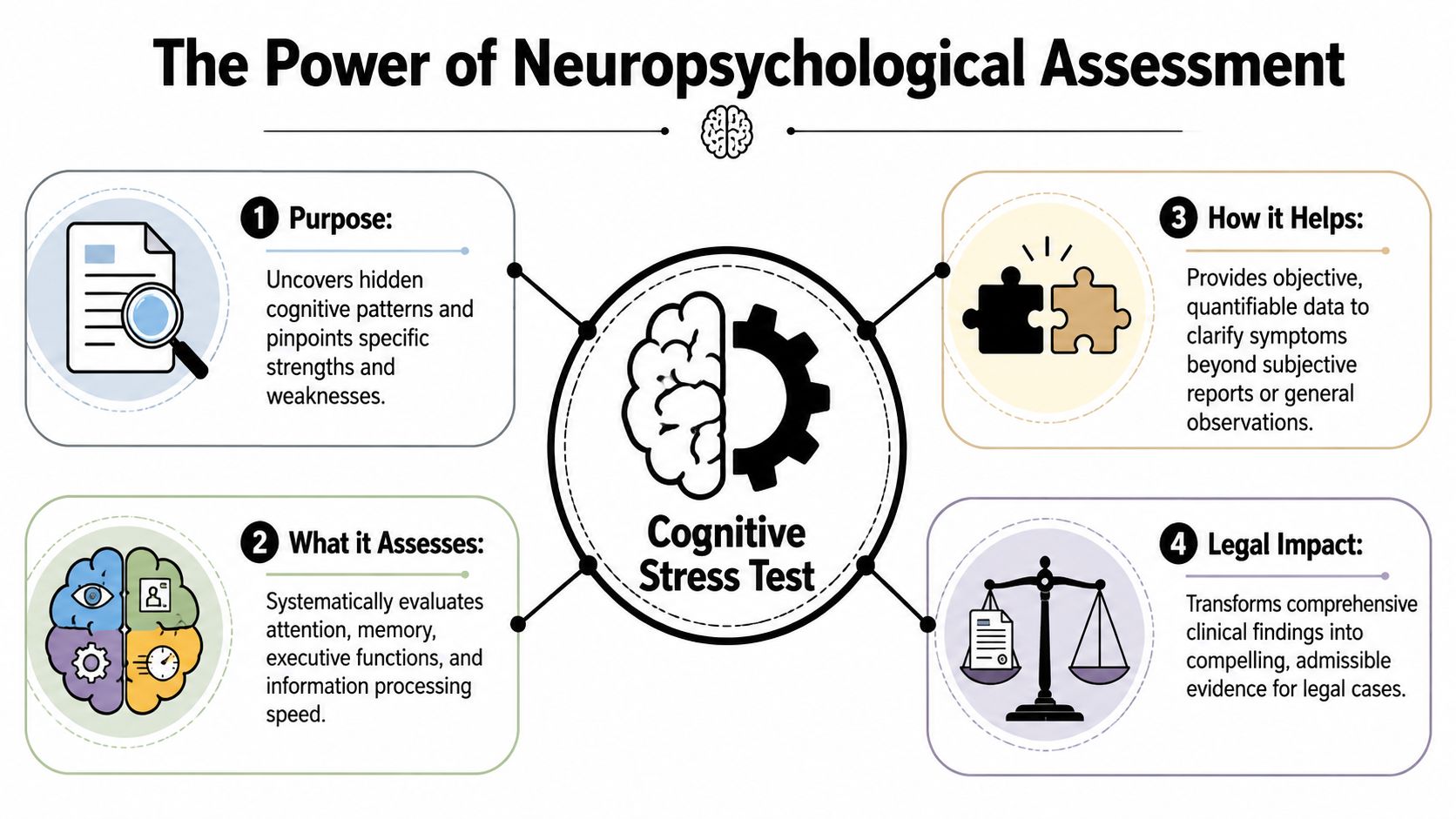
For legal partners, the practical value is that testing makes invisible problems visible. Instead of relying only on self-report, the evaluator can document how the client performs when asked to hold information in mind, switch between rules, resist distraction, or maintain pace over time.
What the testing is actually measuring
In ADHD work, several cognitive domains matter repeatedly:
- Attention: Can the client sustain focus, resist distraction, and remain accurate over time?
- Executive functions: Can the client plan, organize, inhibit impulsive responses, and shift strategies when demands change?
- Working memory: Can the client hold information briefly and manipulate it accurately?
- Processing speed: Can the client complete routine mental tasks efficiently enough for daily demands?
- Learning and memory: Does the person encode information poorly because of inattention, or is there a separate memory problem?
Tests such as TOVA, WCST, and Trail Making Test are often part of this workup, but no single measure is enough. The pattern across tasks is what matters.
Why objective data matters in a legal file
A strong evaluation does two things at once. It describes symptoms, and it quantifies functional consequences. That second step is what often makes the evidence useful in immigration matters.
A psychological report becomes more persuasive when it can say, in effect, that the client’s distractibility isn’t just a complaint. It appears in observed behavior, test performance, developmental history, and collateral reporting. That convergence gives attorneys something far more durable than a sympathetic narrative.
Neurobiology also matters. A review of neuroimaging findings in ADHD describes abnormalities involving regions such as the prefrontal cortex and basal ganglia, along with findings involving altered gyrification, reduced brain volume, decreased cortical thickness, reduced surface area, and compromised white matter integrity. In legal settings, that supports a point practitioners often need to make directly: ADHD is a genuine neurodevelopmental disorder, not a character flaw or a simple motivation problem.
A well-done assessment doesn’t just ask whether ADHD is present. It asks how the brain is functioning, where it breaks down, and what that breakdown means in daily life.
What testing can and cannot do
Testing is powerful, but it has limits. It won’t replace a clinical interview. It won’t erase the need for collateral data. It also won’t make every case stronger merely because more pages were added.
What it does well is clarify a contested picture. That is especially important when a client’s presentation could otherwise be dismissed as anxiety, disorganization, poor effort, or stress alone.
What Happens During the ADHD Assessment Process
The most useful way to think about the process is in three parts. First, the evaluator reconstructs the client’s history. Then the evaluator measures performance under standardized conditions. Finally, the evaluator compares those findings with symptom reports from the client and, when available, other people who know the client well.
A credible ADHD opinion comes from that combined method, not from any single task. Clinical guidance on ADHD assessment tools describes a gold-standard process that integrates clinical interviews, rating scales, and instruments such as TOVA and WCST, while also noting that most individuals with ADHD score within normal ranges on isolated measures. That is why isolated testing is a weak foundation for a forensic opinion.
The interview establishes the developmental timeline
The interview is not a formality. It is where the evaluator determines whether symptoms look longstanding and developmentally consistent, or whether they appear to have emerged after trauma, depression, sleep disruption, substance use, or major life stressors.
In an immigration context, I want the timeline to answer practical questions:
- When did problems with attention, impulsivity, or organization first appear?
- Were similar difficulties present in school, home life, work, or multiple settings?
- What happened before and after migration-related trauma?
- Do family members describe the person as chronically inattentive since childhood, or mainly impaired after a specific event?
This part of the evaluation also covers education, medical history, psychiatric history, occupational functioning, and daily living skills.
Standardized testing measures how the brain handles demands
The testing session usually includes measures of sustained attention, inhibitory control, cognitive flexibility, working memory, and speed. In adult ADHD cases, common tools may include TOVA, WCST, Trail Making Test, and other executive or attentional measures selected for the referral question.
The point isn’t to “catch” ADHD on one task. It’s to see whether a consistent pattern emerges under increasing demands. Some clients do reasonably well on simpler tasks but deteriorate when they must manage speed, shifting rules, divided attention, or longer response chains.
Below is a concise framework attorneys can use when reading a report.
| Component | Purpose | Example for Attorneys |
|---|---|---|
| Clinical interview | Establishes symptom history, developmental course, and alternative explanations | Helps show whether disorganization is longstanding or mainly trauma-linked |
| Standardized cognitive testing | Measures attention, executive control, working memory, and processing under structured conditions | Supports claims that functional problems are measurable, not merely self-reported |
| Rating scales | Captures symptom frequency across settings from the client and others | Shows whether work, home, and relational impairments are consistent |
| Collateral information | Adds outside observations from relatives, partners, or records | Strengthens credibility when third parties confirm chronic symptoms |
| Performance validity testing | Assesses whether test engagement and effort are interpretable | Protects the report against arguments that findings are exaggerated or unreliable |
A visual shorthand can help legal teams explain the process internally. This brain-based assessment graphic is useful for that purpose.

Rating scales and validity measures protect the report
Rating scales matter because ADHD is diagnosed behaviorally as well as cognitively. A client may complete self-report measures, and in many cases a spouse, sibling, parent, or other informant provides collateral information. In immigration work, collateral sources are often imperfect, but even partial outside reporting can help.
Performance validity measures are especially important in forensic settings. They do not accuse the client of faking. They help establish whether the obtained data are interpretable. If effort is inconsistent, the evaluator should say so. If effort is adequate, that strengthens the integrity of the final opinion.
When an evaluator skips validity analysis in a forensic case, the report becomes easier to challenge.
From Clinical Findings to Compelling Legal Evidence
Raw scores don’t persuade USCIS. Interpretation does. The immigration value of neuropsychological assessment lies in the written report and in how precisely it ties clinical findings to the legal question at hand.

A report that says “the client meets criteria for ADHD” is usually underpowered for immigration work. The stronger report explains what data support that conclusion, what impairments follow from it, and why those impairments matter to hardship, credibility, functioning, or vulnerability.
What a strong immigration report actually does
In T visa, U visa, and asylum-related matters, one of the most important clinical tasks is separating pre-existing ADHD from trauma-induced cognitive symptoms. Guidance on neuropsychological diagnosis of ADHD highlights this differential function directly. For legal purposes, the distinction matters because it clarifies whether the person shows a longstanding neurodevelopmental pattern, an acquired trauma-related disruption, or both.
A strong report usually contains these elements:
- A diagnostic formulation: not just a label, but an explanation of why the diagnosis fits and why alternatives fit less well.
- A functional impairment analysis: how the client’s deficits show up in work, parenting, organization, medication adherence, memory for sequences, or hearing preparation.
- A timeline: whether the cognitive pattern predates the traumatic events at issue, follows them, or reflects an interaction.
- A nexus statement: a clear link between the psychological findings and the legal standard the attorney must prove.
That nexus is where many reports become too vague. “The client has executive dysfunction” is clinically accurate but legally incomplete. The question is what that dysfunction does.
How clinical language becomes legal language
Here is the practical translation work attorneys should expect from the evaluator:
- Impaired working memory can become difficulty retaining multi-step instructions from counsel, misunderstanding deadlines, or forgetting key procedural details.
- Reduced inhibitory control can help explain impulsive decisions, emotionally reactive communication, or poor judgment under stress.
- Weak cognitive flexibility may show up as difficulty adapting when plans change, trouble responding to rapid questioning, or rigidity in problem solving.
- Slow processing under stress may affect interview comprehension, form completion, and the ability to respond coherently in adversarial settings.
That translation is especially important where credibility may be questioned. A client with attentional inconsistency may recall central traumatic events but struggle with chronology, peripheral detail, or repeated retelling under pressure. A careful evaluator does not excuse every inconsistency. The evaluator explains which kinds of inconsistency are clinically congruent with the observed profile and which are not.
Legal drafting point: The strongest psychological reports don’t ask the adjudicator to infer functional consequences. They spell them out.
A good nexus paragraph often sounds like this in substance: the client’s documented attentional and executive impairments interfere with sustained employment, accurate completion of complex paperwork, and reliable management of daily responsibilities, thereby increasing dependence on family support and worsening hardship if separated or removed.
The report should also distinguish limitation from incapacity. That nuance matters. Overstatement invites attack. Precision survives scrutiny.
Navigating Nuances in Immigration and Forensic Cases
The hardest ADHD cases in immigration practice are rarely straightforward. They are mixed presentations involving trauma, depression, anxiety, disrupted sleep, cultural barriers, and fragmented developmental records. The evaluator’s job is not to force certainty where certainty does not exist. It is to separate what can be supported from what cannot.
Trauma and ADHD can look similar on the surface
Hypervigilance can resemble distractibility. Dissociation can look like inattention. Depression can reduce speed and concentration. Chronic anxiety can impair working memory. If the evaluator doesn’t analyze these overlaps carefully, the report may read as clinically shallow and legally vulnerable.
That’s why multimethod assessment matters. In adult ADHD identification, a combined approach using neuropsychological test cut scores, current symptom and impairment self-reports, childhood symptom self-reports, informant reports of current symptoms, and family history of ADHD diagnosis correctly classified 87% of cases, according to the Marquette neuropsychological assessment study. The same source also notes that single-test approaches perform poorly in isolation.
For immigration lawyers, the implication is direct. If a report claims to have sorted ADHD from depression or trauma using only one executive test, that opinion is easier to challenge.
Forensic soundness depends on method, not confidence
In a forensic setting, clinicians need to address more than diagnosis. They need to address alternative explanations, effort, consistency across data sources, and cultural-linguistic fit.
That means asking practical questions such as:
- Did the client’s educational history allow ADHD symptoms to be noticed early, or were they masked by instability and interrupted schooling?
- Were tests administered in the client’s dominant language, or through a process that preserved interpretive caution?
- Do collateral accounts support a longstanding pattern?
- Did validity indicators show interpretable performance?
- Is the report honest about what remains uncertain?
A report gains credibility when it states limits plainly. If trauma likely contributes to the profile, say so. If childhood records are missing, say so. If the data support “ADHD with trauma-related exacerbation” more strongly than a pure ADHD explanation, that is often the more persuasive opinion.
In forensic immigration work, cautious wording is usually stronger than absolute wording.
Cultural formulation also matters. Some clients were never assessed as children because attentional symptoms were interpreted through discipline, gender expectations, migration stress, or family survival priorities. A careful evaluator doesn’t confuse lack of prior diagnosis with lack of prior disorder.
Preparing for a Successful Neuropsychological Evaluation
The quality of the final opinion often depends on preparation long before test day. Attorneys who make better referrals tend to receive better reports because they frame the referral question clearly, send relevant records, and choose evaluators who understand both diagnosis and forensic use.
Questions attorneys should ask before making a referral
Start with the evaluator’s method, not their marketing.
- How do you diagnose ADHD in adults? You want to hear about clinical interview, rating scales, collateral data, and selected testing. You do not want to hear that one executive task “confirms” ADHD.
- How do you handle trauma differential diagnosis? This matters in asylum, T visa, U visa, and VAWA work.
- Do you use performance validity measures? In forensic matters, that should be routine.
- Can you write to the legal standard at issue? The evaluator should be able to address hardship, credibility-relevant functioning, or vulnerability in a disciplined way.
- What records are most helpful before the interview? Good evaluators usually want declarations, prior mental health records, school records if available, medical history, and attorney referral questions.
Attorneys should also be cautious about evaluators who rely heavily on executive function testing as if it were diagnostic by itself. A discussion of EF testing limits in ADHD diagnosis emphasizes that executive function tests have low accuracy for diagnosing ADHD on their own and shouldn’t serve as the sole basis for diagnosis. In practice, that means broad method beats narrow battery.
If you want a quick overview of a practice’s background and presentation style before referral, this practice image and profile reference can help orient discussions.

How clients should prepare for test day
Clients don’t need coaching on answers. They need practical preparation.
- Sleep normally if possible: Fatigue can distort performance.
- Bring glasses, hearing aids, or other needed supports: Sensory problems can affect results.
- Take medication as instructed by the evaluator: Don’t improvise on the day of testing.
- Eat beforehand and bring water if permitted: Long sessions require stamina.
- Expect effortful tasks: Some measures are repetitive by design because they test sustained attention and consistency.
Tell clients something simple and accurate: the goal isn’t to look impaired or to look strong. The goal is to show how they function under structured conditions.
Virtual versus in-person assessment
Some parts of an ADHD evaluation adapt well to remote work. Interviews, history gathering, and certain rating-scale components can often be handled virtually. Some cognitive tasks can also be administered remotely when the evaluator has an appropriate platform and a quiet, controlled setup.
Other parts may be better in person, especially when the case is highly contested, the person has language or sensory barriers, or the evaluator needs tighter control over distractions, timing, and observation. In forensic cases, the more the setting can be standardized, the easier the report is to defend.
Strengthening Your Case with Objective Psychological Evidence
Immigration cases often rise or fall on whether the record explains a client’s functioning with precision. ADHD allegations that remain at the level of self-report are easy to minimize. A careful neuropsychological evaluation can change that by showing how attention, executive control, memory, and behavioral regulation operate in measurable ways.
That doesn’t mean every case needs a full battery. It means the right case benefits from the right kind of assessment. The strongest use of neuropsychological assessment adhd is strategic, not routine. It is most valuable when the legal issue depends on differential diagnosis, credibility-relevant functioning, documented hardship, or a clear explanation of why the client cannot perform consistently under ordinary demands.
The practical standard is simple. The report should be clinically grounded, methodologically cautious, and legally usable. It should explain not only what diagnosis fits, but why that diagnosis fits, what impairments follow, and how those impairments affect the immigration claim in real life.
For attorneys, objective psychological evidence can do something declarations alone often cannot. It can translate a client’s long history of “disorganization,” “forgetfulness,” or “inconsistency” into a defensible account of neurodevelopmental impairment and functional limitation. That is the kind of evidence adjudicators can weigh.
A strong legal team also benefits from clear presentation tools. This PPA visual identity asset is one example of how psychological material can be packaged clearly for professional use.

When your case needs rigorous psychological evidence that can stand up to USCIS and immigration court scrutiny, Pro Psychological Analysis provides immigration-focused evaluations for asylum, T visa, U visa, VAWA, and extreme hardship matters. The practice works closely with attorneys to produce evidence-based reports that connect clinical findings to legal strategy with clarity, methodological integrity, and respect for every client’s dignity.