
You're reviewing a domestic violence case with facts that would be compelling in any family court, but the immigration file is thin. There's no police report. No ER visit. The client stayed for years, recanted once, and missed an earlier chance to disclose abuse because the abuser controlled the paperwork, the money, and the story. Now the attorney has to turn a lived pattern of coercion into evidence that USCIS or an immigration judge can use.
That's where many domestic violence and immigration cases stall. The legal remedy may exist, but the record doesn't yet explain why the abuse was hard to report, why the client remained with the abuser, or why immigration status was part of the control. A service-based review of 1,763 immigrant women's files found that 41% reported domestic violence, and women with visitor or temporary status had 1.65 times the risk of reporting domestic violence compared with Canadian citizens, which underscores how precarious status can intensify vulnerability in real life and in case presentation (retrospective review of immigrant women seeking services).
Attorneys usually aren't missing compassion. They're missing a framework that ties trauma, coercive control, and immigration vulnerability to the legal elements of the claim. Survivors often aren't missing truth. They're carrying a history that was built to stay hidden.
Table of Contents
- Navigating the Path from Victim to Survivor
- When Immigration Status Becomes a Weapon
- Legal Pathways to Safety and Stability
- Building a Case When Visible Proof Is Scarce
- How Psychological Evaluations Substantiate Trauma
- Coordinating an Effective Evaluation with an Attorney
- Resources for Survivors and Legal Providers
Navigating the Path from Victim to Survivor
Some of the hardest files involve survivors whose stories are internally consistent but externally under-documented. The spouse threatened to withdraw sponsorship. He hid the passport. He told her that if she called police, immigration officers would take the children or remove her first. She believed him because, from her perspective, he controlled the language, the forms, the transportation, and access to anyone who might contradict him.
That's not an unusual outlier. It's a recurring pattern in domestic violence and immigration work. The abuse often doesn't sit neatly inside a single incident. It spreads across paperwork, housing, parenting, employment, and disclosure.
Why these cases are misread
Traditional evidence models favor visible injury and immediate reporting. Many immigrant survivors can't safely produce either. They may have feared deportation, loss of financial support, or retaliation against relatives. Some were told, repeatedly, that no one would believe them because they lacked lawful status or depended on the abuser for it.
Practical rule: If the immigration facts made the client harder to leave, harder to report, or easier to threaten, those facts belong in the abuse narrative, not in a background paragraph.
What changes the outcome
Strong cases usually don't depend on one dramatic exhibit. They depend on a documented pattern. That means the affidavit, corroborating declarations, and any psychological evidence need to show how coercion operated over time.
Attorneys who do this well stop asking only, “What happened?” They also ask, “How did immigration dependence shape the abuse, the client's choices, and the timing of disclosure?” That shift often turns a fragmented file into a coherent one.
When Immigration Status Becomes a Weapon
Domestic violence and immigration intersect most sharply when immigration status itself becomes a mechanism of coercive control. In these cases, status isn't just background context. It's part of the abuse.

A legal-psychological review documents a familiar set of tactics: threats to contact authorities, threats of deportation, and threats to separate families, all of which can stop survivors from leaving, reporting abuse, or seeking help (legal-psychological review of immigration-status abuse).
How the coercion works
Status-based abuse often looks mundane on paper. In practice, it's devastating. The abuser may:
- Control documents by hiding passports, work authorization papers, marriage records, or children's documents.
- Manipulate process by promising to “fix” status later, refusing to file, or filing selectively to increase dependency.
- Apply fear by saying police will trigger deportation, family court will favor the citizen spouse, or immigration officers will treat the survivor as the wrongdoer.
- Exploit isolation through language barriers, lack of transportation, and misinformation about shelters, benefits, or legal aid.
These tactics matter because they help explain behavior that adjudicators sometimes misread. Why didn't she leave? Why didn't she report? Why are there memory gaps? Why did she return after separation? The answer is often that leaving carried an immigration consequence the abuser had taught her to fear.
What decision-makers need to see
A file gets stronger when counsel names this as coercive control linked to immigration dependence, not just “relationship conflict.” That framing matters. It shows that the survivor's delay, inconsistency on minor details, or lack of public reporting may reflect trauma and credible fear rather than fabrication.
Status-related threats are not side facts. They are part of the abuse mechanism and often the reason the abuse remained hidden.
A useful attorney interview doesn't stop at “Did your spouse threaten deportation?” It drills down: What exact words were used? When? In front of whom? What did the client do afterward? Did she stop going to work, miss a legal appointment, avoid school pickup, or decline shelter because of that threat? Those functional effects are often more persuasive than broad labels.
Legal Pathways to Safety and Stability
The legal remedy has to match the abuse facts, the procedural posture, and the available evidence. Listing visas isn't enough. Counsel needs to identify which route fits the client's history and which one can carry the record you can realistically build.
A key protection comes from VAWA, which created a self-petitioning process so abused spouses of U.S. citizens or lawful permanent residents can seek lawful status without relying on the abuser. That design matters because it severs the link between status and abuser control, which is exactly what many perpetrators exploit (National Network to End Domestic Violence on immigration policy and VAWA remedies).
This side-by-side view helps clients and counsel think strategically.
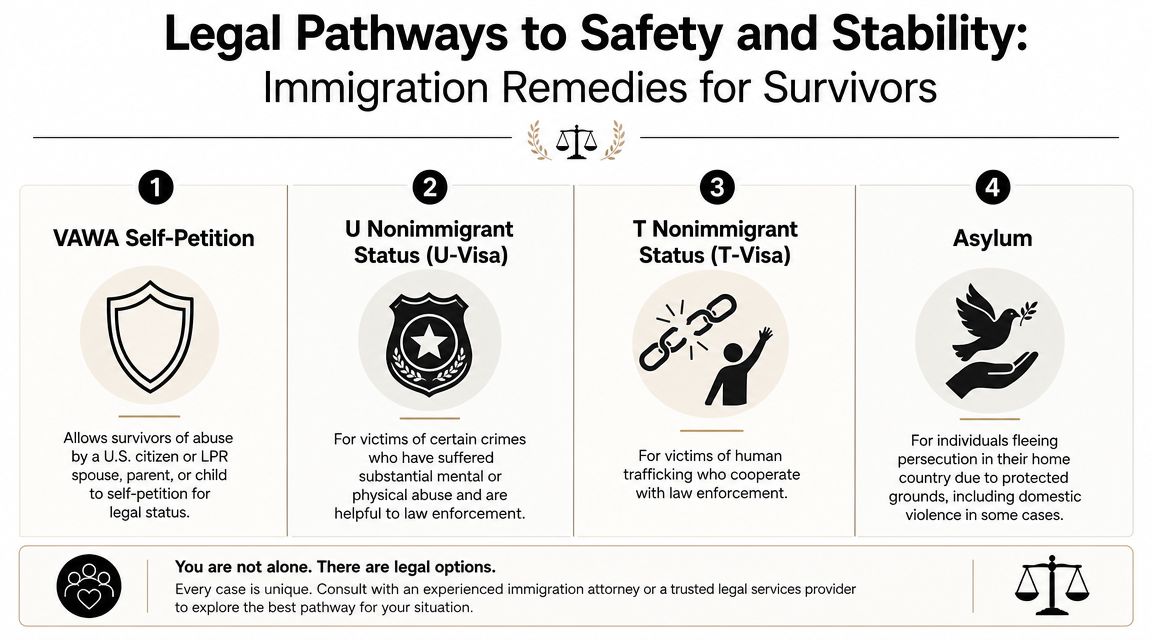
Which remedy fits which facts
| Pathway | Best fit | Main strategic strength | Common pressure point |
|---|---|---|---|
| VAWA self-petition | Abuse by a U.S. citizen or lawful permanent resident spouse, parent, or child | Removes the abuser from the filing process | The record must clearly establish the abuse dynamics and qualifying relationship |
| U nonimmigrant status | Victim of a qualifying crime with substantial harm and law enforcement helpfulness | Useful when the crime reporting record is central | Certification and agency cooperation can become the bottleneck |
| T nonimmigrant status | Human trafficking cases, including coercion tied to labor or sex trafficking | Fits cases where exploitation goes beyond the intimate relationship | Facts are often fragmented and shame-based disclosure is common |
| Asylum | Flight from persecution in the home country, sometimes involving gender-based violence | Can address danger beyond the individual abuser | Nexus and country-condition framing require careful development |
A short reference for practitioners handling male survivors can also be useful in VAWA screening. PPA's discussion of VAWA for men addresses eligibility issues that are often overlooked in intake.
Later in the process, a visual explainer can help orient clients and staff before the legal strategy meeting.
What helps strategically
The strongest remedy isn't always the one that sounds most familiar. It's the one that best aligns with the facts you can prove.
Consider these trade-offs:
- VAWA works well when the abuser controlled status directly. If the spouse or parent controlled the immigration status, VAWA often fits the coercive-control story cleanly.
- U visa cases benefit from documented victimization and cooperation. But a survivor who never felt safe contacting police may need extra work to explain the absence of that history.
- T visa cases require counsel to see exploitation broadly. Some survivors first describe domestic abuse and only later disclose labor control, confiscated earnings, or threats tied to trafficking conduct.
- Asylum claims need country-focused framing. The domestic violence history may be central, but the legal analysis has to connect that history to persecution, state protection failures, and future risk.
Good strategy starts with the abuse mechanism, not the form name.
Building a Case When Visible Proof Is Scarce
Many strong domestic violence and immigration cases begin with an evidentiary disadvantage. The client has no photographs, no criminal case, and no text message in which the abuser says the quiet part out loud. Attorneys who expect a conventional proof package often miss how these cases are won.
A 2023 systematic review of 24 studies found that IPV prevalence estimates among immigrants in the United States varied widely, from 3.8% to 46.9% in the past year and 13.9% to 93% over the lifetime, depending on population and measurement. That range matters because it shows why a single, generic “domestic violence” narrative can under-document the case. Physical, sexual, psychological, and coercive-control elements must be developed separately when relevant (systematic review on IPV and immigration in the United States).
Why standard evidence is often missing
Visible proof is often absent for reasons that are themselves legally important:
- The survivor was deterred from reporting because the abuser used immigration fears to suppress disclosure.
- The abuse centered on control, not visible injury. Document withholding, surveillance, humiliation, threats, and financial restriction don't always produce third-party records.
- The survivor disclosed in fragments. Trauma narratives often emerge over time, especially when shame, fear, and dependency were severe.
That doesn't mean the case is weak. It means the evidence has to be assembled differently.
What to build instead
When records are sparse, build around pattern, chronology, and corroboration.
- Detailed affidavit. Specificity beats adjectives. Dates, locations, exact threats, changes in behavior, and the client's understanding of the consequences all matter.
- Collateral declarations. Friends, relatives, clergy, coworkers, neighbors, advocates, and shelter staff can confirm fear, isolation, injuries, demeanor changes, or the abuser's conduct.
- Behavioral evidence. Missed appointments, sudden relocations, school disruption, financial cutoff, or repeated dependence on the abuser can support the abuse narrative.
- Documentary fragments. Lease records, school emails, screenshots, remittance patterns, transportation receipts, and immigration filings can anchor the timeline.
A common mistake is trying to make every case look like a criminal prosecution. A better approach is to show a consistent pattern of coercive control and its effects.
How Psychological Evaluations Substantiate Trauma
A well-done psychological evaluation can turn a difficult file into an intelligible one. Not because it replaces legal evidence, but because it organizes trauma evidence in a form that adjudicators can understand and weigh.
Research summarized by the U.S. Committee for Refugees and Immigrants describes immigration as a “trauma-amplifier” for many survivors and notes that psychological evaluation can explain delayed reporting and connect trauma symptoms to legal standards in cases such as VAWA, U visa matters, and hardship-based claims (USCRI discussion of domestic violence awareness and immigration trauma).
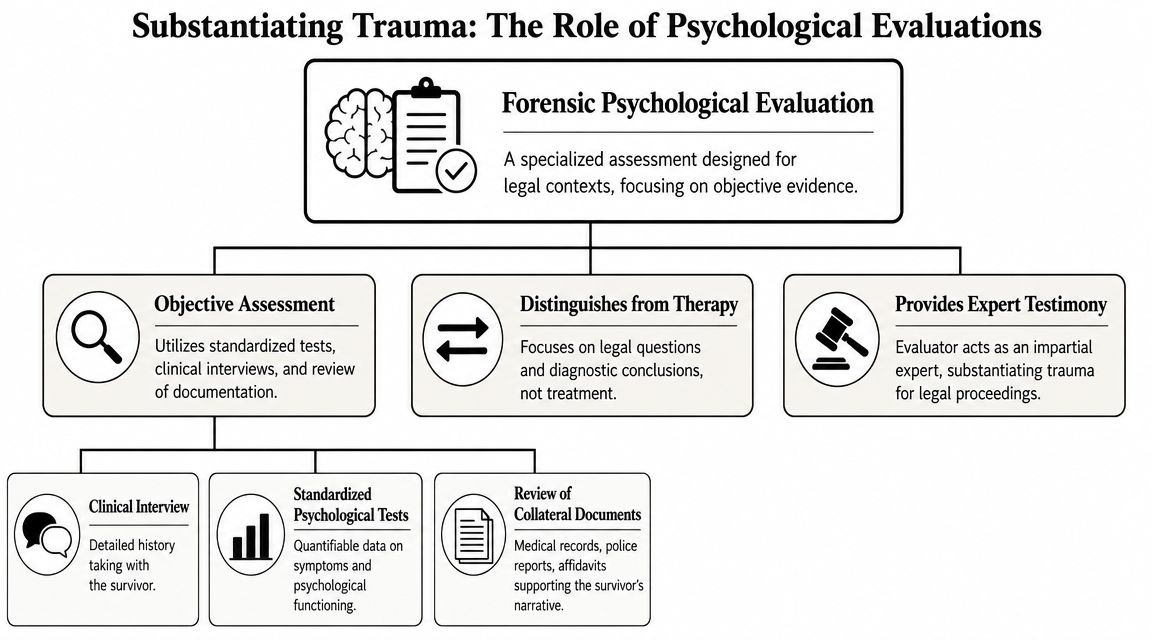
What a forensic report does that treatment records often do not
Treatment notes and therapist letters can help, but they usually aren't designed to answer legal questions. A forensic psychological evaluation is different. It focuses on diagnostic impressions, trauma history, symptom presentation, functional impairment, consistency across sources, and the relationship between those findings and the legal issues in dispute.
That distinction matters in several recurring situations:
| Common case problem | What a forensic evaluation can clarify |
|---|---|
| Delayed disclosure | Trauma, fear conditioning, dependency, and shame can all affect when and how disclosure occurs |
| Memory gaps or fragmented recall | Traumatic stress may affect sequencing and retrieval without undermining core credibility |
| “Why did the client stay?” | Coercive control, immigration dependence, financial entrapment, and fear of family separation often make leaving more dangerous |
| Thin visible evidence | Clinical findings can document psychological injury even where physical records are limited |
A useful report doesn't merely say the client is traumatized. It explains how the trauma developed, how it presents, and why it matters legally.
Where evaluations change the case
The evaluation is most valuable when counsel asks the right question. Not “Can you write a support letter?” but “Can you assess trauma, abuse dynamics, and the functional impact relevant to this filing?”
A strong report often helps in four ways:
- It gives the affidavit context. Symptoms like avoidance, dissociation, hypervigilance, depression, panic, or shame can explain uneven disclosure and daily impairment.
- It supports credibility without vouching. The evaluator should not declare the client “truthful” in a blanket way. The report should instead analyze consistency, symptom patterns, and trauma-related explanations for disclosure behavior.
- It translates psychological harm into legal language. For VAWA, that may bear on extreme cruelty. For U visa or hardship cases, it may help establish substantial harm or hardship consequences.
- It identifies collateral needs. Safety planning, psychiatric referral, interpretation needs, and trauma-informed interview pacing can all affect case preparation.
For attorneys seeking a clinically focused resource on this broader intersection, PPA's article on mental health and immigration addresses how evaluations are used across different forms of relief.
One provider in this space is Pro Psychological Analysis, which conducts immigration-focused psychological evaluations for matters including VAWA, U visa, T visa, asylum, and hardship cases. In practice, the useful question isn't which provider sounds most polished. It's whether the evaluator understands the legal theory, trauma presentation, and evidentiary demands of the specific filing.
Coordinating an Effective Evaluation with an Attorney
The value of a psychological evaluation depends heavily on how counsel sets it up. Good coordination protects the client, sharpens the report, and avoids the most common failure points.
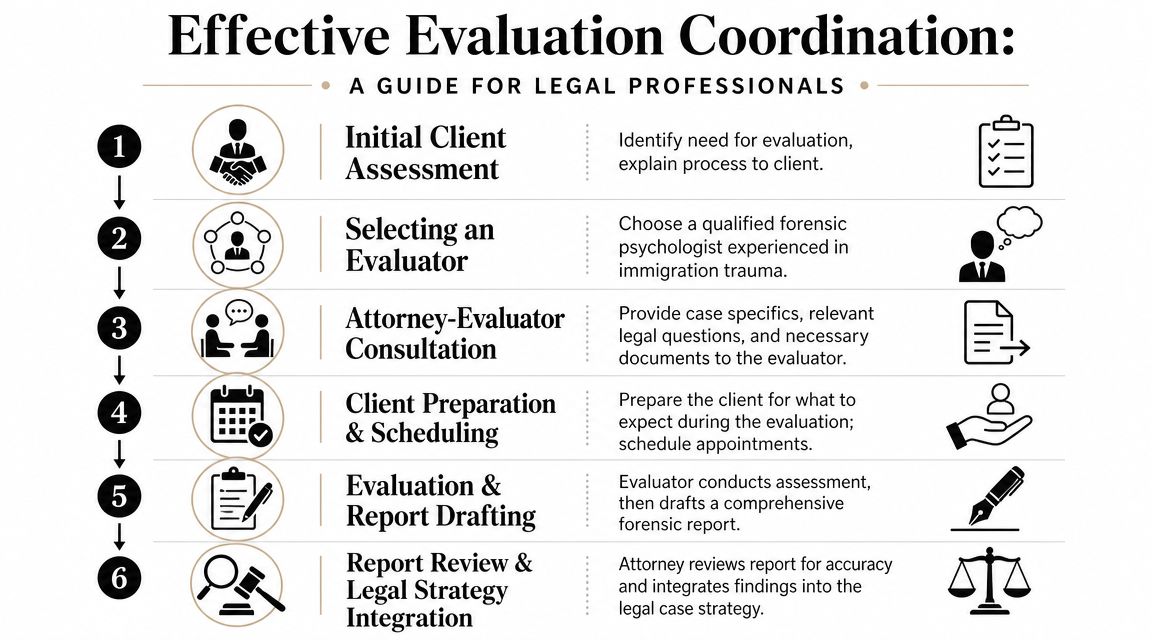
What to send the evaluator
Attorneys get better reports when the referral is concrete. Don't send a two-line email asking for “an immigration eval.” Send the legal theory, procedural posture, deadline, and unresolved evidentiary issues.
A practical referral packet usually includes:
- The key legal question. Is the report meant to address extreme cruelty, substantial mental abuse, hardship, trafficking-related trauma, or asylum-related persecution effects?
- Core documents. Affidavit drafts, declarations, prior applications, notices, police or medical records if they exist, and any adverse facts that the evaluator should understand beforehand.
- Timeline concerns. If dates are disputed or memories are fragmented, say so directly. That allows the evaluator to assess chronology carefully rather than accidentally overstating certainty.
How to prepare the client without coaching
Client preparation should reduce anxiety, not script testimony. Explain what the evaluation is, who will read it, and why difficult topics may come up. Tell the client it's acceptable to say “I don't know,” “I don't remember exactly,” or “I need a break.”
This tends to help:
- Normalize the process. The client should know the evaluation is not therapy, though it should still be conducted respectfully and trauma-informed.
- Arrange language access carefully. If an interpreter is needed, that decision should be made early, with attention to dialect, confidentiality, and the client's comfort.
- Flag safety and emotional risks. If the client is still in contact with the abuser, scheduling and communication protocols matter.
The attorney's job is to prepare the client for the setting, not for the answers.
Counsel should also review the final report for factual accuracy. That doesn't mean editing the clinician's opinions. It means correcting names, dates, immigration history, and exhibit references before filing.
For firms building a more trauma-informed workflow overall, PPA's resource on trauma-informed care assessment is a useful starting point for intake and case coordination.
Resources for Survivors and Legal Providers
The practical lesson in domestic violence and immigration work is straightforward. Relief becomes more attainable when the case documents abuse as a system of control, not just a series of incidents. Where immigration status was used to exert control, the record should say so plainly. Where trauma affected reporting, memory, or help-seeking, the record should explain that with care and precision.
For survivors and legal providers, immediate support often matters as much as long-term strategy. Useful starting points include:
- National Domestic Violence Hotline for safety planning and connection to local services.
- National Network to End Domestic Violence for policy and survivor-centered advocacy resources.
- ASISTA for practitioner-focused support on immigration remedies involving survivors.
- Tahirih Justice Center for services and guidance involving gender-based violence and immigration issues.
- Local legal aid and accredited representatives with experience in VAWA, U visa, T visa, and asylum screening.
- Trauma-informed mental health professionals who understand forensic documentation, not just treatment.
Attorneys should also build a vetted referral list before the emergency call comes in. That list should include an interpreter network, shelter contacts, medical providers, and at least one evaluator who knows how to write for immigration adjudicators rather than for general clinical use.
If your client's case involves domestic violence, coercive control, trauma symptoms, or delayed disclosure, Pro Psychological Analysis provides immigration-focused psychological evaluations that attorneys can use in VAWA, U visa, T visa, asylum, and hardship matters. The practice works with legal counsel to document abuse dynamics, clinical symptoms, and functional impairment in a format designed for immigration filings and court proceedings.