
You have a client whose declaration matters, but every interview seems to produce a different version of the story. Some details arrive late. Some never come out at all. The client shuts down when asked about abuse, detention, trafficking, or assault. You still need a record that will hold up before USCIS or an immigration judge.
That's where a trauma-informed approach stops being a soft concept and becomes a litigation tool. In immigration work, the quality of the assessment process affects the quality of the evidence. If the interview itself increases distress, pushes disclosure too quickly, or ignores language and cultural barriers, the final report can end up incomplete, clinically weak, and easy to attack.
Attorneys often hear that an evaluator is “trauma-informed.” The harder question is what that means in a report you can file. A defensible trauma informed care assessment documents not only symptoms and diagnosis, but also how the evaluator elicited information safely, paced the interview, considered alternative explanations, and translated clinical findings into facts that matter for relief.
Table of Contents
- What Is a Trauma Informed Care Assessment
- The Guiding Principles of Trauma Informed Assessment
- Clinical Components of a Defensible Assessment
- Documenting Trauma for U.S. Immigration Cases
- Ethical Standards and Client Preparation
- Common Pitfalls That Weaken an Evaluation Report
- Frequently Asked Questions
What Is a Trauma Informed Care Assessment
A trauma informed care assessment is not just a standard psychological interview with kinder wording. It is a structured way of gathering clinically useful and legally relevant information while reducing the chance that the assessment process itself will distort memory, disrupt engagement, or trigger avoidable distress.
For immigration attorneys, that distinction matters. A routine evaluation may focus on diagnosis alone. A trauma-informed one asks a broader forensic question. What interview conditions are most likely to produce a reliable, coherent, and ethically obtained history? That means the evaluator pays attention to pacing, sequencing, explanation of purpose, the client's tolerance for detail, and the effect of power dynamics on disclosure.
Trauma exposure is not rare or peripheral. A systematic review published in 2024 reported that 70.4% of respondents across 24 countries reported lifetime trauma exposure, with an average of 3.2 traumas per person. In practice, that prevalence helps explain why trauma-informed assessment has become a basic competency rather than a niche specialty.
What attorneys usually need from it
In legal settings, the assessment has to do more than describe suffering. It should help answer questions such as:
- Credibility and consistency: Why might a client disclose in fragments, omit dates, or recall sensory details more readily than chronology?
- Clinical impact: Are the reported symptoms consistent with trauma-related conditions, depression, anxiety, dissociation, or another pattern requiring further evaluation?
- Functional effects: How do symptoms affect sleep, concentration, daily functioning, parenting, work capacity, or ability to participate in proceedings?
- Forensic defensibility: Can the evaluator explain how the information was gathered and why the method reduced the risk of distortion?
A strong report doesn't assume that inconsistencies equal fabrication. It examines whether trauma, fear, shame, culture, and interview context affected what the client could say and when they could say it.
How it differs from a general clinical assessment
A general clinical assessment may be enough for treatment planning. Immigration work usually requires more. The evaluator needs to tie the method to the stakes of the case, document how trauma-informed safeguards were used, and explain findings in language adjudicators can follow.
That is the practical definition: a trauma-informed care assessment is an evidence-gathering process designed to improve disclosure quality, protect the client, and produce a report that remains useful under legal scrutiny.
The Guiding Principles of Trauma Informed Assessment
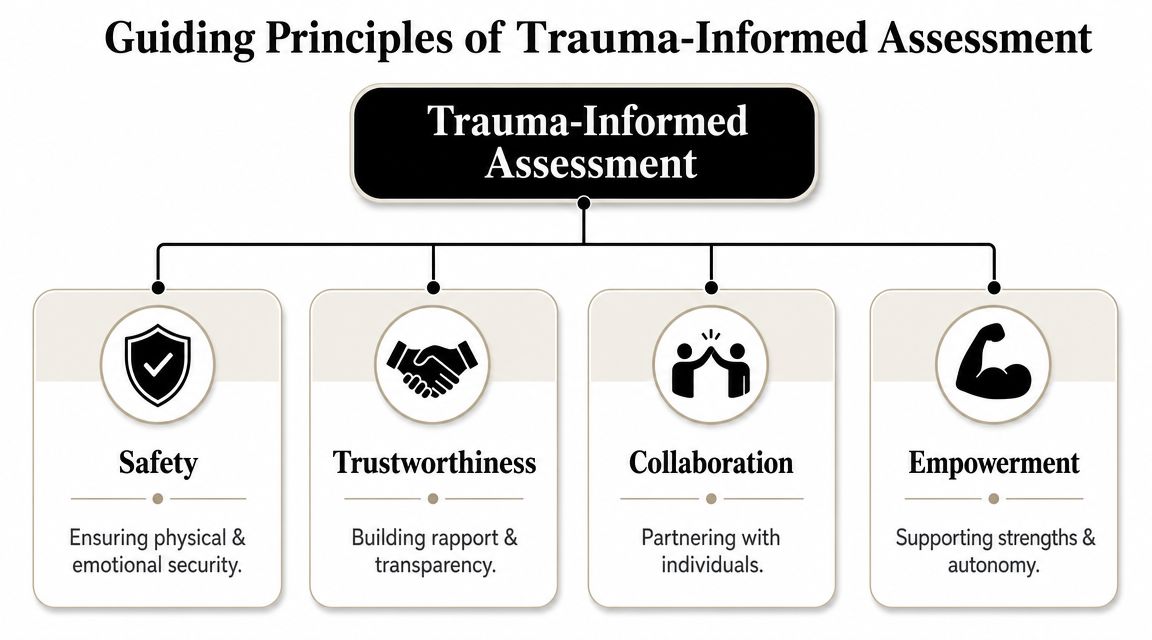
Four principles drive good trauma-informed work in immigration cases. They sound familiar in the abstract. What matters is how they change the interview itself and, by extension, the report.
A useful visual summary appears below.
Safety
Safety is clinical technique, not bedside manner. A client who expects judgment, disbelief, or coercion will often provide a thinner account. In an immigration evaluation, safety includes physical setting, emotional pacing, and clear transitions before difficult topics.
That often means beginning with present functioning, role explanation, and consent before moving into trauma history. It also means watching for overload. If the client becomes disorganized, numb, or visibly flooded, pushing harder rarely improves the record.
Trustworthiness
Trust grows from transparency. Clients need to know why questions are being asked, what the evaluator's role is, and what will happen with the information. If they don't understand those basics, guardedness is rational.
The NCTSN guidance on trauma-informed mental health assessment emphasizes that assessment quality is tied not only to diagnostic accuracy but also to preserving safety and trust. It also notes, consistent with SAMHSA's framework, that trauma-informed care should actively resist re-traumatization. In legal evaluations, that translates into a paced interview and explicit explanation of why sensitive questions are necessary.
Later in the process, video can help some attorneys orient staff and clients to the concepts behind this work.
Collaboration
The evaluator leads the process, but the client should not feel handled. Collaboration means checking whether the person understands the question, inviting clarification, and allowing corrections. It also means acknowledging when memory is uncertain rather than forcing certainty for the sake of a neat narrative.
In court, that restraint helps. A report is stronger when it distinguishes observed facts, self-report, collateral information, and areas of uncertainty.
Empowerment
Recognizing client autonomy is often misunderstood as avoiding hard subjects. That isn't the point. The point is preserving agency while discussing hard subjects. Clients should know they can pause, ask for clarification, or say that they don't know.
Practical rule: The more control a client has over pacing and clarification, the more usable the narrative usually becomes.
A trauma-informed assessment therefore aims for two outcomes at once. It seeks clinically meaningful information, and it protects the conditions that make meaningful disclosure possible. Attorneys who understand those principles are in a better position to evaluate whether a report is merely compassionate in tone or sound in method.
Clinical Components of a Defensible Assessment
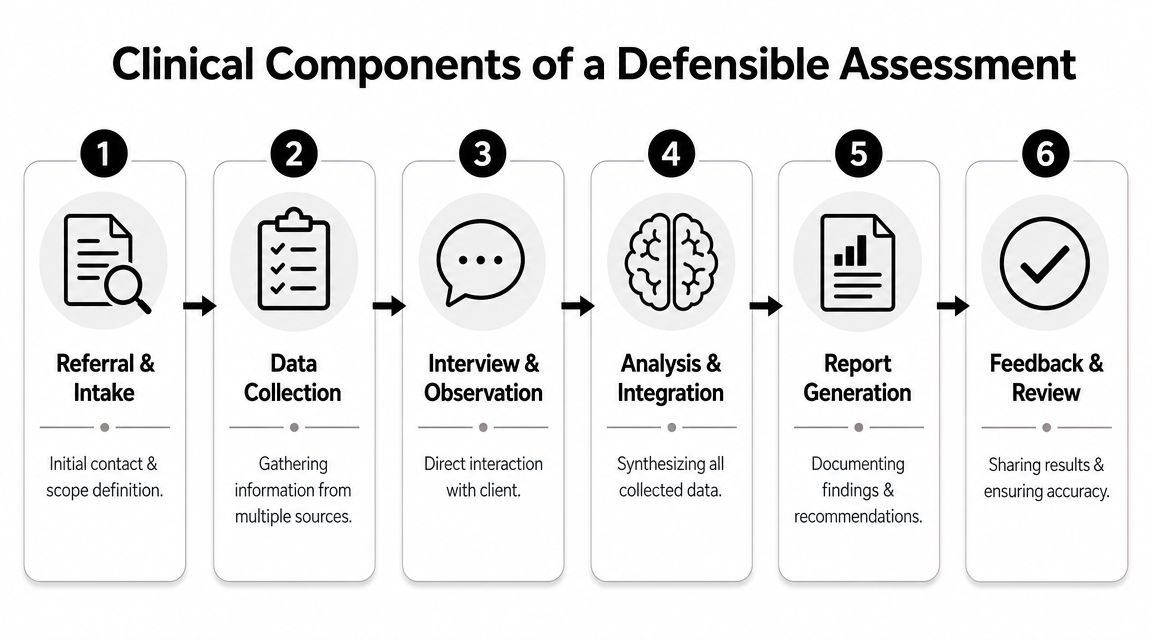
A defensible report rests on method. If the evaluator can't explain how information was gathered, tested, and integrated, the final opinion becomes vulnerable even if the conclusions seem intuitively right.
The process below is a useful working model.
Start with staged assessment
The first mistake many professionals make is trying to conduct full trauma exploration immediately. Clinical guidance in Trauma-Informed Interventions in Child Welfare draws an important distinction between trauma exposure history, trauma-related symptom screening, and full diagnostic assessment. Screening tools are brief and minimally intrusive. If screening suggests concern, then a deeper evaluation follows to determine whether symptoms are subclinical or meet criteria for conditions such as PTSD or ASD.
That sequencing matters in immigration cases because it limits unnecessary distress during first contact while reducing missed cases. It also helps the evaluator explain why the interview unfolded in phases rather than as a single exhaustive trauma narrative.
Use multiple data streams
A good forensic assessment does not rely on a single interview. It integrates:
- Client interview data: symptom report, trauma history, current functioning, and the client's language about events
- Behavioral observations: affect, concentration, pacing, avoidance, dissociation, and response style during the interview
- Collateral records: medical files, police reports, school records, shelter records, declarations, affidavits, and prior evaluations
- Standardized measures when appropriate: used to support, not replace, clinical judgment
One reason attorneys should care about this structure is that it helps separate strong corroboration from overstatement. If a report diagnoses PTSD but never discusses functioning, behavior, or records, the diagnosis may feel detached from the case facts.
Distinguish symptoms from diagnosis
Symptom checklists have value, but they can be misused. The same clinical guidance cautions that symptom checklists should not be used to screen for specific disorders. They are better for understanding current symptom burden. Diagnosis requires more. The evaluator must consider prior treatment history, present impairment, alternative causes, and whether symptoms are attributable to trauma or something else.
That is one reason an in-depth neuropsychological evaluation or other specialized testing may sometimes be relevant when cognitive concerns, head injury, developmental limitations, or severe concentration problems complicate the picture.
The report should show the reasoning path. It should not simply announce the destination.
Build the methodology section like testimony
Attorneys often read the findings first. In contested cases, the methodology section can matter just as much. It should answer practical questions:
| Component | What a strong report shows |
|---|---|
| Intake | Why the client was referred and what forensic questions were posed |
| Interview process | How the evaluator explained role, consent, and pacing |
| Measures | What tools were used and why |
| Records review | Which documents were considered in forming opinions |
| Diagnostic reasoning | How symptoms, history, and function support or limit conclusions |
A report becomes more defensible when the evaluator can show disciplined sequencing, multiple sources of information, and careful differential thinking. That's what gives the opinion legal weight.
Documenting Trauma for U.S. Immigration Cases
An attorney reviews a draft evaluation the night before filing. The report describes fear, nightmares, and years of abuse. It still leaves the attorney with the hard question: what legal element does this prove?
That gap is common in immigration practice. A trauma-informed assessment has little forensic value unless the report ties clinical findings to the form of relief at issue. In high-stakes cases, the task is not only to document suffering. It is to document suffering in a way that is clinically sound, culturally careful, and usable by adjudicators.
The first reporting decision is calibration. Clients in immigration matters often disclose in fragments. Fear of government systems, shame, interpreter concerns, and culturally shaped descriptions of distress can all affect how a history emerges. The Aces Aware chapter on trauma and trauma-informed care explains that trauma-informed systems should account for culture, history, race, gender, location, and language. In a forensic interview, that means the evaluator should explain how the interview was adjusted, how language issues were handled, and what limits those factors place on the opinions.
Match the report to the relief sought
Different forms of immigration relief require different kinds of psychological documentation. A defensible report is organized around that reality from the start, not retrofitted at the end.
| Case Type | Primary Assessment Focus |
|---|---|
| Asylum | Psychological effects of persecution, fear, trauma narrative coherence, and symptom patterns that are consistent with past harm or ongoing fear |
| U Visa | Mental and emotional harm related to the qualifying crime, trauma symptoms, and functional impact |
| T Visa | Effects of trafficking, coercion, control, exploitation, shame, fear, and barriers to disclosure |
| VAWA | Pattern of battery or extreme cruelty, coercive control, trauma effects, and the relationship between abuse dynamics and current functioning |
| Extreme Hardship Waiver | Psychological and functional consequences for the qualifying relative if separation, relocation, or disruption occurs |
Many reports lose force at this point. A generic PTSD summary may sound clinically acceptable and still do little for the case. If the attorney must prove extreme hardship, the report should show what separation or relocation would likely do to functioning, caregiving, treatment stability, or psychiatric vulnerability. If the attorney must prove harm from a qualifying crime, the report should make that harm visible in concrete psychological and daily-life terms.
Build the narrative like evidence, not autobiography
The narrative section should help the court understand what happened and why the client presents as they do now. It should not read like a therapy note, and it should not become a catalog of every painful detail.
A stronger narrative usually does four jobs.
- Identifies legally material events. The report should state the relevant acts, perpetrators, context, and sequence with enough specificity to support the claim.
- Explains the pattern of disclosure. Delayed disclosure, fragmented recall, avoidance, or flat affect may be clinically expectable in trauma cases. If those features appear, the evaluator should explain them rather than leaving adjudicators to treat them as credibility problems.
- Connects symptoms to the history. The report should show the clinical basis for linking current symptoms to the reported trauma, while also identifying limits or competing explanations where they exist.
- Uses restraint. Some details strengthen a case. Some only increase exposure without adding probative value. Good forensic writing knows the difference.
That last point matters. In immigration work, more detail is not always better. The report should include enough facts to support the opinion and the legal theory, but it should not force unnecessary reliving when a shorter description would serve the same forensic purpose.
Functional impairment often carries the most legal weight
Judges and officers rarely need a diagnosis by itself. They need to understand what the person can and cannot do because of the trauma.
That requires translation. Nightmares become chronic sleep disruption that undermines concentration. Hypervigilance becomes inability to use public transportation, attend appointments alone, or tolerate settings associated with police or detention. Depressive symptoms become reduced parenting capacity, missed work, social withdrawal, or inability to complete immigration paperwork without assistance.
In hardship cases, this functional analysis is often where the opinion becomes useful. A qualifying relative may have anxiety, depression, or trauma symptoms. The report becomes persuasive when it explains how relocation, separation, loss of medical care, financial disruption, or removal of a caregiving figure would predictably affect day-to-day functioning. Attorneys assembling corroborating materials often pair the evaluation with practical personal evidence, such as this guide on how to write a letter of hardship.
What attorneys should check before filing
Before filing, counsel should read the report the way a skeptical adjudicator would. The strongest evaluations usually show the following:
- A clear forensic question. The report states why the evaluation was requested and what issue the opinion addresses.
- Case-specific organization. The structure reflects the relief sought rather than using a generic mental health template.
- A disciplined trauma narrative. The history is specific enough to matter legally and restrained enough to avoid unnecessary detail.
- Reasoned clinical conclusions. Diagnoses and symptom opinions are explained, not merely listed.
- Concrete functional findings. The report shows how symptoms affect work, parenting, sleep, concentration, treatment adherence, relationships, or participation in the legal process.
- Cultural and language context. Interpreter use, cultural formulation issues, and limits on the data are identified clearly.
- Plain-English forensic opinions. The conclusion answers the legal relevance question in terms a non-clinician can use.
A report does not become stronger by sounding more certain than the facts allow. It becomes stronger when the evaluator shows disciplined reasoning, names limitations, and ties the clinical picture to the legal claim with precision.
Ethical Standards and Client Preparation
The evaluator in an immigration case is not the client's treating therapist. That line must stay clear. A forensic report gains credibility when the evaluator explains role, purpose, limits of confidentiality, and how the information may be used in legal proceedings.
When that boundary gets blurry, problems follow. Clients may believe the meeting is purely therapeutic. Attorneys may assume every clinically sensitive detail belongs in the report. Neither assumption is safe.
The ethical foundation
A careful evaluator should obtain informed consent in language the client can understand. If an interpreter is used, consent should still be meaningful, not rushed. The client needs to understand who retained the evaluator, what records may be reviewed, whether the report is intended for filing, and what topics may be discussed.

Ethics also require disciplined documentation. The report should separate observations from opinions and identify the basis for each conclusion. If there are limits to the data, those limits should be named. Courts tend to trust reports that acknowledge uncertainty more than reports that pretend certainty where none exists.
How attorneys should prepare clients
Client preparation should reduce anxiety without coaching content. That balance is important. Attorneys can help by explaining the structure and purpose of the evaluation before the first meeting.
Useful preparation often includes:
- Explain the evaluator's role: Tell the client this is an independent professional assessment for the case, not routine therapy.
- Set expectations about topics: Let the client know sensitive issues may come up, including trauma history, symptoms, family relationships, and current functioning.
- Address practical barriers: Confirm interpreter needs, privacy for virtual sessions, transportation, and time availability.
- Normalize difficulty: Clients should know it's common to remember events unevenly or feel distressed discussing them.
- Avoid rehearsing answers: Preparation should focus on process, not scripting.
When clients know what the appointment is for, they usually arrive less frightened and more able to participate meaningfully.
Why preparation improves credibility
Good preparation protects both the client and the report. It lowers the chance that the person feels ambushed by difficult questions. It also helps the evaluator spend more time gathering useful information and less time repairing confusion about the basic purpose of the meeting.
From a legal standpoint, that matters. A report is more persuasive when the circumstances of the evaluation look careful, fair, and professionally bounded. Ethical clarity is not separate from evidentiary value. It is part of it.
Common Pitfalls That Weaken an Evaluation Report
Some weak reports sound impressive. They use clinical vocabulary, long diagnoses, and polished formatting. But when you read closely, the report doesn't answer the legal question, doesn't explain its methods, or leans on tools that add little forensic value.
This comparison helps spot the difference.

Pitfalls that show up often
One frequent problem is therapeutic language without forensic translation. The report may say the client is “processing trauma” or “struggles emotionally,” but it never explains how symptoms affect memory, concentration, daily functioning, or legal participation.
Another problem is weak nexus analysis. The report lists symptoms but doesn't clearly connect them to the alleged persecution, abuse, trafficking, or qualifying crime. That omission makes the opinion harder to use.
A third issue is lack of functional detail. Diagnosis alone rarely carries the whole report. Attorneys need to know what the condition means in daily life.
The tool problem
Methodological weakness also matters. A major review of TIC measurement approaches found that validated measures remain limited, with only a small number in common use, including the ARTIC Scale and the TICOMETER. The review notes that the TICOMETER contains 35 items across five domains, and the ARTIC Scale includes 7 subscales. It also observed that many organizational self-assessments in the field were still unvalidated at the time of publication. That's why a report that leans on unvalidated checklists may be less defensible than one grounded in tested instruments and clear clinical reasoning, as summarized in this review of trauma-informed care measurement tools.
How to fix these issues
Use this review lens when reading a draft:
- Ask for plain-English conclusions: The evaluator should state what the findings mean for the immigration claim.
- Request explicit linkage: Symptoms should be tied to the trauma history and legal theory.
- Look for functioning: Sleep, work, parenting, concentration, and daily activities should appear somewhere in the analysis.
- Check the methods section: If tools were used, the evaluator should identify them and explain their role.
- Insist on limits and nuance: A careful report distinguishes firm findings from tentative ones.
The strongest report is rarely the longest one. It is the one that connects method, facts, symptoms, and legal relevance without overreaching.
Frequently Asked Questions
Can a client still have a useful evaluation if they disclose trauma gradually
Yes. Gradual disclosure is common in trauma cases, especially when the client fears authority, shame, retaliation, or cultural misunderstanding. A trauma-informed assessment does not assume that an incomplete first account is unreliable. It documents the pace of disclosure, the conditions under which more detail emerged, and any factors that may have affected reporting.
Should the evaluator go into every traumatic event in detail
Usually no. More detail is not automatically better. A defensible report includes enough information to support the clinical formulation and legal relevance, but it doesn't require exhaustive narration of every event. Overly detailed questioning can increase distress and sometimes reduces the quality of the information. The better approach is selective depth tied to the referral question.
What should an attorney ask before retaining an evaluator
Ask how the evaluator handles informed consent, interpreters, records review, trauma pacing, and functional analysis. Ask whether the report is written for legal readers or primarily for treatment purposes. Ask how the evaluator distinguishes between screening, diagnosis, and forensic opinion. Those answers usually tell you more than a list of credentials alone.
If you need an immigration-focused psychological evaluation that applies trauma-informed methods in a legally usable way, Pro Psychological Analysis works with attorneys on reports for asylum, VAWA, T visa, U visa, and hardship matters. The practice's work is structured around forensic documentation, clear methodology, and clinically grounded analysis that can be filed in high-stakes immigration cases.