
If a man is eligible for VAWA, why do so many male cases still arrive thin on proof, thin on disclosure, and vulnerable to credibility attacks?
That gap usually isn't about the statute. It's about narrative formation. Male survivors often describe coercive control as “stress,” “arguments,” or “problems at home,” while legal teams may wait for police reports, visible injuries, or a clean victim presentation that never comes. In vawa for men cases, the essential work is translating lived experience into evidence USCIS can effectively use.
From a forensic psychologist's perspective, the strongest male VAWA filings don't just assert abuse. They document the relationship structure, identify conduct that fits battery or extreme cruelty, explain trauma responses that shaped delayed disclosure, and organize corroboration so the record feels internally consistent from start to finish.
Table of Contents
- VAWA Protection Is Not Limited by Gender
- Understanding VAWA Eligibility for Male Survivors
- Meeting the Evidentiary Standard for Male Petitioners
- Navigating Stigma and Credibility Challenges
- How Psychological Evaluations Strengthen a Male VAWA Case
- An Overview of the VAWA Self-Petition Process
- Ensuring Client Safety and Confidentiality
VAWA Protection Is Not Limited by Gender
Could a qualified male survivor be denied protection because the statute says "Violence Against Women"? No. The title causes confusion, but the remedy is not limited to women. Men can seek VAWA protection if the facts and evidence satisfy the legal standard.
That misunderstanding creates real case damage. Male clients often arrive after months or years of minimizing what happened. By then, texts are gone, medical or mental health treatment never started, and patterns of coercion have been mislabeled as "marital problems" instead of abuse. In practice, the first strategic task is often correcting the frame of the case before building the record.
The larger problem is not legal eligibility alone. It is how male victimization is perceived and documented. Many filings weaken because the legal team treats the matter like an ordinary domestic violence case and expects the evidence to present in a familiar way. Male survivors often describe humiliation, threats tied to immigration status, monitoring, financial control, sexual coercion, or fear of false allegations before they use the word abuse. That presentation can sound restrained, defensive, or fragmented. It still fits a trauma pattern.
Attorneys should read this overview of protections under VAWA with that problem in mind. The statute allows relief. The harder task is building a record that shows coercive control clearly enough to overcome assumptions about how a "real" victim is supposed to sound.
Practical rule: In vawa for men cases, ask for behavior, sequence, and impact. What did the abuser do, how often did it happen, what threats were made, what did the client change afterward, and what became harder at work, at home, or in daily functioning?
A stronger male VAWA filing usually does three things:
- It keeps the focus on proof. The petition shows what happened and how it meets the standard, instead of spending pages arguing that men can be victims.
- It documents coercion in concrete terms. Messages, recordings, witness observations, treatment notes, financial records, photographs, and timeline details carry more weight than broad conclusions.
- It explains conduct that may be misread. Delayed disclosure, staying in the relationship, failing to call police, or sounding flat in an interview should be addressed directly and tied to shame, fear, dependency, or trauma response where supported.
When that work is done well, the case stops looking unusual and starts looking what it should have looked like from the beginning. A documented abuse file with a clear theory of coercive control.
Understanding VAWA Eligibility for Male Survivors
What does a male client have to prove to qualify for VAWA, and where do these cases usually weaken? Start with the statute, then test each element the way USCIS will. A persuasive account of abuse helps, but eligibility still turns on whether the file proves each required part of the claim with consistent, organized evidence.
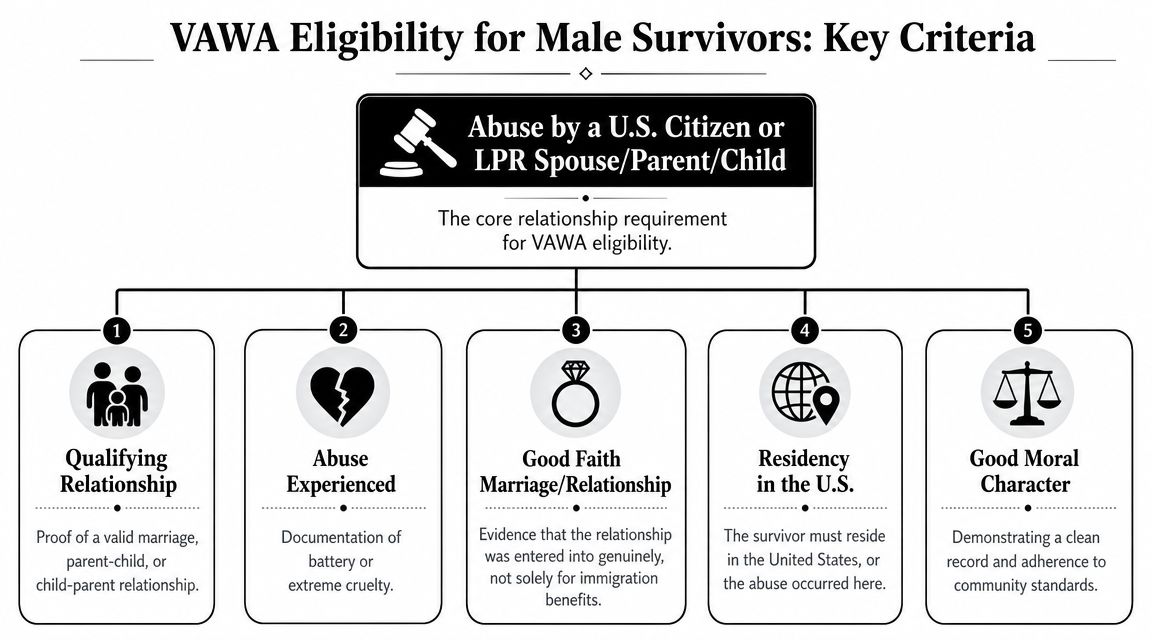
Start with the qualifying relationship
Male survivors are evaluated under the same statutory categories as any other VAWA self-petitioner. Men may qualify as the abused spouse, child, or parent of a U.S. citizen or lawful permanent resident. As described in this guide on VAWA eligibility for men, the petitioner must establish the qualifying relationship, shared residence where required, good moral character, and abuse that rises to battery or extreme cruelty.
For case screening, relationship evidence should be gathered first and checked for conflict before the abuse narrative is drafted in final form. Marriage certificates, divorce decrees, birth records, proof of the abuser's immigration status, joint mail, leases, school records, and other household documents often determine whether the petition starts from stable ground or from avoidable inconsistency.
That order matters.
In male cases, attorneys sometimes spend too much time trying to prove that the client "counts" as a victim and too little time tightening the record on residence, status, dates, and family role. USCIS is more likely to trust a case that is structurally clear from page one.
Separate legal eligibility from the abuse story
A strong filing treats eligibility as a series of distinct proof questions. One set of documents establishes who the parties are, how they are related, whether they lived together when required, and whether the petitioner can show good moral character. A different set explains what the abuser did and why that conduct meets the legal standard.
That separation helps in male survivor cases because credibility problems often start with muddled presentation, not only with weak facts. If the affidavit mixes chronology, immigration history, and abuse detail without a clear theory, the officer may miss how the pieces fit together.
A practical review table helps:
| Element | What to confirm early |
|---|---|
| Qualifying relationship | Marriage, parent-child, or child-parent records |
| Abuser's status | Proof of U.S. citizenship or lawful permanent residence |
| Shared residence | Leases, mail, bills, school or medical records, affidavits |
| Good moral character | Criminal history check, tax issues, rehabilitation evidence, community statements |
| Battery or extreme cruelty | Specific incidents, threats, coercive acts, and resulting fear or impairment |
Extreme cruelty often fits male cases better than clients expect
Many male survivors minimize what happened to them because the abuse did not leave visible injuries or because they fought back verbally, stayed in the home, or delayed disclosure. None of that rules out eligibility. The legal question is whether the conduct amounts to battery or extreme cruelty, and many male petitioners present strongest under the extreme cruelty theory.
In practice, that often includes patterns such as isolation, humiliation, threats tied to immigration status, control of money, interference with sleep, monitoring of communications, intimidation involving children, false accusations, or repeated efforts to make the client appear unstable or dangerous. Those facts should be described concretely, with sequence and context, so the officer can distinguish coercive control from ordinary marital conflict.
For male petitioners, case theory matters most. A file that alleges "emotional abuse" is often too vague. A file that shows repeated domination, fear, dependency, behavioral change, and documented functional impact is far easier to assess and far harder to dismiss.
Meeting the Evidentiary Standard for Male Petitioners
What persuades USCIS when a male survivor has no police report, no dramatic injury photos, and years of minimization in the record?
Usually, it is not one document. It is a file that shows the same pattern across several independent sources. For VAWA self-petitions, USCIS accepts “any credible relevant evidence,” as explained in WomensLaw's discussion of VAWA self-petitions. That standard matters in male cases because many clients never called law enforcement, never sought shelter services, and never described themselves as victims until much later.
The practical question is not whether the client has perfect evidence. The question is whether the record makes coercion, fear, and resulting impairment easy to see.
What a persuasive file usually looks like
Strong male VAWA filings tend to work by convergence. Each piece of evidence does a different job, and together they reduce the room for skeptical interpretations.
- A detailed affidavit that gives dates or approximate timeframes, identifies specific incidents, and explains the client's reactions, decisions, and fear
- Clinical or counseling records that document symptoms, treatment, sleep disturbance, anxiety, depression, trauma responses, substance misuse, or decline in daily functioning
- Third-party statements from people who observed isolation, humiliation, threats, controlling behavior, injuries, panic, or noticeable personality change
- Documentary records such as texts, emails, voicemails, financial records, screenshots, shared-address documents, school records, or medical notes that place events in context
I advise attorneys to treat the affidavit as the spine of the case. It should not sound scripted or packed with legal labels. It should explain what happened, in sequence, with enough behavioral detail that a reviewer can track escalation and understand why the client stayed, delayed disclosure, or returned after separation.
That last point matters. Male survivors are often judged harshly for conduct that is common in trauma cases.
Evidence should answer the questions USCIS will actually ask
A weaker filing often contains real proof but fails to organize it around the legal elements and the credibility problems that tend to surface in male cases. An officer reviewing the file will look for internal consistency, plausible chronology, and corroboration where corroboration should exist.
Several problems come up repeatedly:
- Vague abuse claims: statements like “she controlled everything” or “he was emotionally abusive” do little work unless the filing shows the acts, frequency, and effect
- Silence around hard facts: periods of separation, mutual arguments, delayed treatment, prior arrests, or return to the relationship need explanation
- Symmetry without analysis: if both partners yelled or made accusations, the file still has to identify who used intimidation, dependency, threats, or manipulation as a pattern of control
- Records with no theory: screenshots, medical pages, and witness letters lose value when no one ties each item to marriage, shared residence, abuse, or good moral character
A practical method helps. Build a simple evidence map before filing. Match each document to a legal point and to a credibility issue. One text message may support extreme cruelty. A therapy intake may explain delayed reporting. A coworker affidavit may show behavioral change after a threat involving immigration status or the children.
Clinical documentation is often the difference between a file that feels abstract and one that feels grounded. In male cases, symptoms may appear as irritability, shame, emotional constriction, insomnia, poor concentration, somatic complaints, or overcontrolled presentation rather than open fearfulness. If the record explains that pattern clearly, it helps the officer distinguish trauma from evasiveness.
Broad discretion helps petitioners. It does not excuse thin proof. Specificity, chronology, and corroboration still decide close cases.
Navigating Stigma and Credibility Challenges
Why do some male VAWA cases look thin on paper even when the abuse was serious? In practice, the problem is often not the absence of harm. It is the way shame, gender expectations, and fear of ridicule distort disclosure long before the case reaches USCIS.
Male survivors often arrive with a credibility problem already built into the record. They may have told no one, minimized what happened, or described years of coercion as “marital problems.” Some waited until the relationship ended. Some returned after prior incidents. Some are afraid that reporting emotional, sexual, or financial abuse will make them look weak or dishonest. Those facts do not defeat the case, but they must be explained before an officer fills in the gaps with the wrong assumptions.
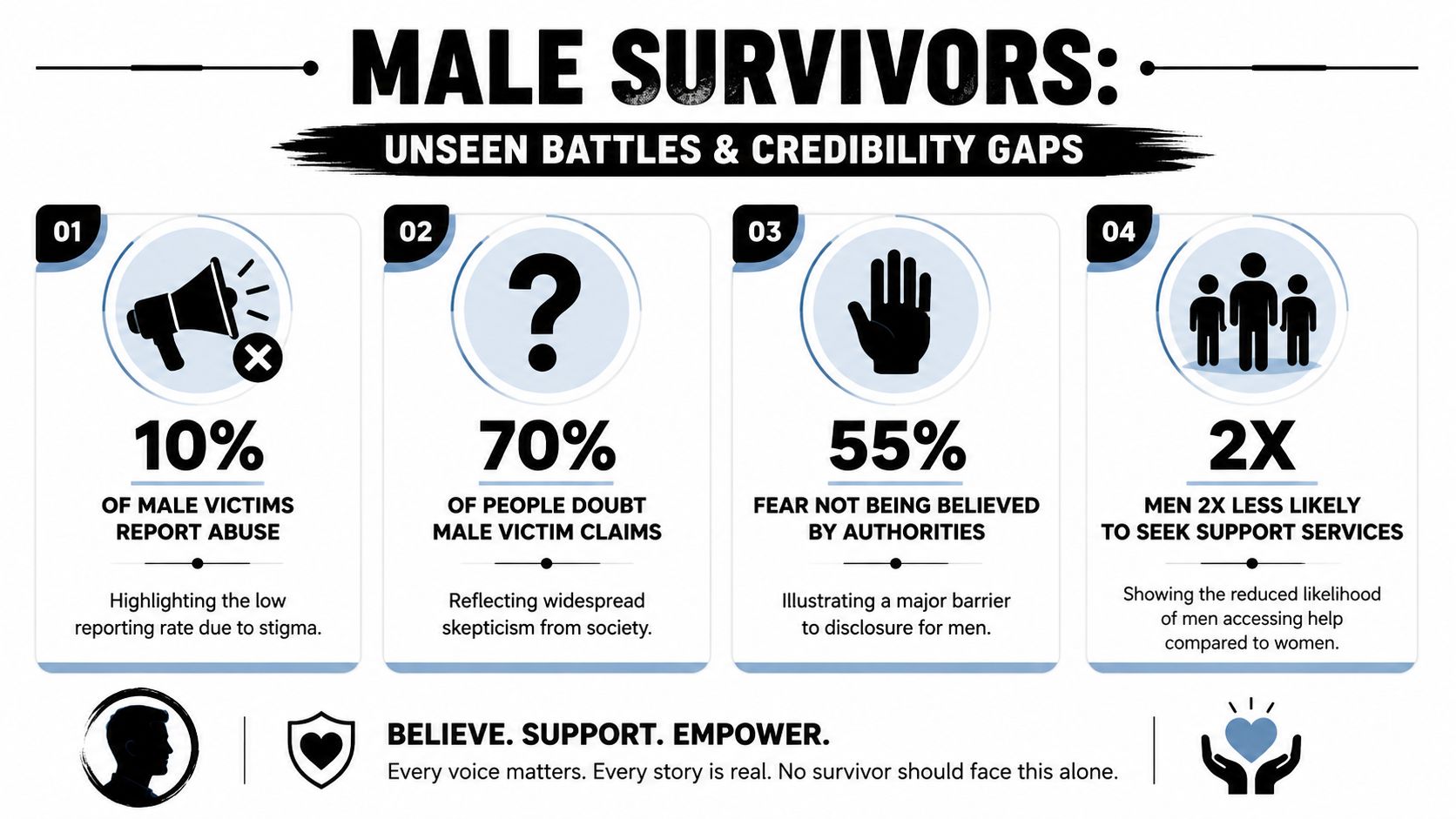
Why skepticism appears so quickly
The recurring problem in male cases is misinterpretation. Officers, clinicians, family members, and sometimes counsel may expect a victim presentation that is emotionally open, visibly fearful, and consistent from the start. Many men present the opposite way. They sound controlled. They skip humiliating facts. They focus on work stress, sleep, anger, or immigration consequences instead of naming abuse directly.
That creates predictable credibility traps:
- He could have left. This ignores financial dependence, concern about children, immigration exposure, fear of false allegations, and trauma-driven attachment.
- He never called police. Some male survivors expect to be mocked, disbelieved, or treated as the primary aggressor.
- He does not seem traumatized. Flat affect, clipped narration, minimization, and irritation are common trauma presentations.
- There are no injuries. Many strong VAWA cases turn on control, humiliation, threats, surveillance, sexual degradation, and isolation rather than visible assault.
I see this often in forensic interviews. A man will describe a partner reading his messages, threatening to report him to immigration, blocking access to money, accusing him of being dangerous in front of the children, and forcing sexual acts through coercion. Then he shrugs and says, “It was toxic on both sides.” If counsel leaves that framing untouched, the file understates both the pattern and the impact.
How to address credibility problems before they harden
The legal task is not just to collect incidents. It is to explain behavior that otherwise looks suspicious. Delayed disclosure, partial memory, inconsistent word choice, return to the relationship, and emotional restraint all need context in the declaration and supporting records.
A practical approach is to identify the weak points first, then answer them with evidence and clinical explanation:
| Credibility issue | Better legal framing |
|---|---|
| Delayed disclosure | Shame, fear of ridicule, fear of retaliation, trauma avoidance |
| No police report | Fear of being misidentified as aggressor, concern about escalation, distrust of response |
| Stayed in the relationship | Coercive control, financial dependency, concern for children, immigration fear |
| Minimizing language | Trauma-related avoidance, male socialization, difficulty labeling nonphysical abuse |
That framing works best when it is tied to records, not argument alone. A therapy intake, primary care note, shelter screening, affidavit from a sibling, or forensic report can show that the client's guarded presentation fits a known trauma pattern rather than fabrication. For attorneys who want a broader view of how clinical evidence fits immigration matters, this guide on mental health evidence in immigration cases gives useful context.
One point deserves special attention. Shame changes what men disclose. Sexual humiliation, reproductive coercion, threats of public embarrassment, and false claims that he was the abuser are often omitted in early interviews. Those omitted facts can be case-defining. Ask directly, ask calmly, and normalize the question.
A guarded presentation can be a survival style. In a male VAWA case, it often needs interpretation before it can be believed.
How Psychological Evaluations Strengthen a Male VAWA Case
How do you prove abuse when the record is thin, the client minimizes key events, and the presentation does not match what adjudicators expect from a victim? In many male VAWA cases, the answer is not more argument. It is better clinical documentation.
A psychological evaluation is most useful when the abuse involved coercive control, humiliation, sexual degradation, threats, or chronic intimidation that did not produce a dramatic public record. Male clients often describe the aftermath in practical terms. They report insomnia, irritability, panic, concentration problems, sexual shame, numbness, or fear. They may not identify those symptoms as trauma, and they often omit the events that best explain them.
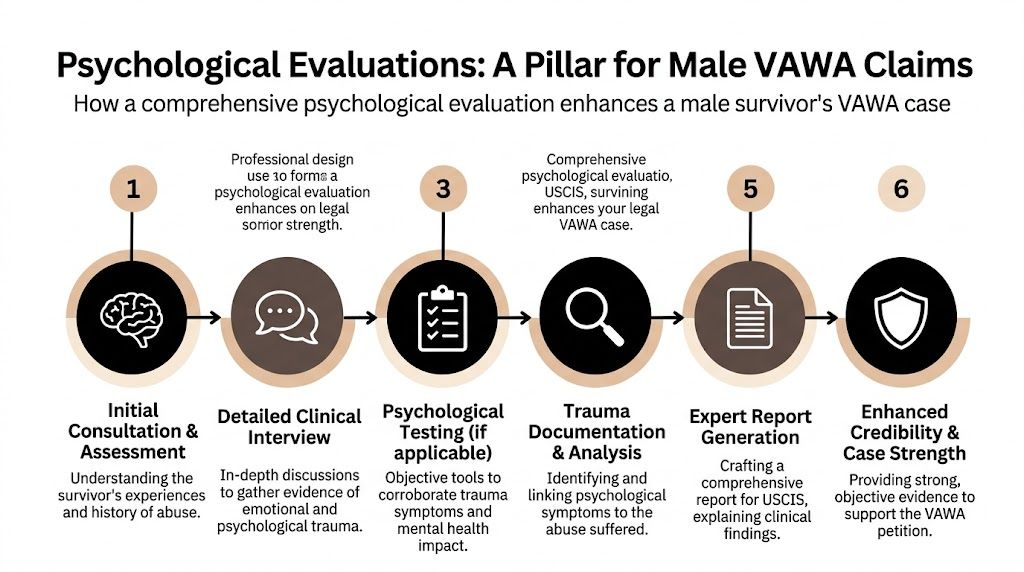
That gap matters. USCIS does not need a diagnosis for its own sake. It needs a coherent, well-supported explanation of what happened, how the abuse affected functioning, and why the client's disclosure pattern looks the way it does. A strong forensic report helps turn a fragmented story into evidence that fits the case theory.
What a Good Evaluation Does
A good forensic evaluation organizes facts in a way the file can use. It does more than list symptoms or attach a diagnostic label.
The report should document the pattern of abuse over time, including escalation, control tactics, and the client's attempts to adapt or stay safe. It should connect current symptoms to that history with clear clinical reasoning. It should also address day-to-day impairment, such as missed work, social withdrawal, sleep disruption, impaired concentration, hypervigilance, shame, or avoidance.
Just as important, the evaluation should explain behaviors that often get misread as credibility problems. In male VAWA cases, I want to see explicit analysis of delayed disclosure, flat affect, minimization, inconsistent sequencing, continued contact with the abuser, and reluctance to discuss sexual or reproductive abuse. Those features can reflect trauma, fear, and gendered shame. Without interpretation, they can be framed as weakness in the case.
This is where mental health evidence in immigration cases becomes strategically useful. The report gives the attorney language for the declaration, helps explain documentary gaps, and gives the adjudicator a clinically grounded reason to read the file with more accuracy.
Here's a short discussion that clients and attorneys often find helpful before the evaluation process moves forward:
What attorneys should ask the evaluator to address
Referral questions shape the final report. If counsel asks for a general mental health evaluation, the result is often too broad to help much. In a male VAWA case, the referral should ask for findings tied to the legal issues in dispute.
Ask the evaluator to address:
- The abuse framework. Identify whether the facts support battery, extreme cruelty, or both, and explain the behavioral pattern behind the incidents.
- Symptom causation. Link the client's symptoms to the abuse history with specific examples rather than a generic trauma summary.
- Credibility-relevant behavior. Explain delayed reporting, minimization, fragmented recall, ongoing contact, and emotional constriction in clinical terms.
- Gender and cultural barriers. Describe how male socialization, fear of ridicule, and cultural expectations may affect disclosure, help-seeking, and symptom language.
- Record gaps. Address why a client may have little treatment history, no police involvement, or sparse third-party documentation, while still presenting a clinically coherent abuse history.
There is a trade-off here. A report that is too cautious may fail to explain the case. A report that sounds like advocacy rather than forensic analysis can hurt credibility. The strongest evaluations stay neutral in tone, specific in reasoning, and closely tied to the available records.
One factual option in this space is Pro Psychological Analysis, which provides psychological evaluations for immigration matters including VAWA, with reports designed to document trauma, abuse dynamics, and clinical symptoms for USCIS-facing cases.
An Overview of the VAWA Self-Petition Process
The procedure is straightforward on paper and more demanding in practice. Male clients often need more time at the front end because the record must compensate for under-documentation and delayed disclosure.
A useful background point comes from service-system data. In the UK, men were 41% of domestic-abuse victims but only 4.4% of those receiving support from local services, according to ManKind Initiative statistics on male victims of domestic abuse. The legal takeaway isn't about importing UK law. It's that male victims can be significantly underrepresented in formal support systems, which often leaves immigration files thinner than expected.
Build the file before you file the form
At the preparation stage, attorneys should gather records with two separate goals in mind. One set proves the legal framework of the case. The other proves the abuse pattern.
A practical pre-filing package often includes:
- Form preparation materials: identification, status records, qualifying relationship documents, and residence evidence
- Narrative materials: a detailed declaration, chronology, and witness affidavits
- Corroborating records: treatment notes, photographs if they exist, communications, financial records, school or employment records, and any relevant clinical evaluation
- Quality control review: date consistency, translation issues, naming conventions, and explanation of missing documents
For declaration drafting, many attorneys find it useful to compare the client narrative against a structured model like this guide on how to write a VAWA declaration. The declaration should sound like the client, not like a template.
Key stages after filing
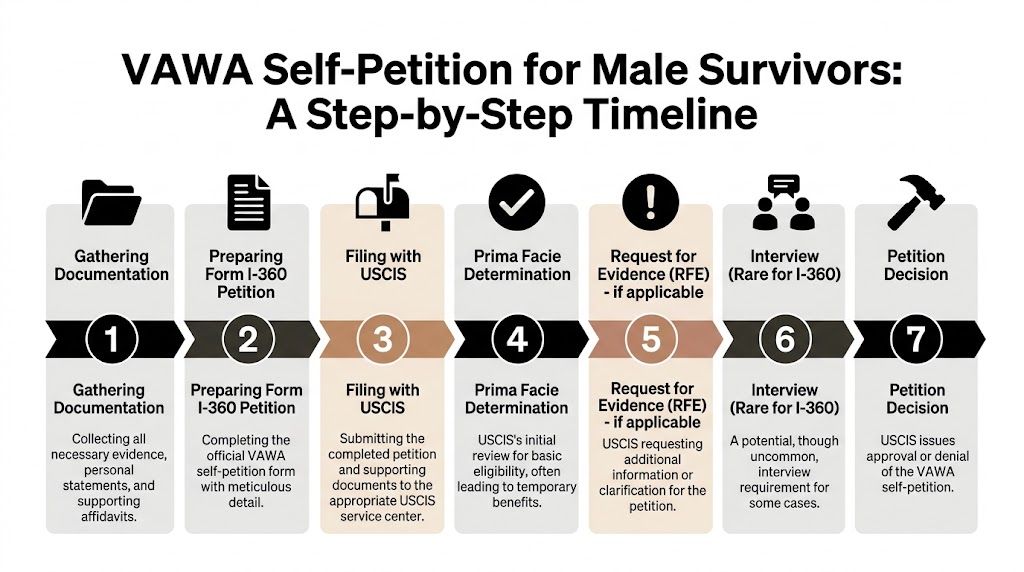
The self-petition process generally unfolds in stages rather than one event. A high-level roadmap looks like this:
- Filing Form I-360 with supporting evidence
- Initial intake and receipt
- Prima facie review
- Possible request for evidence if the file is incomplete or unclear
- Further review and decision on the petition
Some cases may involve biometrics or other related procedural steps depending on posture and accompanying applications. Requests for Evidence are not unusual. In male cases, they often expose issues that could have been resolved earlier, such as unclear residence evidence, vague declarations, or unsupported claims of extreme cruelty.
When an RFE arrives, the best response isn't volume. It's precision. Answer the exact gap USCIS identified, then reinforce the narrative coherence of the entire file.
Ensuring Client Safety and Confidentiality
For many clients, the first real question isn't legal eligibility. It's whether filing will alert the abuser. That fear can block disclosure, delay filing, and distort how the client communicates with counsel.
VAWA practice only works if the client believes the process can be handled safely. That requires confidentiality discipline from the attorney, the clinician, and anyone collecting records.
Confidentiality is part of case strategy
In these cases, safety planning isn't separate from evidence planning. A client who fears interception may avoid email, shared phones, family addresses, or treatment access. That affects scheduling, signatures, mailing, and even where records are stored.
Attorneys should talk through practical questions early:
- Safe contact methods: Which phone, email, and mailing address are private?
- Document storage: Can the client safely keep copies at home, or should counsel hold them?
- Calendar risks: Will appointment reminders appear on a shared device?
- Third-party communication: Who, if anyone, can be contacted without increasing risk?
Practical safety steps for attorneys and clinicians
In male VAWA cases, shame often leads clients to downplay danger. Don't assume a calm presentation means low risk.
Use concrete protocols:
- Confirm privacy at every interaction. Ask whether the client is alone and whether it's safe to speak freely.
- Avoid careless detail in voicemails or emails. Keep messages neutral when safety is uncertain.
- Coordinate affidavit and evaluation timing. Repeated retelling can destabilize the client if done without planning.
- Prepare for retaliation concerns. Clients may fear social smearing, immigration threats, or manipulation through children and family networks.
- Protect dignity as well as confidentiality. Men who already fear humiliation may shut down if the process feels exposing or dismissive.
The strongest representation here is both clinically informed and operationally careful. A client who feels safe discloses more accurately. A client who discloses more accurately gives counsel a better case.
If you're handling a male VAWA case and need clinically grounded documentation that addresses trauma, coercive control, delayed disclosure, and credibility concerns, Pro Psychological Analysis provides immigration-focused psychological evaluations for VAWA and related matters. The practice works with attorneys to produce structured, evidence-based reports that align clinical findings with legal issues while maintaining strict confidentiality and a trauma-informed process.