
What builds trust with a vulnerable immigration client. Warmth, or safety?
Most professionals are taught some version of the same advice about building rapport with clients: smile, find common ground, use humor, make the person comfortable. That guidance isn't useless. It is incomplete. In immigration work, especially with asylum seekers, trafficking survivors, domestic violence survivors, and clients facing removal, conventional rapport tips can misfire. A casual joke can land as dismissive. Fast familiarity can feel intrusive. A polished intake script can sound like just another authority figure extracting a story the client has had to repeat too many times.
In these cases, rapport isn't social ease. It's structured psychological safety. The client is weighing risk from the first moment. Who are you. What will happen to what they say. Will disclosure help them, expose them, or overwhelm them. If you miss that reality, the cost isn't just a less pleasant meeting. You may get a fragmented narrative, omissions that affect legal strategy, visible shutdown, or a client who agrees outwardly while withdrawing internally.
That matters because trust changes what people disclose and how accurately they can do it under stress. It also matters because a positive service experience is strongly tied to return engagement. One customer service benchmark found that 89% of customers are more likely to make a repeat purchase after a positive service experience, which helps explain why rapport has practical consequences beyond courtesy, as discussed in this overview of client rapport and retention. In immigration practice, the equivalent outcome isn't retail loyalty. It's continued participation, fuller disclosure, and a steadier working alliance under pressure.
Table of Contents
- Beyond Handshakes and Small Talk
- Preparing the Space for Trust
- The First Five Minutes Your Opening Script
- Deepening Trust with Active Listening Techniques
- Navigating Culture Power and Virtual Divides
- Maintaining Boundaries and Concluding with Clarity
Beyond Handshakes and Small Talk
Standard rapport advice assumes the interaction is low stakes. Immigration interviews are not. The client may associate institutions with detention, persecution, surveillance, betrayal, or disbelief. Even when you're acting carefully, the structure of the meeting can still resemble an interrogation. You ask questions. You take notes. You request dates, names, sequences, and painful details. The client understands that an authority system sits behind the conversation.

Why friendliness alone can fail
A client doesn't need you to seem charming. They need you to seem predictable, respectful, and safe. That distinction changes the whole approach.
If you rush to create closeness, several things can go wrong:
- Forced warmth can feel manipulative: A client who has survived coercion often notices mismatch quickly.
- Premature personal questions can trigger self-protection: The issue isn't only content. It's timing.
- Light humor can communicate that you don't grasp the stakes: Some clients will smile politely while trust drops.
- Overconfident reassurance can damage credibility: You can't promise outcomes you don't control.
Careful clinical guidance on rapport warns against one-size-fits-all interpersonal scripts. It emphasizes cultural competence, pacing, validation, and avoiding judgment or technical jargon, especially in trauma-affected and legally sensitive settings. It also notes that rapid rapport can help in some contexts, but overusing imitation, premature familiarity, or forced small talk may feel unsafe to clients who need privacy and control, as outlined in this discussion of rapport-building techniques and their limits.
Clinical reality: Clients often decide whether you are safe before they decide whether you are kind.
What effective rapport looks like in immigration work
Building rapport with clients in this setting is less about charm and more about reducing threat cues. The most effective professionals make the interaction legible. They explain roles. They mark transitions. They ask permission before changing topics. They let the client know what will happen if emotion rises, memory fragments, or the person needs a pause.
A useful way to think about rapport here is to separate it from likability.
| Low-value rapport behavior | Higher-value trauma-informed behavior |
|---|---|
| Trying to be instantly relatable | Explaining your role and limits clearly |
| Filling silence quickly | Allowing regulated silence without pressure |
| Asking for the whole story at once | Sequencing disclosure and checking tolerance |
| Sounding casual to reduce tension | Sounding calm and steady to increase safety |
The legal risk when rapport goes wrong
Poor rapport doesn't just create discomfort. It can affect case quality. A client who doesn't feel safe may underreport abuse, minimize symptoms, skip key chronology, or default to short answers because they've learned that disclosure carries consequences. Attorneys sometimes misread this as evasiveness or inconsistency when it's a threat response.
That is why trauma-informed rapport is not an optional bedside manner. It is part of competent fact development in high-stakes legal work.
Preparing the Space for Trust
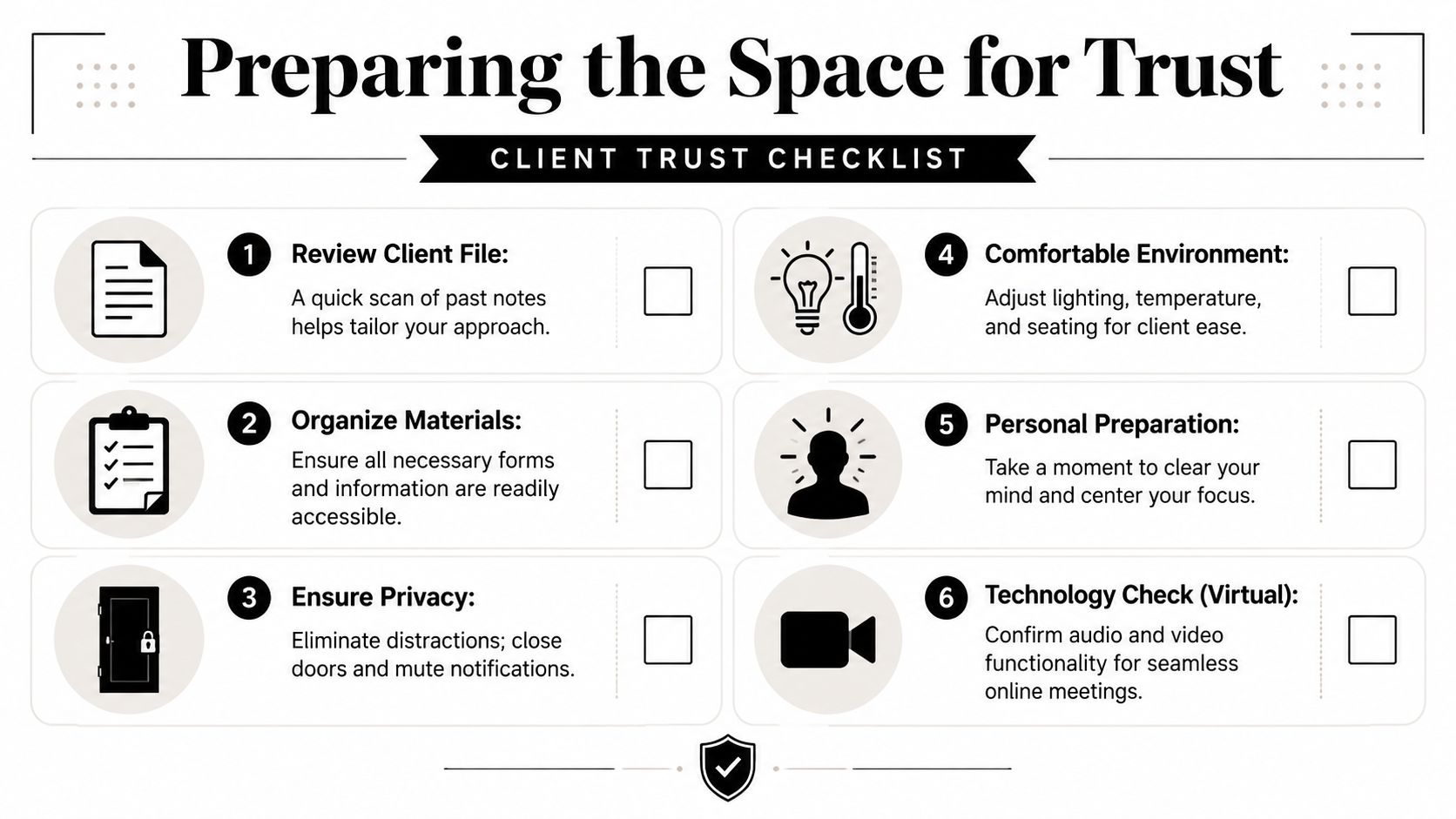
Rapport starts before the first greeting. The room, the technology, your notes, and your own pace all communicate something before you ask a single question. Clients read those signals quickly.
Prepare the environment, not just the file
A good intake space doesn't need to feel luxurious. It needs to feel contained.
Check the basics before every meeting:
- Privacy first: Shut the door, silence notifications, and make sure no one can overhear. In virtual meetings, confirm who's present on both sides.
- Clear physical layout: Avoid placing yourself as a gatekeeper between the client and the exit. Small details affect perceived safety.
- Visible materials: Have forms, tissues, water, interpreter access, and any releases ready so you aren't searching while the client waits.
- Technology stability: If the meeting is remote, test audio, camera framing, and interpretation logistics in advance.
- Sensory neutrality: Lighting, temperature, and seating matter more than people admit. Discomfort competes with disclosure.
- Mental readiness: Review the file briefly, then pause. If you enter rushed or scattered, the client will feel it.
A practical framework for this kind of preparation also appears in trauma-related assessment work. For a deeper look at readiness before sensitive interviews, see this piece on trauma-informed care assessment.
Review the record for trigger points
Don't just review the record to gather facts. Review it to anticipate strain.
Look for material that may destabilize the meeting if introduced abruptly:
- Past detention or confinement
- Sexual violence or trafficking indicators
- Family separation
- Children involved in harm or threats
- Contradictions already documented elsewhere
- Interpreter complications or prior communication breakdowns
This preparation helps you choose sequence. Some facts need to be established early for legal reasons. Others can wait until the client has more orientation and control.
A well-prepared room tells the client, "You won't have to manage my process for me."
Shift your objective from extraction to disclosure
When lawyers are under deadline pressure, it's easy to treat rapport as the soft prelude to the central task of obtaining facts. In trauma-affected immigration matters, creating conditions for disclosure is the crucial task.
That means dropping habits that often look efficient but reduce trust:
- Don't overuse legal jargon: Even common terms can sound opaque or intimidating.
- Don't perform false certainty: Clients usually tolerate difficult information better than vague reassurance.
- Don't mimic too aggressively: Mirroring can help in moderation, but copied tone or posture often feels unnatural.
- Don't act overly personal too soon: Familiarity should follow safety, not substitute for it.
A strong preparation standard is simple: if your setup increases predictability, privacy, and control, it probably supports rapport. If it increases ambiguity or pressure, it probably doesn't.
The First Five Minutes Your Opening Script
The opening of a meeting should lower uncertainty. Many professionals waste those first minutes on pleasantries that don't answer the client's real questions. Vulnerable clients often need orientation more than charm.
One useful benchmark from mental health practice is that, during an initial session, the client should be talking for at least 80% of the time, which reflects a broader move toward collaborative understanding rather than expert-led interrogation, as noted in this guidance on client-centered rapport. That doesn't mean you speak less by being vague. It means you use your words to create a structure in which the client can speak more safely and more fully.
A first-meeting script that gives control
A strong opening sounds something like this:
"Before we get into your history, I want to explain my role, what today is for, and how we'll handle difficult topics. Some questions may be personal. You can tell me if you need a pause, if something isn't clear, or if you'd prefer to start somewhere else. If you don't know an answer or don't remember something exactly, it's better to say that than to guess."
That short script does several things at once. It defines purpose. It gives permission for limits. It reduces the fear that uncertainty will be punished. It also invites accuracy over performance, which is critical in legal settings.
Then use an opening question that widens agency instead of narrowing it:
- "What feels like the most important place for us to begin today?"
- "Before I ask more specific questions, what do you want me to understand first?"
- "What would help this conversation feel manageable for you?"
These questions don't surrender structure. They signal that the client's internal map matters.
A follow-up meeting script
A follow-up should still orient the client. Don't assume continuity equals safety.
Try this:
"Last time we covered some background and stopped when things were getting heavy. Today I'd like to check how you're doing, review what we still need, and make sure the pace works for you. If I ask about something sensitive, I'll tell you why I'm asking."
That final sentence matters. Trauma survivors often tolerate hard questions better when they understand the reason behind them.
An evaluation-focused opening
If your role includes a psychological evaluation, clarity becomes even more important because clients may confuse clinical, legal, and advocacy roles.
A direct opening can be:
"I'm here to assess your experiences and current symptoms in a careful, professional way. My role is not to decide your case. My role is to document relevant psychological information as accurately as possible. Some parts of your story may be difficult to tell, and we can slow down when needed."
What to avoid in the first moments
The wrong opening usually has one of three problems.
| Opening habit | Why it backfires |
|---|---|
| Launching straight into forms | It tells the client procedure matters more than safety |
| Overpromising comfort | It can sound tone-deaf in a high-risk case |
| Asking "Why didn't you…" too early | It invites shame and defensiveness |
Small wording changes that matter
Replace pressure-laden prompts with ones that support recall and dignity.
Instead of "Tell me everything that happened."
Use "Start where it makes sense to you, and we'll build the timeline together."Instead of "You need to be specific."
Use "Details help, and it's okay if you remember them gradually."Instead of "Calm down."
Use "We can slow this down."
These are small edits. In practice, they often determine whether the client feels managed or accompanied.
Deepening Trust with Active Listening Techniques
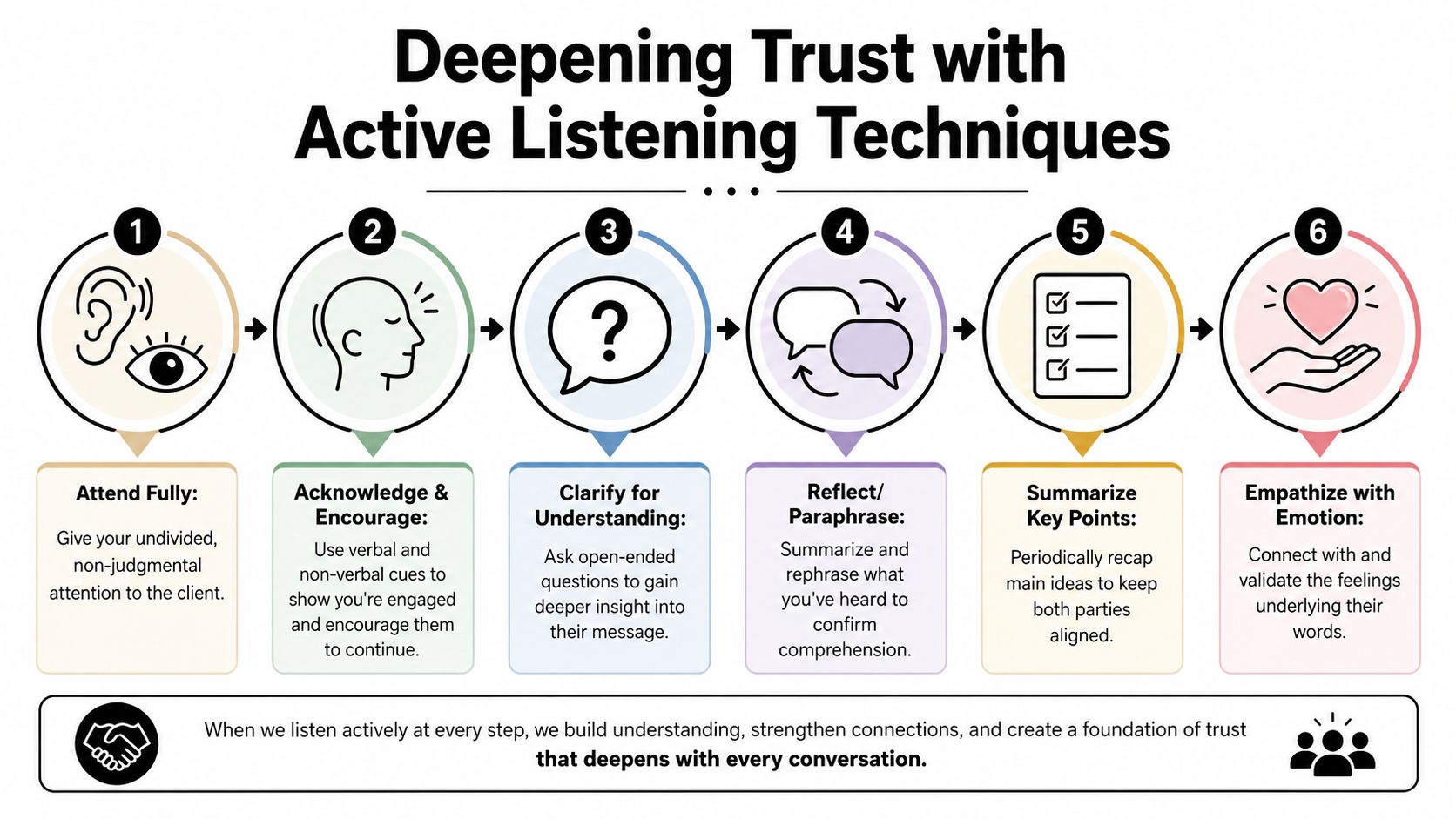
Once the conversation is underway, rapport depends less on what you ask and more on how you receive what comes back. In trauma-sensitive interviews, active listening isn't a soft interpersonal add-on. It is the method that keeps the client engaged without pushing the nervous system past tolerance.
Use a sequence, not a reflex
Clinical guidance describes a reliable sequence for rapport in client interactions: begin with complete presence and open-ended prompting, then use reflective listening and emotional validation, and then adapt your communication through verbal mirroring and energy matching to the client's preferred tempo, as discussed in this clinical review of patient rapport practices.
That sequence matters because many professionals reverse it. They try to "connect" first through tone matching or friendliness before they've shown they can hold the story. Presence comes first.
A practical version looks like this:
- Attend fully: Make your attention obvious through steady pace and minimal interruption.
- Invite narrative: Use open prompts rather than stacked questions.
- Reflect content: Paraphrase the factual thread.
- Validate emotion: Name the impact without overstating it.
- Adjust pace: Slow down or narrow focus when distress rises.
- Check understanding: Confirm what you heard before moving on.
How to validate without overstepping
Validation does not mean agreement with every interpretation. It means acknowledging that the experience had an understandable impact.
Useful phrases include:
- "That sounds frightening."
- "It makes sense that this is hard to talk about."
- "I can see this brings up a lot."
- "We can stay with this for a moment or shift briefly if needed."
Less helpful responses are often well-intended:
- "I know exactly how you feel."
- "You're safe now, so try not to worry."
- "At least that part is over."
Those statements either assume too much or move too quickly toward reassurance. The client may still be dealing with active danger, uncertain status, or ongoing family risk.
Practical rule: Validate the client's experience. Don't narrate it for them.
Working with silence, fragmentation, and distress
Trauma narratives often arrive out of sequence. A client may remember sensory fragments, isolated images, bodily reactions, or emotionally loaded details before chronology becomes clear. That is not necessarily deception. It is often how stress-encoded memory presents.
When the narrative fragments:
- Anchor gently: "Let's slow down and place this one part in time as best we can."
- Separate strands: "I'm hearing two events. Let's take them one at a time."
- Mark uncertainty: "It's okay if the order isn't clear yet."
When the client goes silent, don't rush to fill it. Silence may mean dissociation, shame, language searching, or simple effortful recall. Your task is to distinguish between productive silence and overwhelmed silence.
A quick comparison helps:
| Client presentation | Better response |
|---|---|
| Quiet but engaged | Wait, stay present, then offer a gentle prompt |
| Tearful and flooded | Pause the detail-gathering and orient to the present |
| Disorganized chronology | Build a shared timeline step by step |
| Minimal yes/no answers | Broaden the prompt and reduce pressure |
Listening for what's missing
Deep listening includes noticing absences. If a client describes severe events with flat affect, don't force emotion. If they skip entire periods, note the gap without confrontation. If they agree with every suggestion, check whether comprehension, deference, fear, or interpreter dynamics are shaping the response.
At this point, many interviews derail. The professional gets anxious about completeness and starts firing clarifying questions. The client becomes more compliant but less psychologically available.
A steadier approach sounds like this:
"I want to make sure I'm not moving too fast. What have I understood correctly so far, and what have I missed?"
That question protects dignity and improves accuracy at the same time.
Navigating Culture Power and Virtual Divides
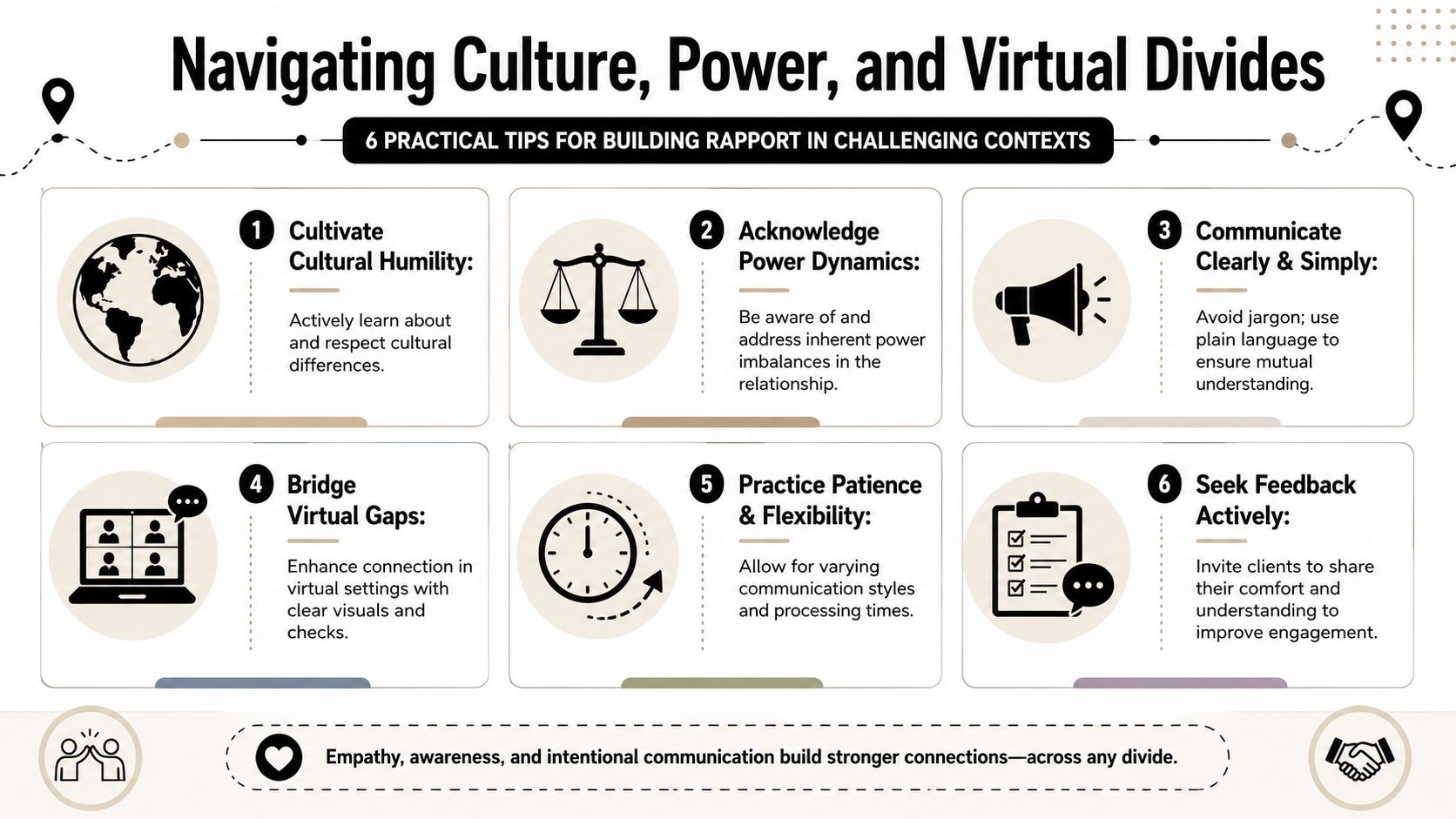
Even excellent listening skills won't carry the interview if you ignore the context around it. Rapport is shaped by three forces that often work against trust in immigration practice: cultural difference, institutional power, and communication medium.
Power is in the room even when you don't name it
You may intend collaboration. The client may still experience you as someone with authority over access, safety, and outcomes. That perception affects eye contact, agreement, disclosure, and hesitation.
Attorneys can reduce the pressure by making the structure explicit:
- State role boundaries clearly: Explain what you can do, what you can't do, and what decisions belong to USCIS or the court.
- Normalize uncertainty: Let clients know that imperfect memory is common under stress.
- Invite correction: Ask the client to tell you if you've misunderstood or if an interpreter got something wrong.
- Explain why questions are repeated: Repetition often feels accusatory unless you frame the legal reason.
Cultural humility is more useful than cultural guessing
Don't confuse cultural competence with a mental catalog of group traits. In practice, rapport improves when you stay curious about the client's own meanings. How do they describe distress. What counts as respectful speech. What topics are private. What pace feels appropriate. What forms of acknowledgment feel credible.
That matters especially when a client presents in ways Western professionals may misread. A client may seem detached, deferential, indirect, or reluctant to discuss family matters in front of an interpreter. Those behaviors can reflect culture, trauma, fear, or all three.
For clinicians and attorneys who handle these dynamics regularly, this overview of cross-cultural assessment is a useful companion to day-to-day interviewing practice.
Cultural humility means letting the client teach you how trust is expressed, not assuming you already know.
Virtual and written communication need different tools
A frequent blind spot in building rapport with clients is assuming that face-to-face techniques transfer neatly to email, text, telehealth, or phone. They don't. A qualitative study on written crisis services found that rapport in text-based exchanges is built through different behaviors rather than nonverbal mirroring, a gap that matters in remote-first services, as summarized in this discussion of rapport in constrained communication settings.
In remote immigration work, that means you should rely less on body-language theory and more on deliberate verbal structure.
For virtual sessions:
- Narrate the process: "I'm taking notes, so if I look away that's why."
- Check contact quality: "Can you hear me clearly, and are you somewhere private enough to continue?"
- Use explicit empathy: Warmth must be spoken more clearly when nonverbal cues are limited.
- Shorten complex questions: Audio delays and interpretation make layered questions fail quickly.
For written communication:
| Common mistake | Better alternative |
|---|---|
| Sending dense legal paragraphs | Break information into short, plain-language chunks |
| Assuming silence means agreement | Ask for confirmation of understanding |
| Writing with generic reassurance | Acknowledge the client's specific concern directly |
| Overusing templates | Personalize enough to show attention and continuity |
What often fails across all three contexts
Some techniques look good on paper and fail in practice.
- Heavy mirroring: It can read as imitation.
- Forced common ground: It may sound trivializing.
- Too much self-disclosure: It shifts attention away from the client.
- Jargon used as efficiency: It usually increases distance, not speed.
The more strained the context, the more you should return to plain language, pacing, consent, and clarity.
Maintaining Boundaries and Concluding with Clarity
A good ending protects the work you've done. Without a deliberate close, even a strong interview can leave the client dysregulated, confused about next steps, or overly dependent on ad hoc contact. Clear boundaries don't weaken rapport. They make it reliable.
Why boundaries create safety
Clients with trauma histories often test for consistency, not because they're difficult, but because inconsistency has been dangerous in the past. If your availability, role, and follow-up process are vague, the relationship becomes harder to trust.
That means you should be direct about:
- What happens next
- How future contact works
- What you can and can't provide
- When the client should seek emergency help elsewhere
- What material will be documented and how it may be used
A firm closing can still feel humane:
"We've covered difficult material today. Before we stop, I want to summarize what I heard, note what still needs clarification, and make sure you know the next step. If questions come up later, here's the best way to contact the office."
Close the conversation before you end the appointment
Don't end immediately after the most painful disclosure. Shift gears intentionally.
A structured closing often includes:
- A brief recap: Reflect the main points without reopening the whole account.
- A containment statement: Name that difficult material was discussed and that the meeting is ending.
- A next-step explanation: Say what documents, follow-up, or scheduling will happen next.
- A final check: Ask whether the client has one concern that needs clarification before leaving.
Documentation is part of rapport, too
Ethical rapport-building should strengthen the record, not blur it. In notes or evaluations, document observed engagement carefully. Record affect, pacing, fragmentation, hesitation, orientation, and response style in clinically relevant language. Don't pathologize normal distress. Don't convert every pause into a symptom. And don't let sympathy dilute precision.
The same discipline applies to your own limits. If you do this work often, monitor the strain it puts on you. Unrecognized exhaustion shortens patience, flattens empathy, and tempts professionals into either emotional withdrawal or overinvolvement. Both harm judgment. This review of vicarious trauma symptoms is worth revisiting if your team handles repeated exposure to traumatic material.
The strongest rapport is not intense. It is steady, clear, and repeatable. That is what vulnerable clients can trust, and that is what high-stakes legal work requires.
When an immigration case depends on careful trauma documentation, the quality of the interview matters as much as the quality of the report. Pro Psychological Analysis partners with attorneys to provide evidence-based immigration evaluations that are clinically rigorous, legally useful, and respectful of client dignity. If your firm needs psychological assessments for asylum, T visa, U visa, VAWA, or extreme hardship matters, PPA offers confidential, nationwide support designed for the demands of immigration practice.