
You're often handed the case at the hardest point. The declaration is drafted. The legal theory is sound. Then the client sits for a psychological evaluation and something doesn't line up cleanly on paper. Their account describes severe trauma, but their affect is flat. They minimize abuse that would alarm any U.S. clinician. They describe family duty, shame, fear of authorities, or spiritual experiences in ways that a standard report can easily misread.
In immigration work, that gap can become a credibility problem if the evaluator treats cultural difference as inconsistency, evasion, exaggeration, or lack of impairment. It can also become an opportunity. A properly framed cross cultural assessment helps the factfinder understand whether the presentation reflects psychopathology, cultural style, trauma adaptation, acculturation stress, or some combination of all four. That distinction matters in asylum, VAWA, U visa, T visa, and extreme hardship cases.
A good report doesn't just say the client has symptoms. It explains why the symptoms appear the way they do, why certain test results should be interpreted cautiously, and why the presentation still supports the legal theory despite seeming unusual through a Western clinical lens.
Table of Contents
- The Critical Moment for a Cross-Cultural Assessment
- Defining Cross-Cultural Assessment Beyond Translation
- Evidence-Based Methods for Valid Assessments
- A Practical Workflow for Immigration Evaluations
- Navigating Ethical and Forensic Considerations
- Reporting That Meets USCIS and Court Standards
- Conclusion The Strategic Value of Cultural Competence
The Critical Moment for a Cross-Cultural Assessment
The warning signs usually appear before the report is written. Counsel notices that the client answers respectfully but briefly. The client avoids eye contact, agrees too quickly, or describes coercive control as normal marital behavior. A standard evaluator may read that as guardedness or poor insight. In many cases, it's neither.

In immigration cases, I watch for a specific mismatch. The narrative may indicate profound trauma, but the demeanor appears controlled, detached, or even emotionally muted. Courts and adjudicators can misread that if the evaluator doesn't explain that some clients are socialized to suppress distress, protect family honor, defer to authority, or avoid discussing private abuse with strangers.
The legal risk hidden in a clinical mismatch
A cross cultural assessment becomes critical when the presentation could be mistaken for unreliability. That happens when:
- Trauma looks unfamiliar: A client reports nightmares, fear, and social withdrawal, but not in the emotional language expected by a U.S. clinician.
- Obligation masks coercion: Family pressure, debt bondage, patriarchal control, or community surveillance gets described as duty rather than abuse.
- Silence gets overinterpreted: Shame, interpreter dynamics, or fear of institutions can reduce disclosure without undermining the core history.
Practical rule: If the client's behavior seems inconsistent with the story, ask whether culture and context explain the presentation before anyone questions credibility.
There's also a systems issue behind this. A CDC National Health Statistics report on culturally and linguistically appropriate care found that 78.4% of non-Hispanic White adults said they could always or most of the time see a provider who shared their culture, compared with 59.1% of Hispanic adults and 59.6% of non-Hispanic Black adults. In practice, many immigration clients are assessed by professionals who don't share their cultural frame. That makes interpretation, not just interviewing, the central problem.
What stronger cases do differently
The stronger record starts earlier. Counsel flags cultural issues before the evaluation, not after a weak draft arrives. The evaluator then treats culture as part of the forensic method, not as a soft disclaimer at the end.
That changes the final opinion. Instead of saying the client was “guarded” or “inconsistent,” the report explains how trauma, migration history, language, authority dynamics, and cultural norms shaped disclosure. USCIS and the court then receive a document that clarifies the record rather than adding another layer of ambiguity.
Defining Cross-Cultural Assessment Beyond Translation
Many attorneys hear “cross cultural assessment” and think of language accommodation. That's too narrow. Translation helps the client understand the words. It doesn't prove the instrument measures the same psychological trait in the same way.
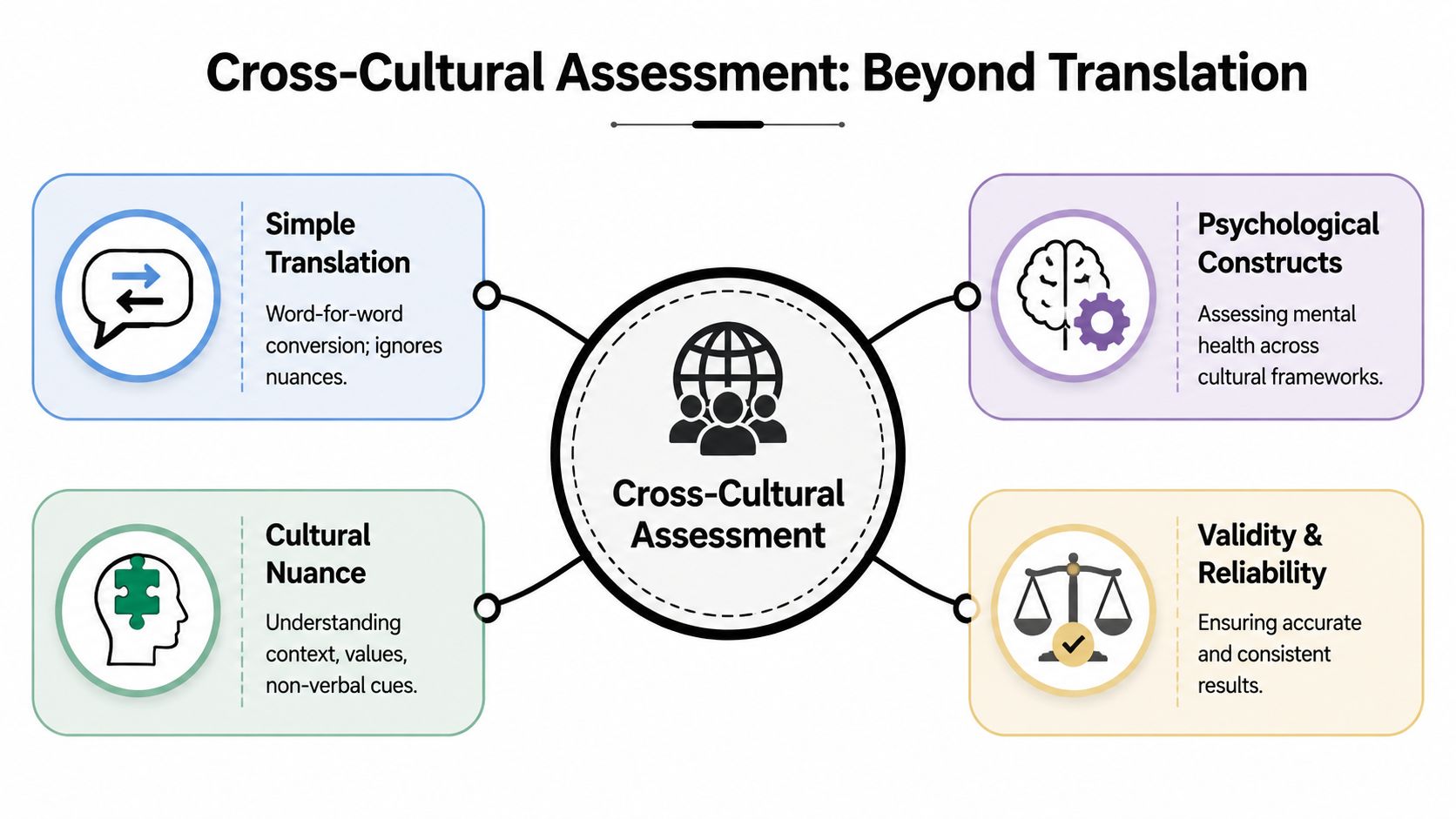
A better analogy is a thermometer at a different altitude. If the instrument hasn't been recalibrated for the new environment, the reading may look precise while still being wrong. Cross cultural assessment asks whether the test, interview, symptom labels, and scoring logic still work when the client's language, values, explanatory models, and social context differ from the population for which the measure was built.
What translation fixes and what it does not
Translation can solve obvious comprehension problems. It can't solve deeper validity problems on its own. A client may understand every item and still interpret the concept differently.
For example, a question about guilt, autonomy, suspiciousness, or family dependence may carry a very different meaning in collectivist, conflict-affected, or heavily surveilled settings. That's one reason APA guidance treats this as an ethical and psychometric issue, not just a language issue. In APA Division 5 guidance on culturally fair tests, the profession's shift toward cross-cultural assessment is tied to demographic reality. The guidance notes a Census Bureau projection that racial and ethnic minorities were expected to become the U.S. majority by 2050, and it emphasizes the need to examine translation, metric, conceptual, and functional equivalence.
A lawyer handling immigration matters sees this in a practical way. If the instrument isn't equivalent across groups, the score may reflect mismatch rather than psychopathology.
Later in the case, this often overlaps with acculturation pressure, role conflict, and identity disruption. For a concise discussion of that dynamic, see this overview of acculturation stress.
A short explainer may help:
The four kinds of equivalence that matter
For immigration attorneys, these are the terms worth understanding:
| Type of equivalence | What it asks | Why it matters in a case |
|---|---|---|
| Translation equivalence | Were the words rendered accurately? | Prevents obvious language distortion |
| Metric equivalence | Does the scale function similarly across groups? | Protects against misleading score comparisons |
| Conceptual equivalence | Does the construct mean the same thing across cultures? | Prevents mislabeling normal cultural patterns as symptoms |
| Functional equivalence | Does the behavior serve the same role in context? | Helps distinguish adaptation from disorder |
A valid cross cultural assessment doesn't ask only, “Can the client answer this?” It asks, “Does this answer mean the same thing in this cultural context?”
That distinction is what makes a report defensible. Without it, a clinician can produce a polished document that still rests on a faulty premise.
Evidence-Based Methods for Valid Assessments
When an evaluator says an assessment was culturally informed, I want to know what actions they took. General sensitivity isn't enough. A defensible method leaves a visible trail.
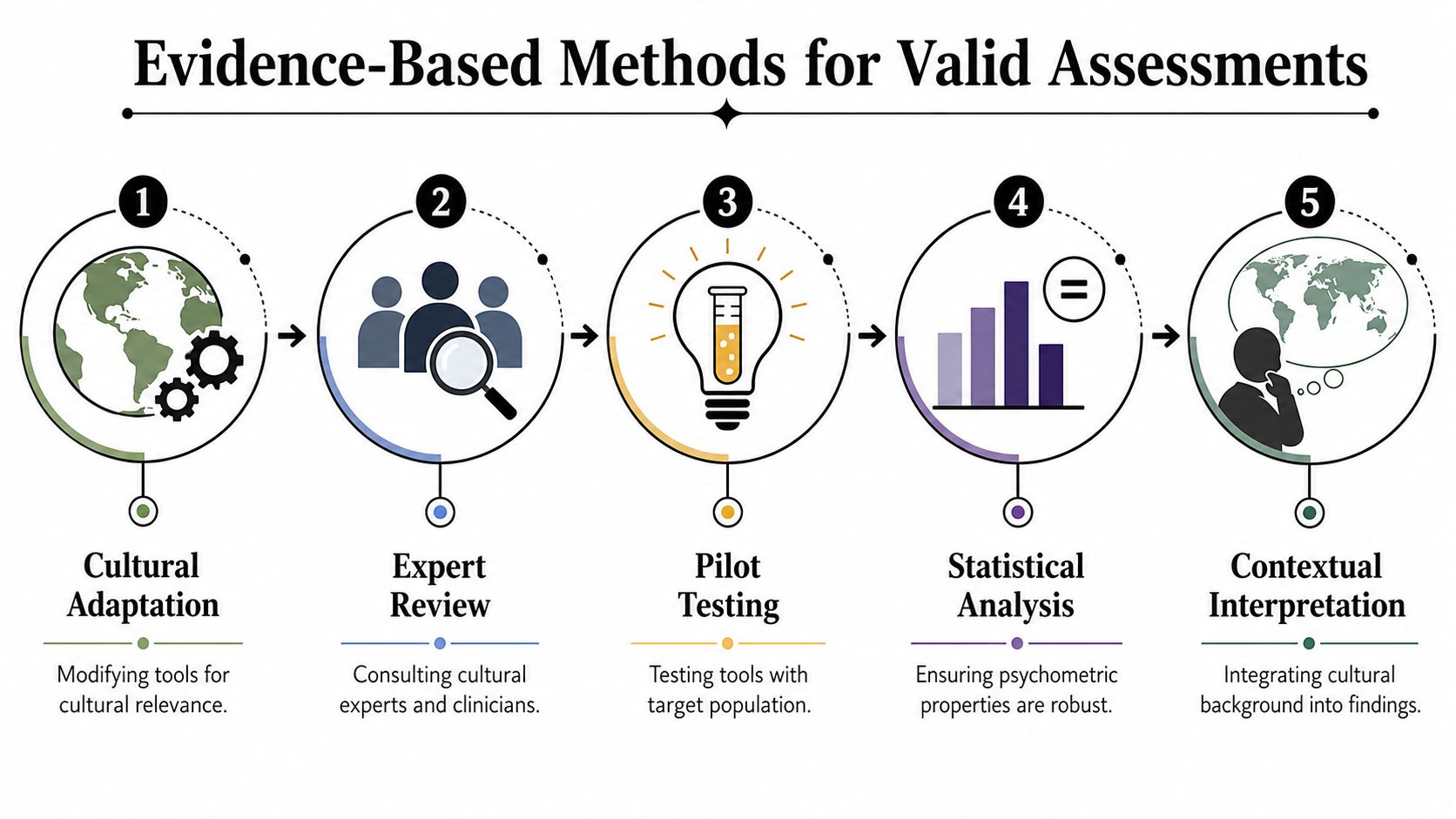
The validation sequence attorneys should ask about
The strongest framework comes from cross-cultural validation research. A review of cross-cultural adaptation and validation methods describes a three-phase workflow: linguistic translation with checks for conceptual and operational equivalence, empirical validation of the adapted form, and possible score adjustment for the target culture. The same review identifies back-translation, dual-panel review, cognitive interviewing, and multi-group confirmatory factor analysis as best-practice methods.
For lawyers, those terms matter because they separate a careful evaluation from a vulnerable one.
Back-translation
One professional translates the material into the target language. A different professional translates it back into the original language. The point isn't literary perfection. The point is catching drift in meaning.
Dual-panel review
This brings in bilingual experts and people familiar with the target population. They can identify wording that is technically correct but culturally off, vague, or misleading.
Cognitive interviewing
The evaluator asks people from the target group how they understood the item. That exposes hidden misunderstandings that ordinary translation misses.
Multi-group confirmatory factor analysis
This is the psychometric check on whether the instrument is measuring the same latent trait across groups. Attorneys don't need to run the analysis. They do need to know whether the evaluator relied on a measure that has this kind of support or presumed it applies.
For a related discussion of interview structure and why standardized process still matters, see what a structured interview is.
Questions that expose weak methodology
Ask your evaluator questions that force specificity:
- Which instrument was used: Was it designed, adapted, or validated for the client's language and cultural context?
- How was language handled: Direct administration, certified interpreter, translated form, or mixed method?
- What cultural checks were used: Did the evaluator examine conceptual fit or just word-level translation?
- How were results interpreted: Were scores treated cautiously, qualified, or adjusted in light of the target culture?
If an evaluator cannot explain why a tool is appropriate for this client population, the report is easier to attack than most attorneys realize.
A practical distinction matters here. In forensic immigration work, not every case requires a long battery of instruments. But every case does require methodological reasoning. Sometimes the sound decision is to rely more heavily on culturally informed interviewing, collateral records, and limited testing with explicit caveats, rather than using a larger set of tools that create false precision.
A Practical Workflow for Immigration Evaluations
A strong cross cultural assessment starts before the client meets the psychologist. Most weak reports can be traced back to a vague referral, incomplete legal context, or no advance discussion of culture and language.
What counsel should send before the evaluation
The referral packet should do more than request an “immigration psych eval.” It should identify the psycho-legal question. Is the report meant to document trauma sequelae, explain delayed disclosure, support hardship, contextualize victim behavior, or address functional impairment?
Counsel should also provide the evaluator with the client's preferred language, country or region of origin, migration history, key family structure, known trauma exposures, and any anticipated cultural issues. That doesn't mean coaching the clinician. It means giving the clinician enough context to choose the right tools and frame the interview properly.
A useful referral memo often includes:
- Case theory: The legal benefit sought and the specific elements the report should illuminate.
- Disclosure concerns: Prior omissions, inconsistencies, memory fragmentation, or shame-based minimization that may require careful interpretation.
- Language logistics: Dialect, literacy concerns, interpreter needs, and whether written questionnaires are realistic.
- Collateral roadmap: Medical records, affidavits, police documents, school records, shelter records, or country conditions that may help contextualize symptoms.
How the interview and testing phase should unfold
The interview should begin with informed consent in language the client understands. In immigration cases, clients often assume the evaluator is aligned with the government, the court, or law enforcement. That misunderstanding can reduce disclosure immediately.
Then the clinician needs to map the client's framework for distress. What does the client call the problem? How do they explain suffering? Which symptoms are spoken about directly, and which are expressed through the body, relationships, religion, fear, or work functioning?
This stage usually works better when the evaluator avoids a rigid Western symptom script at the outset. Start broad. Ask for the story in the client's own terms. Then narrow into diagnostic and forensic questions.
A sound workflow often looks like this:
Referral clarification
Counsel and evaluator agree on the legal issues and likely cultural variables.Pre-evaluation planning
The evaluator decides whether to use direct language administration, an interpreter, translated materials, or primarily interview-based methods.Clinical interview with cultural framing
The evaluator explores trauma, family structure, authority relationships, migration stress, stigma, and culturally shaped coping.Testing, if justified
Instruments are selected carefully, limited where necessary, and interpreted with restraint.Collateral integration
The evaluator compares interview data to declarations, records, and third-party information without assuming every discrepancy equals deception.
In this setting, more testing isn't always better. Better reasoning is better.
One option attorneys use for this kind of work is Pro Psychological Analysis, which provides psychological immigration evaluations and court-oriented reports for matters such as asylum, VAWA, T visa, U visa, and extreme hardship cases.
How interpretation becomes legal evidence
The final interpretive step is where many reports fail. The clinician shouldn't stop at listing symptoms and diagnoses. The clinician should explain how culture shaped symptom expression, disclosure timing, relational behavior, and apparent inconsistencies.
If a client stayed with an abusive spouse, the report should address whether dependency, family obligation, immigration vulnerability, or collectivist norms affected that decision. If the client gave fragmented testimony, the report should discuss trauma effects and any cultural barriers to discussing sexual violence, political persecution, or trafficking exploitation.
That's how a clinical opinion becomes useful legal evidence rather than background material.
Navigating Ethical and Forensic Considerations
A culturally sensitive clinician can still produce a weak forensic opinion. Good intentions don't cure technical problems.
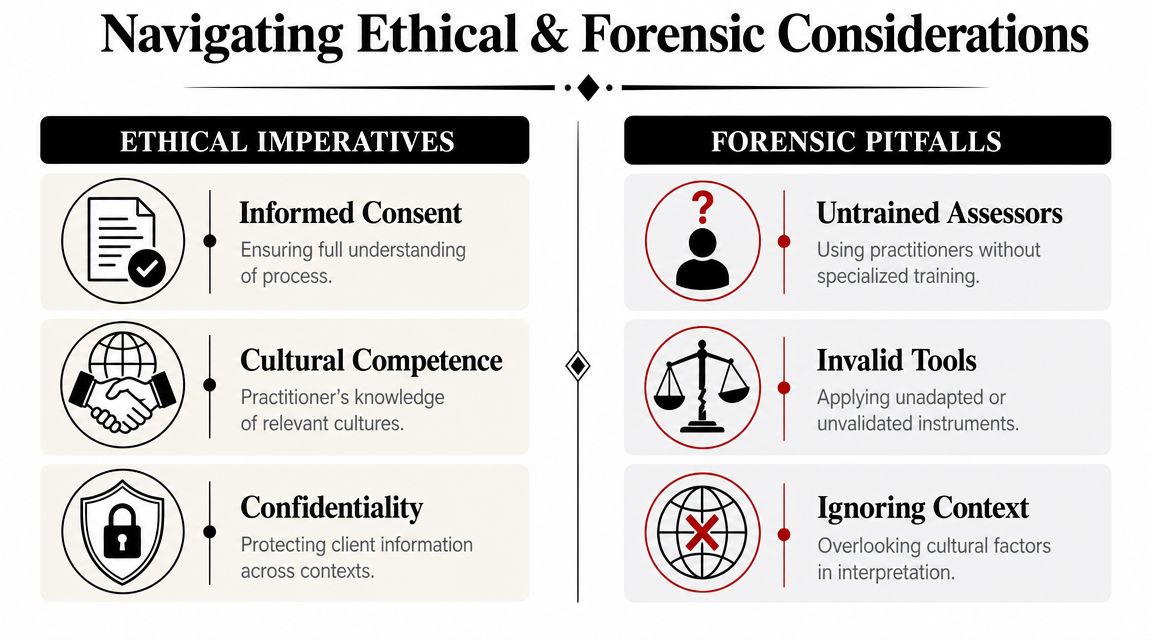
Why cultural sensitivity alone is not enough
The core forensic problem is norm mismatch. Standardized tests are not culturally neutral. SAGE guidance on cross-cultural testing.pdf) states that culturally and linguistically different individuals tend to score lower in proportion to the degree of difference from the population on which the test was normed. It also emphasizes documenting acculturation level, exposure to testing situations, culture-specific response style, and task familiarity, because each can depress scores apart from the trait being measured.
That point has direct courtroom consequences. If a test score is lowered by language difference, unfamiliar format, or acculturation gap, the evaluator may overstate cognitive problems, understate resilience, or misclassify the severity of symptoms.
A careful report should therefore identify at least three things:
- Normative limitations: Whether the measure was normed on people meaningfully similar to the client.
- Administration constraints: Interpreter use, literacy, privacy, fatigue, and test familiarity.
- Interpretive caution: Whether any score should be treated as descriptive rather than strictly comparative.
For attorneys reviewing draft reports, a lot of hidden weakness often lies. A polished diagnostic summary may conceal a shaky psychometric base.
For adjacent practice guidance, this overview of trauma-informed care assessment is useful because trauma process and cultural process often interact in the same interview.
Telehealth and language access problems that distort findings
Remote evaluations create another layer of risk. In immigration practice, telehealth often improves access. It can also distort the assessment.
When the client is in a crowded home, using a borrowed phone, struggling with bandwidth, or relying on imperfect language mediation, the evaluator may be measuring privacy limitations, connection lag, and digital exclusion instead of psychological functioning. In cross cultural assessment, those aren't side issues. They affect attention, disclosure, emotional expression, and test performance.
A few recurrent telehealth problems deserve explicit discussion:
| Risk area | How it shows up | Why it matters |
|---|---|---|
| Connectivity | Delays, freezes, dropped calls | Can look like cognitive slowing or disengagement |
| Privacy | Family nearby, unsafe home, shared room | Can suppress disclosure about abuse or trafficking |
| Device quality | Small screens, audio problems, unstable platform | Interferes with rapport and task comprehension |
| Language mediation | Remote interpreter lag or dialect mismatch | Alters timing, nuance, and emotional content |
Remote access can expand services and still reduce validity in individual cases. Both things can be true at once.
Ethically, the evaluator should say so. In forensic work, silence about these limitations is more damaging than cautious disclosure.
Reporting That Meets USCIS and Court Standards
The report has to do two jobs at once. It has to satisfy clinical standards and function as evidence. Many reports accomplish the first and miss the second.
A recurring problem in the literature is the gap between broad support for culturally responsive practice and the lack of operational standards for high-stakes adjudication. A Frontiers review on culturally responsive assessment notes that practice still struggles to translate cultural responsiveness into transparent decision-making that can separate cultural difference from symptom severity in settings where the record must withstand scrutiny. That's exactly the problem immigration attorneys face.
What a defensible report needs on the page
A court-ready cross cultural assessment should be explicit, not implied. The reader shouldn't have to guess how culture affected the method.
The strongest reports usually include:
- Referral question and legal relevance: Not just “evaluate mental health,” but the issue the opinion addresses.
- Language and interpretation method: Who interpreted, in what language, and what limitations that created.
- Cultural formulation: The client's background, migration context, family and gender norms, authority expectations, stigma, and relevant community values.
- Method statement: Interviews, collateral sources, records reviewed, and any instruments used, with limitations stated directly.
- Diagnostic reasoning: Why symptoms support or don't support a diagnosis, separate from cultural style alone.
- Forensic explanation: How cultural context clarifies conduct that might otherwise be read as inconsistent, delayed, avoidant, dependent, or implausible.
This isn't decorative detail. It's what makes the opinion harder to impeach.
How to tie cultural facts to legal prongs
The report should connect culture to the legal issue without turning into a country conditions memo. The clinician is not there to argue the law. The clinician is there to explain behavior and symptoms in a way the legal standard can use.
A few examples illustrate the difference:
In asylum cases
If the client disclosed persecution inconsistently, the report should explain whether trauma fragmentation, fear of authority, shame, or culturally shaped avoidance of discussing sexual or political victimization affected recall and narration.
In VAWA cases
If the client remained with the abusive spouse or failed to report violence promptly, the report should address coercive control, immigration dependency, family honor, religious pressure, and cultural expectations around preserving the marriage.
In T and U visa cases
If the client appears detached when describing trafficking, assault, or coercion, the report should explain whether emotional numbing, survival adaptation, or culturally shaped stoicism better accounts for the presentation than lack of harm.
In hardship cases
If a qualifying relative minimizes impairment, the report should discuss whether role expectations, stigma, or familial duty caused underreporting despite meaningful functional burden.
The report should answer the question the adjudicator is already asking: “Why did this person act, speak, delay, or present this way?”
One drafting habit helps enormously. Separate what is clinical finding, what is cultural interpretation, and what is forensic implication. When those three layers are kept distinct, the opinion reads as disciplined rather than advocacy-driven.
Another habit matters just as much. State limits openly. If a measure lacked ideal norms, say so. If interpreter use changed nuance, say so. Candor often strengthens admissibility because it shows the evaluator understands the boundaries of the opinion.
Conclusion The Strategic Value of Cultural Competence
In immigration cases, cross cultural assessment isn't an academic extra. It's part of building a record that survives review. When counsel and evaluator handle culture as a forensic variable, not a courtesy, the report becomes clearer, more accurate, and more defensible.
That helps on both sides of the case. It protects clients from being misunderstood, and it gives attorneys evidence that explains behavior the court might otherwise misread. The strongest immigration reports don't just diagnose distress. They show how culture, trauma, language, and context shape the presentation in ways USCIS and courts can effectively use.
If your firm needs psychological evaluations that are designed for immigration case strategy and written for USCIS and court use, Pro Psychological Analysis provides evidence-based assessments for asylum, VAWA, T visa, U visa, and hardship matters, with attention to methodological clarity, confidentiality, and legally relevant reporting.