
An immigration attorney opens a psychological evaluation the night before filing. The report is clinically solid, but it reads like a different language: scaled scores, validity indicators, norm references, behavioral observations, diagnostic formulations. The client's trauma is real. The impairment is real. The problem is translation.
In practice, cases don't fail because a clinician lacked empathy. They weaken because the report never converts psychological data into a legal argument the adjudicator can use. A table of scores doesn't prove extreme hardship by itself. A diagnosis doesn't automatically establish nexus, credibility support, functional impairment, or future risk. Someone has to connect the dots.
That's where psychometric test results interpretation matters. In immigration work, interpretation isn't an academic exercise. It's the process of turning measurements into evidence that fits a legal standard, survives scrutiny, and helps the decision-maker understand what the client is experiencing in functional, credible, case-relevant terms. If you've ever received a dense evaluation and wondered what, exactly, you should quote in a declaration, brief, or exhibit list, you're in the right place. A strong comprehensive clinical psychological evaluation gives you more than numbers. It gives you a framework for making those numbers matter.
Table of Contents
- Introduction From Clinical Report to Legal Argument
- Decoding the Numbers What Scores and Norms Really Mean
- Assessing Admissibility Reliability and Validity in a Legal Context
- Crucial Context Cultural Linguistic and Trauma-Related Factors
- Synthesizing the Report From Data Points to a Cohesive Narrative
- Common Pitfalls and How to Avoid Them
Introduction From Clinical Report to Legal Argument
Most immigration lawyers have had the same reaction to a long evaluation: “This is useful, but what do I do with page 11?” That page usually contains the score tables. The clinician may understand them immediately. USCIS officers and immigration judges usually won't, unless the report explains what the results mean in plain, case-specific language.
That gap matters most in asylum, VAWA, U visa, T visa, and extreme hardship cases. The legal issue isn't whether a client possesses symptoms. The issue is whether the evaluation ties those symptoms to the claimed trauma, explains how they affect functioning, and supports a conclusion that fits the legal theory of the case. If the report says the client has significant trauma symptoms but never explains how that affects memory, concentration, emotional regulation, parenting, employability, or ability to relocate safely, the data stays trapped inside the report.
What attorneys need from the numbers
A useful evaluation answers practical questions:
- What was measured: Symptoms, personality structure, cognitive functioning, response style, or trauma impact.
- How it was measured: Interview, test administration, record review, and behavioral observations.
- Why it matters legally: Credibility support, hardship severity, trauma sequelae, functional impairment, or risk if returned.
- How confident the clinician is: Whether the instruments used are appropriate and interpretable.
Practical rule: Don't quote a score in a brief unless the report also explains what that score means for the client's day-to-day functioning and for the legal standard at issue.
A defensible report doesn't just announce findings. It translates them. Forensic work in immigration settings requires that translation because adjudicators aren't deciding who has the highest symptom score. They're deciding whether the evidence is persuasive, relevant, and grounded in methods that can be trusted.
Decoding the Numbers What Scores and Norms Really Mean
An attorney cites a symptom score in a hardship brief. The number looks strong on the page. Then the government asks a simple question at hearing: compared to what population, under what scoring system, and with what legal significance? If the report cannot answer those points, the score adds very little.
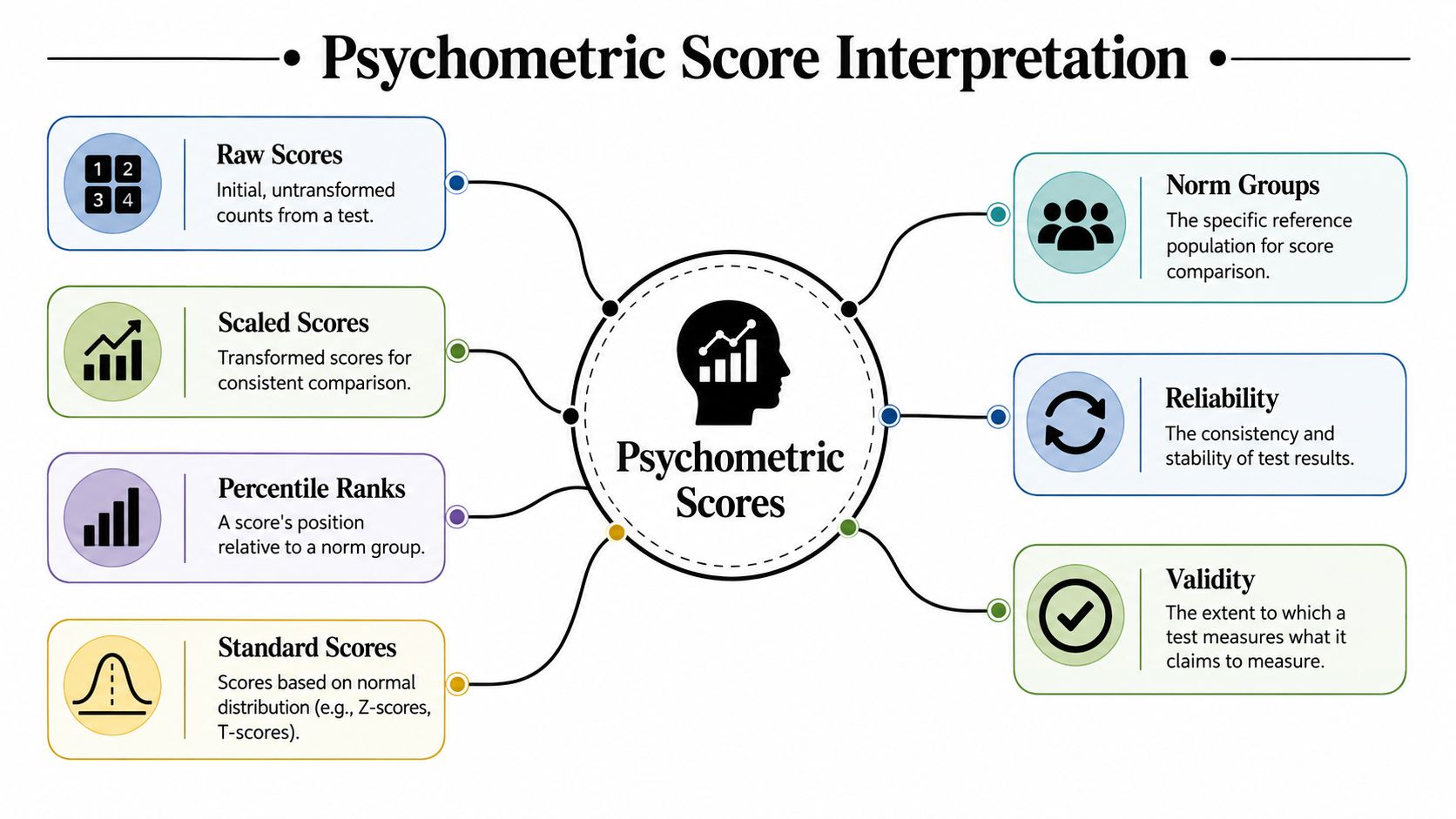
Why raw scores don't help the court
A raw score is only the direct result produced by the instrument. It does not tell USCIS, an IJ, or opposing counsel whether the result reflects ordinary functioning, clinically significant symptoms, or an unusual response pattern.
That is why score interpretation matters more than score reporting. The Psychometric Entrance Test score interpretation guide illustrates the point clearly. A score only becomes interpretable after it is converted through a standardized framework. In that guide, a score of 5 on a 1 to 10 scale reflects performance typical of the reference population. It does not mean the examinee got five items correct. The same interpretive logic applies in clinical immigration work. A depression scale, trauma inventory, or personality measure has little forensic value until the evaluator explains where the client falls relative to the relevant reference group.
For legal use, I look for one sentence in the report that does real work: what this score means for this person, in this case.
The norm group is the comparison point
The norm group is the population used to give the score meaning. If that comparison group is poorly matched, the interpretation weakens fast.
The scoring guide above uses standardized ranges to show how this works. General psychometric scores run from 200 to 800. A score of 538 falls in the 525 to 549 band, with about 47% of examinees scoring lower than that range. Domain scores run from 50 to 150. Those figures matter because the test publisher established a scoring structure and a reference population before anyone tried to interpret an individual result. Without that structure, the numbers are just numbers.
Immigration evaluations raise a harder question. The issue is not only whether the client scored high, low, or average. The issue is whether the comparison group fits the client's language, education, cultural background, and trauma history closely enough to support a defensible inference in a legal proceeding. That is where many reports become vulnerable.
A report should identify at least three things:
- The scoring system used: raw, standard, T, percentile, or another converted score
- The reference population: who the client was compared against
- The forensic meaning: how that score supports or limits an opinion tied to hardship, trauma sequelae, credibility, parenting capacity, or risk on return
This is also why attorneys should understand the validity of assessment tools in forensic evaluations before relying on a chart of scores in a declaration or brief.
In practice, general population norms may be acceptable for broad symptom screening. They are often less persuasive when the case turns on culturally mediated symptom expression, second-language testing, or trauma-related effects on concentration and memory. A translated instrument can still be a poor fit. A statistically ordinary score can still support a strong legal argument if the clinician explains the client's functional impairment, testing conditions, and limitations of the comparison group with precision.
When a report gives the scoring method, the norm reference, and the legal significance in plain language, the numbers stop looking like isolated clinical jargon and start functioning as evidence.
Assessing Admissibility Reliability and Validity in a Legal Context
A well-written immigration evaluation can still fail if the testing method is weak. USCIS officers, DHS counsel, and immigration judges may not debate psychometric theory in detail, but they do look for a basic question: should this measure be trusted for the opinion the clinician is offering?
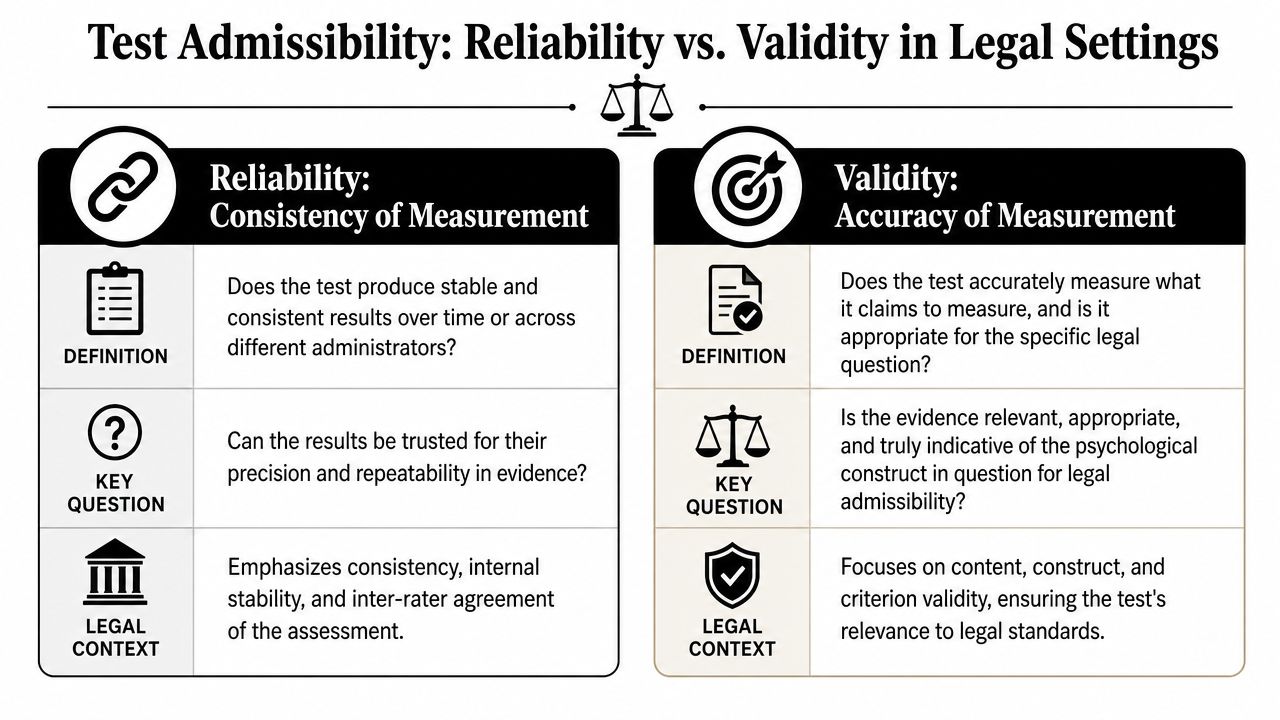
Reliability asks whether the measurement holds
Reliability concerns consistency. If a test produces unstable results across items or across time, the legal argument built on that score is easier to attack.
For immigration cases, that point is practical, not academic. If a hardship opinion, trauma formulation, or functional impairment finding depends heavily on test data, counsel should be able to show that the instrument has acceptable psychometric support and was administered under conditions that did not undermine the result. The NCBI guidance on psychometric properties and normative data outlines commonly cited adequacy thresholds, including internal consistency coefficients at or above 0.60 and test-retest benchmarks such as ICC above 0.4 or Pearson correlation above 0.3.
I tell attorneys to ask four questions before they rely on a score in a declaration or brief:
- Is the instrument established enough to support a forensic opinion, not just a treatment impression?
- Did the evaluator explain why this measure fit the referral question?
- Does the report identify reliability support for the instrument, or at least cite a defensible basis for using it?
- Were there administration problems, such as interruption, fatigue, interpretation issues, or acute distress, that could have reduced consistency?
If those answers are missing, opposing counsel can characterize the report as clinically plausible but methodologically underdeveloped. That distinction matters in contested cases.
Validity asks whether the test supports the legal issue being litigated
Validity is the harder question in immigration work. A test may measure depression, PTSD symptoms, cognitive inefficiency, or personality traits accurately enough, yet still add little to the case if the evaluator does not connect the result to the governing legal standard.
That is the difference between a clinically adequate report and a legally useful one. A persuasive discussion of assessment tool validity in forensic practice should lead to a case-specific explanation: why this instrument helps answer the question before the court. In immigration proceedings, that may mean linking symptom patterns to past persecution, explaining how psychiatric impairment bears on extreme hardship, or showing why trauma-related avoidance and memory fragmentation are consistent with delayed disclosure.
A report becomes vulnerable when testing appears ornamental. Listing instruments without explaining their relevance does not help. Summarizing heightened scales without tying them to functional limits, risk on return, parenting capacity, or credibility-related trauma effects does not help either.
Three problems appear often in weak filings:
- The report names the tests but gives no reason for selecting them.
- The interpretation stays at the diagnostic level and never reaches the legal issue.
- The evaluator ignores validity limits that should have been addressed on the face of the record.
The strongest reports do something more disciplined. They state what the test can support, what it cannot support, and why the remaining opinion still assists the factfinder. That kind of precision improves admissibility arguments and makes the clinical data harder to dismiss as advocacy dressed up as science.
Crucial Context Cultural Linguistic and Trauma-Related Factors
A client may present with high symptom scores, a flat affect, and fragmented recall. In immigration court, those findings can support hardship, fear, or trauma exposure. They can also be attacked if the report ignores language, culture, detention history, or the conditions under which the testing occurred. Interpretation starts there.

Culture and language affect performance before interpretation begins
Test performance is shaped before any score is calculated. A client may understand the wording of an item and still attach a different meaning to authority, danger, family duty, shame, or emotional disclosure than the test assumes. In practice, that affects endorsement patterns, response style, and willingness to report symptoms that could carry stigma.
For immigration evaluations, I look for five threshold issues early: language dominance, interpreter involvement, literacy, acculturation, and whether the instrument has been used appropriately with a similar population. A legally useful discussion of cross-cultural assessment in immigration evaluations treats those issues as part of the measurement analysis, not as background biography.
Several interpretation errors recur in weak reports:
- Literal reading of translated items: The response may track the phrasing of the translation rather than the construct the item was designed to measure.
- Mistaking guardedness for deception: Clients with persecution histories, detention exposure, or chronic fear often answer cautiously for self-protective reasons.
- Using generic U.S. norms without explanation: Courts do not need perfect norms in every case, but they do need the evaluator to explain the limitation and its likely effect.
- Confusing culturally patterned behavior with psychopathology: Reserved affect, indirect communication, and strong family deference may be normative rather than symptomatic.
These are not technical footnotes. They often determine whether a score strengthens the affidavit or gives opposing counsel an easy cross-examination point.
Trauma can shift test presentation over time
A single testing session captures a person under specific conditions. For immigrant clients, those conditions may include recent detention, unstable housing, family separation, medication changes, ongoing threats from abroad, or the strain of preparing testimony. Any of those factors can affect concentration, symptom reporting, recall, and physiological arousal during the exam.
The Clevry discussion of score variability over time is directionally consistent with what clinicians see in practice. Some individuals show meaningful variation across repeated testing, especially on symptoms tied to anxiety, stress tolerance, and current safety. In immigration work, the key question is how the evaluator addressed that possibility in the report.
A short explanation of that issue can help:
The better approach is dynamic interpretation. The clinician should state whether the profile appears to reflect longstanding trauma-related impairment, acute destabilization, partial remission, or symptom escalation under present threat. That framing gives USCIS officers, immigration judges, and trial attorneys something they can use. It ties the numbers to timing, function, and legal relevance.
Consistency still matters. Absolute uniformity does not. A defensible report explains why variation may occur, identifies which findings remained stable across interview, records, and testing, and states the limits of the opinion with precision.
Synthesizing the Report From Data Points to a Cohesive Narrative
The strongest immigration evaluations are never built on one instrument. They are built on convergence. A score matters more when it matches what the client reported, what the clinician observed, and what the records already show.
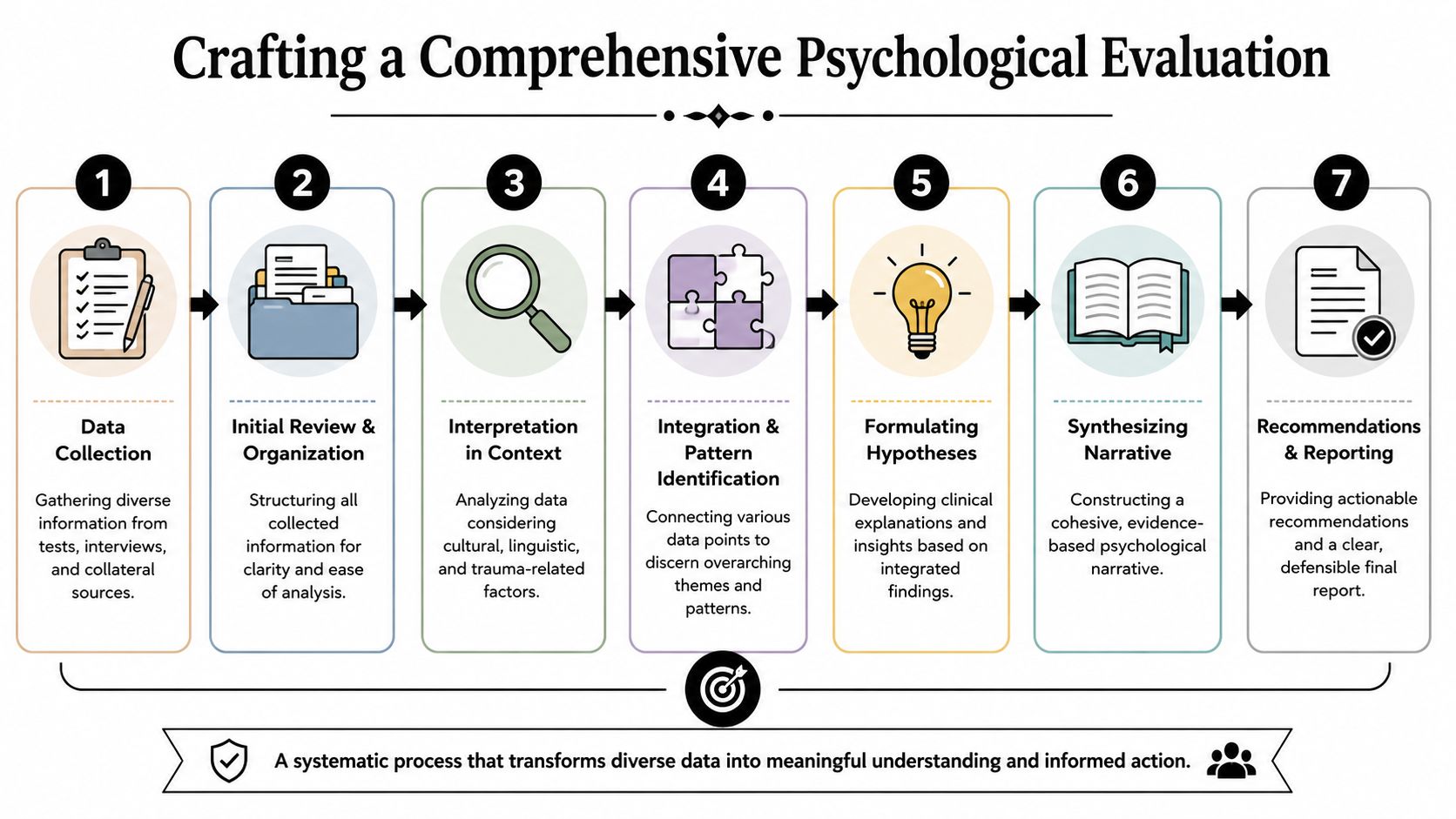
What a defensible synthesis looks like
A clinician may administer trauma and symptom measures, conduct a clinical interview, review declarations or medical records, and note behavior during the exam. None of those data streams should stand alone.
A defensible synthesis sounds more like this: the client described repeated threats, forced isolation, sleep disturbance, and panic symptoms; during the interview the client appeared hypervigilant and struggled to recount events in sequence; testing showed a symptom pattern consistent with trauma-related distress; collateral records documented related complaints over time. The opinion then links those findings to functioning. The client avoids leaving home alone, cannot concentrate reliably, startles easily, and experiences worsening distress when discussing return to the country of feared harm.
That structure matters because adjudicators often look for the “why should I trust this?” answer. Synthesis provides it.
How attorneys should read for the golden thread
When you review a psychological report, don't start with the diagnosis. Start with the chain of reasoning. You're looking for the thread that runs from source data to conclusion.
Read in this order:
Referral question
What legal issue was the clinician asked to address?Data sources
Did the clinician rely on interview only, or also on records, observations, and testing?Consistency across sources
Do the records, interview narrative, behavior, and psychometrics point in the same direction?Functional consequences
How do the symptoms affect daily life, relationships, work, parenting, or safety?Forensic conclusion
Does the clinician tie the findings to the relevant immigration standard?
A report becomes persuasive when each step supports the next. It becomes vulnerable when there is a jump. For example, if the test data suggests distress but the report leaps to broad legal conclusions without explaining functional impairment, the government has room to argue speculation.
Good synthesis doesn't repeat every number. It selects the findings that corroborate each other and support the case theory.
Attorneys can strengthen filings by quoting the integrated conclusions rather than isolated scales. Use the language that links symptom pattern, observed behavior, and legal consequence. That is the portion most likely to help the adjudicator understand why the evaluation deserves weight.
Common Pitfalls and How to Avoid Them
An attorney files a psychological evaluation expecting it to anchor an asylum or hardship case. At the hearing, the government points to one weak inference, one unexplained score, or one missing cultural qualifier and argues the opinion should carry little weight. That is how a technically sound report loses force in immigration practice.
Weak evaluations usually fail at the interpretation stage. The client may present with significant trauma, depression, anxiety, or cognitive disruption. The problem is that the report translates those findings poorly for USCIS or the immigration judge. Once that happens, a clinical document becomes an easy target.
The Xobin discussion of psychometric score interpretation shows a familiar problem. Scores are often read without enough attention to context or the decision they are supposed to inform. In immigration cases, that mistake shows up when a report lists test results but never explains what those results prove about hardship, persecution-related injury, abuse dynamics, or day-to-day functioning.
The mistakes that damage otherwise strong cases
One common error is score worship. A high elevation on one scale can support an opinion, but it cannot carry the whole opinion. If the evaluator treats one score as the answer, the adjudicator can fairly ask where the rest of the forensic reasoning went.
Another error is norm blindness. A score only has meaning in relation to the comparison group, the language of testing, and the conditions under which the test was administered. If the report leaves that unexplained, the interpretation is exposed.
A third problem is construct confusion. Trauma symptoms, personality features, cognitive inefficiency, over-reporting indicators, and mood disturbance are separate constructs. A report that slides from one to another without explanation sounds careless, and careless reports do not hold up well in contested proceedings.
Then there is legal disconnect. I see this often. The clinician may write a solid diagnostic summary, yet never answer the legal question counsel needs answered. A good clinical report is not automatically a useful immigration report.
Before filing, review the evaluation like you would review any expert submission:
- Does the report tie the findings to the specific immigration standard at issue?
- Does it explain the score in context, including norms, language, and testing conditions?
- Does it rely on interview, records, observations, and testing rather than one instrument alone?
- Does it state limitations directly so opposing counsel cannot frame them first?
Common Interpretive Pitfalls and Legal Solutions
| Pitfall | Impact on Legal Case | Solution for the Legal Team |
|---|---|---|
| Overreliance on a single elevated score | Government can argue the opinion is shallow or exaggerated | Ask for integration with interview data, records, and behavioral observations |
| Inappropriate or unexplained norm group | Adjudicator may question whether the score is meaningful for this client | Require the clinician to explain the comparison framework and any limits |
| Treating personality traits as clinical diagnoses | Findings may look overstated or conceptually sloppy | Separate trait description from symptom-based diagnosis and impairment analysis |
| Ignoring trauma-related fluctuation | Opposing counsel may use inconsistent presentation to challenge credibility | Have the report explain why symptom intensity may vary across settings and time |
| No link to legal standard | Useful clinical material may receive little evidentiary weight | Request a concluding section that ties findings to hardship, persecution effects, abuse dynamics, or functional impairment |
| Failure to address language and culture | The test results may appear biased or poorly fitted to the client | Ask the evaluator to document language choice, interpreter use, and cultural considerations |
This is a risk management exercise. Treat the evaluation as expert evidence that must survive scrutiny, not as sympathetic background material. If counsel cannot explain why a score matters, how it was interpreted, and what legal point it supports, the report is not ready.
Strong psychometric test results interpretation does three jobs at once. It explains the score. It states the limits of the score. It places the score inside a factual and legally relevant narrative that an officer or judge can use.
When you need immigration-focused psychological evidence that translates clinical findings into persuasive legal arguments, Pro Psychological Analysis provides thorough evaluations for asylum, VAWA, T visa, U visa, and extreme hardship cases. The practice works with attorneys to produce clear, evidence-based reports that document trauma, functional impairment, and case-specific psychological issues in a format built for USCIS and immigration court review.