
You've probably been in this position. A client has a credible trauma history, the declaration is strong, and the legal theory is sound. Then someone says, “Let's get a psych eval,” as if any clinical report will automatically convert suffering into usable evidence.
It won't.
In immigration practice, the difference between a routine mental health assessment and a detailed clinical psychological evaluation can determine whether the report clarifies the case or merely adds paperwork. A treatment-oriented report may describe symptoms well enough for therapy. A forensically sound evaluation must do something narrower and harder. It must answer a legal question, document methods, explain limits, connect symptoms to functioning, and present opinions in language a judge, officer, or reviewing attorney can use.
Table of Contents
- Why a Standard Psych Eval Fails in Immigration Court
- Anatomy of a Comprehensive Psychological Evaluation
- Ensuring Your Evaluation Is Legally Admissible
- Structuring the Report for Maximum Legal Impact
- Navigating Logistics Timelines and Ethical Duties
- How to Leverage the Evaluation in Your Legal Strategy
- Preparing Your Client and Answering Common Questions
Why a Standard Psych Eval Fails in Immigration Court
The common mistake is simple. Counsel requests a “psych eval” without defining the legal issue the evaluation needs to address. The result is often a decent clinical summary that says very little about the actual burden of proof.
That happens because thorough and forensic are not the same thing. As Meridian University's discussion of comprehensive psychological services notes, a major underserved issue is the difference between routine therapy intake and high-stakes legal evaluation. The same source also makes the key point that such an evaluation does not automatically mean “forensic,” especially in immigration matters such as asylum, VAWA, U, T, and hardship cases.
Treatment documents answer clinical needs
A treating clinician usually writes for continuity of care. The audience is another provider, an insurer, or the patient. The note may focus on symptom relief, diagnosis, medication history, safety concerns, and treatment goals.
That kind of document may be sincere and clinically responsible, but it often leaves out what legal readers need:
- Referral clarity: What exact immigration issue is being evaluated?
- Method transparency: What records were reviewed, what interviews were conducted, and what testing was used?
- Functional analysis: How do symptoms affect memory, concentration, daily living, parenting, work, or testimony?
- Causation language: Is there a clinically reasoned link between reported events and current symptoms?
- Alternative explanations: Were other diagnostic possibilities considered and addressed?
Forensic usefulness depends on discipline
A forensically usable report does not advocate by assertion. It reasons. It shows how the evaluator moved from data to opinion.
Practical rule: If the report could be dropped into any therapy chart without revision, it probably isn't tailored enough for immigration litigation.
Attorneys see this problem when the report contains broad statements such as “client presents with trauma” or “client appears depressed,” but never explains why those findings matter to the legal claim. In asylum matters, the report may fail to analyze how trauma affects disclosure, memory fragmentation, or avoidance. In VAWA cases, it may describe abuse but not the pattern of coercion, fear, and functional harm. In hardship matters, it may list diagnoses yet say little about the actual consequences for the qualifying relative.
The legal question must drive the assessment
A strong immigration evaluation starts with a narrower inquiry than general clinical care. The evaluator should know whether the opinion must illuminate persecution-related trauma, abuse dynamics, crime victimization, trafficking, or hardship-based impairment.
That's why the best request from counsel isn't “please evaluate my client.” It's a focused referral that tells the clinician what the case requires, what records exist, what timeline matters, and what issues are disputed. Once that happens, the evaluation stops being a generic mental health document and becomes evidence.
Anatomy of a Comprehensive Psychological Evaluation
A proper thorough clinical psychological evaluation is built from multiple streams of information, not a single interview and not a single test. ScienceDirect's overview of psychological evaluation describes this approach as integrating clinical interviews, standardized questionnaires, behavioral observation, and record review. The same overview notes that the MCMI-III contains 175 items and assesses 11 clinical personality patterns, which reflects the field's movement toward structured, psychometrically grounded tools.
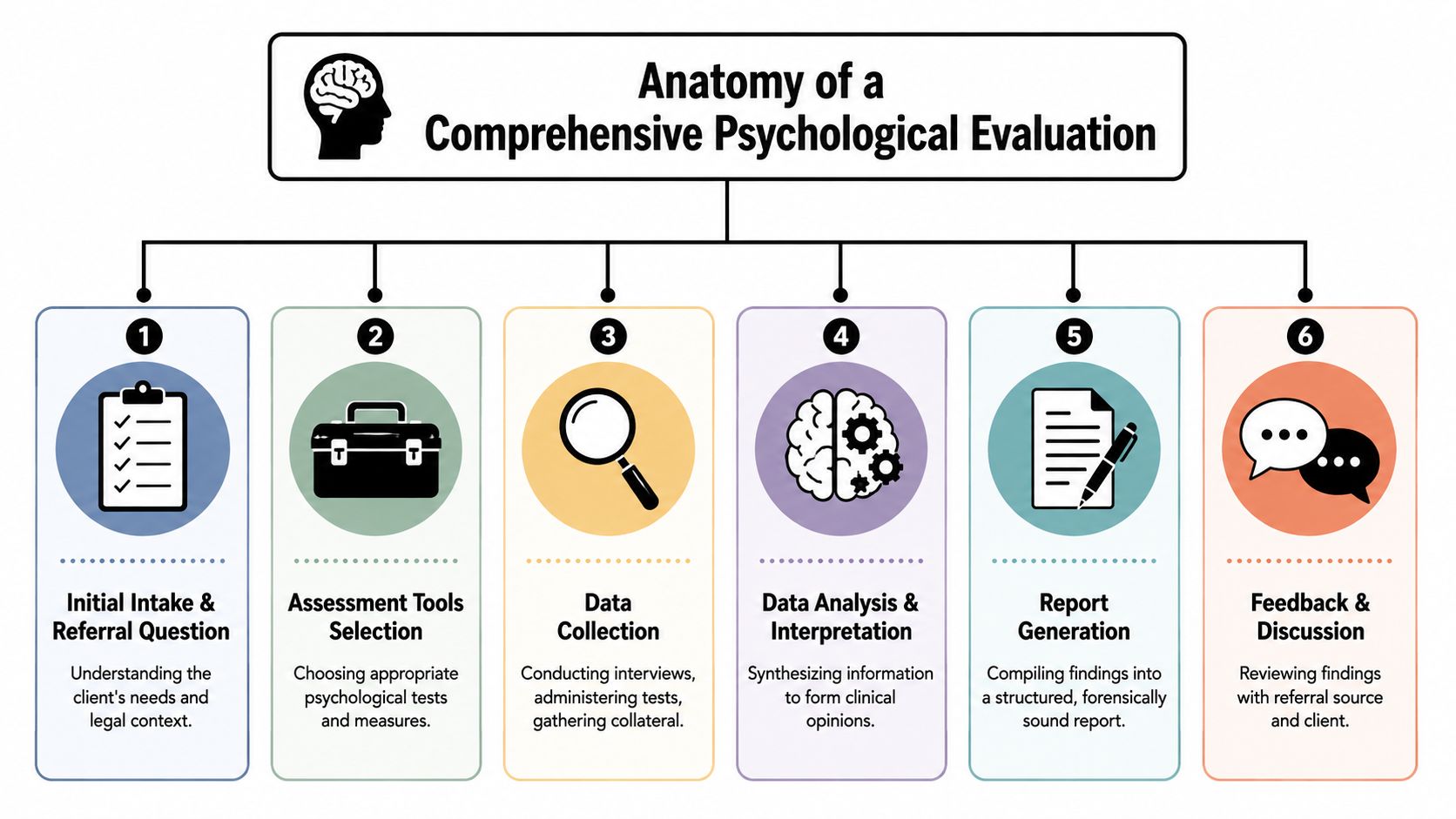
Start with the referral question, not the symptoms list
The first task is conceptual, not diagnostic. The evaluator needs to know what the report is being asked to prove or clarify.
A weak referral says, “Evaluate for trauma.” A useful referral says, in substance, “Assess psychological sequelae of domestic violence, document functional impairment, address consistency of the trauma narrative with known symptom patterns, and provide clinically supported opinions relevant to the pending VAWA matter.”
That difference changes the entire process. It determines what records matter, what themes need exploration, and what opinions belong in the final report.
A structured interview is often the backbone of this phase because it keeps the inquiry disciplined and reduces the chance that essential areas will be skipped. For counsel who want a clearer sense of why that matters, this explanation of a structured interview in psychological assessment is a useful reference.
Build the file from multiple data streams
Once the referral question is clear, the evaluator gathers information from several channels. No single data point should carry the whole opinion.
Typical components include:
- Clinical interview: Chronology, symptom onset, trauma exposure, coping style, and functioning are explored in detail.
- Behavioral observation: The evaluator notes presentation, affect, pace, consistency, distress tolerance, and interaction style.
- Standardized measures: These can help organize symptom data and test clinical hypotheses.
- Record review: Declarations, affidavits, medical records, school records, prior evaluations, police reports, and country-context materials can all matter when available.
- Collateral information: Family members or other collateral sources may clarify functioning and history when appropriate.
What doesn't work is treating a test score as the conclusion. A measure can support or complicate a formulation, but it doesn't replace clinical judgment.
Formulation matters more than test output
The strongest evaluations don't read like a stack of disconnected findings. They synthesize. The clinician explains what the data mean together.
That synthesis usually addresses several questions at once:
| Question | Why it matters in immigration work |
|---|---|
| What symptoms are present? | Diagnosis alone isn't enough, but it provides a clinical foundation. |
| How severe and persistent are they? | Legal readers need a sense of scope and impact. |
| How do they affect functioning? | Impairment often matters more than labels. |
| What is the likely relationship to the claimed events? | Nexus is where clinical work meets legal relevance. |
| What limits exist in the opinion? | A transparent report is more credible than an overclaimed one. |
A clinically careful evaluator doesn't hide ambiguities. They identify them, explain them, and still state opinions where the data support them.
In practice, this means the report should distinguish between observed facts, self-reported history, test findings, record-based information, and professional inferences. It should also explain why certain symptoms are expected in trauma-affected individuals and why delayed disclosure, fragmented memory, or emotional numbing don't automatically undermine credibility.
For attorneys, the key takeaway is operational. If the clinician cannot describe the evaluation process step by step, the report is unlikely to withstand close review. A sound evaluation is not just thorough because it is long. It is thorough because each layer of data serves a defined purpose in the final opinion.
Ensuring Your Evaluation Is Legally Admissible
A report can be clinically thoughtful and still fail as evidence. Legal usefulness depends on whether the evaluator worked in a way that a court or adjudicator can trust.
What adjudicators need to see
A persuasive immigration evaluation usually has four traits.
First, the evaluator's role is clear. The clinician is there to assess, not to function as an advocate disguised as an expert. That difference shows up in tone. Reports that sound like argument briefs tend to lose force.
Second, the methods are identifiable. The reader should know what information the evaluator relied on, how the interview was conducted, whether records were reviewed, and whether testing was used. If an interpreter participated, the report should say so and explain any limits that created.
Third, the reasoning is explicit. The evaluator should connect observed symptoms, reported history, and functional consequences to the legal issue without overstating certainty. In immigration cases, the report often needs to show how trauma, abuse, trafficking, or fear relates to behavior that may otherwise be misunderstood.
Fourth, the report should be culturally and linguistically thoughtful. A symptom pattern can be misread when the evaluator ignores language barriers, cultural idioms of distress, or the client's fear of disclosure.
What weakens a report
The problems tend to be predictable. They usually come from shortcuts.
- Undefined purpose: The report never states what question it is answering.
- Thin methodology: It refers vaguely to an assessment but doesn't describe the basis for conclusions.
- Advocacy language: The evaluator appears to be arguing the case rather than offering professional opinions.
- No alternative analysis: The report ignores differential diagnosis, competing explanations, or evidentiary limits.
- Weak nexus discussion: Symptoms are listed, but the link to the legal claim is left implicit.
A legally stronger report acknowledges what it cannot determine. That doesn't weaken the opinion. It usually makes it more credible.
The court does not need certainty where the discipline cannot provide certainty. It needs a methodical opinion that shows how the clinician reached the conclusion.
The nexus must be stated, not assumed
Many reports fail at the exact point where they should become most useful. They describe trauma and diagnosis, then stop short of explaining why those findings support the legal theory.
A sound nexus discussion does more than repeat the client's narrative. It examines whether the symptom pattern is clinically consistent with the reported experiences, whether the impairment is meaningful, and how those findings bear on issues such as fear, coercion, delayed reporting, or dependency.
For attorneys reviewing a draft, one question usually exposes the problem quickly: Can a legal reader identify the bridge between clinical findings and the required legal showing without guessing? If not, the report needs revision before filing.
Structuring the Report for Maximum Legal Impact
The report is where good clinical work either becomes usable evidence or gets buried in dense prose. Immigration lawyers do not need a document that sounds academic. They need one that is organized, restrained, and easy to cite.

The sections that make the report usable
A strong structure usually includes the following parts.
Referral and scope
Open with the referral source, the purpose of the evaluation, and the legal context in plain terms. This section should also identify the intended use of the report and the limits of the evaluator's role.
Useful language sounds like this: the evaluation was conducted to assess psychological functioning and provide clinically grounded opinions relevant to the pending immigration matter. It should not sound like the evaluator has already adopted the petitioner's legal conclusions.
Informed consent and confidentiality limits
This belongs near the front because it frames the relationship correctly. The client should understand that this is an evaluative setting, not ordinary therapy, and that the report may be shared for legal use.
Methods and sources of information
List what was reviewed and what was done. If the report is based on interview, behavioral observations, testing, and records, say so directly. If records were limited, say that too.
Psychosocial and trauma history
This section should be chronological enough to orient the legal reader, but not padded with every life detail. The focus is relevance. Developmental history, family context, migration history, abuse history, medical background, prior treatment, and current functioning may all matter depending on the case.
Mental status and behavioral observations
The evaluator translates in-room observations into disciplined clinical description. Tone, affect, concentration, memory presentation, distress during recall, and observable avoidance can all be relevant.
Diagnostic impressions and formulation
Diagnosis matters, but formulation carries the weight. The report should explain why the diagnoses fit, what evidence supports them, and how symptoms affect life functions. This is also where the evaluator addresses competing explanations or limitations.
Immigration-relevant opinions
This is the section attorneys often turn to first. It should state the evaluator's opinions in direct language tied to the case theory.
Examples of language that helps legal readers
A few wording habits make reports much easier to use in declarations and briefs.
| Weak phrasing | Stronger phrasing |
|---|---|
| “Client seems traumatized.” | “The examinee reported trauma-related symptoms, and the observed pattern of avoidance, distress during recall, and functional disruption is clinically consistent with trauma-related disorder.” |
| “She is depressed because of abuse.” | “Based on the interview, observed presentation, and reviewed records, the reported abuse appears clinically related to the onset and persistence of depressive symptoms.” |
| “He has memory problems.” | “The examinee described difficulty recalling parts of traumatic experiences. In trauma-affected individuals, fragmented recall can occur and does not, by itself, indicate fabrication.” |
Use short, quotable conclusion lines where appropriate:
- On functioning: “Symptoms interfere with sleep, concentration, emotional regulation, and daily stability.”
- On disclosure: “Avoidance and shame can affect how trauma is disclosed over time.”
- On nexus: “The reported psychological sequelae are clinically consistent with the claimed events.”
Drafting test: If a lawyer cannot lift two or three sentences from the opinion section and use them accurately in a brief, the report is probably too vague or too cluttered.
This is also the stage where some attorneys consider practice-specific providers who routinely prepare immigration-focused evaluations. One example is Pro Psychological Analysis, which provides psychological evaluations for matters such as asylum, VAWA, U visa, T visa, and hardship cases. The key issue is not branding. It's whether the evaluator writes in a way that legal readers can use without rewriting the report themselves.
Navigating Logistics Timelines and Ethical Duties
Attorneys often lose time because nobody sets realistic expectations at the start. A thorough evaluation isn't delayed because the clinician is slow. It takes time because interviewing, testing, scoring, interpretation, and writing all have to be done carefully.
Set expectations early
Johns Hopkins Medicine's overview of comprehensive psychiatric evaluation states that a thorough psychological evaluation usually takes 2 to 6 hours, with results commonly available within 1 to 3 weeks after testing is finished. That timeline makes sense in legal practice because the evaluator isn't just gathering symptoms. The work includes severity, duration, and impact across areas of functioning.
For more complex referrals, timing can stretch further in practical terms. All Health DTC's description of what to expect during a psychological evaluation notes that direct testing commonly takes about 2–8 hours, clinical interviews often last 45–90 minutes, and scoring, interpretation, and report writing may take days to weeks afterward.
That means counsel should ask these questions before the referral goes out:
- Deadline reality: When is the filing or hearing date, and is there enough time for records, interviewing, drafting, and revision?
- Document flow: Who will send declarations, prior records, police reports, or medical materials, and when?
- Language planning: Will an interpreter be needed, and who will coordinate that?
- Review process: Will counsel have an opportunity to flag factual errors before submission?
A rushed referral is one of the fastest ways to get a thin report.
Ethical lines that cannot blur
The evaluator is not the treating therapist, even if the client wishes they were. The roles carry different duties and different risks.
A forensic evaluator must preserve independence, document limits, and avoid shaping findings to fit the desired legal result. Counsel should want that distance. A report that reads like advocacy can be attacked as unreliable.
Informed consent is also not a formality. The client needs to understand what the evaluation is for, who may see it, and how confidentiality differs from treatment. Firms that want to tighten their intake process often benefit from reviewing clear informed consent procedures in psychological practice.
Virtual evaluations need added discipline
Remote evaluations are now common, but convenience doesn't eliminate quality-control issues. Attorneys should confirm how the evaluator handles privacy, identity verification, interpreter logistics, and interruptions. Trauma disclosure over video can be clinically workable, but it requires planning and judgment.
What doesn't work is assuming telehealth is identical to in-person assessment in every case. Some clients disclose more remotely. Others dissociate, shut down, or struggle with safety and privacy in their environment. Ethical practice means recognizing both possibilities and documenting the limits.
How to Leverage the Evaluation in Your Legal Strategy
The report should not sit in the file as an attachment nobody fully uses. When handled well, it can strengthen the written narrative, guide testimony prep, and help counsel explain behaviors that might otherwise be misread.
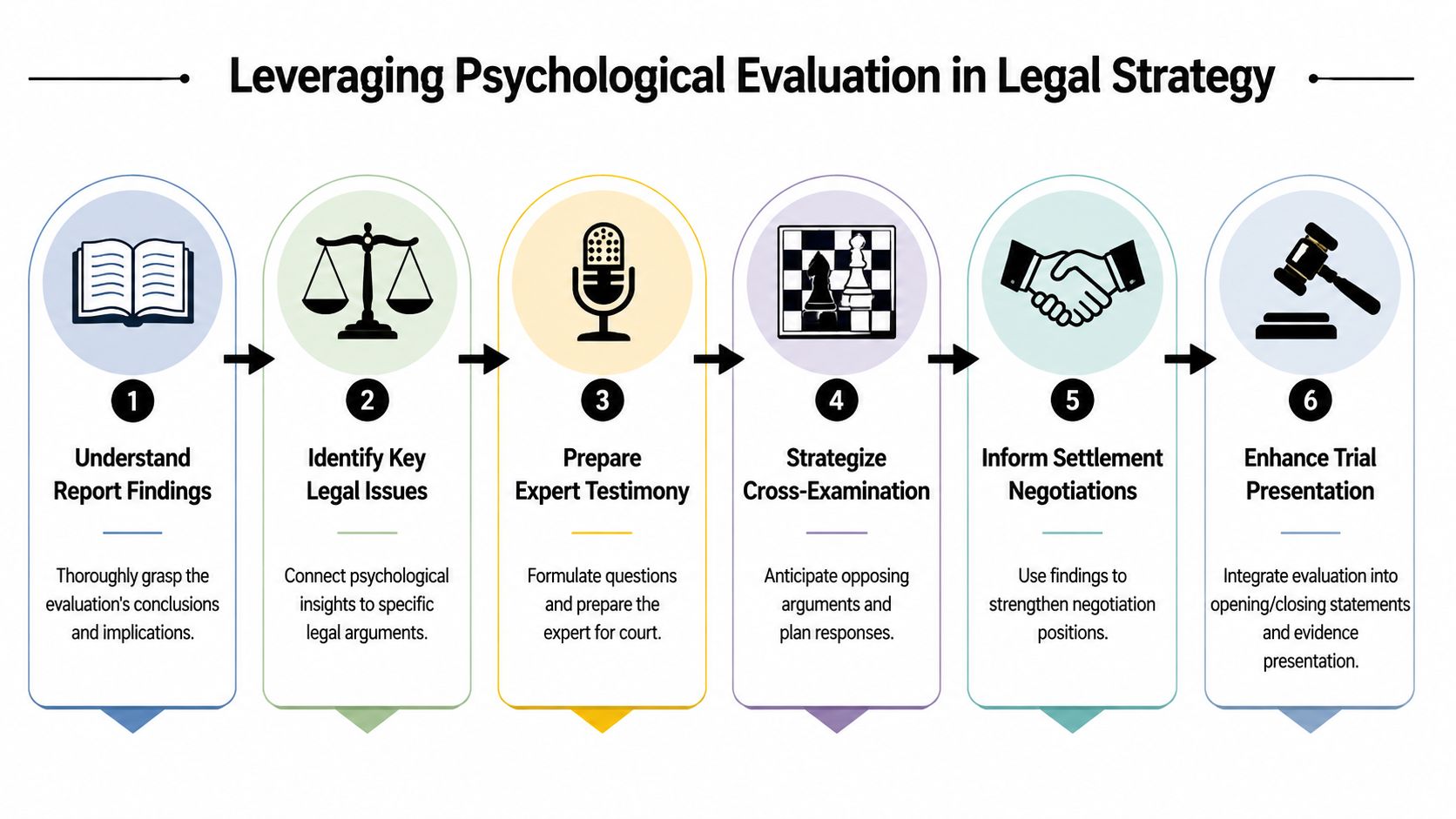
Use the report as a theory-building document
Start by identifying the report's most usable findings. Not every clinically interesting detail belongs in the brief.
Look for findings that do legal work:
- Symptom-function links: Findings that explain concentration problems, avoidance, emotional dysregulation, dependency, or fear.
- Disclosure dynamics: Observations that help explain delayed reporting, fragmented chronology, or omission of painful details.
- Abuse or coercion patterns: Clinical descriptions that support how control operated in the relationship.
- Consistency analysis: Opinions that the symptom presentation is clinically consistent with the reported history.
Then integrate those points where adjudicators will see them. A good report should shape the declaration, not just confirm it afterward. It can also sharpen your theory of the case by showing which harms are most clinically supported and which arguments should remain modest.
Don't quote every diagnosis. Quote the findings that explain behavior, impairment, and the relationship between the events and the symptoms.
Prepare the client without coaching the facts
A psychological evaluation often helps you understand why a client may testify in a nonlinear or emotionally constricted way. Use that insight to prepare process, not content.
That usually means:
- Normalize the experience of the evaluation. Explain that difficult emotions, incomplete recall, or fatigue during discussion of trauma are common.
- Review likely pressure points. If the report notes avoidance, shame, fear, or concentration limits, prepare the client for those moments during legal proceedings.
- Align the file. Make sure the declaration, supporting evidence, and psychological report don't create preventable contradictions through sloppy dates or mislabeled events.
- Plan expert use carefully. Decide whether the report will stand on its own or whether testimony or an affidavit from the evaluator may become useful.
A careful attorney also reads for risk. If the evaluation contains mixed findings, don't ignore them. Understand them early and decide how to address them. A balanced report is often still helpful, but only if counsel has absorbed its limits before the government or the court points them out.
Preparing Your Client and Answering Common Questions
Clients often arrive worried that the evaluation is a test they can fail. That anxiety can make them guarded, overly brief, or focused on sounding “consistent” instead of being accurate. Counsel can lower that pressure before the first appointment.
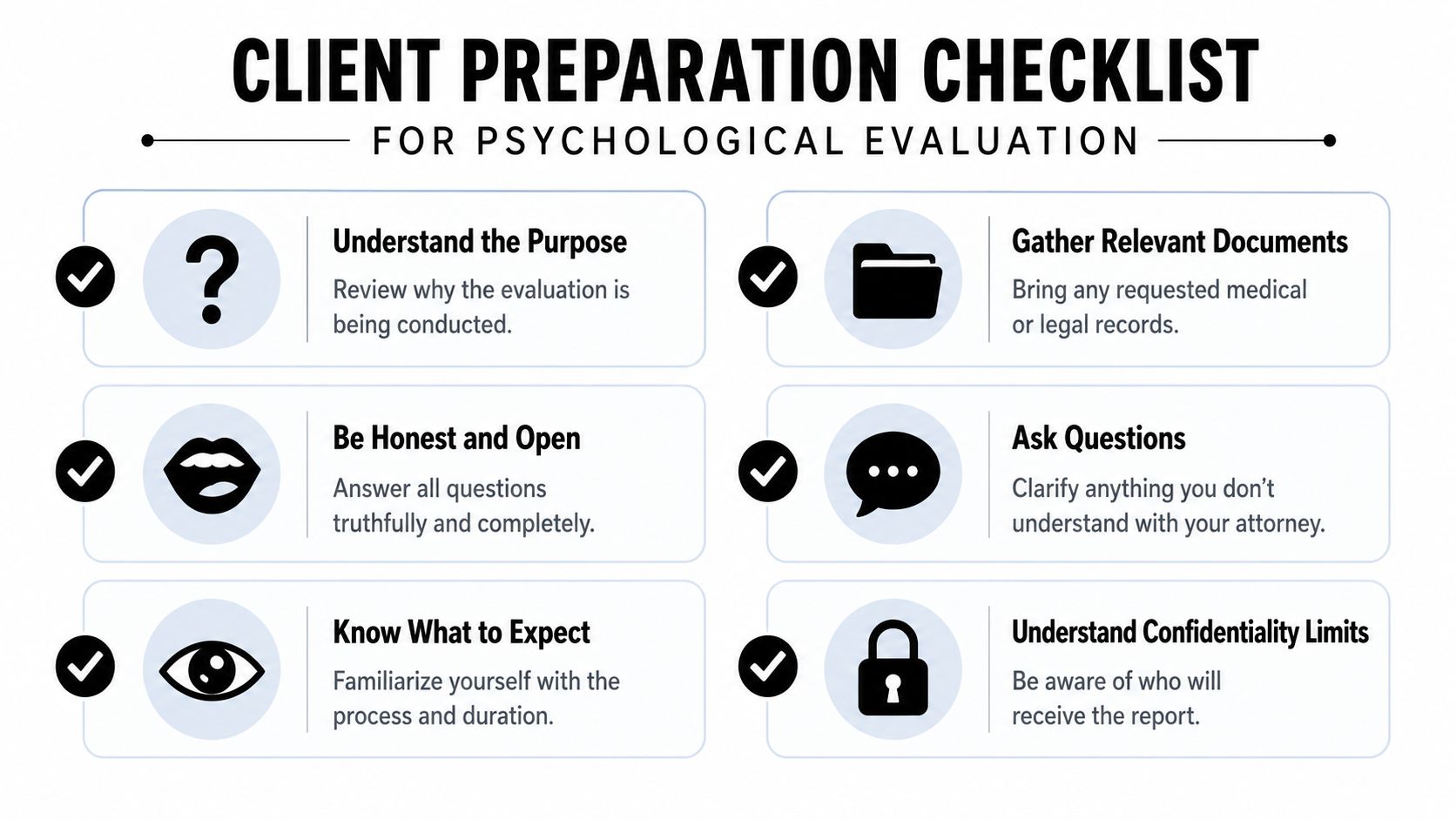
A short preparation checklist for clients
Give clients practical instructions, not vague reassurance.
- Understand the purpose: Tell the client the evaluation is meant to document psychological effects and functioning in relation to the immigration case.
- Bring what was requested: If the evaluator asked for records, medication lists, or prior mental health documents, gather them in advance.
- Provide accurate answers: The client doesn't need to sound dramatic or polished. Accuracy matters more than intensity.
- Expect difficult topics: Trauma history, family history, and current symptoms may all come up.
- Ask about confidentiality: The client should know who will receive the report and how it may be used.
- Plan the setting for remote sessions: If the meeting is virtual, the client should choose the most private and stable environment available.
Current practice shows that virtual in-depth evaluations are routine, but questions remain about informed consent, interpreter use, and reliability for trauma-exposed clients, as reflected in Columbia Doctors' expert comprehensive evaluation page. That matters in immigration work because remote access helps, but quality controls still have to be actively managed.
Some clients also benefit from plain-language orientation before the appointment. This client-facing article on how to approach a psychological evaluation can help reduce unhelpful fear if you frame it correctly. The goal isn't to “pass.” It's to participate honestly.
Common questions from clients and counsel
Will the abuser find out what I say in a VAWA evaluation?
That depends on who receives the report and how it is used. The client should ask the attorney and evaluator to explain confidentiality, report distribution, and any legal filing implications before the interview begins.
What if I can't remember every detail of what happened?
That is common in trauma-related evaluations. Clients should not guess, fill gaps, or force a perfect timeline. It is usually more helpful to say, “I don't remember,” than to speculate.
Could the evaluation hurt the case?
Any expert assessment can produce findings that are mixed, limited, or less supportive than hoped. That is one reason counsel should use evaluators who work methodically and should review the report carefully before deciding how to deploy it.
Should the client prepare answers in advance?
The client can review life events and documents, but shouldn't rehearse a script. Rehearsed answers often sound flat or oddly overcontrolled.
What should the client do during a remote session if privacy disappears?
The client should say so immediately. A high-stakes evaluation should not continue if another person can overhear sensitive disclosures.
Can an interpreter be used?
Yes, when needed, but the evaluator should know about that in advance and should document the language arrangement and any resulting limits on the evaluation.
A well-prepared client doesn't need to perform certainty. They need to understand the process, speak truthfully, and know that a careful evaluator is assessing more than isolated answers.
If you need an in-depth clinical psychological evaluation specific to immigration litigation, Pro Psychological Analysis works with attorneys on asylum, VAWA, U visa, T visa, and hardship matters, providing evidence-based reports designed for legal use, with attention to confidentiality, methodology, and filing timelines.