
You may be staring at a blank page, trying to write an extreme hardship waiver letter sample for a client or your own family, and feeling the pressure of every sentence. That reaction is normal. In waiver work, the letter often feels like the heart of the case because it carries the family's voice, the fear of separation, and the reality of what relocation would do.
But a strong hardship letter isn't a diary entry and it isn't a dramatic plea. It's a legal narrative supported by evidence. The strongest letters read like a guided explanation of why this qualifying relative's hardship rises above the ordinary consequences USCIS expects in immigration cases.
As a psychological expert who works alongside immigration attorneys, I see the same pattern repeatedly. Cases get stronger when the declaration, records, and clinical evidence all point to the same story. Cases get weaker when the letter is emotional but vague, or detailed but disconnected from the legal standard. If you're looking for an extreme hardship waiver letter sample, the most useful model is not a fill-in-the-blank template. It's a structure that helps you build a persuasive, forensically sound record.
Table of Contents
- The Hardship Letter From a Strategic Perspective
- Deconstructing the Legal Standard of Extreme Hardship
- Anatomy of a Compelling Hardship Letter with Samples
- Assembling Your Corroborating Evidence Packet
- The Critical Role of a Psychological Evaluation
- Common Pitfalls and Best Practices for Attorneys
The Hardship Letter From a Strategic Perspective
The hardship letter works best when you treat it as a strategic legal document. Its job is to organize the officer's thinking. It should show who the qualifying relative is, what would happen under separation or relocation, why those consequences exceed the usual level of hardship, and where the proof appears in the packet.
That changes how you write. You don't start with the most heartbreaking fact just because it's heartbreaking. You start with the facts that frame the legal theory of the case. If the strongest argument is medical dependence, the letter should foreground treatment needs, caregiving demands, and what would happen if the family system were disrupted. If the strongest argument is psychological deterioration, the letter should show functioning before the immigration crisis, current symptoms, and the expected impact of separation or forced relocation.
What the letter is actually doing
A weak letter asks for sympathy. A strong letter does three things at once:
- It identifies the qualifying relative clearly so the officer never loses sight of whose hardship matters legally.
- It ties each hardship claim to concrete life functions such as caregiving, treatment adherence, employment stability, parenting capacity, or educational continuity.
- It points outward to evidence instead of asking the officer to accept bare assertions.
The best declarations also sound human. Clinical precision and emotional truth can coexist. In fact, they should.
Practical rule: If a sentence makes a serious claim, ask what document proves it. If there's no answer, rewrite the sentence or get the evidence.
What works and what fails
What works is a disciplined narrative. The letter should move from facts to impact to corroboration. It should avoid abstract suffering and describe lived consequences. “I will be devastated” is common. “I manage our child's school meetings, my spouse's medication schedule, and transportation to specialty care, and I cannot sustain those responsibilities alone if he is removed” is useful.
What fails is overstatement without detail. USCIS officers read hardship letters constantly. They know families love each other. They know separation hurts. The letter has to show why this case is different in degree, complexity, or cumulative burden.
When attorneys and clinicians coordinate early, the declaration stops being an isolated document. It becomes the narrative spine of the waiver packet.
Deconstructing the Legal Standard of Extreme Hardship
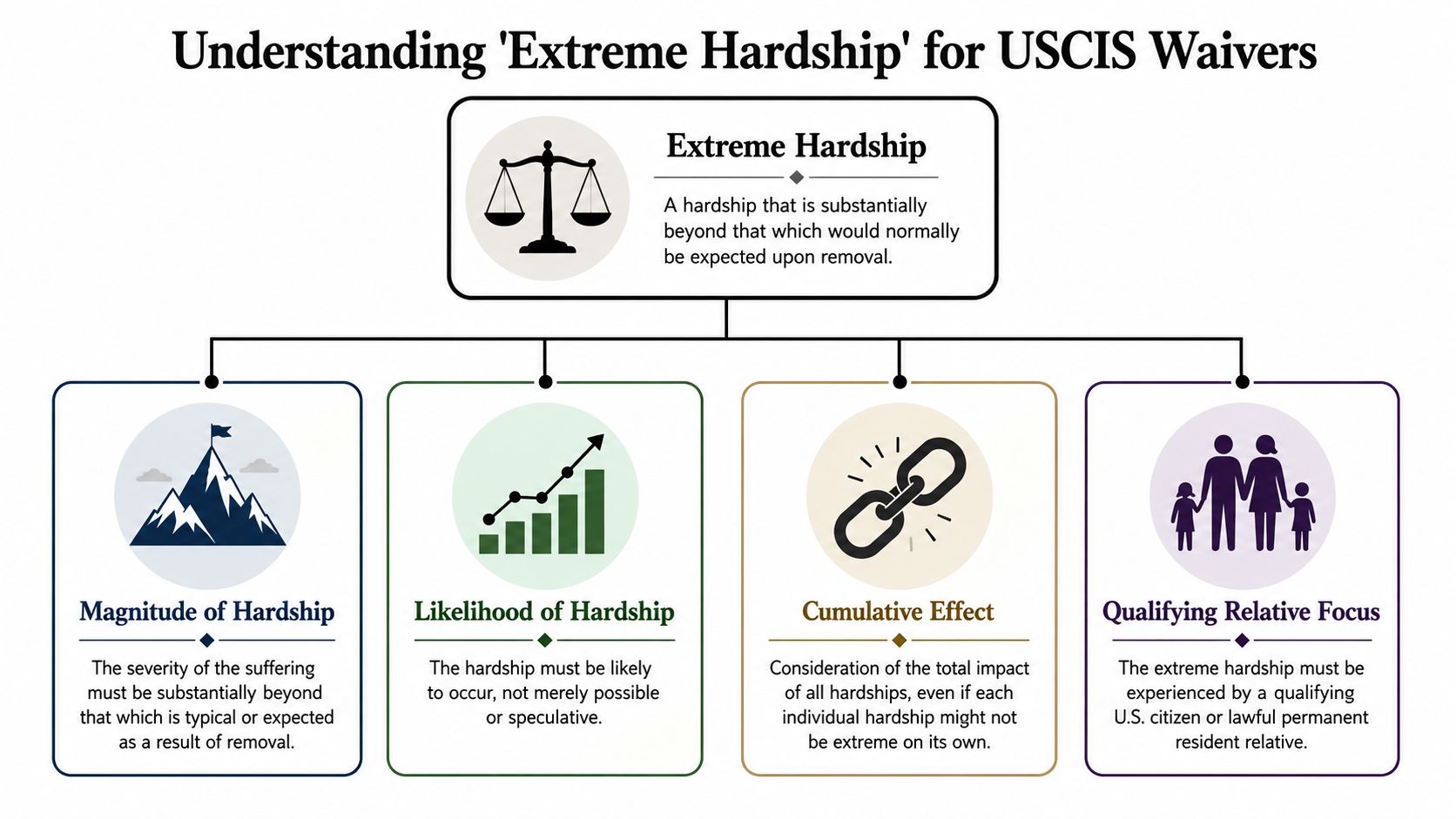
Before drafting language, anchor the case in the legal standard. The current guidance matters because it changed how waiver cases can be presented. The final guidance defining extreme hardship took effect on December 5, 2016, applies to waiver applications adjudicated on or after that date, allows applicants to establish hardship in either a separation or relocation scenario, identifies five factors that often weigh heavily, and requires proof by a preponderance of the evidence, as summarized by CLINIC's discussion of the USCIS extreme hardship guidance.
What USCIS is looking for
USCIS does not approve a waiver because separation is sad or relocation is inconvenient. Those are expected consequences. The adjudicator is looking for hardship that rises above the normal consequences associated with family separation or moving abroad.
The five categories identified in the guidance often carry substantial weight:
- Family ties
- Social and cultural issues
- Economic issues
- Health conditions and care
- Country conditions
These categories are not boxes to check mechanically. They interact. A parent's anxiety may worsen because the family would lose income. A child's educational needs may matter more because country conditions would limit access to appropriate support. A chronic medical condition may become more serious because the qualifying relative depends on the applicant for transportation, reminders, and daily functioning.
Normal hardship versus extreme hardship
Many letters deviate from their intended purpose. They describe pain, but not legal significance.
A useful comparison looks like this:
| Issue | Usually seen as ordinary | More persuasive when it becomes case-specific |
|---|---|---|
| Separation from spouse | Emotional sadness and loneliness | Documented mental health decline, impaired parenting, caregiving collapse, treatment disruption |
| Financial strain | Reduced household income | Specific shared obligations, inability to meet essential needs, documented debt, caregiving barriers |
| Relocation abroad | Difficulty adjusting | Country-specific barriers tied to health, education, safety, language, or social isolation |
| Medical concerns | General stress | Diagnosed condition, treatment plan, doctor's letter, care dependency, foreseeable worsening |
Hardship becomes persuasive when the officer can see severity, likelihood, and cumulative effect in the qualifying relative's real life.
The burden of proof changes how you draft
“Preponderance of the evidence” is not a literary standard. It's an evidentiary one. The letter should therefore read like a factual declaration that happens to carry emotion, not an emotional statement that happens to mention facts.
That means every major paragraph should answer three questions:
- What is the hardship?
- Why is this qualifying relative especially vulnerable to it?
- What evidence confirms it?
A good extreme hardship waiver letter sample doesn't just sound sincere. It mirrors the way USCIS evaluates hardship.
Anatomy of a Compelling Hardship Letter with Samples
Most hardship letters fail because they're either too thin or too chaotic. The fix is structure. A compelling letter usually has four parts: an opening statement of purpose, fact-based hardship sections, a paragraph addressing the likely scenario, and a closing summary that pulls the facts together.
The opening paragraph
The first paragraph should orient the officer immediately. Identify the writer, the relationship to the applicant, the form of relief sought, and the core hardship theory.
I am the U.S. citizen spouse of [Applicant Name], and I am submitting this declaration in support of his waiver application. If I am separated from my husband, I will face severe hardship because I rely on him for daily support related to my medical treatment, care of our children, and management of our household finances.
That works because it is direct. It doesn't drift into biography before stating the legal point.
A weaker opening often spends half a page describing how the couple met, how much they love each other, or how unfair the situation feels. Those facts may matter later, but they are not the frame.
The body should be organized by hardship, not chronology
Chronology is intuitive for clients. It's often inefficient for adjudicators. Organize the declaration by hardship domains instead.
Medical hardship sample
If health is central, describe diagnosis, treatment, functioning, and dependency in concrete terms.
I have been receiving treatment for my condition and depend on my husband to drive me to appointments, help me remember medication schedules, and care for our children when symptoms interfere with daily tasks. Without him, I would struggle to maintain treatment and basic household responsibilities.
Why this works:
- It identifies specific tasks.
- It connects the applicant's role to treatment continuity.
- It shows impairment in daily functioning.
Medical claims should align with records. If the letter says the qualifying relative cannot attend appointments alone, the provider letter should help explain why that assistance matters.
Financial hardship sample
Financial sections often stay too general. “We would suffer financially” is weak unless you explain how the household functions.
My husband's role in our household is not limited to income. He manages transportation, child care coverage, and shared bills. If we are separated, I would have to absorb those responsibilities while trying to maintain employment, which would place my job stability and our ability to meet monthly obligations at risk.
Many practitioners benefit from reviewing examples of how to write a hardship letter that move beyond generic phrases and show how factual detail carries the argument.
Emotional and psychological hardship sample
Psychological hardship should never be reduced to “I will be depressed.” That language is too broad and often too unstructured.
Since learning that my husband may be removed, I have experienced persistent fear, difficulty sleeping, problems concentrating, and increasing irritability that affects my parenting and work performance. The possibility of separation has not only caused emotional distress, it has interfered with my ability to function consistently day to day.
That paragraph works because it translates feelings into observable impairment.
The scenario paragraph
A strong letter also addresses the likely hardship scenario clearly. If the argument is separation, say why the qualifying relative would remain in the United States and what would happen. If the argument is relocation, explain why moving would create distinct burdens.
Use one scenario well rather than two scenarios poorly. The legal standard allows hardship in either separation or relocation. The declaration should reflect the scenario that matches the family's real plan and strongest evidence.
The closing paragraph
The closing should summarize. It should not introduce new facts.
I respectfully ask USCIS to consider the full effect that my husband's departure would have on my health, emotional stability, parenting responsibilities, and financial survival. The hardship I would face is not the ordinary distress of family separation. It would affect my ability to function, care for my family, and maintain stability.
A useful extreme hardship waiver letter sample gives you wording patterns, but its main value is the architecture. The declaration should sound personal. Its structure should still feel disciplined.
Assembling Your Corroborating Evidence Packet
A hardship letter without corroboration is just an assertion. That's why strong waiver cases are built from the packet outward, not from the declaration inward. The letter introduces the hardship, but the evidence makes it believable.
A recurring problem is puffery. The declaration uses sweeping language, but the records don't support it. That mismatch damages credibility. As noted in Dr. Lisa Long's guide to I-601 and I-601A hardship evaluations, successful applications often include evidence packets exceeding 100+ pages, and emotional pleas without concrete support such as budgets or treatment plans are often inadequate.
What makes evidence strong
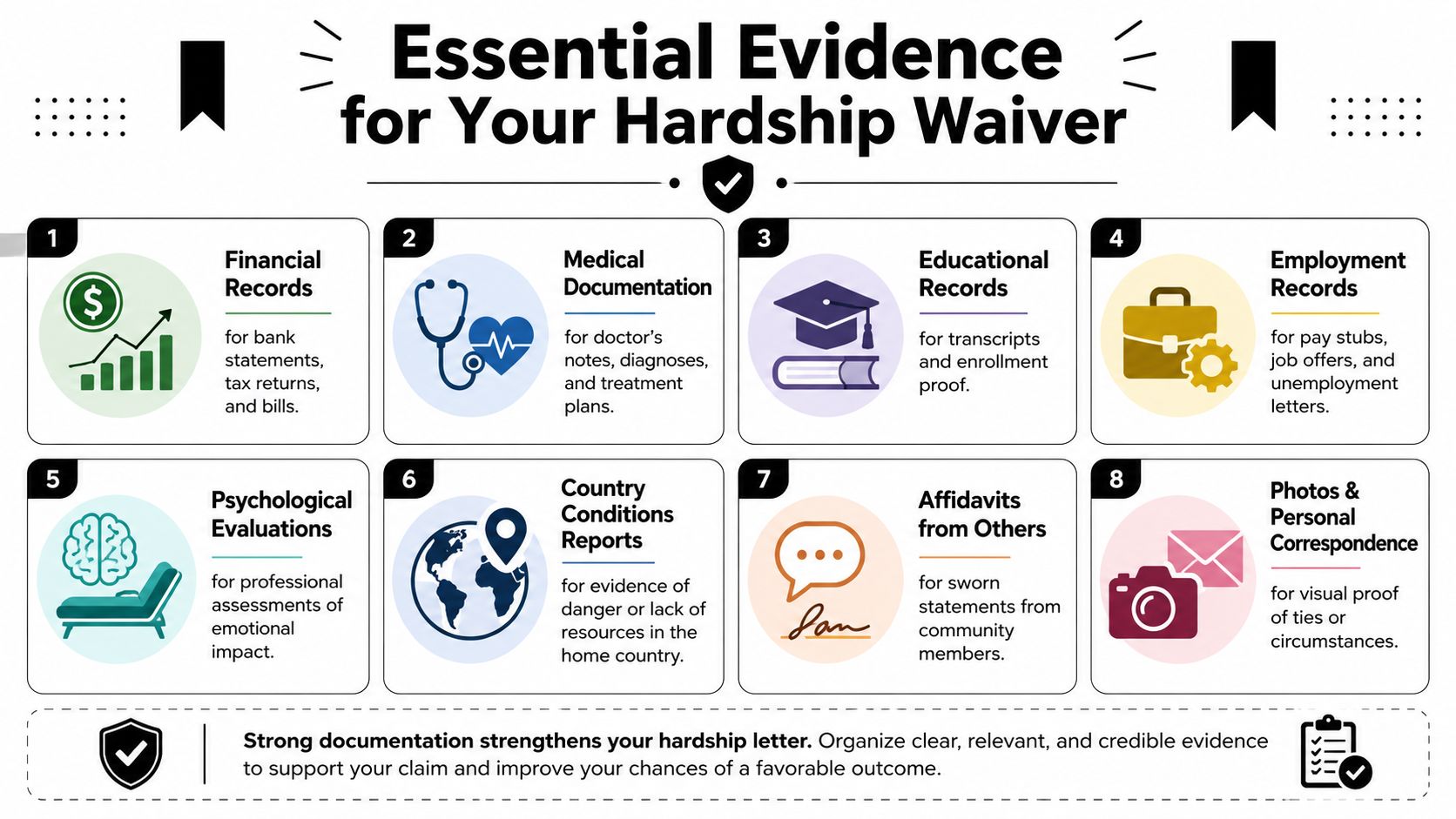
Strong evidence is specific, current, and tied to the claim in the declaration. If the letter says the qualifying relative would suffer financially, the packet should show actual obligations and actual income patterns. If the letter says the relative's functioning has deteriorated, the packet should include records from professionals or other witnesses who observed that decline.
Use evidence in layers:
- Primary records such as tax returns, pay stubs, bank statements, and medical records
- Professional opinions from doctors, therapists, teachers, or evaluators
- Collateral statements from family members, clergy, employers, or community members
- Context documents such as country condition materials when relocation is part of the claim
A useful companion in cases involving family functioning is a social support assessment, because it helps clarify who provides care, supervision, transportation, emotional regulation, and practical assistance inside the household.
Evidence categories that commonly matter
The strongest packets often include a mix like this:
- Financial records that show the household reality. Tax returns, pay stubs, bank statements, rent or mortgage records, utilities, child-related expenses, and proof of shared obligations are stronger than a general statement that money is tight.
- Medical documentation that explains diagnosis, treatment, medications, prognosis, and why the applicant's presence matters. A short letter that merely confirms a patient relationship is less useful than one that describes functional impact.
- School and child-related records when a child's needs affect the qualifying relative's burden. Transcripts, attendance records, individualized supports, and letters from school staff can show how fragile the family's routine may be.
- Affidavits from others that confirm daily realities. The best affidavits are factual and observational, not repetitive character letters.
A packet is persuasive when each document answers a question the officer would otherwise have to guess at.
Build the packet around the declaration
Don't collect documents randomly and hope a story appears. Build a chart with four columns: claim, supporting document, date, and why it matters. That exercise exposes gaps quickly.
For example, if the declaration claims the qualifying relative cannot relocate because of treatment needs, ask:
- Which provider records identify ongoing treatment?
- Is there a letter explaining continuity of care?
- Is there proof of medication management or specialty follow-up?
- Is there documentation of the applicant's caregiving role?
Many attorneys save cases, not by writing more, but by matching each hardship claim to proof.
The Critical Role of a Psychological Evaluation
Psychological hardship is often the most compelling part of a waiver case, and also the part most likely to be underdeveloped. Clients know they are suffering. Attorneys can see the disruption. USCIS, however, weighs evidence, not intuition. A psychological evaluation translates distress into clinically organized findings.
One legal training resource drew over 1,000 registrants for a webinar on hardship waivers, and it notes that professional hardship evaluations can cost $500 to over $2,000 in more complicated immigration cases, reflecting the importance of this evidence in documenting the mental health impact on a qualifying relative, as discussed in the ILRC webinar materials on understanding extreme hardship waivers.
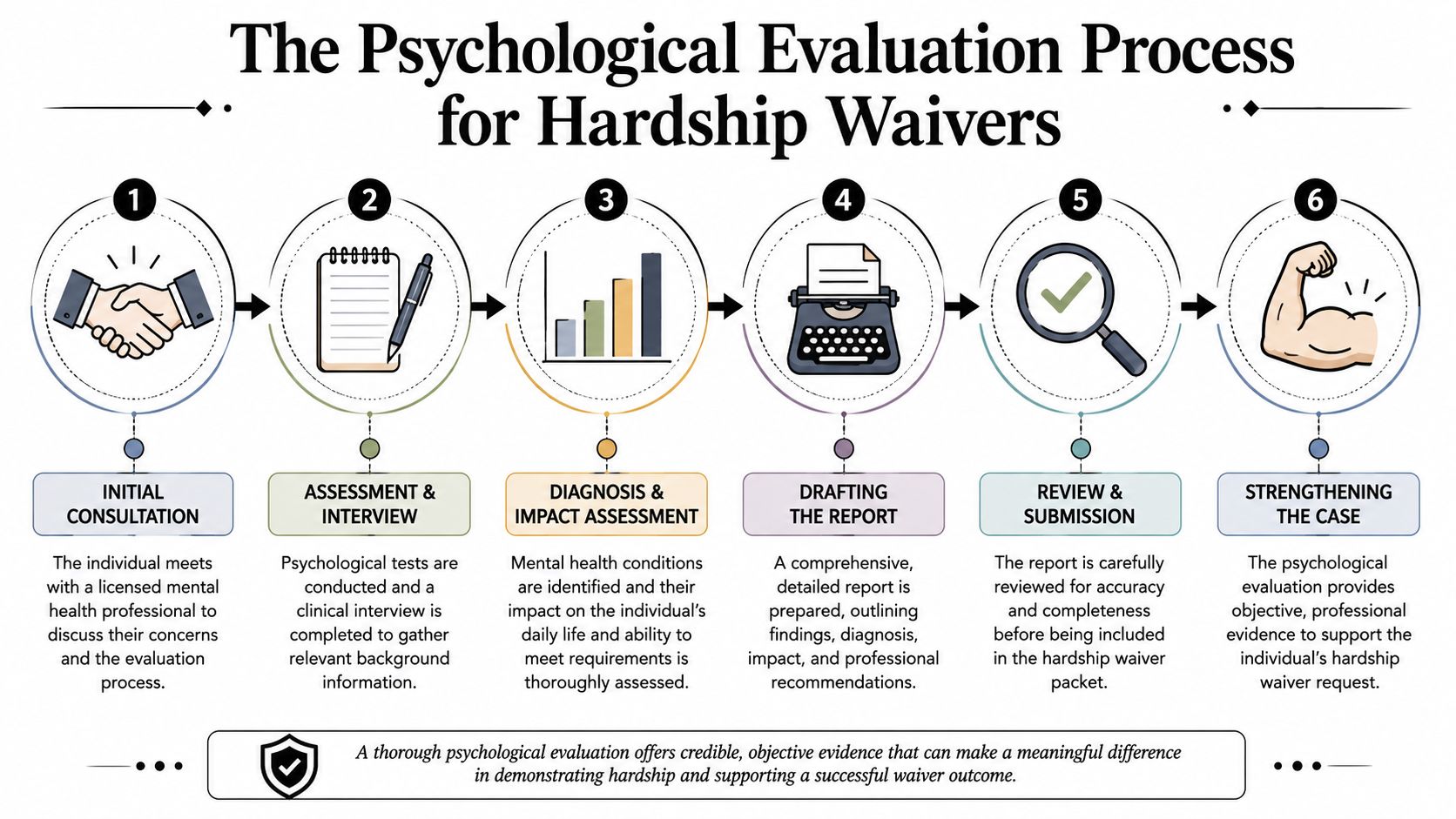
A visual overview helps clarify what that process should look like.
What the evaluation adds that a letter cannot
A declaration can describe sadness, fear, panic, insomnia, irritability, and hopelessness. It cannot independently diagnose, assess severity, evaluate consistency, or explain clinical significance. That is where the evaluation matters.
A thorough hardship evaluation generally examines:
- the qualifying relative's current symptoms
- relevant history
- functional impairment
- relationship dynamics
- foreseeable consequences of separation or relocation
- consistency between self-report and records
It can also identify an issue attorneys sometimes miss. The relevant psychological question is not only whether a child or spouse is suffering, but how that suffering affects the qualifying relative's mental health and functioning. That distinction is critical in waiver cases.
Later in case preparation, a comprehensive clinical psychological evaluation can help attorneys understand how clinical findings should be framed and integrated into the broader packet.
What a forensically sound report looks like
Not every mental health letter helps. Some are too brief, too advocacy-driven, or too vague to carry weight. A stronger report is methodical. It links symptoms to functioning and links functioning to the waiver scenario.
The most useful evaluation does not simply say the client is anxious. It explains how anxiety affects sleep, concentration, parenting, work, medical decision-making, and the ability to cope with prolonged separation or forced relocation.
A sound report also avoids overclaiming. Adjudicators are more likely to trust an expert who distinguishes between observed facts, reported symptoms, diagnostic impressions, and professional opinions about likely impact.
The process itself also deserves careful handling. The evaluation should involve a detailed interview, review of available records, and careful attention to cultural and family context.
The following video gives additional context on this type of evidence in immigration cases.
Why this often changes the case theory
A psychological evaluation can do more than support a preexisting claim. It can sharpen the legal argument. Sometimes the strongest hardship is not just emotional pain. It is reduced functioning. A qualifying relative may no longer be able to maintain work attendance, regulate a child with special needs, manage medical appointments, or sustain treatment compliance under the strain of separation.
That shift matters. USCIS can weigh concrete impairment more easily than generalized distress. The evaluation helps convert a subjective plea into objective expert evidence.
Common Pitfalls and Best Practices for Attorneys
Many waiver packets are not denied because the family lacks hardship. They are denied because the hardship was presented poorly. The common assumption is that a heartfelt declaration will carry the case if the facts are strong enough. In practice, poor framing can bury strong facts.
Do this, not that
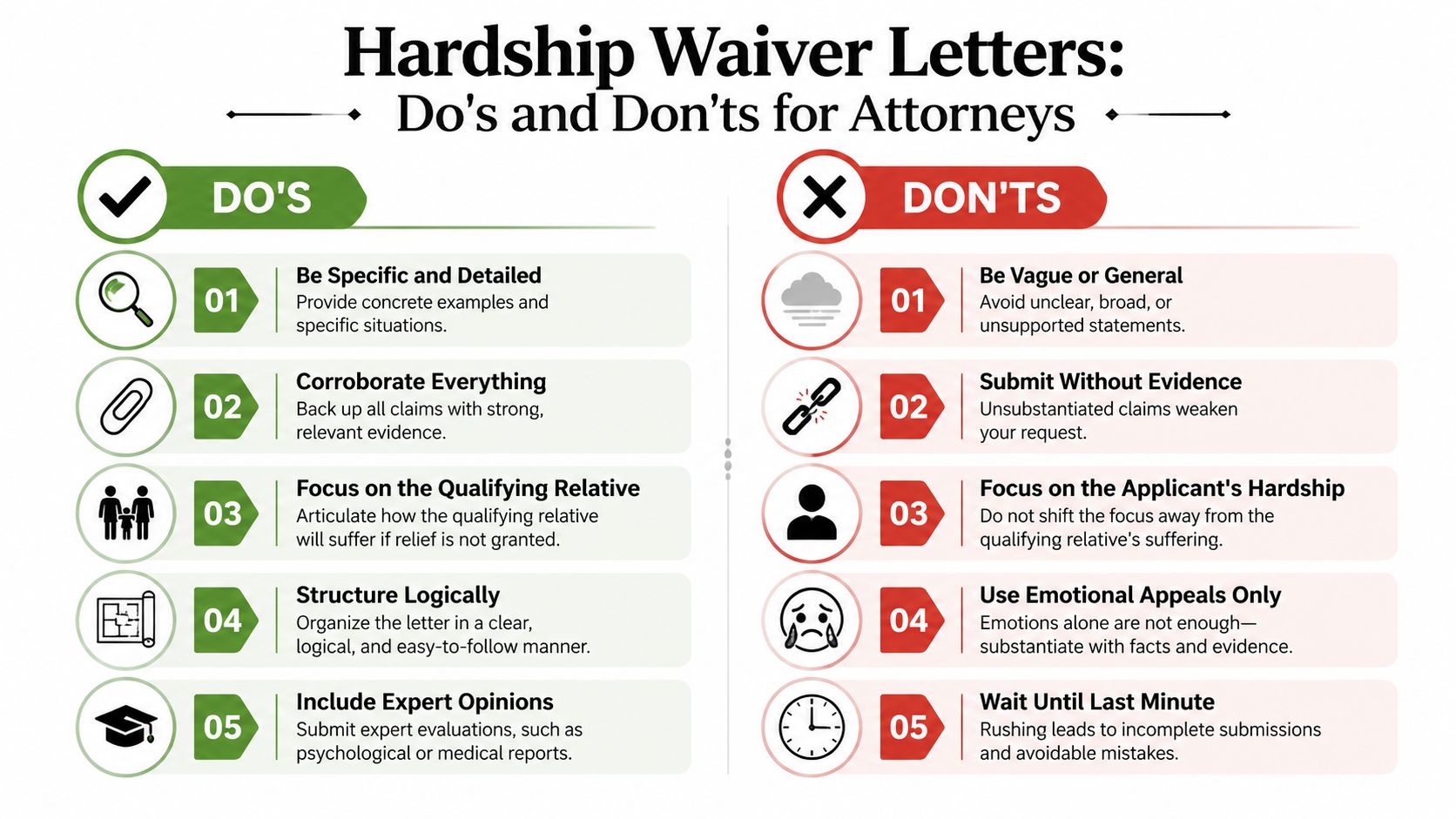
Use this as a practical screen before filing:
- Do focus on the qualifying relative. Don't let the declaration center the applicant's suffering so fully that the legal focus becomes blurred.
- Do insist on specifics. Don't accept phrases like “I can't live without him” when the better question is, “What daily functions collapse without him?”
- Do organize by hardship theme. Don't submit a narrative that jumps between childhood history, finances, health, and relationship details without a clear roadmap.
- Do corroborate major claims. Don't rely on adjectives when records are available.
- Do prepare the client for consistency. Don't let the declaration, legal brief, and clinical interview tell three different versions of the same story.
Best practices in attorney-clinician collaboration
The strongest collaborations start before the evaluation, not after it. Attorneys should identify the legal theory of hardship, the qualifying relative, the likely scenario, and the records already available. That doesn't script the clinical opinion. It helps the evaluator understand the legal context.
A practical workflow often includes:
| Stage | Attorney task | Why it matters |
|---|---|---|
| Intake | Clarify qualifying relative and hardship theory | Prevents misdirected evidence gathering |
| Declaration prep | Elicit concrete examples and timelines | Produces facts that can be corroborated |
| Evaluation referral | Share records and case posture | Improves relevance and accuracy |
| Packet assembly | Align declaration, exhibits, and brief | Reduces contradictions |
| Final review | Check consistency across all documents | Protects credibility |
Attorneys get better results when they prepare clients to describe functioning, not just feelings.
Errors that quietly damage credibility
Three problems come up often.
First, the packet overstates. The declaration claims total dependence, but the records show partial dependence. Second, the packet is underexplained. Key records are included, but no one tells the officer why they matter. Third, the packet is disorganized. A good case can lose force if the adjudicator has to hunt for the proof.
The legal cover letter should solve that. It should map each hardship claim to the supporting exhibits and show how the record fits the legal standard. The declaration should then feel like the human account inside a larger, coherent argument.
Attorneys handling these matters know that waiver work is part law, part storytelling, and part evidence management. The strongest extreme hardship waiver letter sample is never just a sample. It is a model of disciplined case theory.
If you need clinically rigorous hardship evaluations that align with waiver strategy, Pro Psychological Analysis works with immigration attorneys nationwide to produce evidence-based psychological reports for extreme hardship and other immigration matters. Their evaluations are structured for legal use, grounded in careful clinical methodology, and designed to help turn subjective suffering into organized, persuasive evidence.