
You're likely here because a client, family member, or qualifying relative has to explain hardship in writing, and every example online looks wrong for the case in front of you. Mortgage templates talk about missed payments. Creditor letters ask for reduced interest or a payment pause. None of that captures what an immigration adjudicator or immigration judge needs to see when the underlying issues are trauma, family separation, disrupted treatment, child functioning, caregiving collapse, or the consequences of relocation.
That mismatch causes weak filings. People write as if they are asking for mercy when they should be building a documented, credible narrative tied to legal standards. In immigration work, a hardship letter doesn't carry weight because it sounds emotional. It carries weight when it is specific, organized, and supported by records that make the claimed hardship concrete.
Table of Contents
- Beyond Templates Writing a Hardship Letter for USCIS
- The Core Components of a Persuasive Hardship Narrative
- Structuring Your Letter for Readability and Impact
- Mastering the Language and Tone of Your Hardship Letter
- How to Coordinate with Legal and Clinical Experts
- Your Pre-Submission Checklist and Final Tips
Beyond Templates Writing a Hardship Letter for USCIS
The biggest mistake I see is using a generic hardship format for an immigration filing. That approach usually produces a letter that sounds sincere but proves very little. USCIS and immigration courts are not evaluating whether someone feels distressed in a broad sense. They are evaluating whether the record supports a legally meaningful hardship claim and whether the narrative is coherent enough to fit the rest of the evidence.

Most online hardship guidance is built around financial problems. Immigration hardship works differently. As Kolko Casey notes in discussing immigration hardship letters, these letters need a more specific, evidence-linked story about diagnosis, functional impairment, and access to care, not just a general account of suffering. That difference matters even more in a global context where over 122 million forcibly displaced people worldwide in 2024 were reported by UNHCR through the same discussion, because many applicants present with trauma, family separation, and barriers to treatment that generic templates do not capture.
Why generic hardship letters fail in immigration cases
A creditor letter can survive on a straightforward formula. “I lost work, my bills increased, please reduce my payment.” An immigration hardship letter usually cannot. It has to answer a different set of questions.
- Whose hardship is central: The adjudicator needs to know exactly who is suffering the hardship and why that person's experience matters legally.
- What kind of hardship is being claimed: Medical, psychological, developmental, educational, financial, caregiving, and safety issues often overlap, but they should not be lumped together.
- How the hardship functions in daily life: Sleep disruption, panic symptoms, treatment interruption, school decline, inability to care for a child or elder, or loss of necessary medical follow-up are more persuasive than abstract statements about stress.
- What evidence corroborates each point: A good narrative points the reader toward records, affidavits, evaluations, and official notices.
Practical rule: In immigration cases, the letter is not a substitute for evidence. It is the roadmap that tells the reader how to understand the evidence.
Three pillars that make the narrative usable
A strong immigration hardship letter should feel less like a plea and more like a disciplined account of facts, effects, and consequences. That's especially true in waiver cases, VAWA matters, U and T visa filings, and other situations where mental health symptoms and family functioning can be central to the legal argument. Attorneys handling I-601 and I-601A waiver cases already know that unsupported emotion rarely moves a file. Corroborated impairment does.
Use this lens while drafting:
| What weak letters do | What strong letters do |
|---|---|
| Tell a painful story in general terms | Tie specific facts to legal hardship |
| Focus on feelings alone | Show symptoms, impairment, and consequences |
| Repeat family history without structure | Present a clear chronology |
| Ask for help vaguely | Make the hardship legible to the adjudicator |
The letter should help the reader answer one question quickly: if the requested immigration outcome is denied, what concrete human consequences follow, and how does the record prove them?
The Core Components of a Persuasive Hardship Narrative
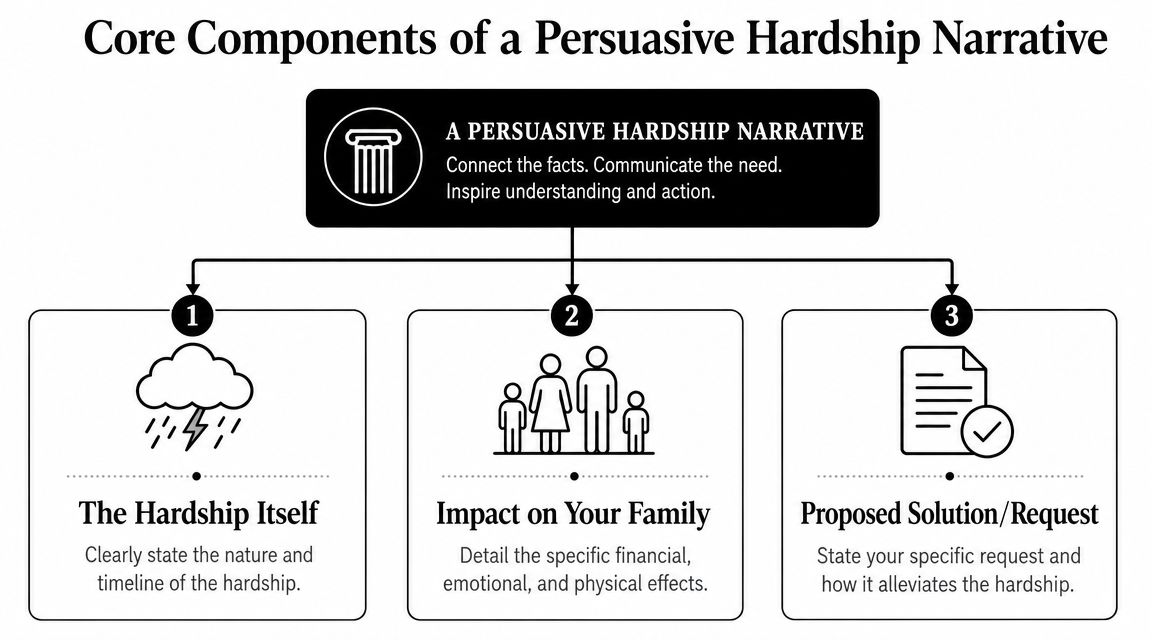
Before drafting, separate the narrative into parts. That alone improves quality because it forces the writer to stop blending facts, feelings, and requests into one long statement. The cleanest immigration hardship letters usually rest on three pillars: the hardship statement, the timeline, and the supporting evidence.
Why generic hardship letters fail in immigration cases
Specificity is not optional. As Credit.com's hardship letter guidance explains, a hardship letter should ideally be one page and should include concrete dates, amounts, and references to supporting documents. That same guidance is useful in immigration work because the letter's primary job is to serve as a concise narrative that connects documentary proof to the relief being requested.
That principle translates well to USCIS and court filings. If a mother says her child's symptoms worsened after a detention event, the letter should identify when that happened and what changed afterward. If a spouse describes treatment needs, the letter should connect those needs to actual care, medications, appointments, or barriers to access. If relocation would affect functioning, the letter should explain how, in practical terms.
A hardship statement should answer these questions in plain language:
- What happened: The triggering event or condition.
- When it began: A usable timeline, not “for a long time.”
- Who is affected: Name the person and their role in the family system.
- How it impairs functioning: Daily activities, parenting, work, schooling, treatment adherence, or physical health.
- Why the immigration outcome matters: Separation, relocation, loss of support, interrupted care, exposure to trauma reminders, or other foreseeable consequences.
Later in the section, it helps to give the reader a visual framework. This short explainer is useful in client meetings:
Three pillars that make the narrative usable
The second pillar is the timeline of events. Immigration adjudicators read many declarations that feel emotionally true but temporally confusing. If the sequence doesn't make sense, the hardship claim weakens. Build a straightforward chronology with major events, symptom changes, treatment milestones, school disruptions, caregiving burdens, moves, and family separation periods.
The third pillar is supporting evidence. The letter itself should mention what exists in the file so the reader can connect statement to proof.
Useful support often includes:
- Medical records: Diagnoses, treatment plans, medication history, specialty referrals, discharge summaries.
- Mental health evidence: Therapy records where appropriate, a psychological evaluation, symptom inventories, and clinical observations.
- School records: Attendance concerns, counseling notes, learning support records, behavior reports.
- Financial and employment records: Pay stubs, bank statements, termination letters, tax forms, housing notices, bills.
- Third-party statements: Affidavits from relatives, teachers, clergy, social workers, or caregivers who can describe observed functioning.
A persuasive letter doesn't try to prove everything by itself. It points to evidence the adjudicator can verify.
When attorneys train clients on how to write a letter of hardship, this is the shift that matters most. The letter is not the whole case. It is the narrative spine of the case.
Structuring Your Letter for Readability and Impact
A strong record can still underperform if the letter is disorganized. Immigration officers and judges should not have to assemble the argument themselves. The structure should carry them from identification, to hardship, to consequences, to the requested outcome in a sequence that feels inevitable.
Use a four-part sequence
A useful framework comes from broader hardship-letter guidance, but it adapts well to immigration matters. As Experian's discussion of hardship letters explains, a technically strong letter follows a four-part evidentiary sequence: identify the account or case and request, state the cause of hardship, quantify its impact, and propose a specific remedy or outcome. In immigration practice, that becomes a clean drafting model.
Use these four parts:
Opening identification and purpose
Start with the writer's name, relationship to the applicant or qualifying relative, case identification if appropriate, and the purpose of the letter. Do this immediately. Don't bury the point beneath biography.Cause of hardship
Describe the central circumstances. This may include trauma history, medical conditions, caregiving obligations, child vulnerability, family dependency, or treatment needs. Keep the focus on what is relevant to the case.Impact and consequences
This is the heart of the letter. Explain what the hardship has already done and what denial would likely do. Use practical consequences, not dramatic adjectives.Requested outcome
End respectfully and clearly. State what outcome is sought and why the facts in the letter support it.
A simple model for paragraph order
A readable hardship letter usually works best when each paragraph has one job.
| Paragraph | Job |
|---|---|
| First | Identify the case and state the request |
| Second | Explain the hardship circumstances |
| Third | Describe current impairment and likely consequences |
| Final | Summarize the request and refer to attached support |
This structure also helps when you're using a sample medical hardship letter as a formatting reference. The point is not to copy stock language. The point is to keep the letter disciplined.
Here is what tends to work versus what does not:
- Works well: “I am writing in support of my husband's case. I have been diagnosed with a chronic condition that requires ongoing treatment in the United States. Since his absence, I have struggled to attend appointments without assistance and my symptoms have worsened.”
- Works poorly: “Our family has been through so much and I don't know how we can survive if this doesn't get approved.”
The second example may be heartfelt, but it gives the adjudicator little to evaluate. The first identifies the relationship, the medical issue, the role of the family member, and the functional consequence.
The reader should never have to guess what the letter is asking for or why the writer's experience matters.
Mastering the Language and Tone of Your Hardship Letter
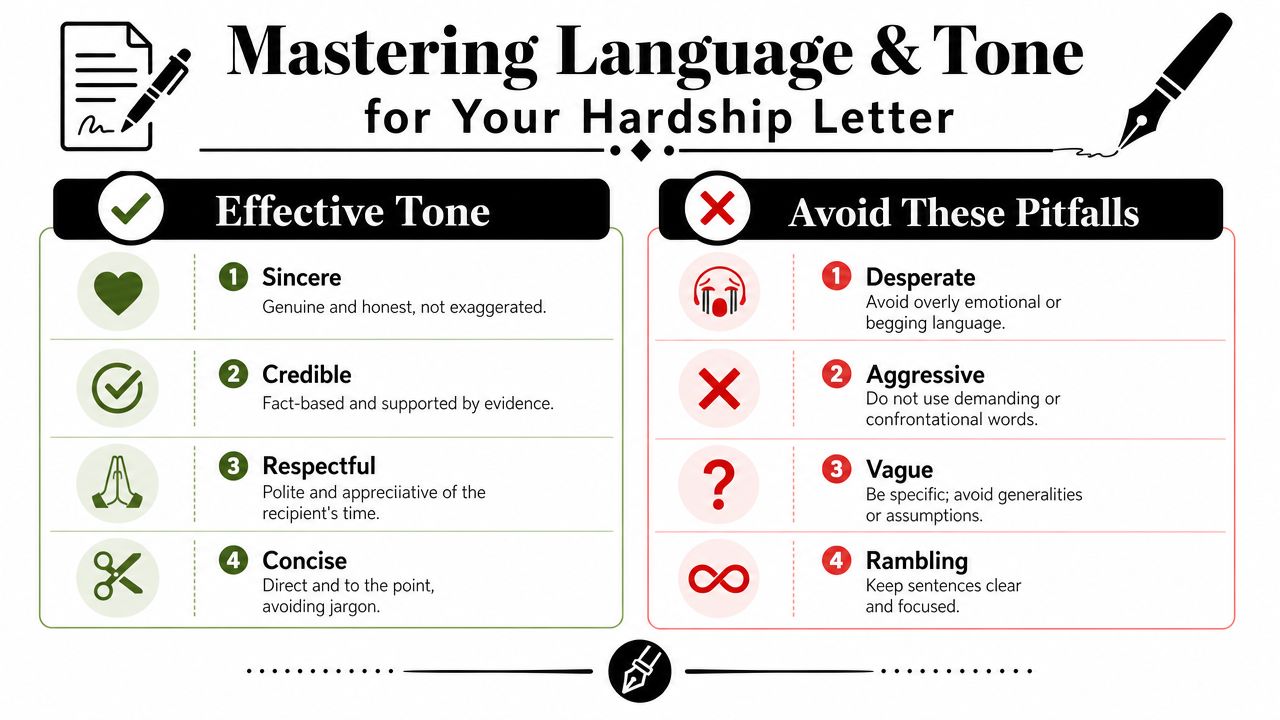
Tone changes credibility. In immigration hardship writing, the most persuasive voice is usually calm, concrete, and restrained. Writers often think stronger emotion will make the letter more convincing. In practice, exaggerated language can make the filing feel less reliable, especially if the attached records are thin or inconsistent.
Credibility beats intensity
The goal is not to sound cold. The goal is to sound trustworthy. A good hardship letter allows emotion to appear through facts. If a child has nightmares, behavioral regression, and school avoidance after family separation, those details are powerful on their own. You do not need to say the child is “totally destroyed” or that the family is “living in unbearable agony.”
That kind of phrasing usually creates three problems:
- It sounds inflated.
- It doesn't map to legal or clinical standards.
- It distracts from stronger evidence already in the file.
A better approach is to describe observable facts and functional consequences. If the writer has a diagnosis, name it if counsel wants it included. If there is no formal diagnosis, describe symptoms carefully without pretending to make a clinical conclusion.
Phrases that help and phrases that hurt
Use language that is specific, modest, and anchored in lived consequences.
| Less effective phrasing | Stronger phrasing |
|---|---|
| “I would be devastated” | “His removal would interrupt the practical support I rely on to attend treatment and care for our children.” |
| “My child is suffering so much” | “Since the separation, my child has had difficulty sleeping, increased fearfulness, and problems at school.” |
| “We cannot live without him” | “Without his help, I would not be able to manage transportation, childcare, and medical appointments consistently.” |
| “Everything will fall apart” | “Denial would likely worsen the instability we are already struggling to manage.” |
A few drafting habits help immediately:
- Choose concrete verbs: “attend,” “care for,” “sleep,” “work,” “concentrate,” “travel,” “supervise,” “manage.”
- Prefer observed facts over labels: “cries daily and refuses school” is stronger than “is emotionally broken.”
- Keep legal dignity intact: Respectful language matters, especially when the letter is one piece of a larger professional filing.
- Avoid overclaiming: If the evidence shows anxiety symptoms, don't turn the letter into a dramatic trauma narrative unless the record supports it.
“The most believable hardship letters sound like testimony under oath, not a fundraising appeal.”
One more practical point. Avoid copying internet phrasing. Officers and court staff read repetitive language constantly. A letter becomes more credible when it sounds like the actual person and still stays within a disciplined structure. That balance is hard, but it is exactly what makes the writing persuasive.
How to Coordinate with Legal and Clinical Experts
A hardship letter is rarely strong enough standing alone. It gains value when it fits the legal theory of the case and aligns with the corroborating record. That's why process matters as much as wording.
The letter must match the legal theory
Broader hardship guidance makes this point in a different context, but the lesson applies directly here. As Pine Tree Legal Assistance explains in hardship process guidance, the process is not just about writing. It involves speaking with the relevant decision-maker first, sending the letter to the correct person, and using a traceable method when appropriate. In immigration work, that means the writer should coordinate with counsel before drafting and before submission.
Attorneys should review the letter for at least four issues:
- Consistency with the filing theory: The letter should support the legal standard being argued, not wander into side issues.
- Consistency with the documentary record: Dates, treatment history, family composition, addresses, and prior events must align.
- Risky admissions or unnecessary details: Clients often include facts that are emotionally important but legally harmful or irrelevant.
- Scope: The letter should not try to replace the attorney brief, declaration set, or expert report.
This is also why early consultation matters. A letter drafted in isolation often creates cleanup work later.
What a psychological evaluation adds
From a forensic psychology perspective, the main value of a psychological evaluation is not that it makes a hardship claim more emotional. It makes the claim more organized, clinically grounded, and externally assessable. It converts subjective statements such as “I'm overwhelmed” into a more formal picture of symptoms, functioning, trauma exposure, and impairment when the facts support that formulation.
For attorneys who want a practical overview of the process behind this kind of evidence, a clinical assessment overview is helpful background. The key point for hardship letters is simpler: if the letter describes panic attacks, depressive symptoms, trauma reactions, parenting impairment, or child emotional decline, the evaluation can provide a structured professional context for those claims.
That affects drafting in useful ways:
- The letter can focus on lived experience.
- The expert report can handle diagnostic formulation and clinical interpretation.
- The attorney can integrate both into a cleaner legal narrative.
A well-coordinated file divides labor properly. The client tells the story. The lawyer frames the legal standard. The clinician documents and interprets psychological evidence where appropriate.
Your Pre-Submission Checklist and Final Tips
By the time the letter is ready, most of the hard work should already be done. The final stage is quality control. During this stage, many preventable problems frequently surface, especially mismatched dates, vague references to attachments, and unsupported claims that looked acceptable in draft form but weaken the finished filing.
Final review before filing
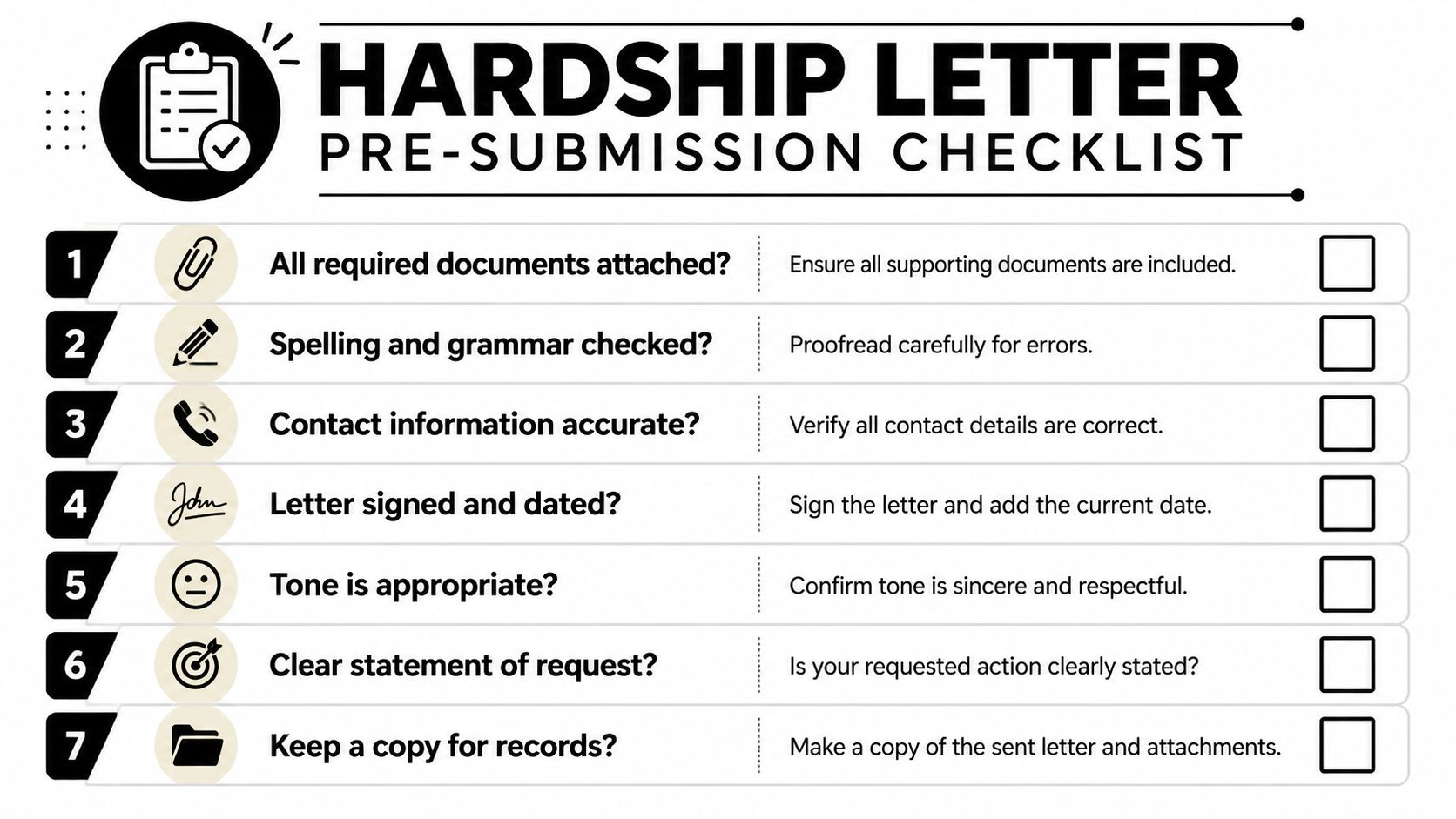
Use a disciplined review pass before anyone signs.
- Check identities carefully: Names, relationships, case numbers, A-numbers where appropriate, and dates of key events should match the rest of the filing.
- Trim unsupported statements: If a sentence cannot be tied to a document, affidavit, or expected testimony, reconsider whether it belongs.
- Reference attachments clearly: If the letter mentions treatment, school problems, financial strain, or caregiving needs, make sure the related records are attached or available in the packet.
- Keep it readable: If the letter sprawls, tighten it. Guidance across hardship-letter practice often converges on brevity, and that discipline helps immigration filings too.
- Proofread for tone: Remove sarcasm, blame, argument with the government, and statements that sound rehearsed rather than sincere.
A short final question helps: if a stranger picked up only this letter and the attached exhibits, would the hardship claim still make sense?
Submission habits that prevent avoidable problems
Process mistakes can undercut good writing. Legal-aid guidance on hardship requests emphasizes building a traceable record of communication, including contacting the relevant decision-maker first and sending the material directly to the right person when appropriate, often by certified mail, so the request is documented as made and received, as explained by People's Law Library's hardship letter guidance.
For immigration cases, adapt that idea carefully to the actual filing process used by counsel:
Confirm who should receive the letter
In many cases, the attorney will submit it as part of a larger packet. The client should not send independent materials unless instructed.Keep a clean copy of everything
Save the signed letter, translations if any, and all attachments in the same order they were submitted.Verify signature and date
An unsigned letter looks unfinished. A dated letter is easier to place in the record.Check translation needs
If the writer used a language other than English, make sure the filing includes a proper translation approach consistent with counsel's practice.Preserve the submission trail
Save delivery confirmations, portal receipts, attorney transmittals, and any follow-up correspondence.
Final check: The best hardship letter is not the most dramatic one. It is the one that a lawyer can file confidently, a clinician can support if needed, and an adjudicator can follow without confusion.
When someone asks how to write a letter of hardship, the answer is not “write from the heart and hope it lands.” The better answer is this: write a restrained, evidence-linked account of real impairment and foreseeable consequences, then fit that account carefully into the legal file.
If your case needs clinically rigorous psychological evidence to support an immigration hardship narrative, Pro Psychological Analysis works with attorneys to produce evidence-based evaluations for waivers, VAWA, U visas, T visas, asylum matters, and related filings. Their reports are built for legal use, align with case strategy, and translate trauma, symptoms, and functional impairment into documentation that USCIS and immigration courts can meaningfully evaluate.