
You're likely looking at a case file right now where the hardship is obvious to any humane reader, yet the evidence still feels thin. The client's declaration is compelling. The spouse, parent, or child describes fear, isolation, dependence, and the practical fallout of separation or removal. But when you ask the question that matters in litigation, “How do I prove this in a way that survives skepticism?”, the record gets soft around the edges.
That gap is where a social support assessment becomes strategically useful. In immigration work, hardship often turns on more than diagnosis. It turns on who helps the person function, who stabilizes them, who translates, who drives them, who watches the children, who buffers trauma, and what happens when that network is fractured or absent. A well-executed assessment doesn't just say someone feels alone. It documents the nature, quality, and reliability of support in a way that can be tied to legal consequences.
For attorneys, that matters because adjudicators often discount unsupported narratives as subjective. Forensic evaluation can convert those same facts into structured findings that are harder to wave away.
Table of Contents
- The Missing Evidence in Your Hardship Case
- Defining Social Support for Legal Arguments
- How Social Support Is Measured in a Forensic Context
- Recommended Instruments for Social Support Assessment
- Best Practices for Documenting Assessment Findings
- Ethical and Cultural Considerations for Immigrant Clients
- Integrating Assessment Findings into Your Legal Strategy
The Missing Evidence in Your Hardship Case
A familiar problem in hardship cases is that the story is strong, but the file doesn't yet show the mechanism of harm. The record may include affidavits describing depression, fear, dependency, or social isolation, yet nothing ties those experiences to a structured assessment of what support exists, what support is missing, and why that matters functionally.
That omission creates room for an adjudicator to minimize the hardship. If the relative has extended family somewhere, speaks to friends occasionally, or belongs to a faith community, the government can imply that support is available without ever testing whether it is reliable, accessible, or relevant to the person's actual needs.
A social support assessment helps close that gap. It gives you a disciplined way to document whether the client has emotional support, practical help, guidance, validation, or only the appearance of a network. In many cases, the issue isn't whether names can be listed on a form. It's whether those people can and do provide meaningful support under stress.
Practical rule: Hardship arguments get stronger when you can show not just that separation would hurt, but how the loss of specific support functions would impair daily life, safety, treatment adherence, parenting, or coping.
This is especially useful when you're building out the evidentiary record around declarations and narrative materials such as a hardship letter for immigration evidence. The declaration tells the human story. The assessment tests and organizes it. Together, they do more than repeat the same point in different words.
In practice, that means the clinician's job isn't to decorate the case with mental health language. It's to identify the missing evidentiary bridge between lived hardship and legally persuasive documentation.
Defining Social Support for Legal Arguments
Social support isn't a vague sense of belonging. In forensic work, it refers to identifiable resources a person can draw on when distressed, impaired, overwhelmed, or placed under unusual strain. For immigration attorneys, that distinction matters because hardship claims often rise or fall on whether the record shows concrete dependency and foreseeable disruption.
What lawyers need to hear in plain terms
The cleanest way to think about social support is through four functions.
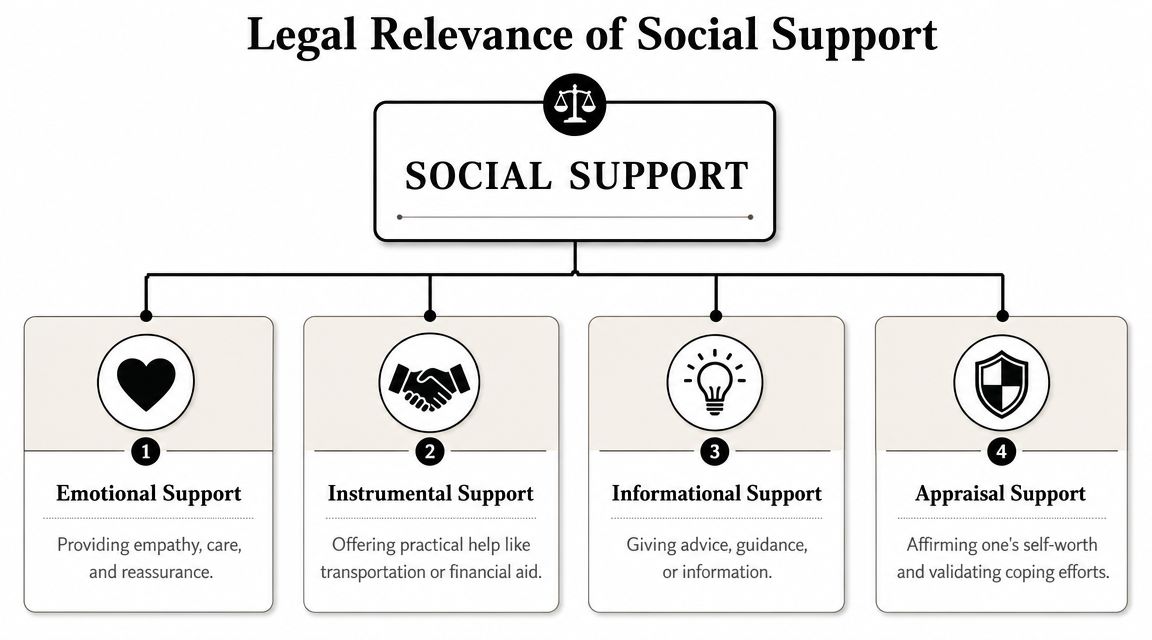
Emotional support includes empathy, care, reassurance, and steady presence. In legal terms, this often matters when a qualifying relative relies on a spouse or family member to regulate anxiety, trauma symptoms, grief, or fear.
Tangible support means practical assistance such as transportation, childcare, household help, financial organization, accompaniment to appointments, or physical care during illness. This is often the most persuasive category because it's concrete and easier to corroborate.
Informational support includes advice, guidance, translation of complex systems, and help making decisions. In immigration matters, this can be critical where a client depends on a particular person to navigate schools, medical systems, or bureaucratic demands.
Appraisal support refers to affirmation, reality testing, and feedback that helps a person judge situations accurately and maintain self-worth. This is highly relevant in trauma cases, domestic violence cases, and claims involving coercive control, where the loss of a stabilizing person can deepen confusion, self-blame, or vulnerability.
A strong legal argument doesn't collapse these into one broad statement that “the family is close.” It identifies which support functions are present, which are absent, and which would be lost or degraded by removal, detention, relocation, or family separation.
Why this matters in common immigration matters
Different forms of relief make different support deficits legally important.
In an extreme hardship case, loss of practical support can show why relocation or separation would disrupt caregiving, treatment routines, transportation, and household functioning in a way that exceeds ordinary consequences. In VAWA, T visa, or U visa work, emotional and appraisal support may help explain why the client's functioning depends on a limited circle of trusted people and why isolation increases vulnerability.
For asylum matters, informational support can become central where a person relies on a small network for safe navigation, interpretation, community contact, and basic orientation. If that support is unavailable in the destination country, the hardship narrative gains structure.
One reason this belongs in evidence rather than intuition is that social support can be measured and interpreted against normative patterns. A validation study of the F-SozU K-6 in adults over 60 found a mean social support score of 23.97 with a standard deviation of 4.82, and women scored slightly higher than men, which illustrates that support is a measurable construct with group-level variation rather than a purely impressionistic idea (validation findings on F-SozU K-6 in older adults).
When an attorney can show that “support” means specific, measurable functions, the hardship argument stops sounding sentimental and starts sounding evidentiary.
How Social Support Is Measured in a Forensic Context
The first forensic mistake is treating social support like a yes-or-no question. A client can have relatives, phone contacts, church attendance, and still have very little usable support. Another client can have a small network and be well buffered because the support they receive is stable, trusted, and responsive.
That's why a serious social support assessment separates concepts instead of flattening them.
Perceived support is not the same as received help
Perceived support asks whether the person believes help is available if needed. Received support asks what help has been provided. In litigation, that difference matters a lot.
A person may report that family members exist but are emotionally unavailable, hostile, geographically unreachable, financially strained, or unsafe to rely on. If an adjudicator sees only the existence of family ties, the record may look stronger than the client's actual situation. Perceived support captures that gap.
There's a similar distinction between structural support and functional support. Structural support refers to the network itself. Functional support refers to what that network does. Lawyers often get handed evidence of structure, names, relationships, addresses, and occasional contact. Hardship often turns on function.
For that reason, I'm wary of reports that summarize social support in one sentence or one global impression. The better model is multidimensional. Evidence from underserved older adults showed that treating support as a single score is a mistake and that assessment should distinguish constructs such as social interactions, satisfaction with support, and perceived isolation, because baseline differences and change varied across those measures (multidimensional assessment findings in underserved older adults).
A good evaluation separates the strands
A defensible forensic assessment usually combines several sources:
- Clinical interview data that identifies who provides help, in what form, how often, and under what limits.
- Standardized instruments that measure perceived support in a structured way.
- Collateral logic that tests whether the claimed network is realistically available.
- Contextual analysis that connects support deficits to the legal issue, such as relocation, separation, trauma recovery, or caregiving burden.
If the clinician uses a structured interview process well, the report becomes far more useful to counsel because the findings are organized around replicable questions rather than intuition. Attorneys who want to understand that process usually benefit from reviewing how a structured interview in psychological evaluation sharpens reliability and reduces loose, impressionistic conclusions.
A support network on paper isn't the same as a support network under pressure.
In cross-examination terms, this is the difference between a report that can defend its reasoning and one that collapses when asked, “How do you know those relatives wouldn't help?”
Recommended Instruments for Social Support Assessment
Not every instrument belongs in an immigration evaluation. The best tools are brief enough to be practical, established enough to be defensible, and specific enough to help the evaluator say something more precise than “the client feels unsupported.”
What makes a tool useful in immigration work
I favor instruments that do one of two things well. Either they measure the perceived adequacy of support from identifiable sources, or they measure whether support is available if needed across meaningful domains. That difference isn't academic. It shapes how you argue the case.
The history of this area also matters. Social support assessment used to be fragmented. A classic review identified 23 different instruments in the field, while later tools moved toward shorter, more standardized formats. The MSPSS uses 12 items and classifies support into low (12 to 35), medium (36 to 60), and high (61 to 84) ranges, a shift that improved feasibility while preserving structured measurement (history of social support measurement and MSPSS scoring ranges).
That move toward concise tools is useful in forensic practice because overburdening vulnerable clients can distort the evaluation. Brevity helps when trauma, fatigue, and interpreter use already slow the interview.
A broader clinical framework also helps attorneys evaluate the evaluator. If the report uses standardized tools as part of an integrated case formulation rather than as a stand-alone shortcut, it's usually stronger. That's the same logic behind a sound clinical assessment in forensic practice.
Comparison of Social Support Assessment Tools
| Instrument | Measures | Number of Items | Best Use Case for Immigration Law |
|---|---|---|---|
| MSPSS | Perceived adequacy of support from family, friends, and a significant other | 12 | Useful when the legal issue centers on who the client relies on and whether those specific relationships are strong, weak, or absent |
| MOS Social Support Survey | Availability of support if needed across domains including emotional support and tangible help | 19 | Useful when counsel needs to show whether support is realistically available during illness, crisis, or daily functioning demands |
| NIH Toolbox social relationship scales | Brief self-report scales covering emotional support, instrumental support, friendship, loneliness, perceived rejection, and perceived hostility | Brief scales | Useful when the evaluator wants a wider map of social connection and strain across the lifespan |
The MSPSS is especially practical because it is short and source-specific. Published guidance describes it as a 12-item measure using a 5-point Likert scale, with mean scores of 1.0 to 2.9 as low, 3.0 to 5.0 as moderate, and 5.1 to 7.0 as high perceived support (published MSPSS description and scoring guidance). In a hardship case, that can help distinguish a client who has nominal family ties from one who perceives those ties as dependable.
The MOS Social Support Survey is different in a way lawyers often appreciate. It is a 19-item, multidimensional, self-administered instrument designed to measure whether support is available if needed across areas such as emotional support and tangible help. That makes it well suited to cases where the central question is not social contact, but whether the person could count on help during crisis, illness, childcare disruption, or psychological decline.
Neither instrument should be used mechanically. The MSPSS is often cleaner when the case turns on relationship-specific dependency. The MOS is often stronger when the case turns on practical accessibility of help under strain. The best reports explain why the evaluator chose the instrument, not just what score came out.
Best Practices for Documenting Assessment Findings
Scores don't persuade adjudicators by themselves. Interpretation does. A forensic report has value when it translates the assessment into a clear statement about functioning, corroboration, and legal significance.
What a defensible write-up looks like
The write-up should do five things at once. It should identify the instrument, explain what it measures, report the result accurately, connect the result to interview data, and tie the finding to the hardship theory in the case.
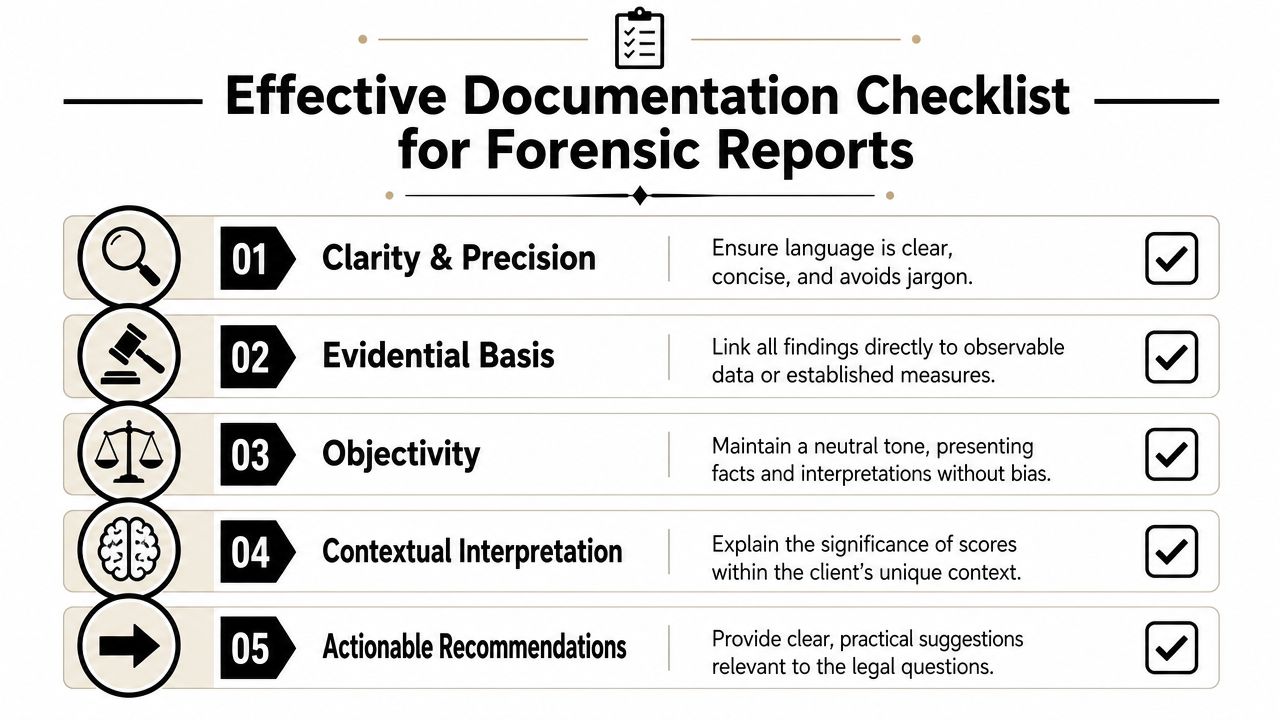
One useful example is the MOS Social Support Survey. Because it measures whether support is available if needed across domains like emotional support and tangible help, it helps the evaluator distinguish between the mere presence of contacts and the client's perceived access to usable support (MOS Social Support Survey description and forensic relevance). That distinction is often exactly what a hardship brief needs.
A weak sentence says, “Client has limited support.” A stronger paragraph says that the client's responses indicate limited perceived availability of emotional and tangible support, that this pattern is consistent with the interview history, and that the deficit bears directly on daily functioning if separation or relocation occurs.
Phrasing that helps rather than hurts
Attorneys should expect report language that is cautious, concrete, and tied to data. Useful phrasing often sounds like this:
- Instrument statement: “The evaluator administered the MSPSS, a standardized measure of perceived support from family, friends, and a significant other.”
- Interpretive statement: “The obtained score falls within the low perceived support range.”
- Corroborative statement: “This finding is consistent with the examinee's credible report that family relationships are strained, geographically limited, or unavailable during crisis.”
- Functional nexus: “Reduced support increases the likelihood of difficulty managing childcare, transportation to treatment, emotional regulation, and adherence to medical or legal obligations.”
- Legal relevance: “The loss of this support is therefore relevant to the claimed hardship because it affects functioning in concrete, foreseeable ways.”
Drafting tip: The best paragraph links score, story, symptom pattern, and legal consequence in one continuous line of reasoning.
What doesn't work is overclaiming. Don't let the report say that low support “proves” a legal element. It doesn't. It strengthens the factual basis for the legal argument. That distinction protects admissibility and credibility.
A disciplined report also acknowledges limits. If support appears mixed, say so. If one family member is reliable but others aren't, that nuance often makes the whole document more believable. In forensic settings, precision beats advocacy language every time.
Ethical and Cultural Considerations for Immigrant Clients
Immigration evaluations fail when they confuse visibility with support. Many immigrant clients belong to dense family or community networks, but that doesn't automatically mean usable help is available. Shame, fear, status concerns, trauma history, language barriers, economic strain, and coercive family dynamics can all restrict access to support that appears intact from the outside.

Context changes the meaning of support
A context-sensitive evaluation asks more than “Who do you have?” It asks who the client can safely call, who understands the problem, who can offer concrete help, and what social or cultural costs come with asking.
That matters because group differences can disappear when context is properly analyzed. In a U.S. study, immigrant status was associated with less frequent emotional support in unadjusted models, but those differences disappeared after adjustment for socioeconomic and health context, showing why one-size-fits-all screening can overstate group differences (context-sensitive findings on immigrant status and emotional support).
That finding should make attorneys cautious about simplistic narratives. The question isn't whether immigrants as a category “have less support.” The question is whether this client, in this setting, under these constraints, has meaningful support that would remain available under the legal scenario at issue.
A culturally competent evaluator also has to account for language and interpretation. If the assessment is done through an interpreter, the clinician should consider whether concepts like reassurance, burden, obligation, dependence, or isolation translate cleanly in the client's language and cultural frame.
Cultural humility matters because people don't all define “support” the same way, and adjudicators often assume they do.
Later in the interview, it can help to ground the client before shifting to more difficult material. This brief resource is often useful in that context:
The evaluator is not the client's advocate
The strategic importance of ethics becomes evident. The evaluator's role is to provide an independent opinion, not to produce a favorable narrative at any cost. That independence is what gives the report weight.
A trauma-informed approach doesn't mean uncritical acceptance of every statement. It means eliciting information carefully, avoiding needless re-traumatization, using qualified interpreters where needed, explaining confidentiality and its limits, and documenting both strengths and vulnerabilities with accuracy.
For attorneys, that's not a drawback. It's an advantage. Reports that acknowledge complexity usually withstand scrutiny better than reports that sound like argument masquerading as science.
Integrating Assessment Findings into Your Legal Strategy
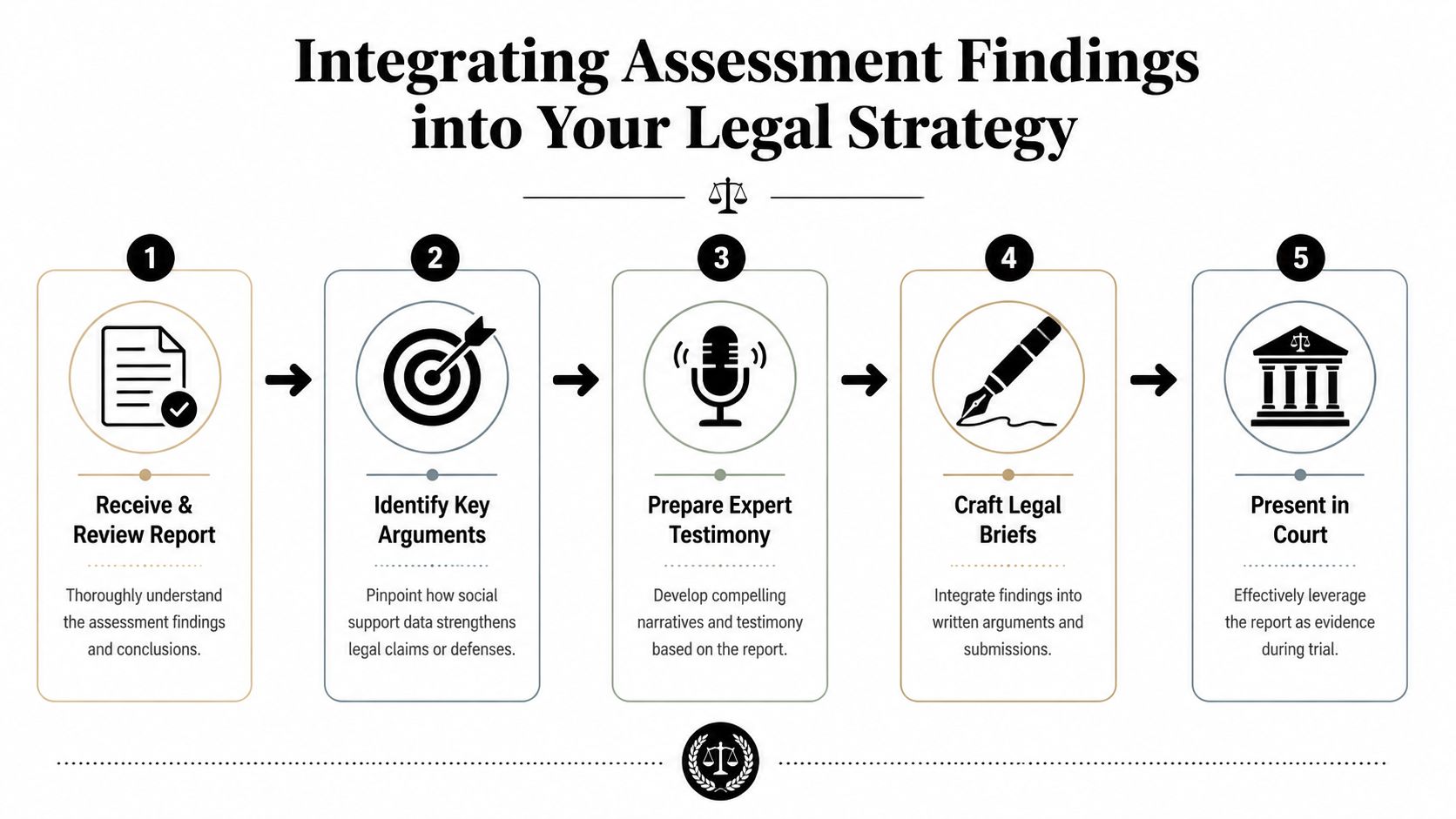
A social support assessment has no strategic value if it sits in the exhibit packet untouched. Its value comes from how you use it to sharpen theory, structure testimony, and rebut predictable government assumptions.
Use the report as proof, not decoration
Start by pulling out the findings that do actual work in the case. You're looking for statements that connect support deficits to identifiable consequences. Those may involve parenting burden, treatment adherence, trauma recovery, medical fragility, practical dependence, or the absence of any reliable fallback if the client is removed or the family is separated.
Then integrate those findings in three places:
- The legal brief should cite the support findings as objective corroboration of hardship, not as a generic mental health add-on.
- The affidavit or declaration should use ordinary language that mirrors the report's core conclusions without sounding scripted.
- Direct examination should walk the witness through the functions of support that are at stake.
A common government response in hardship cases is that the person can rely on relatives, friends, or community resources. Social support findings help you answer that point with specificity. The issue isn't whether some contact exists. The issue is whether the identified support is available, trusted, safe, and sufficient for the person's actual needs.
Prepare testimony around the strongest support findings
Use the report to help the client testify concretely. General statements like “I'd be alone” are easy to discount. Specific testimony is harder to dismiss.
Good testimony tends to answer questions like these:
- Who provides support now: Which person handles transportation, appointments, emotional stabilization, or childcare.
- Why that support matters: What happens when that person isn't available.
- Why alternatives won't substitute: Distance, conflict, finances, health, fear, prior abuse, or practical impossibility.
- What the foreseeable consequence is: Missed care, worsening symptoms, inability to work, impaired parenting, or heightened vulnerability.
The strongest use of a social support assessment is to rebut the lazy assumption that “someone else will help.”
When the legal theory, affidavit, and testimony all point to the same support-related mechanism of hardship, the report becomes more than a credentialed attachment. It becomes part of the case's logic.
If your firm needs immigration evaluations that translate clinical findings into legally usable evidence, Pro Psychological Analysis provides forensic psychological assessments for asylum, VAWA, T visa, U visa, and extreme hardship cases. The practice works with attorneys to produce evidence-based reports that document trauma, abuse dynamics, mental health symptoms, and social support deficits with clarity, methodological rigor, and respect for client dignity.