
An immigration attorney often reaches the same frustrating point. The client's record shows “autism,” but the legal problem isn't the label. The problem is that the client gives fragmented timelines, misses implied questions, shuts down under pressure, or appears evasive when overwhelmed. In court or in a USCIS interview, those behaviors can be misread as dishonesty, lack of remorse, poor parenting, or failure to cooperate.
That's where neuropsych testing for autism becomes useful. It does not merely confirm that autism is present. It documents how autism affects attention, judgment, social understanding, language, and day-to-day functioning in ways that matter to legal decision-makers. For an asylum case, that may explain inconsistent testimony. For VAWA or T visa matters, it may clarify vulnerability to coercion, dependency, or inability to detect danger. For hardship cases, it may show why separation from a caregiver would have unusually severe functional consequences.
A diagnosis tells the court what condition the person has. A neuropsychological evaluation helps show what the condition does.
Table of Contents
- Introduction The Diagnostic Label Is Not Enough
- What Neuropsych Testing for Autism Measures
- The Difference From a Standard ASD Evaluation
- A Look Inside the Evaluation Process
- Translating Test Results into Legal Arguments
- Choosing an Evaluator and Forensic Considerations
- Conclusion From Diagnosis to Actionable Evidence
Introduction The Diagnostic Label Is Not Enough
A client with autism appears for an immigration interview alone. He is verbal, polite, and has no obvious psychosis or intellectual disability. Within minutes, the record starts to turn against him. His answers are literal, disorganized, and incomplete. He misses the point of open-ended questions, fails to explain risk in a coherent sequence, and seems oddly passive about exploitation that would alarm any experienced adjudicator.
In that setting, an autism diagnosis by itself does very little. It names a condition. It does not show how the condition affects testimony, decision-making, dependency, susceptibility to manipulation, or the ability to manage ordinary demands in a legally relevant way.
That distinction matters in immigration practice. Adjudicators and reviewing attorneys usually need more than a chart entry stating "ASD." They need evidence that connects the diagnosis to functional limitations in the specific areas the case turns on. Can the person give a reliable narrative? Follow instructions? Recognize social threat? Manage forms, deadlines, and appointments? Live independently without unusual support? A bare diagnostic label rarely answers those questions with enough precision to carry an evidentiary burden.
It also does not sort out competing explanations. In many cases, the primary forensic task is differential attribution. Counsel must know whether the client's presentation is better explained by autism, trauma, anxiety, ADHD, depression, cognitive limitation, or a combination of those factors. Without that analysis, opposing counsel or an adjudicator can frame the behavior as evasiveness, poor effort, or simple noncompliance.
Practical rule: If the legal issue involves function, vulnerability, credibility, dependency, or capacity, diagnosis alone usually will not be enough.
I see the same pattern repeatedly in referrals from immigration counsel. The client may look capable on brief contact, especially if verbal ability is stronger than judgment, planning, or social inference. Then the case record shows missed deadlines, inconsistent statements, failure to detect coercion, or heavy reliance on a parent, spouse, or caseworker for tasks that appear routine on paper. Without testing, those facts are easy to misread.
Neuropsychological testing helps convert those facts into evidence. It can show that the problem is not unwillingness, but impaired executive control. Not deception, but weak social comprehension, limited narrative organization, or slowed processing under stress. That kind of opinion is far more useful in an immigration case because it gives counsel a basis to explain conduct, support accommodations, and tie observed impairment to the legal theory of the case.
The legal value is straightforward. A diagnosis tells the court or agency what the condition is. A well-prepared neuropsychological report shows what the person can do, where performance breaks down, what support is realistically required, and how those findings should be interpreted in the context of immigration evidence.
What Neuropsych Testing for Autism Measures
In an immigration case, the question is usually not whether autism is present. The question is how autism affects memory for events, response to authority, ability to follow instructions, independence, susceptibility to manipulation, and stamina during interviews or hearings. Neuropsychological testing addresses those functional questions with objective data.
A diagnosis identifies the condition. A neuropsychological report maps the pattern of strengths, weaknesses, and likely points of failure under real demands.
The functional domains counsel can use
For autism, the most useful neuropsychological domains usually include intelligence, attention, executive functioning, social cognition, and praxis. Those domains are not abstract. They help explain conduct that can otherwise be misread in the record.
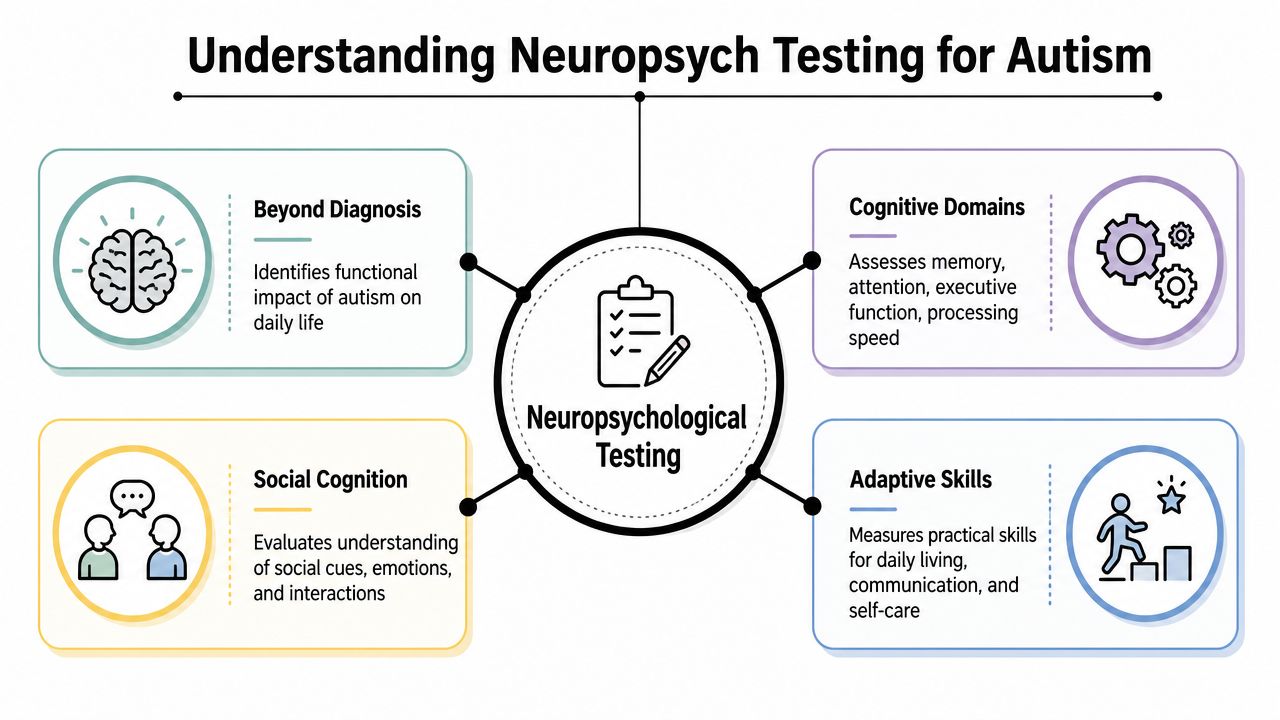
A strong report translates test findings into behaviors the attorney, officer, or immigration judge has already seen. If set-shifting is poor, that can help explain why the client breaks down when instructions change mid-interview. If working memory is weak, it may explain inconsistent sequencing in a declaration without suggesting dishonesty. If social inference is impaired, the report should address literal interpretation, missed cues, and vulnerability in high-pressure interactions with officials, employers, smugglers, or abusive partners.
The same principle applies to adaptive functioning. Test scores matter, but the legal value comes from showing what the client can do alone, what requires prompting, and where supervision is still required. That distinction often carries more weight than a diagnostic label in cases involving hardship, dependency, competence, or need for accommodations.
The domains that tend to matter most in the record
- Intelligence: This helps separate verbal knowledge from judgment and practical reasoning. A client may sound articulate and still have serious difficulty handling unstructured tasks, risk assessment, or independent decision-making.
- Attention: This addresses sustained focus, distractibility, and the ability to retain instructions. In practice, it bears on interview reliability, fatigue, and whether the client can follow multi-step legal directions.
- Executive functioning: This covers planning, organization, inhibition, cognitive flexibility, and problem solving. These findings are often central when the case involves missed deadlines, dependence on others, or apparent noncompliance.
- Social cognition: This examines recognition of social cues, interpretation of motives, and understanding of context. It is often the clearest bridge between autism and vulnerability, suggestibility, or misreading authority-driven encounters.
- Praxis: This concerns the planning and execution of skilled actions. It is less discussed by attorneys, but it can matter when the dispute involves day-to-day independence and functional self-care.
I often see one misleading pattern in immigration files. The client performs adequately in a short, structured meeting, then fails badly when demands become open-ended, unfamiliar, or stressful. Neuropsychological testing can document that split. That is the kind of evidence counsel can use.
For a related example of how domain-based testing supports functional legal arguments, see this discussion of a neuropsychological assessment for ADHD in high-stakes cases.
Neuropsych testing is most useful when the report ties score patterns to specific legal facts, such as inconsistencies, dependence, coercion risk, or the need for procedural accommodations.
The point is the profile, not a single number. Autism-related impairment rarely appears as one neat deficit. What persuades in a forensic setting is a coherent pattern that fits the developmental history, the observed behavior, and the problems already documented in the immigration record.
The Difference From a Standard ASD Evaluation
A common immigration problem looks like this: counsel has an autism diagnosis in the file, the client clearly struggles, and the report still does not answer the question the adjudicator will ask. The missing piece is usually function. In practice, that is the difference between a standard ASD evaluation and a neuropsychological evaluation.
Two evaluations, two legal uses
A standard ASD evaluation is built to answer a diagnostic question. Does the person meet criteria for autism spectrum disorder? Those evaluations often rely on autism-specific instruments such as the ADOS-2 and ADI-R, along with developmental history and clinical observation. That can be enough if counsel only needs to establish that autism is present.
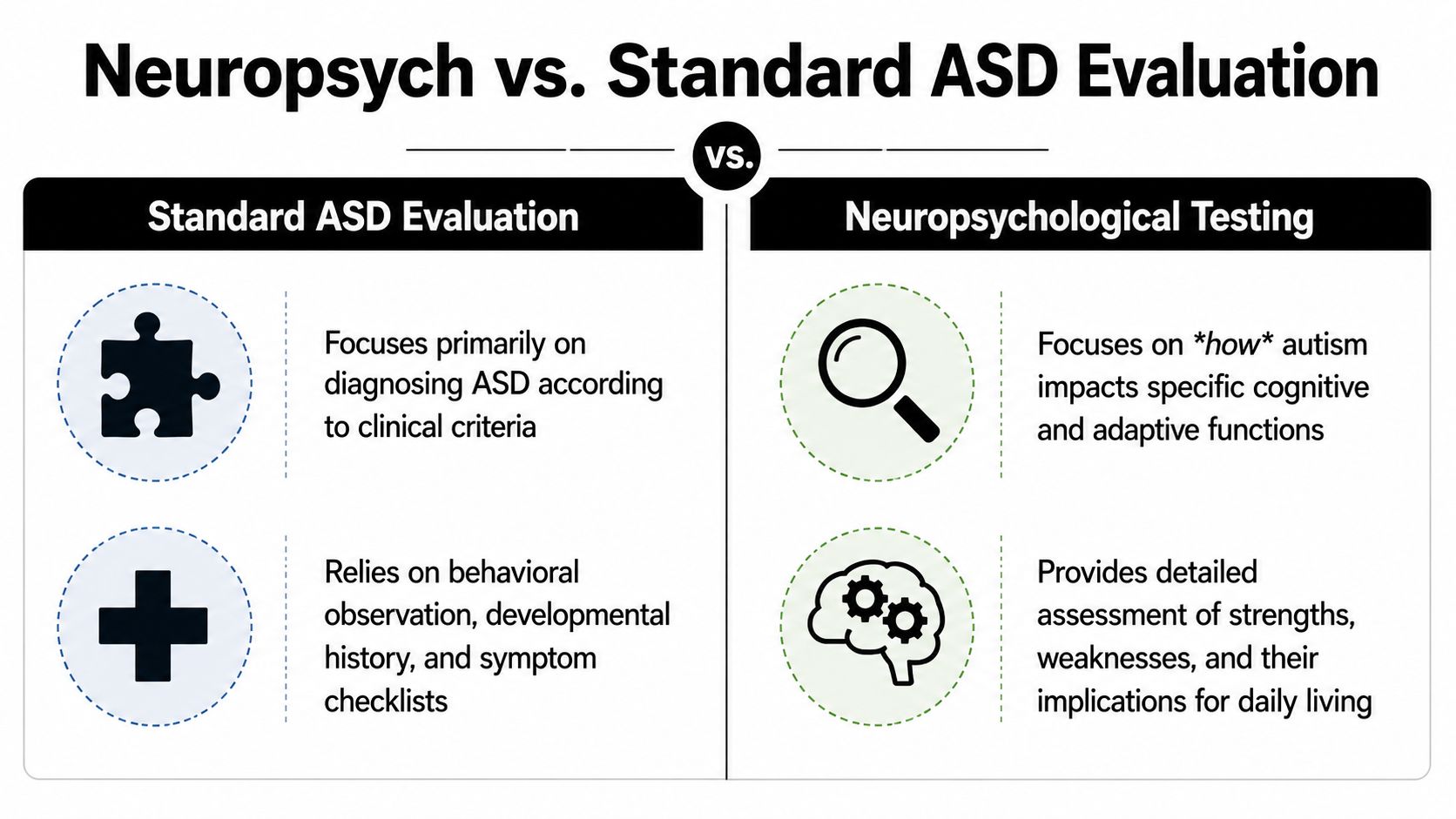
A thorough neuropsychological evaluation answers a different question. It examines how autism affects attention, executive control, language, memory, social reasoning, adaptive judgment, and day-to-day functioning under real demands. For immigration cases, that broader profile is often what turns a diagnosis into usable evidence.
Here is the practical distinction:
| Evaluation type | Main question | Typical output | Best legal use |
|---|---|---|---|
| Standard ASD evaluation | Does the person meet ASD criteria | Diagnostic conclusion | Establishing the presence of autism |
| Neuropsychological evaluation | How does autism affect functioning | Cognitive and functional profile | Proving impact, dependency, vulnerability, or explanation of behavior |
Why this distinction matters in immigration practice
USCIS, immigration judges, and opposing counsel usually need more than a label. They need a reasoned explanation for specific limitations that matter to the case. Can the client manage paperwork without assistance? Do they misread authority figures or social intent? Does stress cause disorganization, concrete thinking, or inconsistent reporting that could be mistaken for evasiveness?
A standard ASD evaluation may support background and diagnosis. It often does not fully address capacity, reliability, susceptibility to coercion, or the need for accommodations during interviews and testimony. A neuropsychological evaluation is better suited to those questions because it measures performance across domains and ties deficits to functional consequences.
This distinction also matters when autism is not the only issue in the record. Some clients show overlapping problems with attention, impulse control, learning, or emotional regulation. In those cases, counsel should consider whether the referral needs a broader battery, including issues commonly addressed in a neuropsychological assessment for ADHD in high-stakes cases.
The legal strategy should drive the referral. If counsel needs a diagnosis, a standard ASD evaluation may be sufficient. If counsel needs to explain fragmented testimony, dependence on caregivers, poor judgment in unsafe relationships, or difficulty functioning independently in a complex system, a neuropsychological evaluation is usually the more probative report.
A Look Inside the Evaluation Process
A common failure point is timing. Counsel learns two weeks before filing that the client has a prior autism diagnosis, assumes that diagnosis will carry the case, and then requests a neuropsychological evaluation on an emergency schedule. The result is often a thin report, missing records, or findings that do not answer the legal question.
A useful evaluation starts with a referral framed in legal terms. “Evaluate for autism” is usually too vague for immigration work. Counsel should specify what must be proved or explained: whether the client can complete forms without help, whether social misreading increases vulnerability to exploitation, whether stress disrupts recall, or whether the client needs accommodations for interviews, declarations, or testimony.
Before any testing begins, the evaluator should review the file with that purpose in mind. That includes prior diagnoses, school records, treatment notes, developmental history, work history, affidavits, and counsel's case theory. In my experience, weak forensic reports usually fail at this stage. They gather clinical information but do not sort it by evidentiary value.
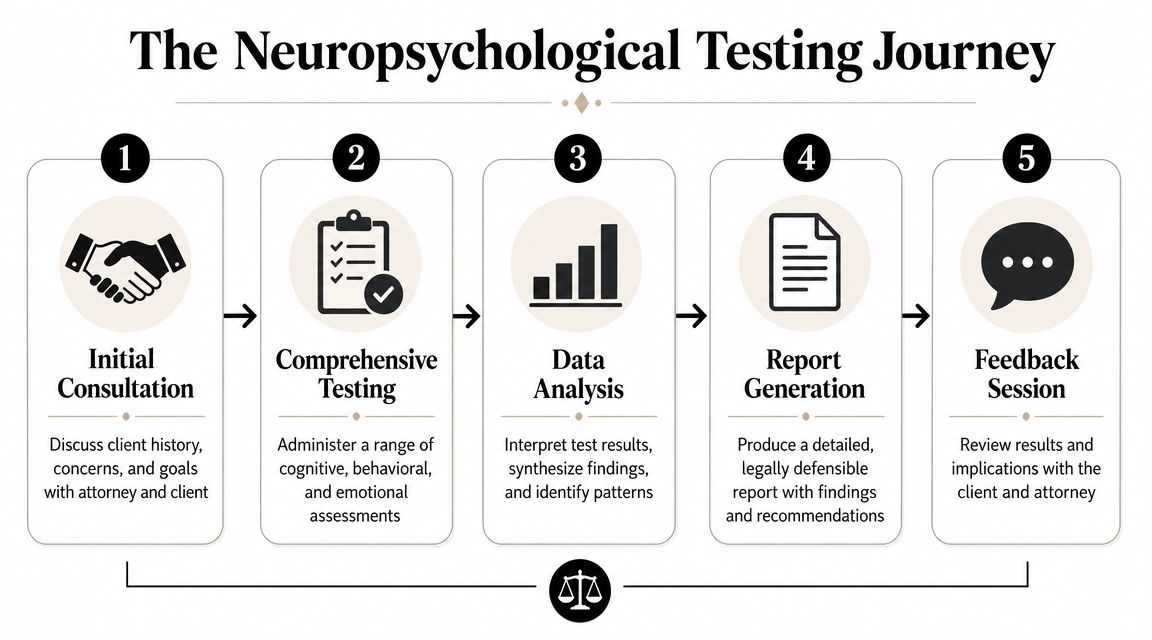
For attorneys who want a clearer sense of the sequence, this overview of the full neuropsychological evaluation process outlines what the work generally covers from intake through reporting. Autism-focused cases often require hours of direct testing plus separate time for scoring, record review, and written analysis. That has practical consequences for deadlines, interpreter coordination, and client preparation.
What happens during and after testing
The testing session is usually built from several parts, selected to answer the referral question rather than to fill a standard battery.
Clinical interview
The evaluator documents developmental history, education, work, relationships, medical and psychiatric history, daily functioning, and the client's account of current limitations. In immigration cases, this interview also helps identify whether language barriers, trauma exposure, or cultural factors may affect performance and interpretation.Autism-focused measures
If diagnostic clarification is still at issue, the evaluator may include an instrument such as the ADOS-2 along with rating scales and collateral history. The point is not merely to confirm a label. It is to define how autistic traits appear in communication, reciprocity, flexibility, and behavior under social or cognitive demand.Cognitive and executive testing
These measures examine attention, processing speed, working memory, reasoning, planning, inhibition, and related functions. For legal purposes, the question is functional. Can the client follow multistep instructions, organize documents, shift topics without losing accuracy, or respond reliably when pressured?Adaptive and behavioral interpretation
Test scores are only part of the record. The evaluator must compare formal results with observed behavior, collateral reports, and real-world functioning. A client who can answer structured test items may still be unable to manage appointments, travel alone, or recognize manipulation in unscripted settings.
The report should answer the attorney's question in forensic terms, with clinical support for each conclusion.
The analysis after testing is where the opinion either becomes useful or falls apart. Raw scores do not explain why a client gave fragmented answers at an asylum interview. The evaluator has to integrate performance data, language ability, behavioral observations, symptom validity, and the consistency of outside records. That synthesis is what allows counsel to argue dependency, diminished functional capacity, accommodation needs, or vulnerability in a way the court can follow.
One practical point deserves attention. If the case may require a declaration, live testimony, or a filing on a fixed schedule, discuss timing with the evaluator at the outset. Good forensic work takes coordination and careful writing. A rushed opinion is easier to attack on cross-examination and harder to use in a brief.
Translating Test Results into Legal Arguments
The report becomes valuable when the attorney can turn clinical findings into legally relevant propositions. That means moving from “the client has weak executive function” to “the client cannot reliably organize multi-step tasks without supervision, which bears directly on hardship, dependency, and daily functioning.”

From score patterns to case theory
Neuropsychological interpretation relies on norm-referenced comparison. The value comes from the profile of strengths and weaknesses against age-matched norms, not from one cutoff score. That same interpretive approach is especially important in autism because specific language difficulties in semantics, speech output or comprehension, and pragmatic language can directly affect test validity and the person's ability to coherently describe past events (guide to interpreting neuropsychological testing reports).
That has immediate immigration relevance. In testimony-driven cases, a client may appear inconsistent when the actual problem is pragmatic language impairment, weak narrative organization, literal interpretation, or poor comprehension of compound questions. A careful report can help counsel explain why fragmented testimony is not necessarily deception.
Different findings can support different legal arguments:
- Executive dysfunction: Useful where the case turns on independent functioning, care needs, or inability to manage complex systems without support.
- Impaired social cognition: Relevant when the client was vulnerable to manipulation, coercion, abuse, or exploitative relationships.
- Attention and processing inefficiency: Important when the record contains inconsistent timelines, incomplete responses, or failure to follow multi-step instructions.
- Language-based impairment: Critical when declarations, interviews, and cross-examination depend on coherent narrative recall.
What attorneys should pull from the report
A neuropsychological report shouldn't sit in the exhibit packet as background reading. It should shape how the case is presented. Attorneys often benefit from reviewing a sample neuropsychological evaluation for adults to see how findings can be organized for persuasive use.
Look for these pieces:
- Functional conclusions: Not just “low” or “average,” but what the pattern means in daily life.
- Behavioral observations: How the client responded to structure, ambiguity, fatigue, and social demands during the exam.
- Differential explanation: Whether the evaluator separates autism-related limitations from trauma, anxiety, ADHD, or mood symptoms.
- Forensic linkage: Whether the report explicitly ties findings to dependency, credibility concerns, vulnerability, or need for accommodation.
A strong report gives the court a reasoned explanation for behavior that otherwise looks confusing, resistant, or unreliable.
That is the bridge between clinical science and legal persuasion.
Choosing an Evaluator and Forensic Considerations
Not every competent clinician is the right evaluator for an immigration case. Treatment skill and forensic skill overlap, but they aren't identical.
What to look for before you refer
The evaluator should understand autism across presentation styles, including clients whose social or language features are subtle enough to be missed in ordinary interviews. They should also know how to distinguish developmental impairment from trauma responses, anxiety, depression, and attention-related symptoms.
For immigration work, ask practical questions:
- Forensic writing experience: Can the evaluator explain findings in plain language suitable for USCIS, immigration court, and attorney use?
- Instrument selection: Do they choose tools based on the referral question, rather than giving the same battery to every client?
- Collateral integration: Will they review declarations, prior records, school history, and attorney concerns?
- Availability for clarification: If counsel needs an addendum or testimony preparation, can the evaluator support that process?
One option attorneys may consider is Pro Psychological Analysis, which provides psychological evaluations for immigration matters and works with case-specific referral questions. What matters most, however, is not the practice name. It's whether the evaluator can produce a report that is clinically sound, carefully limited, and legally usable.
Clinical usefulness is not the same as forensic usefulness
A treatment report may be perfectly appropriate for therapy planning and still be weak evidence. Forensic reports need tighter reasoning. They must identify what data were reviewed, what tools were used, how conclusions were reached, what limitations exist, and what the findings do and do not establish.
That restraint matters. An evaluator should not overclaim. They can explain how autism-related deficits affect communication, judgment, dependency, and vulnerability. They should not speculate beyond the data or act as an advocate disguised as an expert.
Confidentiality also needs attention from the start. In immigration practice, records may become part of a filing or hearing record. The client should understand who the intended audience is, how information will be used, and where clinical privacy gives way to forensic disclosure.
The best evaluator for these cases is usually the one who can hold both realities at once. They understand the person clinically, and they write for the legal forum that will decide the case.
Conclusion From Diagnosis to Actionable Evidence
When autism affects an immigration case, the central problem usually isn't whether a diagnosis exists. It's whether anyone has translated that diagnosis into evidence the court can use. A file may already contain medical records, therapy notes, or a prior ASD diagnosis. Those documents help, but they often stop short of the question that matters most. How does this condition affect function in the settings relevant to the case?
That is where neuropsych testing for autism becomes strategically important. It can identify the client's pattern of strengths and weaknesses, clarify whether testimony problems reflect language and social-communication limits rather than dishonesty, and document why support needs or vulnerability are greater than they appear.
For immigration attorneys, the practical takeaway is simple. Refer for this type of evaluation when the legal issue turns on functioning, dependency, vulnerability, or misunderstood behavior. Ask a focused referral question. Expect a substantial process. Use the final report as evidence, not decoration.
A well-done forensic neuropsychological evaluation turns confusing behavior into a coherent clinical explanation. In immigration court and before USCIS, that difference can matter.
If your case needs a psychological report that connects autism-related findings to the actual legal standard, Pro Psychological Analysis can serve as a clinical partner to immigration counsel. The practice provides immigration-focused evaluations designed to translate psychological data into clear, defensible findings for asylum, VAWA, T visa, U visa, and hardship matters.