
You're probably dealing with a file that looks straightforward on paper and unstable in practice. The client is older, anxious, forgetful, traumatized, cognitively slowed, or all of the above. Family members insist the person cannot learn English or retain civics material. A doctor is willing to help. Someone says, “We just need the waiver form.”
That mindset sinks cases.
An N-400 medical waiver is not a mercy request. It is a legal claim built through medical evidence. The claim succeeds only when the record shows that a qualifying condition directly prevents the applicant from learning or demonstrating the English and/or civics knowledge required for naturalization. If that link is thin, the file invites scrutiny. If that link is clear, specific, and clinically grounded, the case becomes far more defensible.
Most weak waiver cases fail for predictable reasons. The diagnosis is real, but the explanation is vague. The clinician describes symptoms, but not functional limits. The lawyer files too early, or too late, or without checking whether the medical narrative matches the applicant's history and interview presentation. In harder cases, the disability is psychological or neurocognitive rather than obvious on sight, which makes the quality of the clinical explanation even more important.
Table of Contents
- The Strategic Role of the N400 Medical Waiver
- Who Qualifies for a Medical Waiver
- Mastering Form N-648 and USCIS Evidence
- The Role of Psychological Evaluations in Waiver Cases
- The Waiver Process From Filing to Decision
- Avoiding Common Waiver Pitfalls
- Frequently Asked Questions About the N400 Waiver
The Strategic Role of the N400 Medical Waiver
A client walks into the naturalization consult speaking politely, answering basic questions, and following the conversation well enough that everyone assumes the case is routine. Six months later, interview prep exposes the underlying problem. The client cannot retain civics material, cannot process test-style questions consistently, or shuts down when asked to recall basic facts. By that point, the case has a timing problem, an evidence problem, and often a credibility problem.
That is why the N-400 medical waiver matters strategically. It is not just an accommodation request attached to a naturalization filing. It is the mechanism that lets counsel define the case early, with a medical explanation that connects the applicant's condition to the specific testing requirements they cannot meet.
Handled well, the waiver changes how the file is read. The officer is not left to sort through scattered treatment notes, family explanations, and inconsistent interview performance. The record starts with a focused certification that answers the question USCIS cares about: why this applicant cannot learn, retain, or demonstrate the required English or civics knowledge because of a qualifying impairment.
The waiver is a proof problem
The diagnosis alone rarely carries the case. What decides these files is the link between the condition and the functional limitation.
Junior attorneys often stop at the label. Depression, PTSD, traumatic brain injury, dementia, developmental disability, or another serious condition may be present, but USCIS still needs a usable explanation of how that condition interferes with memory, comprehension, concentration, language processing, or the ability to respond reliably in the testing setting. Without that connection, the form reads like a medical summary instead of evidence.
A strong N-648 gives the officer a clear chain of reasoning in one reading. It identifies the condition, explains how the clinician reached the diagnosis, describes the resulting limitations in concrete terms, and ties those limitations to the applicant's inability to satisfy the naturalization requirements. If that chain is missing, the file invites follow-up, delay, or denial.
Strategy starts before the form
The best waiver cases are built as medical-legal records from the start.
That means the legal theory and the clinical documentation must match. Prior immigration filings, the client's own account, family observations, treatment history, and the clinician's conclusions should all point to the same functional picture. If one part of the file suggests mild forgetfulness while another suggests total inability to learn, the inconsistency becomes the story.
This is where experienced case screening matters. Some files need a treating physician who can explain a long-documented neurological or physical condition. Other files need a formal psychological evaluation because the core issue is not diagnosis in the abstract, but proof of cognitive or psychiatric impairment severe enough to prevent learning or test performance. In close cases, psychological evidence often supplies the missing nexus. It can show, with far more precision than a brief office note, why the applicant's symptoms are not ordinary stress, low education, limited literacy, or age.
Volume does not fix a weak theory. A shorter file with a coherent clinical explanation is usually more persuasive than a stack of records that never squarely address functional inability.
The practical goal is simple. By the time USCIS opens the waiver, the officer should understand what the condition is, how it affects this applicant, and why the limitation prevents compliance with the testing requirements. That level of clarity is what gives the case its best chance of success.
Who Qualifies for a Medical Waiver
A client may have obvious memory problems, years of school difficulty, and real anxiety about the interview, yet still fail to qualify for an N-648. That is the first screening point junior attorneys need to internalize. USCIS is not asking whether the applicant will have a hard time with English and civics. USCIS is asking whether a medically determinable impairment prevents the applicant from learning or demonstrating the required material.
The waiver is narrow by design
Form N-648 applies to applicants with a physical, developmental, or mental impairment that has lasted, or is expected to last, at least 12 months. The form can be completed only by a licensed U.S. M.D., D.O., or clinical psychologist. Those threshold rules matter because they force the case theory into a medical framework early. If the file starts as a hardship story, an education story, or an age story, it usually stays weak.
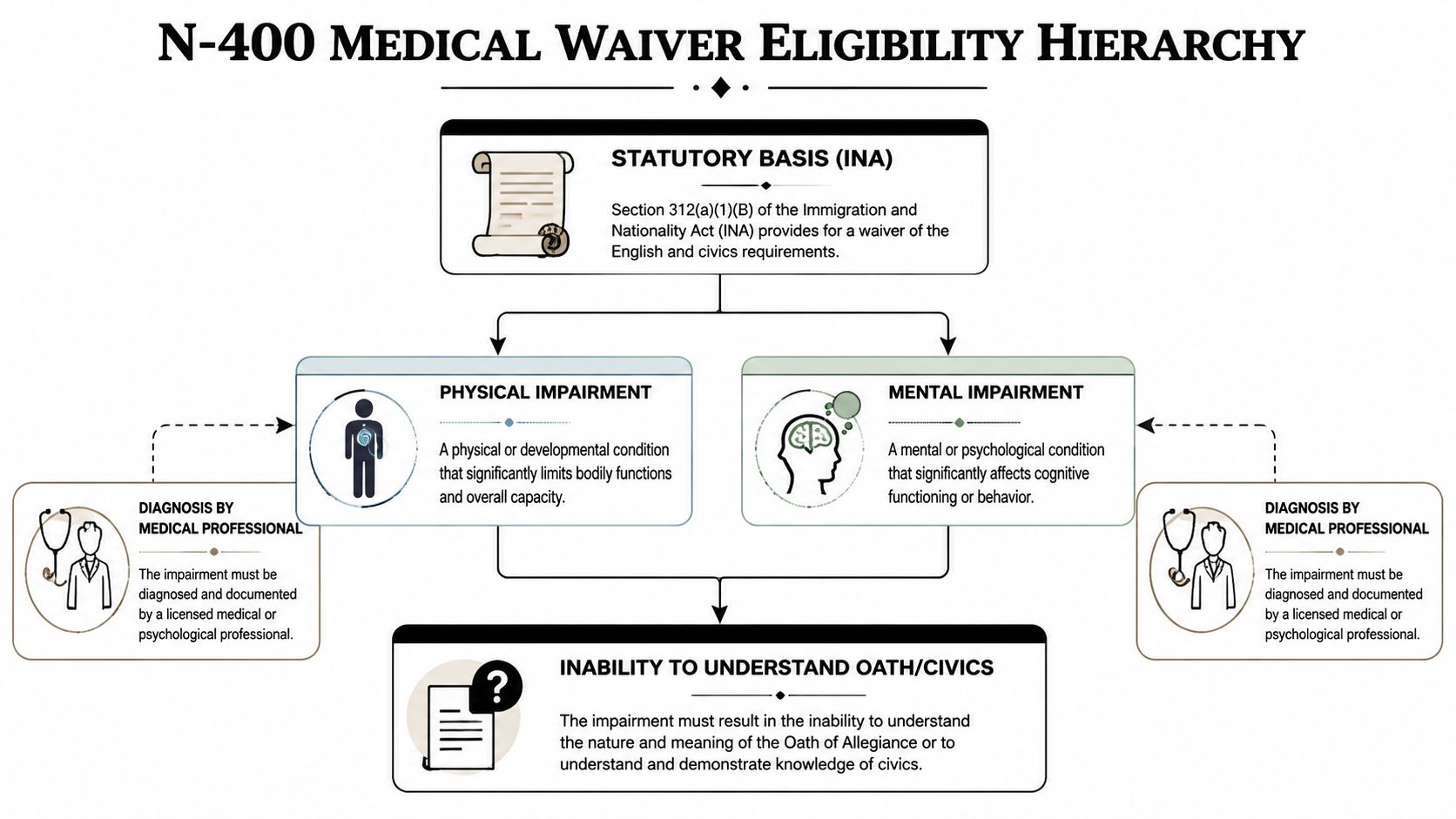
Two questions sort viable cases from sympathetic but non-qualifying ones:
- Is there a medically determinable impairment supported by competent clinical evidence?
- Does that impairment prevent the applicant from learning, retaining, or demonstrating English and or civics knowledge?
The second question is where many cases are won or lost. A diagnosis alone does not answer it. Neither does a family member's understandable view that the client “cannot pass.”
Nexus decides the case
The legal issue is nexus. The record has to connect the diagnosed condition to the specific functional failure that matters under the naturalization rules.
That connection should be concrete. Officers need to see why this applicant cannot encode new information, retain facts long enough to answer questions, comprehend spoken prompts, retrieve learned material, or communicate a response reliably. If the file skips that explanation, the officer is left with disconnected facts such as a diagnosis on one page and a conclusion on another.
A weak presentation usually sounds like this:
- “Patient has dementia.”
- “Patient has memory issues.”
- “Patient cannot take the test.”
A stronger presentation explains the mechanism. It describes the impairment, the symptoms observed in evaluation or treatment, and the resulting inability to perform the mental tasks the test requires. Attorneys should review the file the same way they would review medical documentation used to support functional conclusions. The point is not volume. The point is whether the records support the precise limitation being claimed.
Here is the practical screening distinction:
| Situation | Usually not enough | Potentially viable |
|---|---|---|
| Limited schooling | Little or no formal education | A separate qualifying impairment independently prevents learning |
| Normal aging | Slower recall, frustration, fatigue | Clinical evidence shows a diagnosable condition causing functional incapacity |
| Language barrier | Applicant does not speak English | A qualifying impairment prevents learning or demonstrating knowledge |
| Mental health history | Past treatment, medication, or a diagnosis by itself | Current clinical evidence shows the condition blocks test-related functioning |
This is why close cases often need psychological evidence. In many files, the diagnosis is not the main problem. The problem is proving the effect of the condition on memory, comprehension, attention, processing speed, or expressive ability in a way that matches the legal standard. A well-done psychological evaluation can do that with far more precision than a brief treatment note.
What usually works and what usually does not
Specificity improves waiver cases. Substitution weakens them. Age cannot stand in for diagnosis. Sympathy cannot stand in for nexus. Family observations can support the story, but they cannot replace clinical reasoning.
Ask one direct question when screening any prospective waiver case: what feature of this condition makes learning or demonstrating the required material functionally impossible for this applicant? If the clinician cannot answer that question with detail, the case is not ready. If the answer is clear and supported, the waiver theory has a real foundation.
Mastering Form N-648 and USCIS Evidence
Lawyers often treat N-648 like a form-completion exercise. It isn't. It's an evidentiary document written for a non-clinical reader who has to decide whether the explanation is credible, coherent, and tied to the legal standard.
What officers need to understand quickly
The certifying professional should give the officer four things without forcing the officer to guess:
- A clear diagnosis: Not a vague label, but a clinically stated condition.
- How the diagnosis was reached: Evaluation, testing, examination, history, record review, or other clinical methods.
- The functional impact: What the applicant cannot learn, retain, comprehend, or express.
- The legal connection: Why those limits prevent compliance with the naturalization test requirements.
If you want a useful framework for reviewing support records before drafting your filing strategy, this overview of medical documentation in legal and evaluative settings is a good baseline.
Weak language versus usable language
The difference between a weak and strong N-648 usually isn't the diagnosis. It's the writing.
A weak entry says:
- “Patient has anxiety.”
- “Patient struggles with memory.”
- “Patient is unable to pass the citizenship test.”
A stronger entry says:
- the applicant has a diagnosed mental or cognitive condition,
- the clinician used identifiable clinical methods to assess it,
- the symptoms interfere with memory, attention, comprehension, or communication,
- and those deficits prevent the applicant from learning or demonstrating the required English or civics knowledge.
Notice what changed. The stronger version doesn't just announce incapacity. It explains mechanism.
Officers don't reject many N-648s because the condition is implausible. They reject them because the form reads like a conclusion without reasoning.
What to look for before filing
When you review a completed N-648, audit it like adverse counsel would. Ask:
- Is the language plain enough? Officers should not need specialized medical training to follow the explanation.
- Is the account internally consistent? Symptoms, diagnosis, and functional limitations should fit together.
- Does the form answer the obvious follow-up question? If the client can converse socially, why can't they learn civics? If the client has treatment, why doesn't treatment restore test capacity?
- Does the clinician sound certain where certainty is justified? Overly hedged language can make a valid case look speculative.
One practical habit helps a lot here. Read the N-648 without looking at the rest of the file. If it doesn't stand on its own, the officer may never piece the case together the way you hoped.
The Role of Psychological Evaluations in Waiver Cases
Psychological evidence becomes especially important when the impairment isn't visible in the waiting room. Many applicants with trauma-related disorders, severe anxiety, depression, neurocognitive decline, developmental disorders, or brain injury can appear calm and cooperative for short periods. That superficial presentation often misleads both families and adjudicators.
Why psychological evidence changes the file
A formal psychological evaluation can do something ordinary treatment notes often cannot. It translates symptoms into functional limits that matter legally. That includes attention, processing speed, short-term memory, executive functioning, language comprehension, and the effect of stress on recall or communication.
For an N-400 medical waiver, that matters because the problem is rarely just “mental health.” The problem is whether the condition blocks the applicant from learning or demonstrating the material required for naturalization. A well-constructed clinical report can articulate that connection with far more precision than a brief office note.
Attorneys who haven't worked closely with this kind of evidence should review what a comprehensive clinical psychological evaluation typically includes. The value isn't just the diagnosis. It's the integration of history, testing, behavioral observations, and functional conclusions.
When a formal evaluation becomes the difference-maker
Some cases almost require psychological depth.
Consider the applicant with PTSD who dissociates under stress, the client with severe anxiety who cannot process verbal questions when pressured, or the older applicant with subtle cognitive decline that family members see daily but primary care notes barely capture. In these files, a conclusory medical statement often won't hold up. A structured evaluation can explain why the person may look competent in casual interaction yet still be unable to acquire or demonstrate the required knowledge under testing conditions.
A solid psychological report also helps the lawyer in a quieter way. It disciplines the theory of the case. It forces precision about what the applicant can and cannot do. That prevents overclaiming, which is one of the fastest ways to damage credibility.
The strongest waiver files don't exaggerate impairment. They define it carefully and tie it to the exact task USCIS cares about.
Expert psychological evidence often gives the case real stability. Not because every waiver is psychological, but because many of the hardest waiver cases involve functions that psychologists are specifically trained to assess and explain.
The Waiver Process From Filing to Decision
A common failure point looks like this. Counsel files the N-400 to meet a client goal, assumes the medical waiver can be cleaned up later, and then spends the next few months trying to reconcile a thin N-648 with stronger facts that never made it into the first submission. USCIS often reads that sequence as inconsistency, not development.
Procedure shapes credibility. In waiver cases, timing affects how the officer interprets the medical evidence, the interview, and any later clarification.
Timing is a case strategy question
The filing date should follow the evidence theory, not the other way around. If the clinical record already explains the diagnosis, duration, severity, and the applicant's specific inability to learn or demonstrate English and civics, filing the N-400 with the N-648 usually puts the case in the cleanest posture. If the clinical picture is still being documented, filing too early can force the doctor or psychologist into vague language that is hard to defend later.
USCIS policy has shifted on whether Form N-648 may be submitted after the N-400. Current practice allows some flexibility in appropriate cases, but that flexibility should not be treated as a routine shortcut. The ILRC update on disability waiver policy revisions discusses the current approach, including the period USCIS may allow for later submission in some cases. It also addresses a practical point many attorneys miss. Sometimes waiting for clinician collaboration produces a better filing record than rushing a weak certification into the file.
That choice has consequences.
| Filing approach | Best use case | Main risk |
|---|---|---|
| File N-400 and N-648 together | Medical and psychological evidence already matches the legal theory | A weak form is locked into the record early |
| File N-400 first, then submit N-648 if permitted | Deadline pressure or urgent filing reasons, with credible medical support still being finalized | USCIS may view the waiver as reactive if the delay is poorly explained |
| Wait to file | The nexus evidence still needs development, testing, or record review | Naturalization is delayed, sometimes significantly |
The best option depends on what the record can prove now.
What USCIS evaluates after filing
Once the case is filed, the N-648 is judged in context. Officers do not read it as a stand-alone medical note. They compare it to the N-400, prior immigration filings, interview presentation, daily functioning described elsewhere, and any signs that the stated limitations are overstated or poorly explained.
That is where disciplined clinical support matters most. A persuasive waiver file does more than name a condition. It shows how the condition prevents the applicant from learning, retaining, or communicating the material required for naturalization. In closer cases, counsel should pay attention to the assessment methods and validity considerations that make evaluative reports more persuasive, because USCIS scrutiny often turns on whether the clinician's conclusion appears grounded and testable rather than conclusory.
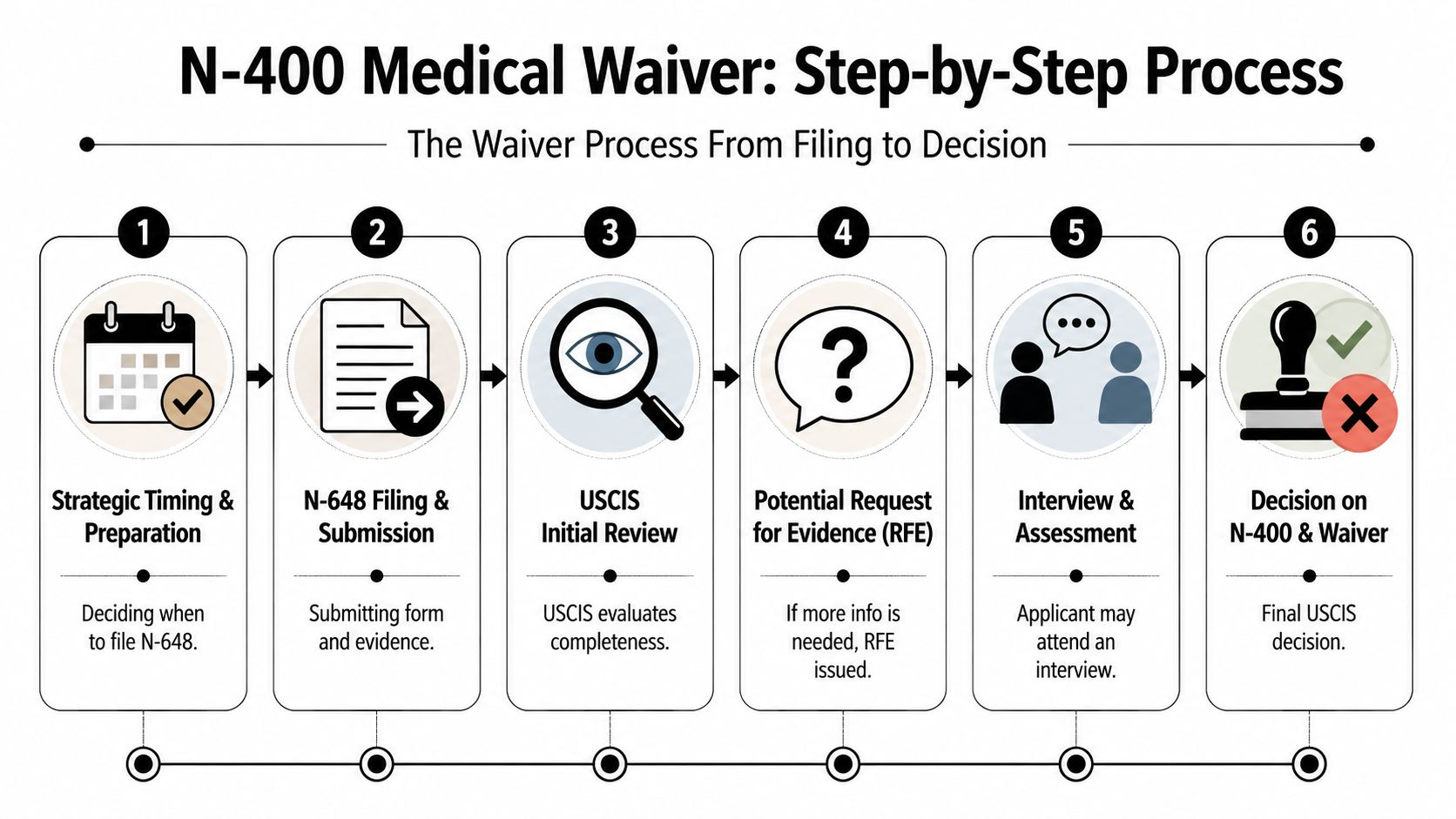
This walkthrough may help clients understand the broader process before interview:
Prepare the applicant for an interview even when the waiver is well supported. The officer may still ask about identity, residence, selective service, trips, criminal history, and the medical condition itself. A granted waiver changes the testing requirement. It does not eliminate credibility review.
Common outcomes after filing include:
- Waiver approval and continued N-400 processing: This usually happens when the diagnosis, functional limits, and nexus are stated clearly and remain consistent across the file.
- Request for Evidence: USCIS often issues an RFE when the form is too generic, the timeline is unclear, or the stated limitations do not match other records.
- Waiver denial with the N-400 proceeding under standard requirements: If the exception is not accepted, the applicant may still need to satisfy the ordinary English and civics rules.
In practice, the strongest files are built backward from likely USCIS objections. If an officer asks why this applicant cannot learn, why the limitation has lasted long enough, and why the clinician reached that conclusion, the record should already answer all three.
Avoiding Common Waiver Pitfalls
A weak waiver case often looks acceptable until you read it the way an officer will. The diagnosis sounds serious. The form is signed. The records are attached. Then the central question remains unanswered: why does this medical condition prevent this applicant from learning or demonstrating the English or civics requirement?
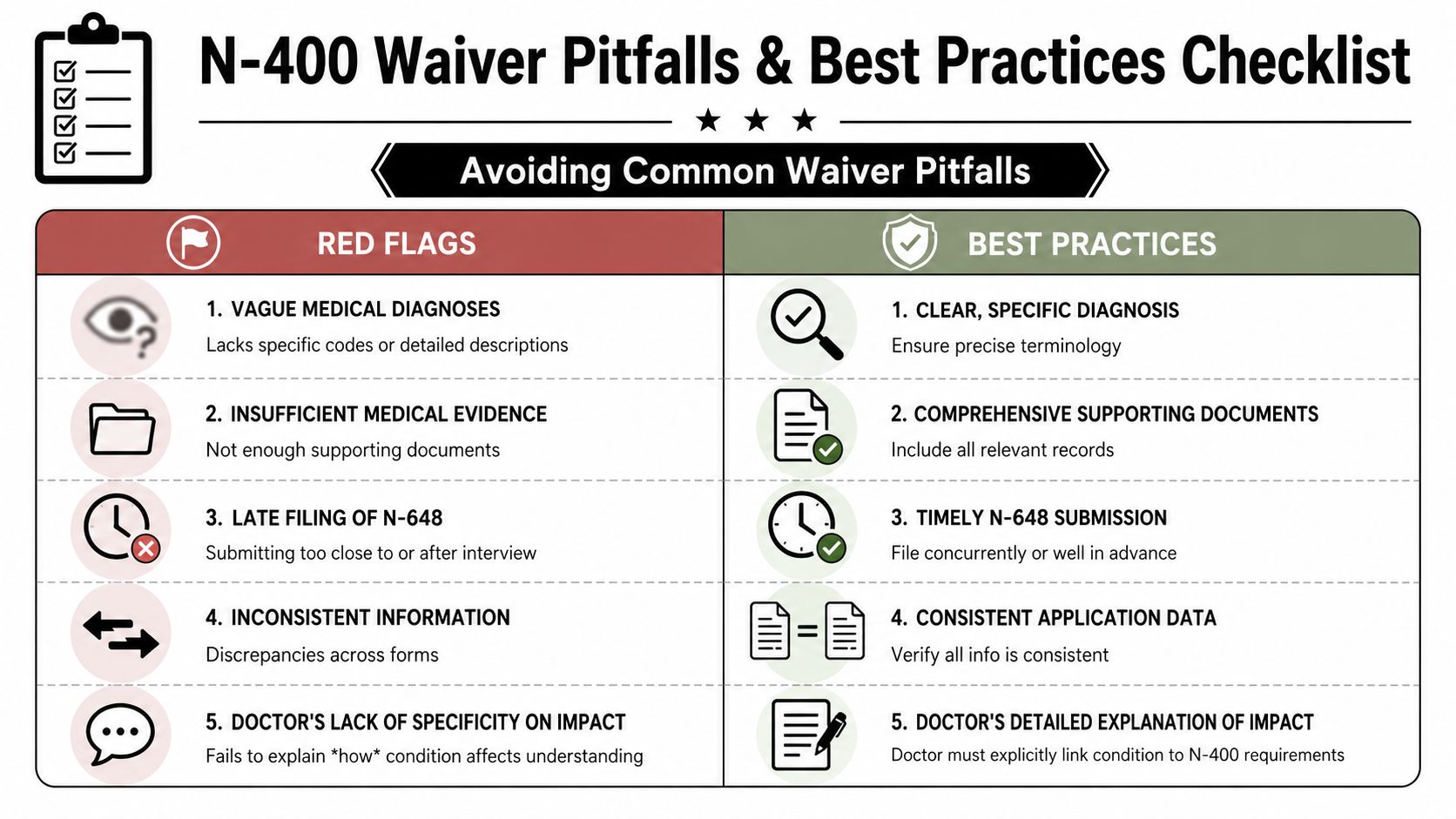
That gap drives many denials and RFEs. USCIS is not just checking for a diagnosis. The officer is testing whether the clinical evidence supports the legal standard. The best waiver files make that connection explicit and consistent from the first page.
Red flags that invite scrutiny
The first warning sign is generic clinical writing. If the N-648 could be swapped into another file with only the patient name changed, it will draw attention for the wrong reason. USCIS expects individualized analysis, not stock language.
A second problem is diagnosis without function. Depression, PTSD, dementia, traumatic brain injury, and developmental disorders may all support a waiver in the right case. None of them wins the issue by label alone. The form has to explain how the condition affects memory, attention, processing speed, language acquisition, or test performance in a way that prevents the applicant from meeting the requirement.
Watch for inconsistency across the file. An N-648 that describes severe cognitive impairment will not sit well beside records showing independent completion of complex forms, detailed English communication, or other functioning that appears hard to reconcile. Some inconsistencies are explainable. The file has to explain them before USCIS does.
The assessment foundation matters too. If the clinician gives bottom-line conclusions with no meaningful explanation of interview methods, testing, records reviewed, or behavioral observations, the opinion carries less weight. Attorneys who review these cases should understand basic markers of reliable evaluation methods, especially the validity of assessment tools in forensic and evaluative work. That knowledge helps you spot when a report is proving the point and when it is only asserting it.
Practices that make the case stronger
File strategy starts before the form is signed. Build the theory of the case around the legal question, then test whether the clinical evidence supports that theory.
Use a simple internal checklist:
- Define the impairment precisely: Avoid broad labels if the actual issue is narrower, such as impaired short-term memory, limited comprehension, or poor retention.
- Show the nexus clearly: The report should connect the condition to the applicant's inability to learn or demonstrate English, civics, or both.
- Match severity to the records: If the limitation is profound, the surrounding evidence should make that plausible.
- Review timing carefully: A late-generated form with little prior documentation can still work, but it usually needs a more careful explanation of history, onset, and duration.
- Use the right clinician for the theory: An eligible signer is required. A clinician who can write in a way that addresses legal scrutiny is often what determines whether the form persuades.
Psychological evidence often becomes the deciding factor here. In many borderline cases, the issue is not whether the client has a condition. It is whether someone has documented, in clinically defensible terms, how that condition impairs learning, recall, attention, or expressive ability enough to satisfy the waiver standard. A thoughtful psychological evaluation can close that gap. A thin one can widen it.
What usually fails
Trying to rescue a weak N-648 with stacks of additional records rarely solves the underlying problem. If the core explanation is underdeveloped, more paper usually creates more opportunities for inconsistency.
Overstatement is another common error. Claim only what the evidence supports. If the applicant has a genuine but limited impairment, describe that limited impairment well. Officers are more likely to trust a careful, bounded opinion than sweeping claims that the rest of the record does not support.
I tell junior attorneys to ask one question before filing: if USCIS challenges the nexus, does the file answer that challenge in plain terms, with clinical support, without exaggeration? If the answer is no, the waiver is not ready.
Frequently Asked Questions About the N400 Waiver
Can a family doctor complete the form
Yes, if that family doctor is an eligible professional. The certifier must be a licensed U.S. M.D., D.O., or clinical psychologist. The better question is whether the doctor can produce a detailed, legally useful explanation. Many treating providers know the patient well but still write weak N-648s because they describe treatment history instead of the test-related functional limitation.
What if the waiver is denied at or after interview
The applicant does not automatically stop being an N-400 applicant. If the waiver is denied, the case may continue under the standard naturalization requirements, depending on posture and what USCIS directs next. From a strategy standpoint, the first move is to identify why the waiver failed. Was the problem eligibility, specificity, consistency, or timing? Don't assume a new form alone will solve a structural defect in the case theory.
Does old age qualify by itself
No. Age alone is not the basis for this waiver. A client may be older and still qualify, but the qualifying factor is the medically determinable impairment and its functional effect on the ability to learn or demonstrate the required material.
Can the waiver cover both English and civics
It can, if the clinical explanation supports that scope. Some cases show impairment broad enough to prevent both. Others support only part of the exception theory. Match the request to the evidence. Overbroad claims create avoidable credibility problems.
Should you file quickly once a diagnosis exists
Usually not. A diagnosis is only one piece. Filing before the clinician has documented the nexus clearly can create more trouble than waiting for a stronger certification. In waiver work, readiness is about sufficiency, not speed.
If your case hinges on nuanced cognitive, trauma-related, or psychological evidence, a specialized evaluation can make the difference between a conclusory waiver request and a persuasive medical-legal record. Pro Psychological Analysis works with immigration attorneys to produce thorough psychological evaluations that translate clinical findings into clear, evidence-based opinions USCIS can evaluate.