
You're preparing a declaration, affidavit, or hardship packet. The facts look strong on paper, but the client can't tell the story in a straight line. They forget dates they once gave confidently. They shut down when you ask about a child left behind, or they become flat and detached at the exact moment you need detail. In another meeting, they appear inconsistent enough that you worry an adjudicator will see evasion where a clinician would see trauma.
That's where many immigration cases go off course. Attorneys often recognize that family separation matters, but the legal file doesn't always show how it matters clinically, functionally, and over time. A separated parent may present as distracted, irritable, forgetful, or emotionally numb. A separated child may regress, cling, stop speaking as freely, or develop sleep and somatic complaints. If those reactions aren't documented carefully, they can be misread as weak credibility, poor preparation, or ordinary stress.
In practice, the strongest cases don't treat family separation effects as background context. They treat them as evidence. The client's psychological state can help explain fragmented memory, impaired daily functioning, fear of return, vulnerability after persecution, and the severity of hardship if separation continues or recurs. For attorneys handling asylum, waivers, T, U, and VAWA matters, that difference is often decisive.
Table of Contents
- The Human Cost of a Case File
- The Science of a Broken Bond
- Immediate Crises and Lifelong Echoes
- Recognizing Trauma in Your Client
- Translating Clinical Findings into Legal Arguments
- Nuanced Approaches for Complex Cases
- Best Practices for Attorneys and Evaluators
The Human Cost of a Case File
A case file can hold declarations, school records, police reports, and country conditions, yet still miss the central fact of the client's lived experience. Separation doesn't stay confined to one event on a timeline. It enters the interview room. It changes how a parent answers, how a child behaves, and how a family functions day to day.
I often advise attorneys to listen for disruption in ordinary routines. Can the client sleep. Can they focus long enough to complete forms. Are they missing work, avoiding medical care, or unable to parent consistently because thoughts of the separated family member intrude all day. Those details are often more persuasive than broad statements like “the client is suffering.”
A familiar problem in practice
An attorney preparing an asylum case may ask for a chronological account and receive pieces instead of a narrative. The client jumps from the border to a childhood memory, then to a recent panic episode after a phone call with family abroad. If counsel treats that only as a preparation problem, the record stays thin. If counsel recognizes it as a possible trauma presentation, the case changes.
Practical rule: When a client can't provide a linear account after family separation, don't assume resistance first. Consider whether trauma is interfering with concentration, memory retrieval, and emotional regulation.
Attorneys document facts. Clinicians document meaning, symptoms, and impairment. Both matter. A declaration may say, “My son was taken from me.” A psychological evaluation can connect that event to panic symptoms, insomnia, intrusive images, concentration problems, and impaired ability to testify coherently.
A related issue is support. Separation trauma rarely occurs in isolation. Clients who lack stable family contact, community ties, or practical help usually struggle more in daily functioning and legal participation. A structured social support assessment for immigration evaluations can help identify what protection has been lost and why that loss matters clinically.
What strong legal teams do differently
The most effective attorneys I work with don't wait until the week before filing to think about mental health evidence. They look early for signs that family separation effects are shaping the case.
They usually do three things well:
- They document behavior, not just conclusions. Instead of “client seemed upset,” they note crying, pauses, dissociation, confusion, or inability to continue.
- They track functional impact. They ask how symptoms affect work, parenting, school attendance, sleep, appetite, and medical adherence.
- They refer when the behavior has legal significance. That includes impaired testimony, severe fear, child regression, or hardship that needs clinical substantiation.
A good evaluation doesn't replace legal theory. It gives the theory a human nervous system, a time course, and observable consequences.
The Science of a Broken Bond
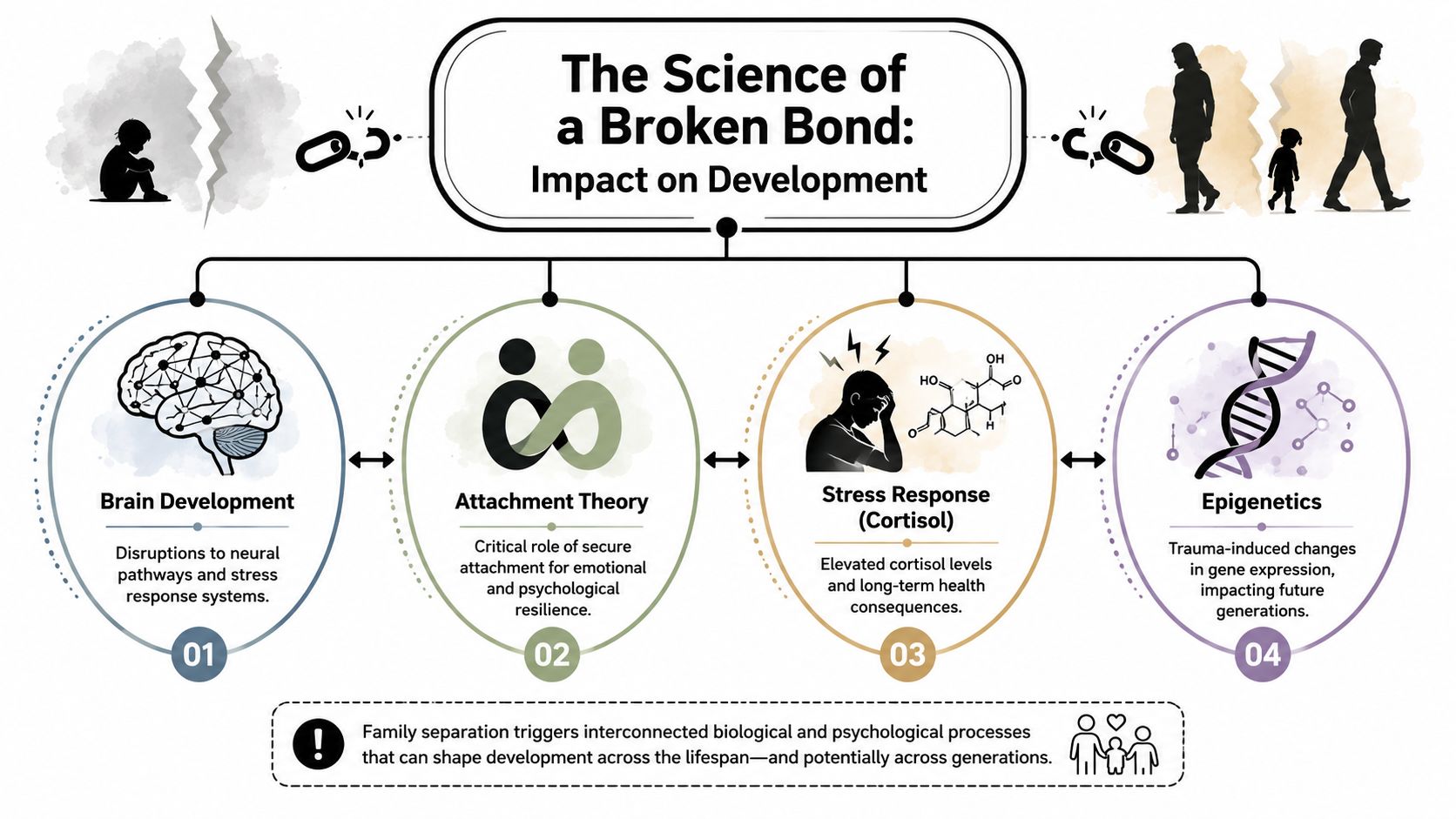
Family separation effects make more sense when you start with one basic clinical principle. Human beings regulate themselves through relationships, especially close caregiving relationships. When that bond is abruptly disrupted, the mind and body don't experience it as a minor stressor. They experience it as danger.
Early in the legal process, it helps to give this a plain-language frame. A primary caregiver functions as a secure base. For a child, that means the person who makes the world feel navigable. For adults in close family systems, attachment bonds also organize safety, predictability, and emotional regulation. Remove that anchor under coercive or traumatic circumstances, and the person often loses more than companionship. They lose the mechanism that helps them stay oriented and calm.
A visual summary can help legal teams and clients understand the underlying mechanisms.
Why attachment disruption hits so hard
Attachment theory isn't abstract for immigration practice. It explains why people may become clingy, disorganized, shut down, or frantic after separation. A child may not have language for terror, but the behavior often says it clearly. An adult may know the family member is alive, yet still function as if catastrophe is imminent because the attachment system remains activated.
For attorneys, the practical point is this. Distress after separation isn't just grief in a general sense. It often reflects a loss of the person's internal sense of safety. That's why clients may seem irrationally preoccupied with contact, updates, reunification, or fear of another separation. The behavior is often consistent with attachment threat, not exaggeration.
A second clinical concept matters just as much. Toxic stress refers to prolonged activation of the stress response without adequate buffering support. When separation is sudden, prolonged, or tied to detention, persecution, deportation risk, or uncertainty, the body can remain in high alert. That state affects sleep, memory, appetite, mood, concentration, and physical symptoms.
For a practical explanation of how this can look behaviorally, attorneys may find it useful to review patterns of nervous system dysregulation in trauma-exposed clients.
How prolonged stress reshapes functioning
Research summarized by the University of Michigan on parent-child separation at the U.S.-Mexico border reported that more than 2,300 children were separated from their parents in just May and June 2018, and linked prolonged separation and trauma to delayed speech, language, and motor development in young children, as well as higher risk of depression, anxiety, psychotic disorder, inflammation, and abnormal physiological functioning later in life (University of Michigan summary on family separation at the U.S.-Mexico border).
That finding matters because it ties the legal event of separation to developmental and health consequences. It also helps explain why some symptoms appear immediate while others unfold over time. A young child may first show sleep disruption, clinginess, or regression. Years later, the same person may present with anxiety, depression, mistrust, or chronic physiological stress.
This short video is useful when you need a concise, accessible explanation of trauma's effects on development and regulation.
Separation trauma doesn't only change what a person feels. It changes what they can access, organize, and tolerate in the moment you're asking them to tell their story.
That's why a clinically informed record often reads differently from a standard interview memo. It links event, symptom, and impairment. It also recognizes that inconsistency can be a sign to investigate trauma more carefully, not a reason to stop asking.
Immediate Crises and Lifelong Echoes
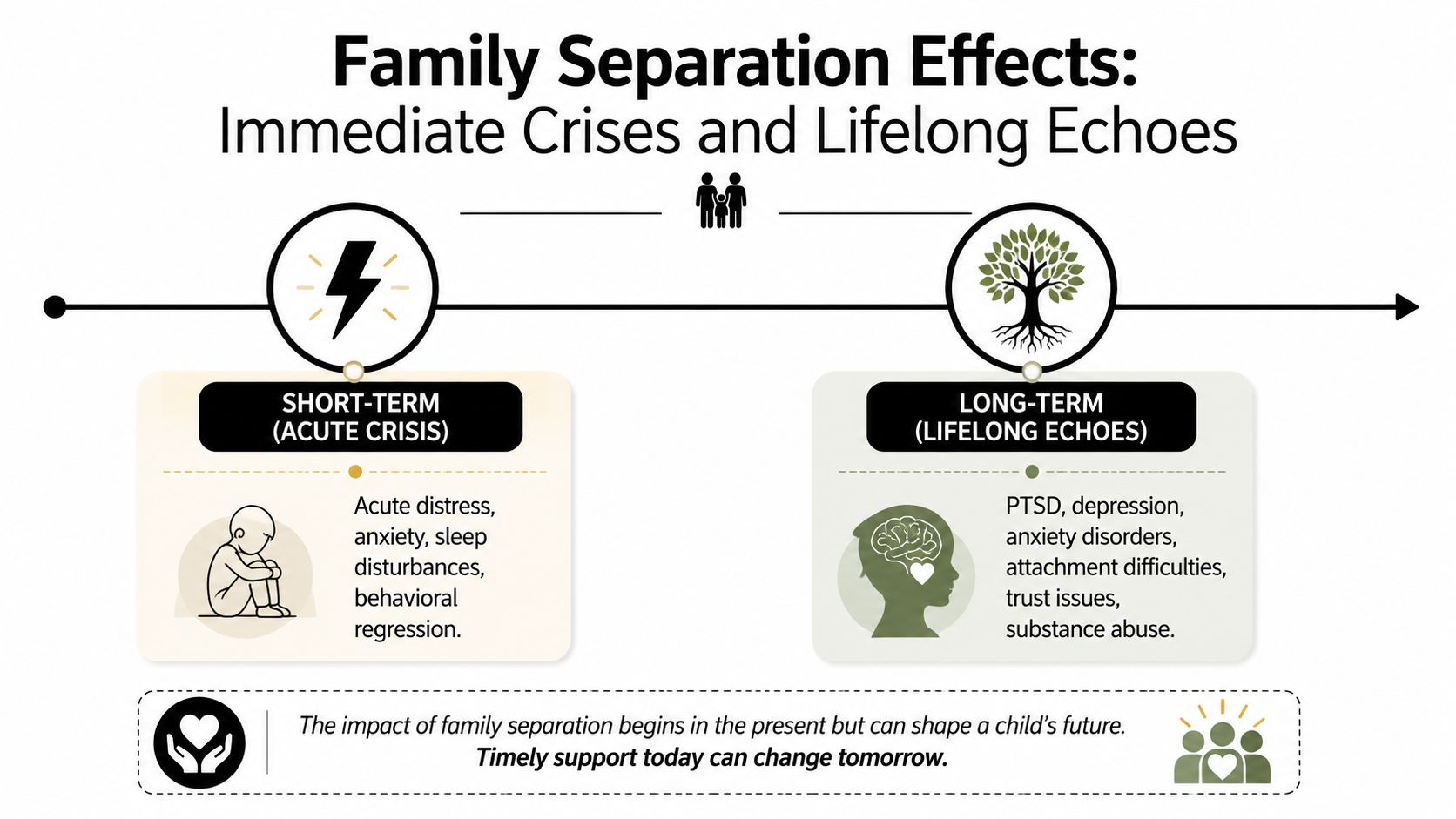
The legal file should distinguish between what happened right after separation and what remains long after the event. Those are related, but they aren't interchangeable. Acute symptoms show the immediacy of harm. Persistent symptoms show durability, prognosis, and future impact.
What shows up in the acute phase
In the short term, family separation effects often present as crisis. Children may cry inconsolably, cling to any available adult, regress in toileting or language, stop playing normally, or become unusually irritable and withdrawn. Adults may report panic, insomnia, appetite loss, racing thoughts, inability to concentrate, and persistent fear about the separated relative's safety.
What attorneys often miss is that acute distress may look different depending on the client. One person sobs and can't continue. Another becomes emotionless and answers in a monotone. A third keeps talking but can't stay organized. All three can reflect severe trauma.
Common acute patterns include:
- Behavioral regression in children. A child who had been functioning well may become more dependent, fearful, or difficult to soothe.
- Somatic distress. Headaches, stomach pain, fatigue, and bodily tension are common ways trauma appears when the person has limited emotional language.
- Cognitive disruption. Clients may lose track of dates, confuse sequencing, or forget facts they know when they're less activated.
- Relational desperation. Repeated checking, persistent worry, and intense distress about communication gaps are clinically meaningful, not merely inconvenient.
What can remain years later
Long-term consequences are often where legal arguments become stronger, especially in hardship and protection cases. A U.S. Census Bureau working paper found that nearly one-third of Americans born between 1988 and 1993 experienced their parents' divorce before adulthood, and that divorce in early childhood reduced children's income in their mid- to late 20s by 9% to 13%. The same analysis reported that teen birth rates among children of divorce jumped 63% after the split, while the risk of early death before age 25 rose 35% to 55% and remained high for at least a decade (U.S. Census Bureau analysis of how divorce affects children).
Those findings concern divorce rather than immigration detention or deportation, but they are still clinically useful. They show that family disruption can have measurable consequences far beyond the original event. In immigration practice, that supports a careful inquiry into future functioning rather than a narrow focus on present distress.
A symptom that starts as an acute response can become the client's baseline if the separation is prolonged, unresolved, or repeatedly triggered by the legal process.
Long after the separation, attorneys may see:
- Persistent anxiety and depressive symptoms. The client remains fearful, hopeless, or emotionally constricted.
- Impaired trust and attachment. Children and adults may become excessively dependent or, just as often, avoid closeness because closeness now feels dangerous.
- Educational and occupational disruption. Concentration problems, absenteeism, and poor persistence can derail school or work trajectories.
- Health vulnerability. Chronic stress often appears in sleep disturbance, appetite change, fatigue, and broader physical complaints.
A practical mistake is treating reunification, if it occurs, as the end of the analysis. For many clients, reunification doesn't erase the learned expectation of loss. It may even increase anxiety because the person now fears another separation. In case documentation, the timeline should therefore include onset, persistence, triggers, and current functional limitations rather than a simple before-and-after narrative.
Recognizing Trauma in Your Client
Attorneys don't diagnose. They do, however, observe. Good observation is often what makes a referral timely and the eventual evaluation far more useful. If you know what trauma commonly looks like after separation, you're less likely to misinterpret your client's behavior and more likely to preserve details that matter later.
A Physicians for Human Rights case series of separated asylum-seeking families found that nearly all evaluated individuals met criteria for at least one mental health disorder, including PTSD, major depressive disorder, and generalized anxiety disorder. Reported symptoms included insomnia, appetite loss, frequent crying, persistent hypervigilance, and impaired concentration, all of which can affect a person's ability to participate in legally relevant interviews and proceedings (Physicians for Human Rights case series on forced family separation).
What attorneys often observe first
The first signs are usually behavioral rather than diagnostic. A client may scan the room constantly, startle at hallway noise, or struggle to sit with their back to the door. They may give brief answers not because they have nothing to say, but because saying more triggers physiological overload.
Other clients look composed until you ask about the separation itself. Then the speech slows, eye contact changes, or the person becomes confused about sequence. That's a clinically important observation. It suggests the topic is trauma-linked and may impair reliable narrative production without supportive pacing.
Watch for patterns like these:
- Hypervigilance and startle. The client appears on guard, distracted by sounds, or unable to relax.
- Fragmented memory. Key events are recalled in pieces, out of order, or with sensory details but poor chronology.
- Emotional numbing. The client describes serious events with flat affect or visible detachment.
- Dysregulation during testimony preparation. Crying, shutting down, irritability, or dissociation appear when discussing family loss.
- Somatic interference. Headaches, stomach distress, chest tightness, or exhaustion repeatedly interrupt meetings.
If a client can describe neutral events clearly but becomes disorganized around separation, that contrast is often more informative than the inconsistency alone.
Clinical indicators and legal relevance
The chart below isn't a diagnostic tool. It's a practical translation aid for attorneys deciding what to document and when to refer.
| Clinical Sign / Symptom Cluster | Potential Diagnosis (DSM-5) | Relevance for Immigration Case (Asylum, Hardship, etc.) |
|---|---|---|
| Intrusive memories, panic when discussing separation, avoidance of reminders | PTSD | Helps explain fragmented testimony, fear responses, and ongoing impairment tied to persecution or separation |
| Persistent sadness, hopelessness, low energy, reduced functioning | Major Depressive Disorder | Supports severity of hardship, inability to maintain daily functioning, and sustained suffering after separation |
| Excessive worry, tension, insomnia, difficulty concentrating | Generalized Anxiety Disorder | Relevant to future fear, chronic distress, impaired interview participation, and hardship analysis |
| Hypervigilance, exaggerated startle, scanning for danger | Trauma-related disorder or anxiety disorder | Explains guarded presentation that might otherwise be misread as evasiveness |
| Appetite loss, crying spells, sleep disruption after separation | Depressive or trauma-related presentation | Shows immediate impact and supports temporal connection between event and symptoms |
| Withdrawal, detachment, emotional flatness | PTSD, depressive disorder, dissociative features | Clarifies why a client may seem indifferent to severe events when they are actually overwhelmed |
| Developmental regression, clinginess, behavioral change in child | Trauma-related response, adjustment-related presentation | Important in child-centered hardship evidence and in explaining educational or caregiving disruption |
A referral is especially important when legal success depends on explaining credibility issues, documenting child harm, or showing that hardship goes beyond ordinary family distress. In those situations, a psychological evaluation should answer four practical questions: what symptoms are present, how they relate to the separation, how they impair functioning, and whether the effects are likely to persist.
Translating Clinical Findings into Legal Arguments
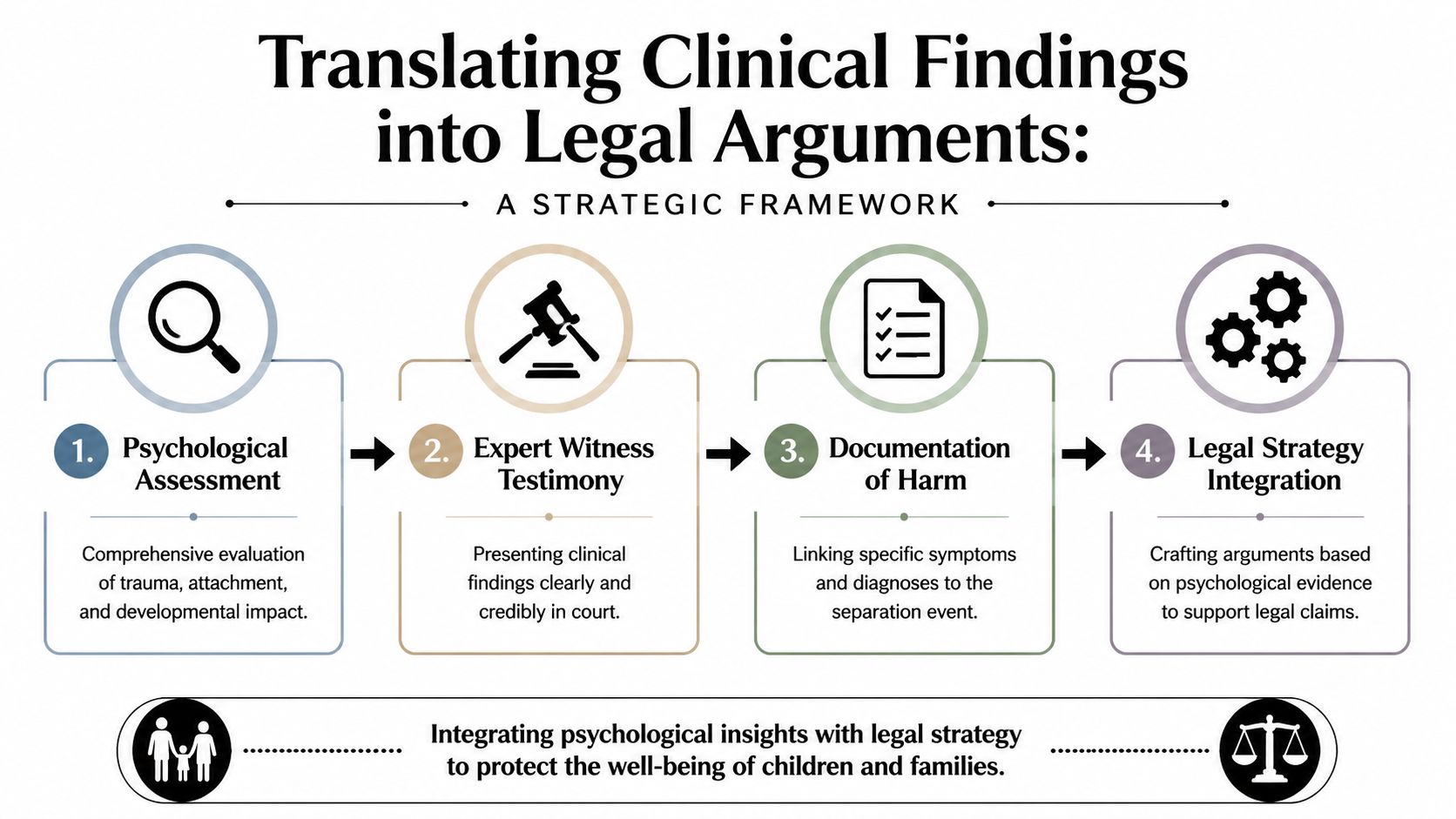
A psychological report becomes useful when it does more than label symptoms. The report has to connect diagnosis, time course, functional impairment, and legal relevance. Attorneys should read the evaluation asking a direct question. What statutory or evidentiary point does this clinical information help prove?
That translation work is easier when the legal team uses a consistent framework.
For asylum and related protection claims
In asylum matters, family separation effects often matter in at least three ways. First, they can corroborate the severity of past persecution. Second, they can explain testimonial difficulties that might otherwise be framed as credibility problems. Third, they can support the psychological reality of ongoing fear.
A strong argument doesn't say only that the client has PTSD or depression. It says the client's symptoms are consistent with trauma following persecution and separation from close family, and those symptoms impair memory organization, concentration, sleep, and emotional regulation in ways that are observable and clinically coherent.
Useful legal phrasing often looks like this:
- Corroboration of harm. “The evaluation documents trauma-related symptoms temporally associated with the forced separation and consistent with the client's account of persecution.”
- Credibility context. “Observed memory fragmentation and avoidance are clinically consistent with trauma and help explain difficulties providing a linear narrative.”
- Future fear. “The persistence of severe anxiety linked to separation and threat exposure supports the client's continued fear of return.”
For hardship waivers and victim-based petitions
In hardship cases, the issue is usually not whether separation is painful. It obviously is. The issue is whether the file shows specific, individualized, clinically significant hardship. General statements about sadness won't carry much weight. Functional impairment often will.
Use the evaluation to tie symptoms to daily consequences. Can the qualifying relative parent effectively. Are medical conditions worsened by stress. Has the person become unable to sleep, work, drive, or attend appointments consistently. Are children showing behavioral deterioration that increases caregiving burden.
For T, U, and VAWA matters, the report should also describe the relationship between trauma and victimization dynamics. Separation may increase dependence, fear, vulnerability, and coercive control. It may also leave the survivor unable to describe abuse chronologically or with emotional steadiness.
A practical framework for using the report:
- Anchor the event. Identify the separation clearly and place it on the timeline.
- Name the symptoms. Pull only the symptoms that matter to the legal standard.
- Show impairment. Translate diagnosis into parenting, work, school, medical, or testimonial consequences.
- Link duration and prognosis. Explain whether the harm is ongoing, likely to persist, or likely to worsen with renewed separation.
The best psychological evidence doesn't compete with the legal brief. It gives the brief a clinically grounded language for suffering, function, and risk.
What doesn't work is overclaiming. If the evaluation supports severe anxiety, don't stretch it into every possible theory. If the strongest evidence is child regression and caregiver destabilization, build there. Precision is more persuasive than breadth.
Nuanced Approaches for Complex Cases
Some of the most important family separation effects are the ones legal teams oversimplify. Not every client presents the same way. Not every symptom comes from one cause. And not every case improves solely because contact has been restored.

Reunification doesn't erase the injury
One common assumption is that the main harm ends once the parent and child are reunited or once regular communication resumes. Clinically, that's often wrong. The injury may persist because the person now lives with an entrenched expectation that safety can disappear again.
The available evidence supports caution here. Clinicians reviewing separated asylum families documented ongoing psychological trauma, and the California Association of Marriage and Family Therapists has noted that negative consequences can remain even after families are reunited (CAMFT statement on the impacts of forced family separation).
In practice, post-reunification cases often include new symptoms rather than symptom resolution. Children may become intensely clingy, oppositional, or fearful of routine separations like school drop-off. Parents may experience guilt, intrusive recollections, and chronic overmonitoring of the child. If the legal analysis stops at “family is back together,” it misses the clinically relevant question of whether the trauma is still impairing function.
Adult distress and culturally informed assessment
Another blind spot is the tendency to focus almost exclusively on child trauma. Adult functioning matters too, especially in mixed-status and transnational families. A 2023 study of undocumented Latinx immigrants found that greater distress from transnational family separation was associated with significantly higher depressive symptoms (β = .25, p < .001), anxiety (β = .18, p = .006), and physical symptoms (β = .24, p < .0001). Population-health research summarized in the same source also links mixed-status family separation to lower healthcare use, poorer child health, and cardiovascular risk factors tied to deportation worry (IAPHS discussion of mixed-status families and family separation impacts).
That's highly relevant in hardship cases. Adult suffering isn't secondary just because a child is involved. A parent's depression, anxiety, somatic symptoms, and healthcare avoidance can directly affect caregiving capacity, financial stability, treatment adherence, and household functioning.
Cultural formulation matters just as much. Distress may be expressed through bodily complaints, spiritual language, silence, deference, or intense focus on family obligation rather than explicitly psychological terms. A one-size-fits-all interview can miss significant pathology solely because the client isn't using Western mental health vocabulary.
For complex cases, attorneys and evaluators should ask:
- What predates the separation. Pre-migration trauma doesn't negate separation trauma. It may intensify it.
- What changed after the separation. The timeline matters more than theoretical debates about one single cause.
- How does this client express distress. Tears, headaches, shame, insomnia, and social withdrawal may all be the language of trauma.
- What persists despite reunification or contact. Ongoing symptoms are often the most legally important facts.
Best Practices for Attorneys and Evaluators
The difference between a generic mental health letter and a persuasive immigration evaluation usually comes down to preparation, communication, and discipline. The legal team has to know what question the evaluation must answer. The evaluator has to know how the client's symptoms relate to that question without becoming an advocate in place of a clinician.
How to set up a useful evaluation
Start the referral early enough that the client isn't being asked to disclose trauma under deadline pressure alone. Send the evaluator the core case documents that matter most: declaration drafts, referral questions, charging or procedural documents if relevant, and any records showing major timeline events. A vague referral like “please assess hardship” often produces a vague report.
How you prepare the client matters too. Explain that the evaluation isn't a test they pass or fail. Tell them the clinician may ask about painful events, symptoms, daily functioning, family relationships, and prior trauma. Encourage honesty over performance. Clients who think they must sound “severe enough” often become less credible, not more.
A trauma-informed approach in legal meetings also improves the evaluation later. Guidance on building rapport with clients in high-stakes matters is directly relevant here because trust and pacing affect the quality of disclosure.
How to review the finished report
When the report arrives, don't skim only for diagnosis. Read for legal utility. Does it clearly identify the separation event. Does it explain symptom onset and persistence. Does it describe functional impairment in concrete terms. Does it distinguish observed behavior from self-report. Does it avoid sweeping claims it can't support.
A strong report usually includes:
- A clear causal formulation. It connects symptoms to separation and other relevant trauma without oversimplifying.
- Specific functional examples. It shows how the condition affects parenting, work, school, testimony, or medical care.
- A careful tone. It is clinically grounded, measured, and free of legal conclusions that belong to counsel.
- Language an adjudicator can follow. Technical enough to be credible, plain enough to be useful.
Good collaboration protects both accuracy and dignity. The attorney preserves legal relevance. The evaluator preserves clinical integrity. The client gets a record that reflects what happened and what it cost.
When attorneys and clinicians work this way, family separation effects become more than a sympathetic theme. They become documented evidence of harm, impairment, and risk.
If your case needs clear, court-ready psychological documentation, Pro Psychological Analysis provides immigration evaluations specific to asylum, hardship waivers, T visa, U visa, and VAWA matters. Their team works with attorneys to produce evidence-based reports that connect trauma, family separation effects, and functional impairment to the legal issues that matter in the case.