
A client emails your office late on a Friday. Their landlord says the Emotional Support Animal letter on file is no longer current, and the property manager wants updated documentation before the next lease step. The client is already juggling court dates, biometrics, trauma treatment, work instability, and the ordinary fear that comes with an unresolved immigration case. Housing pressure lands on top of all of it at once.
For immigration attorneys, ESA letter renewal isn't an isolated mental health task. It's part of case stability. The letter itself won't decide a USCIS filing or an immigration court outcome, but stable housing often determines whether a client can keep appointments, respond to legal requests, stay engaged in treatment, and function well enough to participate in their own case. When the renewal process is handled early and correctly, it reduces preventable crises. When it's handled casually, small documentation errors can turn into lease disputes at exactly the wrong time.
Table of Contents
- Why ESA Letter Renewal Is a Critical Case Milestone
- Assessing Eligibility and Timing Your Renewal
- The Clinician and Documentation You Need
- Legal Guardrails and Ethical Best Practices
- Common Renewal Pitfalls and How to Avoid Them
- ESA Renewal FAQs for Immigration Cases
Why ESA Letter Renewal Is a Critical Case Milestone
The landlord's message usually sounds administrative. The consequences are not. If a client's animal is treated as an unauthorized pet because the documentation on file is no longer accepted as current, the client may face lease conflict, pressure to remove the animal, or the sudden risk of housing disruption.
In immigration practice, that instability spreads fast. A client who is worried about losing housing may miss legal calls, delay evidence gathering, avoid medical appointments, or become harder to reach. For trauma survivors, the practical threat of displacement can also intensify symptoms that were already affecting concentration, sleep, and trust.
Housing stability supports legal participation
An ESA letter renewal matters because it helps preserve a client's daily functioning. The animal may be part of how the client manages fear, panic, depression, or trauma-related distress in the home environment. If the landlord challenges the accommodation, the legal team often ends up managing a preventable emergency that has nothing to do with the merits of the immigration claim and everything to do with timing.
Practical rule: Treat ESA renewal dates like filing deadlines that protect client stability, not like optional paperwork.
This is especially important for clients in asylum, VAWA, T visa, and U visa matters. Many are already living with uncertainty, family separation, relocation, or the aftereffects of abuse and trafficking. Housing is where regulation happens. It's where the client sleeps, decompresses, and regains enough emotional control to engage with counsel.
A renewal issue can become a case management issue
Attorneys sometimes assume the ESA question belongs entirely to the clinician. Clinically, the renewal belongs with the mental health provider. Strategically, the deadline belongs on the legal team's radar because expired documentation can trigger practical damage that reaches the case file quickly.
A strong law office doesn't need to practice mental health care to handle this well. It needs a system.
| Legal team task | Why it matters |
|---|---|
| Track the letter date | Prevents last-minute scrambling |
| Ask about recent moves | State licensure problems are common after relocation |
| Limit unnecessary disclosure | Protects the client's privacy and immigration-sensitive information |
| Encourage early renewal | Reduces landlord conflict and client stress |
When firms build ESA renewal into client maintenance, they reduce noise around the case and protect a basic condition of legal participation: a stable place to live.
Assessing Eligibility and Timing Your Renewal
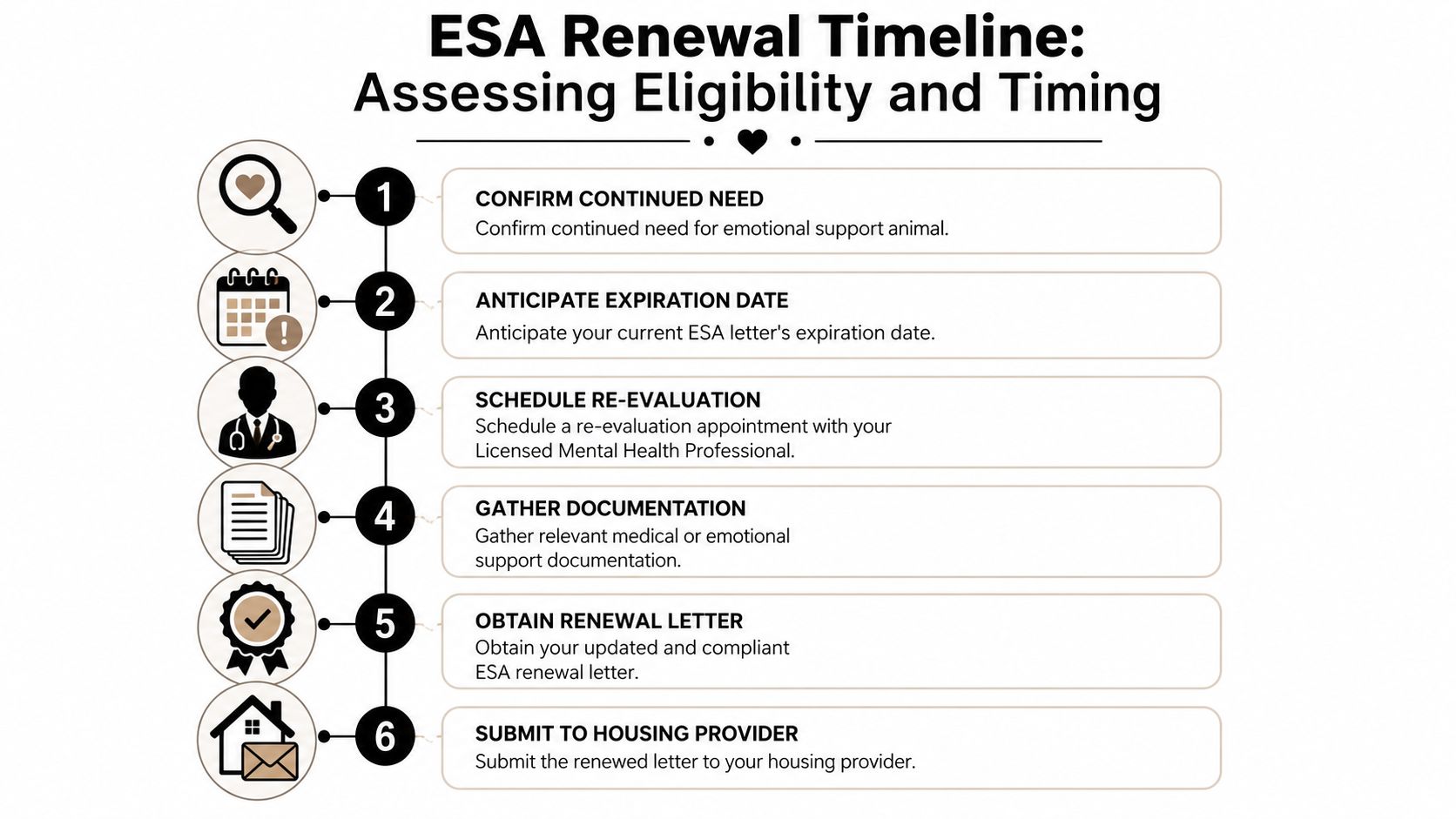
Renewal isn't a rubber stamp. A valid renewal requires a fresh clinical judgment that the person still has a qualifying mental or emotional condition and that the animal continues to provide therapeutic support related to that condition. If either piece is missing, the renewal becomes harder to defend.
The timing matters just as much as the eligibility review. ESA letters are widely treated as current for one year, and experts recommend scheduling the renewal appointment at 10 to 11 months after issuance to avoid lease delays or housing disputes, as noted in guidance on ESA renewal timing.
What renewal actually reassesses
The clinician should revisit current symptoms, functioning, and the role the animal plays in emotional regulation or psychiatric support at home. That doesn't mean the client must start from zero. It does mean the professional needs enough current information to support a new letter ethically.
For immigration attorneys, preparation proves helpful. If a client is also pursuing a psychological evaluation for immigration near me, don't assume that evaluation automatically substitutes for housing documentation. The purposes differ. Immigration evaluations address legal standards and evidentiary needs. ESA renewals address current housing accommodation documentation.
A renewal discussion is usually smoother when the client is ready to explain, in plain terms:
- Current symptoms: How anxiety, trauma symptoms, depression, or related distress are affecting daily life now.
- Functional role of the animal: What the animal helps the client manage at home.
- Changes since the last letter: Moves, treatment changes, worsening stressors, or interruptions in care.
- Housing urgency: Whether the landlord has already requested updated paperwork.
A workable timeline for law firms
Law offices do best with a repeatable schedule instead of ad hoc reminders. Put the issue date into case management software the day the client receives the letter. Then create internal follow-up tasks before the one-year mark.
A simple workflow looks like this:
- At intake or file review, ask whether the client has an ESA letter and record the issue date.
- Around the tenth month, tell the client to schedule a renewal evaluation.
- Before submission to the landlord, confirm the new letter is dated, signed, and current.
- After submission, save a copy in the client's file and note any landlord response.
If the client waits until the landlord complains, the renewal process becomes more stressful than it needs to be.
Clients in immigration proceedings often relocate during a case. They may move for safety, affordability, family support, or work. That alone is a reason to start early. Once relocation is involved, state licensure and access to a properly licensed clinician become immediate practical issues.
The Clinician and Documentation You Need
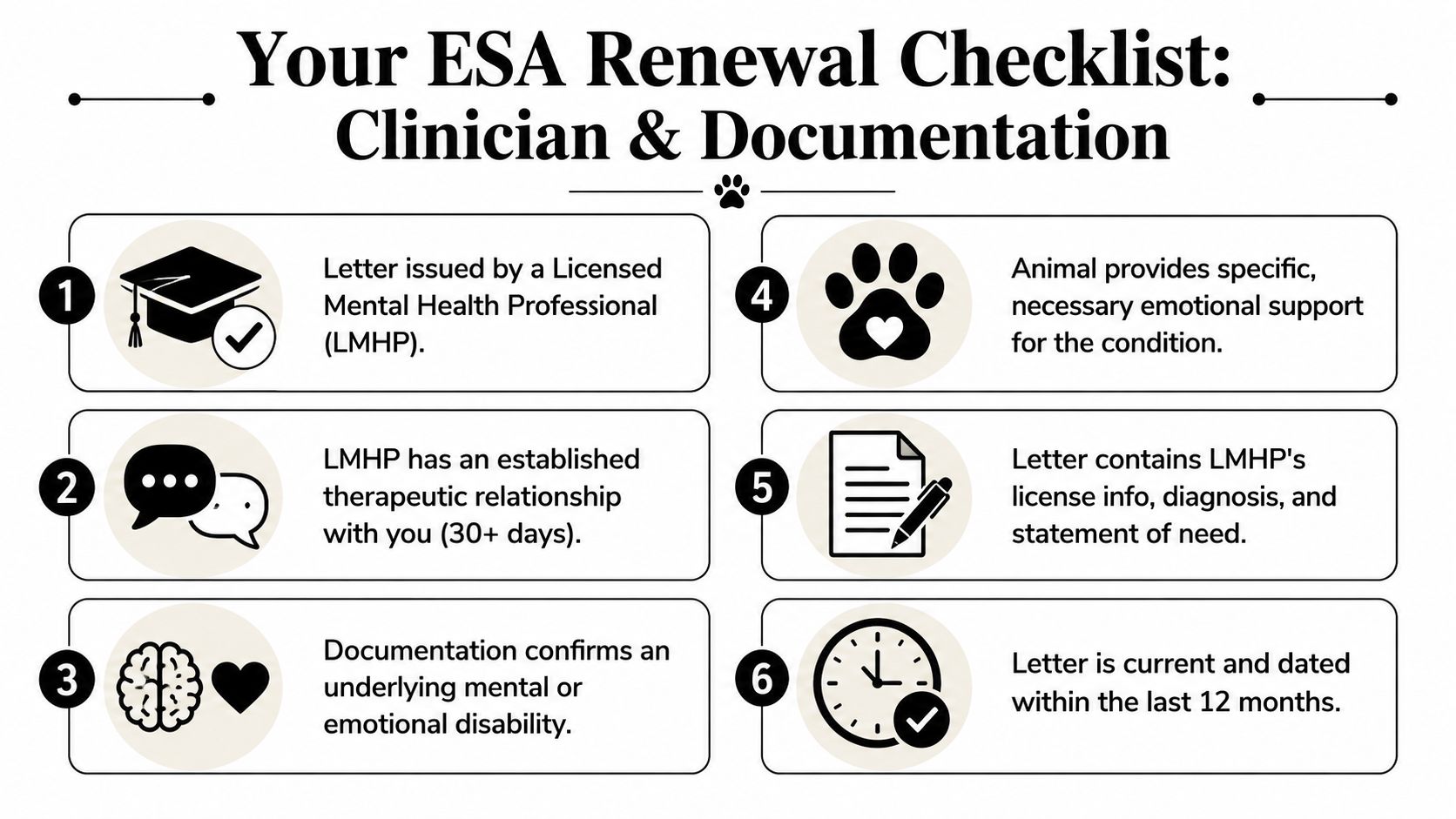
The clinician matters as much as the letter. A landlord reviewing a renewal usually wants to see that a real, currently licensed professional evaluated the tenant and issued fresh documentation that can be verified. For immigrant clients who have moved since the original letter, this is often where the process breaks down.
A compliant renewal requires consultation with a Licensed Mental Health Professional who is currently licensed in the client's state of residence, followed by a clinical evaluation. If the clinician validates the ongoing need, the new letter should be issued on official letterhead and include the clinician's license number, date of issue, and signature, as described in this explanation of the ESA renewal process.
Who can issue a defensible renewal letter
For legal and practical purposes, the safest path is a licensed mental health professional whose state licensure can be verified where the client currently lives. That point becomes critical after interstate moves. A therapist who was appropriate when the client lived in one state may not be able to issue a usable renewal after the client relocates.
This is also where law firms should separate legitimate telehealth from low-credibility websites. A telehealth appointment can be perfectly appropriate if the clinician is licensed in the client's current state and performs a real assessment. What doesn't work well is a platform selling “instant approval” without individualized clinical review.
Later in the process, many clients ask what counts as sufficient paperwork generally. A concise overview of what is medical documentation can help attorneys explain why housing providers focus on current, professional, identifiable records.
A short explainer can help clients understand what to expect:
What the letter should contain
A renewal letter should be easy for a housing provider to review and easy for a clinician to stand behind. It doesn't need to reveal more than necessary, but it does need the essential elements that show it is current and legitimate.
Use this checklist before the client sends anything to a landlord:
- Professional identity: Full clinician name, credentials, and contact information on official letterhead.
- Licensure details: License number and state of licensure.
- Current issuance information: A clear issue date and a signature.
- Clinical purpose: A statement supporting the need for an emotional support animal as a housing accommodation.
- Client matching details: The letter should plainly identify the client so the housing provider can match it to the accommodation request.
What clients should bring to the appointment
Attorneys can improve the quality of the renewal by telling clients what to gather ahead of time. That avoids vague appointments and incomplete letters.
A practical prep list includes:
| Bring this | Why it helps |
|---|---|
| Prior ESA letter | Gives the clinician baseline context |
| Photo identification | Confirms identity for records |
| Current address | Important if the client has moved states |
| Brief symptom update | Helps the clinician assess current need |
| Landlord request, if any | Shows timing and documentation demands |
A good renewal letter is specific enough to be credible and restrained enough to protect privacy.
Legal Guardrails and Ethical Best Practices
A common case problem looks like this. The client moves to a new state while the immigration matter is still pending, keeps an older ESA letter, and assumes the housing issue is solved. Then a landlord asks for current documentation, the client worries that more disclosure could affect the immigration case, and counsel is left sorting out both the accommodation request and the privacy risk under time pressure.

The legal rule and the practical rule
The Fair Housing Act does not create a federal expiration date for ESA letters. Housing providers still often expect current documentation, especially if the tenant has moved, changed providers, or is making a new request during a lease renewal or transfer. For law firms handling immigration matters, the working rule is straightforward. Treat renewal as a current-support question, not an abstract debate over whether an older letter is still technically valid.
That distinction affects strategy. A legally defensible position can still be a poor case-management choice if it invites delay, extra scrutiny, or informal landlord resistance. In practice, current documentation usually resolves more problems than it creates, provided the letter is clinically supportable and limited to what housing law requires.
Terminology matters too. Clients often arrive with language picked up from websites that sell badges, registries, or certificates. Those products do not substitute for a clinician's assessment and letter. If counsel wants a plain-English resource to correct that misunderstanding without adding confusion, this explanation of ESA pet certification is a useful client handout.
Ethical limits on what the clinician should say
A sound renewal letter supports the accommodation without drifting into advocacy that the clinician cannot defend. As a psychologist, I advise firms to watch for overstatement. The provider should not guarantee that the animal is medically necessary in absolute terms, predict legal outcomes, or include details that read like testimony drafted for litigation rather than housing review.
The safer approach is narrower. The clinician documents that the client has a mental or emotional condition recognized in clinical practice, that the animal provides support related to that condition, and that the recommendation is based on a current professional assessment. That is usually enough.
This matters even more in immigration cases, where one document can end up being reused in the wrong setting. A letter prepared for housing should stay a housing document. It should not become an all-purpose exhibit that discloses trauma history, treatment details, or facts counsel may prefer to present differently in immigration proceedings.
Privacy practices that protect immigration clients
Privacy concerns are often sharper for noncitizen clients. Some fear any paper trail. Others assume the landlord is entitled to the same level of detail that a court or agency might request. Neither assumption is helpful.
Use a minimum-necessary approach:
- Limit disclosures to the accommodation issue: The landlord generally needs a valid support letter and, if requested through proper channels, basic verification from the clinician. Diagnosis details and immigration status usually do not belong in the packet.
- Keep clinical and legal records separate: Do not attach asylum declarations, psychological evaluations prepared for court, or other immigration filings to a housing request unless there is a specific legal reason.
- Prepare for cross-state complications: If the client moved during the case, confirm that the evaluating clinician can legally assess and issue documentation in the client's current state.
- Control communications: Clients should know who speaks to the landlord, what can be disclosed, and when requests for extra information should be routed back to counsel.
The strongest ESA renewal package answers the housing question, protects the client's privacy, and avoids creating new problems for the immigration case.
Common Renewal Pitfalls and How to Avoid Them
A common case pattern looks like this. The client is mid-move, the lease office wants updated ESA documentation by Friday, and counsel learns the prior letter came from a clinician who no longer practices in the client's current state. At that point, what should have been a routine renewal becomes a housing problem and, for some immigration clients, a stability problem that affects the broader legal case.
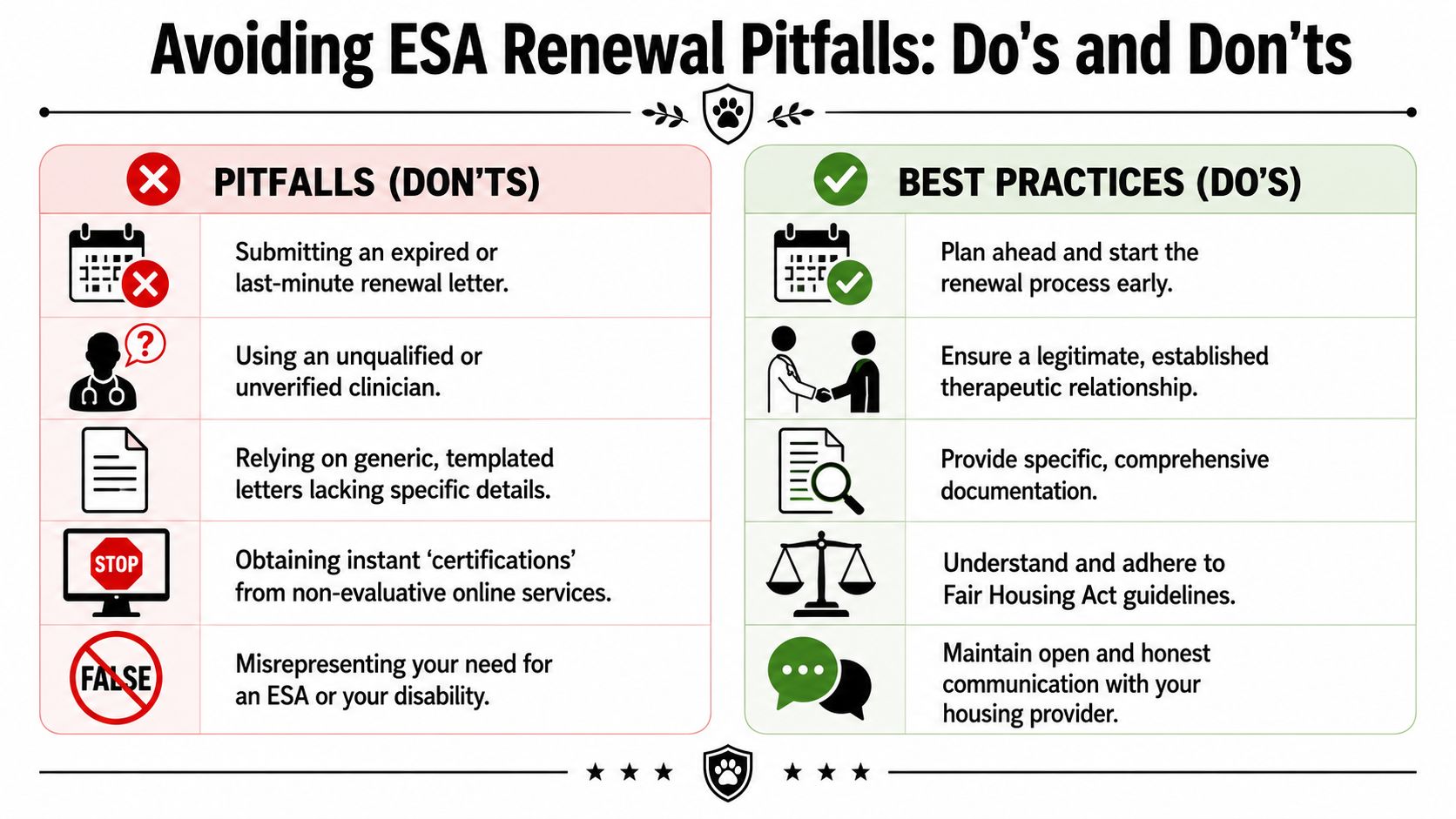
The avoidable errors are usually practical, not malicious. Clients reuse an old provider without checking licensure, purchase a fast online letter that does not reflect an actual clinical assessment, or send a generic document before anyone reviews it for obvious weaknesses. Landlords tend to focus on those defects because they are easy to spot and easy to question.
Mistakes that trigger landlord pushback
In practice, the same problems come up repeatedly:
- Renewing too late: Once the letter is outdated, the client loses time and the landlord gains an advantage.
- Using the wrong clinician for the client's current location: This is a frequent problem when a client relocates during an active immigration matter.
- Submitting a letter that reads like a template: Boilerplate language invites scrutiny because it suggests little or no individualized evaluation.
- Relying on an instant approval service: If the provider cannot defend the assessment process, the letter is easier to challenge.
- Sending inconsistent identifying information: A mismatch in name, address, or contact details can trigger unnecessary questions, especially for clients using different name formats across housing and legal records.
- Letting the client speak to the landlord without a plan: Off-the-cuff explanations often disclose more than the accommodation request requires.
Cost is a real concern for many clients. Cheap does not automatically mean invalid, and expensive does not guarantee quality. The useful question is whether a licensed clinician evaluated the client, documented the current need for the accommodation, and can verify the letter if a proper follow-up request comes in.
What works instead
Treat renewal like a short compliance review before anything is sent out.
First, confirm the basics. The clinician should be licensed where the client currently resides, actively practicing, and willing to conduct an individualized assessment. If the client moved recently, verify that point before scheduling. I see firms lose valuable time when everyone assumes the prior provider can reissue the letter.
Next, review the document for administrative defects. Counsel does not need to rewrite the clinical opinion, but counsel should catch errors that predict trouble. A missing signature, stale date, wrong state, or vague wording can turn a routine accommodation request into a dispute.
Use this pre-submission screen:
| Check before sending | Red flag |
|---|---|
| Current issue date | Old date carried forward |
| Signature present | Unsigned PDF or typed name only |
| License number included | No licensure details |
| State matches residence | Provider licensed elsewhere |
| Individualized content | Generic, boilerplate wording |
One more point matters in immigration cases. If the client has changed states, changed addresses, or uses different versions of their name across records, align the housing packet before submission. That does not mean disclosing immigration history. It means reducing avoidable inconsistencies so the ESA renewal supports housing stability instead of creating a side dispute the legal team then has to contain.
ESA Renewal FAQs for Immigration Cases
A common immigration-case scenario looks like this: the client has a pending matter, a recent address change, shared housing, and real anxiety about who will see mental health records. ESA renewal can still be handled well, but it needs tighter coordination than a routine housing request. The legal team should protect privacy, reduce inconsistencies across records, and keep the housing purpose separate from the immigration strategy.
Can an ESA evaluation hurt an immigration case
In most cases, no. An ESA evaluation for housing is not an immigration merits evaluation, and it does not decide eligibility for asylum, VAWA, a U visa, or any other form of relief. The practical concern is disclosure control.
I advise firms to separate the files and the functions. The clinician should assess current symptoms, impairment, and housing-related need. The attorney should decide what belongs in the legal record and what should remain in ordinary protected health communications. Landlords do not need immigration history, trauma narratives drafted for court, or details that go beyond the accommodation request.
That separation protects the client in two ways. It limits unnecessary disclosure, and it reduces the chance that inconsistent descriptions of symptoms or life events will create avoidable questions later in the case.
What if the client moved to a new state
This issue comes up often in immigration practice because clients relocate during proceedings, after release, or when family support changes. State licensure matters. The renewal should come from a mental health professional who is authorized to practice where the client currently lives.
A prior clinician may still know the client well, but familiarity does not fix a licensure problem. Housing providers sometimes verify credentials, and an out-of-state letter can create delay right when the client needs stable housing. If telehealth is used, confirm before the appointment that the clinician can legally evaluate a patient in the client's current state.
For law firms, the operational point is simple. Match the client's current residence, the clinician's active license, and the address used in the housing packet before anyone submits the renewal.
What does renewal usually cost
Cost is a real barrier for many immigration clients, especially when they are also paying filing fees, translation costs, or expert evaluation fees in the same period. Consumer pricing published by CertaPet states that ESA letter renewals can cost between $149 and $199, depending on the provider and the review involved.
Price alone is a poor screening tool. A lower-cost service may still be legitimate if a licensed clinician conducts an individualized assessment and issues a properly completed letter. A higher fee does not guarantee a defensible document. I tell attorneys to ask about three points before the client pays: who the clinician is, whether the clinician is licensed in the client's state, and whether the provider will reassess current need rather than recycle an old form.
How do you help clients with limited English proficiency
Start with the fear that is often sitting underneath the appointment. Many clients worry that discussing anxiety, depression, or trauma will somehow affect their immigration case, their family, or their housing. Clear role definition lowers that fear.
Explain the process in plain language. The clinician evaluates whether the client currently has a mental health condition that supports a housing accommodation. The lawyer advises on legal consequences and document handling. Those are related tasks, but they are not the same task.
These steps usually prevent errors:
- Use a qualified interpreter when needed: Sensitive mental health information should not default to a child, roommate, or landlord.
- Give short written instructions: Include the appointment date, the documents the client should bring, and the current address the clinician should use.
- Check understanding out loud: Ask the client to repeat the next step in their own words.
- Prepare a landlord-facing script: Help the client respond without volunteering immigration status or unrelated medical details.
In immigration matters, a good renewal process is not just about getting a letter. It is about getting a usable letter without creating privacy problems, record inconsistencies, or delays that make the housing situation less stable.
If your firm needs immigration-focused psychological documentation handled with clinical rigor, confidentiality, and deadline discipline, Pro Psychological Analysis supports attorneys and their clients with evidence-based evaluations for asylum, T visa, U visa, VAWA, and extreme hardship cases. The practice works in step with legal strategy while protecting client dignity and privacy throughout the process.