
Someone looking for a psychological evaluation for immigration near me is rarely browsing casually. They're trying to solve a very specific problem under pressure. An attorney may be facing a filing deadline and need clinical evidence that fits the legal theory of the case. A client may know their trauma is real, but not know how to explain it in a way USCIS or the immigration court can weigh.
That search often starts with geography and ends with strategy.
A strong immigration evaluation isn't just a letter saying someone has anxiety or trauma. In U.S. immigration practice, these evaluations are used to document extreme hardship, trauma, and mental health consequences in matters such as asylum, VAWA, U visas, and hardship waivers. Their role is evidentiary. They're written clinical reports submitted to USCIS or the court. A widely cited 2018 study found that asylum applicants who underwent a clinical evaluation were 89% more likely to be granted asylum than the 37.5% national approval average, a difference of 51.5 percentage points (discussion of immigration psychological evaluations and asylum outcomes).
That number matters, but the fundamental takeaway is broader. A good report gives structure to suffering. It translates fear, trauma, depression, sleep disruption, memory gaps, and functional impairment into findings the legal system can effectively utilize. That's why the evaluator, the attorney, and the client have to work as a team. The most persuasive reports usually come from that partnership, not from a rushed appointment with no records, no legal question, and no coordination.
Table of Contents
- Navigating Your Immigration Case with a Psychological Evaluation
- Understanding the Purpose of an Immigration Evaluation
- Tailoring the Evaluation to Your Immigration Case
- What to Expect During the Evaluation Process
- How to Find the Right Immigration Evaluator
- Working with Your Attorney and Protecting Your Rights
- Take the Next Step with Pro Psychological Analysis
Navigating Your Immigration Case with a Psychological Evaluation
A common pattern looks like this. The client has already written a declaration, gathered records, and told their story multiple times. The attorney can see the case has merit, but something is still missing. The file needs clinical evidence that does more than repeat allegations. It needs to explain how the person's symptoms, functioning, and trauma history support the legal claim.
That's where the evaluation changes the case.
For asylum matters, the report can help document the psychological effects of past persecution or the mental health consequences tied to fear of return. In VAWA, T visa, and U visa cases, the report can clarify abuse dynamics, trauma responses, coercion, shame, avoidance, and why a survivor may have delayed disclosure or stayed in a dangerous situation. In hardship waivers, the central issue is different. The evaluation often focuses on the qualifying relative and the seriousness of the emotional or psychological consequences if separation or relocation occurs.
A sufficient report answers the referral question. A persuasive report answers it with clinical detail, corroboration, and language the adjudicator can apply to the legal standard.
Clients often assume the hardest part is telling the story. It usually isn't. The harder part is telling it in a way that is clinically coherent and legally relevant. Trauma rarely comes out in neat chronology. People omit details, minimize abuse, confuse dates, or remember sensory fragments instead of timelines. That doesn't automatically weaken a case. But it does mean the evaluator has to know how to assess trauma carefully and explain the presentation properly.
Attorneys face a different problem. They need a report that doesn't drift into advocacy, overstate certainty, or read like treatment notes. A forensic evaluation has to stay grounded. It should be compassionate, but it also has to be methodical.
What makes the partnership work
Three things usually separate an effective process from a disappointing one:
- The attorney frames the legal question clearly. The evaluator needs to know what form of relief is being pursued and what the report must help establish.
- The client prepares for depth, not speed. A real evaluation requires more than a quick summary of symptoms.
- The evaluator builds a bridge between clinical findings and legal relevance. Diagnosis alone rarely carries the report.
When those three pieces align, the evaluation becomes more than an add-on. It becomes part of the case strategy.
Understanding the Purpose of an Immigration Evaluation
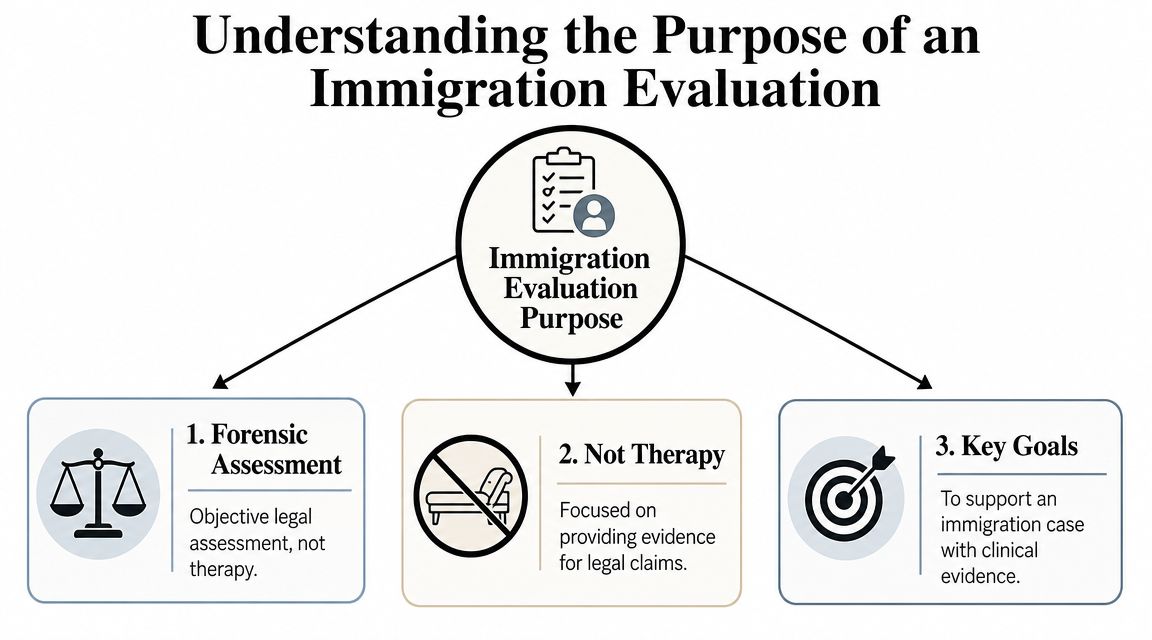
An immigration psychological evaluation is usually a forensic assessment, not therapy. That distinction changes everything about how the interview is conducted, how records are reviewed, and how the final report is written. A technically strong immigration evaluation typically includes an independent evaluator, a clinical interview, review of supporting documents, and often psychometric testing or other structured measures to document symptom severity, trauma history, functional impairment, and consistency of the narrative (overview of forensic immigration evaluations).
What the evaluator is actually doing
The easiest way to understand the process is to think of it as a detective file with clinical standards. The evaluator collects pieces of information, interviews the client, examines symptoms, looks for relevant records, and then reaches opinions that answer a specific referral question. If you want a more general background on the concept, this explanation of the definition of evaluation in psychology gives helpful context.
The task isn't to provide emotional support, although a careful evaluator will still work in a humane and trauma-informed way. The task is to answer questions such as:
- Does this presentation fit with trauma exposure or abuse?
- How has the person's functioning changed?
- Are the reported symptoms clinically meaningful and legally relevant?
- Do the records and interview data support the conclusions?
A treating therapist may focus on healing, coping skills, and the therapeutic relationship. A forensic evaluator focuses on documentation, objectivity, and how the findings relate to the legal issue in dispute.
What the report is for and what it is not for
This report is designed to help immigration adjudicators connect observed symptoms to legally relevant harms such as persecution, abuse, or hardship. That means the evaluation should explain not just what the person feels, but how those experiences affect sleep, concentration, daily functioning, parenting, work capacity, memory, fear responses, or ability to relocate safely.
Practical rule: If a report could be swapped into any therapy file with almost no changes, it probably isn't serving the forensic purpose well enough.
What it is not for is ongoing treatment. Some clients do enter therapy after an evaluation, and sometimes that's clinically important. But the immigration evaluation itself is a focused assessment tied to a legal referral question. That's why a report can be emotionally validating while still remaining independent and evidence-driven.
Tailoring the Evaluation to Your Immigration Case
A one-size-fits-all immigration report usually fails where it matters most. The structure may look polished. The diagnosis may be accurate. But if the evaluation doesn't answer the legal question of the specific case type, it won't carry the weight it should.
Why case type changes the clinical questions
In asylum cases, the evaluator usually examines the mental health consequences of persecution, trauma exposure, and fear related to return. The report may help explain avoidance, fragmented memory, panic, hypervigilance, nightmares, or other trauma-related symptoms that affect disclosure and credibility.
In VAWA, T visa, and U visa matters, the focus often shifts to the dynamics of victimization. A clinician may need to document coercive control, grooming, fear of retaliation, trauma bonding, shame, dissociation, and the impact of interpersonal violence or exploitation. These cases often require the evaluator to explain behavior that outsiders misunderstand.
Hardship cases call for a different lens. The issue is often not whether trauma happened in the past, but whether a qualifying relative would experience severe psychological consequences if separation or relocation occurred. That requires detailed attention to dependency, medical or emotional vulnerability, caregiving roles, prior losses, and the practical realities of the family system.
The strongest reports don't just describe pain. They tie that pain to the exact form of relief being requested.
Immigration evaluation focus by case type
| Case Type | Primary Psychological Focus | Key Evidence to Document |
|---|---|---|
| Asylum | Effects of past persecution and fear connected to return | Trauma history, symptom pattern, functional impairment, consistency between narrative and clinical presentation |
| VAWA | Impact of domestic abuse and coercive control | Abuse dynamics, fear, shame, dependency, trauma symptoms, barriers to disclosure |
| U Visa | Psychological harm related to qualifying criminal victimization | Trauma response, emotional injury, functional disruption, effects on safety and daily life |
| T Visa | Consequences of trafficking, coercion, and exploitation | Control tactics, trauma symptoms, dissociation, fear, vulnerability, impact on functioning |
| Extreme Hardship Waiver | Psychological hardship to a qualifying relative if separation or relocation occurs | Emotional dependence, mental health vulnerabilities, caregiving needs, anticipated hardship, functioning risks |
What persuasive tailoring looks like in practice
A sufficient asylum report may identify PTSD symptoms and document persecution history. A more persuasive one also explains why the client's fragmented recall is clinically consistent with trauma rather than fabrication, and why certain triggers or fears are specifically linked to the country conditions described in the legal case.
A sufficient VAWA or U visa report may say the client has depression and anxiety after abuse. A more persuasive report explains how coercion, threats, isolation, and trauma affected the person's decision-making and ability to seek help.
A sufficient hardship report may say separation would be difficult. A more persuasive report shows why the hardship would be clinically serious for this family member in this situation, based on functioning, vulnerability, records, and the likely impact of removal or relocation.
That's the difference between a generic evaluation and a strategic one. The first describes symptoms. The second makes them matter.
What to Expect During the Evaluation Process
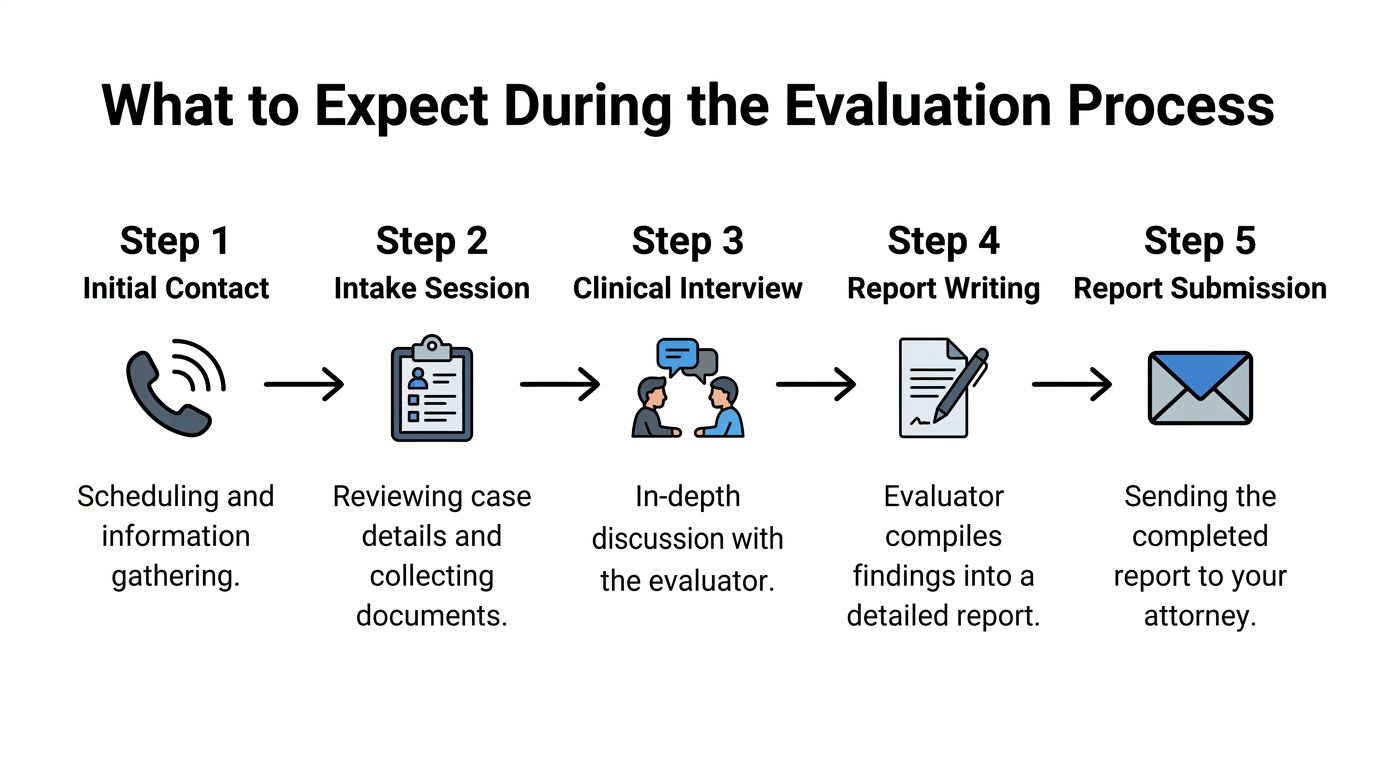
Most clients feel more comfortable once the process is concrete. The evaluation is still personal, but it shouldn't feel mysterious. The sequence is usually predictable, and good preparation makes the interview more accurate and less stressful.
Early in the process, many practices explain the workflow visually. This is the basic shape of it.
From intake to interview
The first step is usually scheduling and intake. The attorney or client provides the case type, deadlines, and basic background. The evaluator may ask for filings, declarations, police records, medical records, prior mental health records, or other relevant documents. Those records matter because forensic opinions should rest on more than conversation alone when corroboration is available.
The interview itself is more structured than many people expect. If you're unfamiliar with that format, this overview of a structured interview in psychology helps explain why evaluators ask focused, repetitive, or clarifying questions. The purpose isn't to trap the client. It's to document a coherent and clinically defensible account.
Published market benchmarks show that the core appointment often lasts 90–120 minutes, while some providers report up to 3 hours of interviews plus document review. Report production is commonly completed in about 3 weeks, with expedited turnaround sometimes available in 10 days (published timing benchmarks for immigration evaluations).
Here's a short video that helps humanize what clients often worry about before the appointment.
How timelines and logistics affect the final report
A deeper evaluation takes time for a reason. The clinician may need to review documents closely, compare statements across sources, consider symptom validity, and decide whether psychometric testing or collateral information would strengthen the report. That's part of why “fast” and “strong” aren't always the same thing.
Several factors can extend the process:
- Interpreter involvement: Interpreters are often necessary and appropriate, but they can lengthen interviews and require more careful pacing.
- Collateral records: Hospital notes, police reports, affidavits, declarations, and treatment records take time to review and integrate.
- Case complexity: Trafficking, long trauma histories, multiple perpetrators, or mixed diagnostic pictures often require more careful analysis.
Clients also ask what the final report includes. A solid report usually contains the referral question, records reviewed, interview findings, symptom description, diagnostic impressions when appropriate, functional analysis, and opinions tied directly to the legal issue.
A rushed report may save time on the calendar but cost weight in the case file.
The practical goal is balance. The attorney needs the report in time to use it. The evaluator needs enough time to produce something that can withstand scrutiny.
How to Find the Right Immigration Evaluator
A client finds a local clinician with an open appointment, pays quickly, and gets a short report a few days later. The attorney reads it and sees the problem immediately. The history is thin, the legal question is only partly addressed, and the conclusions do not explain why the psychological evidence matters to the form of relief requested. The issue was never distance. The issue was fit.
The phrase psychological evaluation for immigration near me sounds like a location question, but it is primarily a quality question. Convenience matters. So do scheduling and cost. But the report has to do a job inside a legal case. A sufficient report summarizes symptoms and history. A persuasive report connects clinical findings to the legal theory, addresses competing explanations, and gives the attorney something usable in declarations, briefs, and evidentiary strategy.
Fit matters more than proximity
Search results often emphasize “fast,” “affordable,” and “local.” Those factors have a place in case planning, but they do not tell an attorney whether the evaluator understands forensic method, immigration-specific referral questions, or the difference between a treatment summary and a forensic opinion. A useful discussion of speed versus quality appears in this article on fast immigration evaluations and report quality tradeoffs.
That is why I tell attorneys to screen for forensic fit.

A strong local therapist may still be the wrong choice for an immigration case if they do not write forensic reports or work from a clear referral question. The reverse is also true. A telehealth evaluator in another part of the state may be better prepared to review records, interview with a legal purpose, and produce a report that holds up under scrutiny. For attorneys comparing options, it also helps to review how a practice presents its training and scope of work, as in this overview of clinical psychology services in San Diego.
The key question is simple. Can this evaluator help turn the client's clinical story into credible evidence the attorney can use?
Questions worth asking before you hire anyone
Ask direct questions, and listen for specific answers.
- What immigration case types do you evaluate most often? Asylum, VAWA, U visa, T visa, and hardship cases raise different clinical and forensic issues. The evaluator should be able to explain those differences clearly.
- What materials do you review beyond the interview? Strong opinions often depend on records, declarations, prior treatment notes, police reports, or other collateral information.
- How do you decide whether testing is useful? Testing is not required in every case, but the evaluator should know when structured measures add support and when they do not.
- How do you work with the attorney? Look for a process that includes a referral question, document review, deadline planning, and communication if missing records or inconsistencies affect the opinion.
- How do you handle trauma interviewing? The evaluator should know how to obtain a detailed history without pushing so hard that the interview becomes clinically careless or factually unreliable.
A few warning signs deserve attention.
| Warning sign | Why it matters |
|---|---|
| The evaluator promises an outcome | No ethical clinician can guarantee immigration relief. |
| The process sounds generic | Generic interviews often produce generic reports that do little to support the legal argument. |
| There is no interest in records | Self-report alone may leave major gaps in a forensic opinion. |
| The service is marketed only as fast | Quick turnaround can help, but speed does not fix a weak analysis. |
Pro Psychological Analysis is one example attorneys and clients may consider for immigration-focused evaluations delivered through telehealth. The practical advantage of that model is access to evaluator fit and case-specific experience, rather than limiting the search to driving distance alone.
Working with Your Attorney and Protecting Your Rights
The best evaluations usually begin with a clear legal referral. The attorney identifies the form of relief, the factual theory of the case, and the issues the report needs to address. The evaluator then translates those legal needs into clinical questions. That division of labor protects the integrity of the process. The attorney handles law. The evaluator handles clinical opinion.
The attorney gives the evaluation direction
Without legal context, even a skilled clinician can produce a report that misses the mark. An asylum case may need detailed attention to trauma and fear of return. A hardship case may need a focused analysis of the qualifying relative's mental health and functioning. A VAWA case may need careful explanation of coercive control and delayed disclosure.
The attorney doesn't tell the evaluator what to conclude. The attorney tells the evaluator what question needs answering.
That's an important ethical line. A proper forensic evaluation is not ghostwriting for a legal argument. It is an independent clinical opinion shaped by the actual referral question.

Confidentiality and informed consent
Clients often worry that speaking openly will put them at risk. That concern is understandable. Immigration evaluations involve profoundly personal material, including trauma, abuse, sexual victimization, fear, family conflict, and mental health symptoms.
A professional process should address that clearly at the start. The client should understand who the evaluator is, why the evaluation is being performed, how the information may be used, and with whom the report may be shared. If the attorney retained the evaluator, the report is typically shared within that attorney-client case framework. If the client retained the evaluator directly, the client usually controls whether the report is released to counsel.
Good practice also includes secure handling of records, clear consent procedures, and careful explanation of limits to confidentiality. Clients are often more forthcoming once they understand that the evaluation isn't a casual conversation. It is a formal, protected, and purposeful part of their legal case.
Take the Next Step with Pro Psychological Analysis
If you're looking for a psychological evaluation for immigration near me, the most useful shift is to stop asking only who is close and start asking who can produce a report that fits the case.
The core standards are straightforward:
- The evaluation should be forensic, not generic therapy documentation.
- The clinical focus should match the exact immigration relief being sought.
- The process should include coordination with counsel, careful interviewing, and meaningful record review.
- The final report should connect symptoms and functioning to the legal issue, not just list diagnoses.
That's what turns an evaluation from a formality into a strategic document.
For attorneys, this means choosing an evaluator who can work inside real deadlines without sacrificing method. For clients, it means understanding that the appointment is not a test of whether your suffering is “bad enough.” It's a structured process for documenting your experience accurately and credibly.
When that partnership works, the client is heard more clearly, the attorney has stronger evidence, and the adjudicator receives a report that is clinically grounded and legally useful.
If you need an immigration-focused psychological evaluation, Pro Psychological Analysis offers secure, attorney-coordinated assessments designed for asylum, VAWA, T visa, U visa, and hardship cases. Reach out to discuss the referral question, timeline, and records needed so the evaluation supports the legal strategy from the start.