
“ESA pet certification” is the wrong frame, and in legal practice it causes avoidable damage. No general registry or online badge creates housing rights. What matters is a defensible ESA letter based on a clinician's evaluation, with enough substance to support a disability-related accommodation request if the documentation is questioned.
I see the problem most clearly when attorneys are trying to protect clients under pressure. A client facing housing instability, trauma symptoms, or immigration-related stress is often the easiest target for a certification website promising a fast fix. That shortcut can weaken a valid request, create credibility issues in a contested record, and put counsel in the position of relying on documentation that does not meet clinical or legal standards. The better question is whether the letter was issued by a qualified licensed professional after an adequate assessment, and whether the document can withstand scrutiny if a landlord, agency, or opposing party challenges it.
Table of Contents
- The ESA Certification Myth
- What a Legitimate ESA Letter Is
- The Legal Framework for Emotional Support Animals
- Who Can Legally Provide ESA Documentation
- How to Obtain and Verify a Legitimate ESA Letter
- Red Flags of ESA Certification Scams
- Guidance for Attorneys and Vulnerable Clients
The ESA Certification Myth
“ESA pet certification” sounds like a recognized legal status. In practice, it usually means a product sold to anxious consumers: a registry entry, an ID card, a badge, or a printable certificate. None of those items creates housing rights by itself.

That misunderstanding causes real damage in legal practice. A client may arrive convinced they already “have their ESA papers.” A landlord, housing provider, or government reviewer may read the same paperwork as proof that the client relied on a commercial shortcut instead of legitimate medical documentation. For attorneys handling immigration or housing-related matters, that gap matters because weak supporting records can undermine credibility at the exact moment the client needs careful, defensible evidence.
Why the word certification causes trouble
ESA documentation follows a medical documentation model, not a consumer verification model. The relevant question is whether a qualified clinician evaluated the person and produced supportable documentation of a disability-related need connected to the animal. A registry cannot substitute for that process. A decorative certificate cannot repair the absence of an actual clinical opinion.
Attorneys already understand this distinction in other settings. Medical evidence carries weight because it comes from evaluation, recordkeeping, and professional judgment. The same basic logic applies to medical documentation used to support a claimed condition or need.
The risk increases for vulnerable clients. People facing unstable housing, trauma histories, language barriers, or immigration stress are common targets for websites promising instant approval. Those vendors sell speed and certainty. The client often receives neither.
Clinical reality: If the seller offered the letter, certificate, or registration before any real assessment of mental health symptoms and functional need, the document deserves close scrutiny.
What attorneys should reframe immediately
When a client asks how to get ESA pet certification, counsel should change the framing before discussing documents.
- Use accurate terms: Ask whether the client has a clinician's ESA letter based on an evaluation.
- Focus on the legal issue: The issue is a disability-related accommodation request in housing.
- Protect the evidentiary record: Do not submit registry printouts or ornamental certificates as though they were medical support.
- Assess timing and source: A same-day online purchase with no meaningful clinical contact can create credibility problems that are difficult to correct later.
I advise attorneys to treat commercial ESA “certifications” the way they would treat any unsupported medical exhibit. Good faith may explain why the client bought it. Good faith does not make it persuasive evidence.
What a Legitimate ESA Letter Is
A legitimate ESA letter is best understood as a clinical opinion document. It is closer to a prescription rationale than to a consumer certificate. The clinician evaluates the person, determines whether the individual has a qualifying mental health disability, and assesses whether the animal functions as a necessary part of treatment or symptom relief.
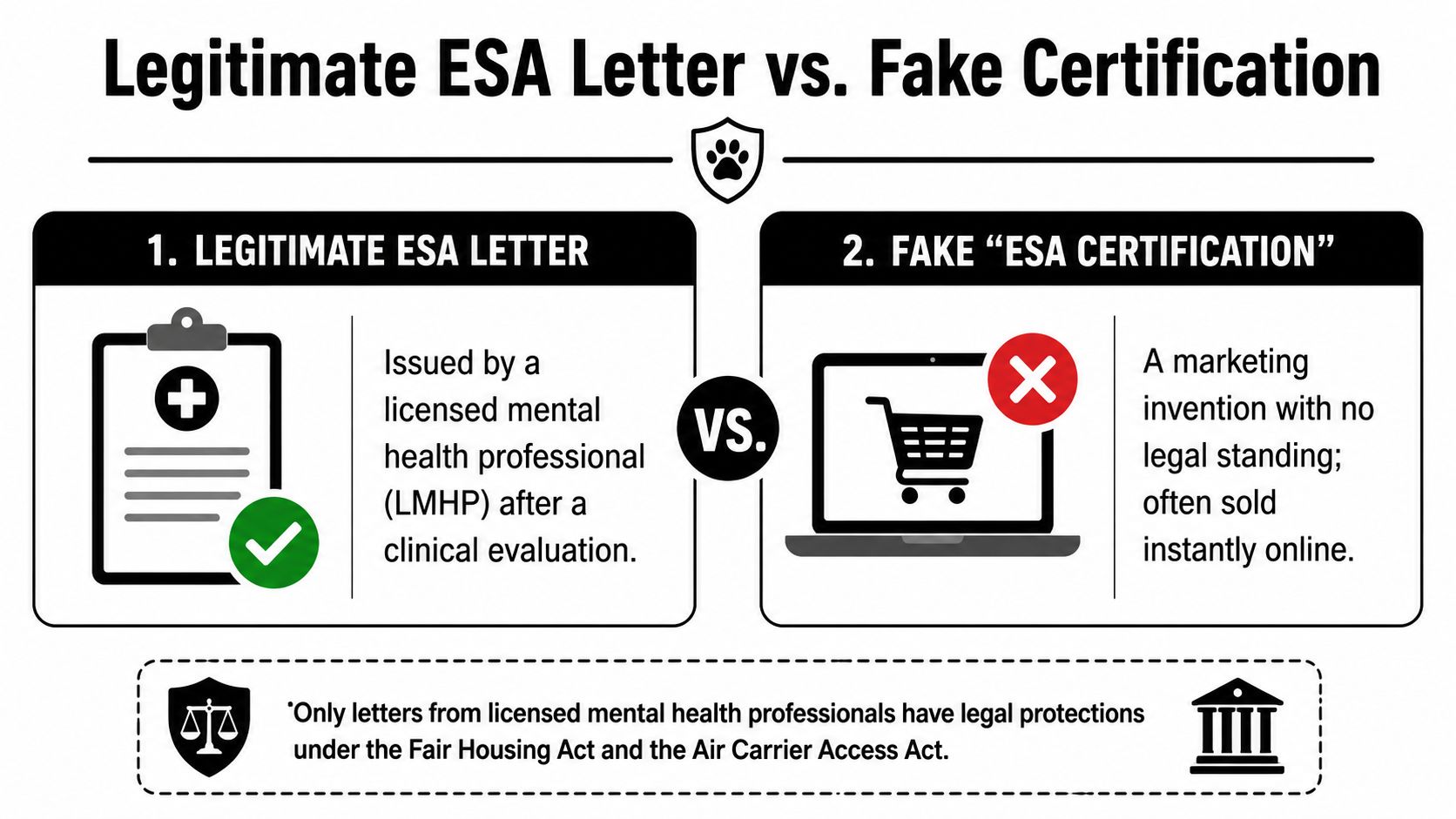
The legal and clinical literature describes the recognized standard this way: the letter must prescribe the animal as a necessary treatment component for a qualifying mental health disability and satisfy a four-part model involving legal compliance, disability assessment, animal function validation, and client-animal interaction analysis (clinical review of ESA documentation standards).
The letter is the product of evaluation
That point is where many consumer guides fail. The letter is not the service. The evaluation is the service. The letter is the formal output of that evaluation.
Attorneys who work regularly with medical evidence will recognize the pattern. The same logic applies in broader medical documentation practice. A valid document matters because of who prepared it, what assessment supports it, and whether the opinion is tied to a legitimate professional methodology. Without those elements, the paper itself carries little weight.
What should be in the document
A valid ESA letter should be specific enough to establish legal sufficiency and restrained enough to protect privacy. It doesn't need to read like a psychotherapy note, and it shouldn't disclose more than necessary to support the accommodation.
A well-formed letter generally includes these elements:
- Professional identity: The clinician's name, credentials, and licensing information.
- Formal presentation: Official letterhead, signature, and date.
- Disability confirmation: Language establishing that the patient has a qualifying disability.
- Functional nexus: A statement that the animal alleviates symptoms or supports the individual's psychological well-being.
- Verification details: Contact information that allows lawful verification of the provider's status.
A polished certificate proves only that someone designed a template. A clinically grounded letter shows that a licensed professional exercised judgment.
What it should not be confused with
A legitimate ESA letter is not:
| Document type | What it looks like | Why it fails |
|---|---|---|
| Online registration | A database listing or membership page | No registry creates legal status |
| ID card | Badge, wallet card, or pet tag | Identification isn't proof of disability-related need |
| Generic certificate | Downloadable “certification” PDF | A certificate is not a substitute for clinical opinion |
For attorneys, that distinction isn't academic. If you attach the wrong document to a housing packet, you may weaken a request that could have been supported properly with competent clinical evidence.
The Legal Framework for Emotional Support Animals
The central federal protection for ESAs is housing. That is the main legal context attorneys should focus on when advising clients.
Under the Fair Housing Act, an ESA may qualify as a reasonable accommodation when reliable documentation connects the disability to the need for the animal. The clinical review cited above explains that the FHA is the sole federal legislation under which ESAs qualify in this way, and that a valid letter can support the right to keep the animal in housing despite pet rules or fees when the documentation is reliable and tied to disability-related need.
Where the law helps and where it doesn't
A recurring source of confusion is that people blend three different legal categories: housing rights, airline rules, and public access. That confusion drives many bad online claims about ESA pet certification.
Here is the practical map attorneys should use:
| Context | Governing law | Rights granted | Key limitation |
|---|---|---|---|
| Housing | Fair Housing Act | Possible reasonable accommodation for an ESA with reliable documentation | Request can still be scrutinized for adequacy and legitimacy |
| Public places | Americans with Disabilities Act | ESA status does not create the same public access rights as a service animal | Restaurants, stores, and similar spaces generally need not admit an ESA on that basis |
| Air travel | Carrier-specific and travel documentation practices | Travel may depend on airline requirements and animal behavior forms | ESA status does not create broad public-access style rights |
The practical result is simple. Housing is the strongest legal lane for ESA documentation. Attorneys should resist expanding that lane into public access claims the law doesn't support.
Why precision matters for legal advice
A client who believes an ESA letter grants restaurant access or unrestricted travel can create avoidable disputes. In immigration work, those disputes can spill into the broader record. An otherwise sympathetic client may be portrayed as exaggerating rights or misusing documentation.
Practical rule: Advise only what the document actually supports. Housing accommodation is one question. Public access is another.
The difference between ESAs and service animals
This distinction should be stated plainly in client counseling. A service animal and an emotional support animal are not interchangeable legal categories. They arise from different standards and are treated differently by institutions.
That matters because scam vendors often exploit the confusion. They market ESA pet certification as a shortcut around service-animal rules. It isn't. Clients who use ESA paperwork to demand access reserved for service animals can face denials, complaints, or allegations of misrepresentation.
For attorneys, the cleanest approach is to separate the analysis:
- housing accommodation;
- medical documentation;
- public access limitations;
- factual use of the animal in the client's life.
When those are kept distinct, the legal advice becomes more accurate and the record becomes easier to defend.
Who Can Legally Provide ESA Documentation
The provider must be a licensed mental health professional acting within professional and legal boundaries. In practice, that can include a psychologist, psychiatrist, licensed clinical social worker, or licensed professional counselor, depending on the jurisdiction and scope of practice.
The title matters less than the license. What attorneys should verify is whether the professional is authorized to perform mental health assessment and issue the opinion in the client's state.
Licensing is not a technical detail
Clients often assume that any therapist-looking website or telehealth portal is enough. It isn't. The provider's license, jurisdiction, and ability to verify authorship are central to the document's reliability.
The stricter professional criteria described in this overview of ESA letter validity include official letterhead, signature, date, medical licensing information, diagnosis details, and contact information for verification by housing authorities. Those aren't cosmetic items. They are the details that help distinguish an accountable clinician from a document mill.
The evaluation must be real
A legitimate assessment isn't a checkbox form that asks whether the client likes their pet or feels calmer around animals. The clinician should assess at least four core questions that appear in the clinical framework already noted earlier:
- Legal compliance: Does the documentation meet the applicable accommodation standard?
- Disability assessment: Is there a qualifying mental health condition rising to the level relevant for the accommodation analysis?
- Animal function: Does the specific animal help alleviate symptoms in a clinically meaningful way?
- Client-animal interaction: Is the relationship stable, beneficial, and consistent with the claimed need?
That process requires judgment. It also requires enough clinical contact to form an opinion responsibly.
Ethical duties attorneys should respect
From the legal side, there is a temptation to treat ESA letters as procurement tasks. Find a provider, get a letter, submit it. That mindset can pressure clinicians into producing unsupported opinions. It also places attorneys too close to the clinical conclusion itself.
A better practice is to request competent documentation, not to script the diagnosis or dictate the recommendation. Counsel can explain the legal question. The clinician must answer the clinical one.
The strongest ESA letter is not the most dramatic one. It's the one a licensed professional can defend if questioned.
That distinction protects everyone involved. It protects the client from weak documentation, the clinician from ethical compromise, and the attorney from relying on evidence that may collapse under scrutiny.
How to Obtain and Verify a Legitimate ESA Letter
A proper ESA process is slower than buying ESA pet certification online. That's a feature, not a flaw. The delay usually reflects that someone is doing actual clinical work.
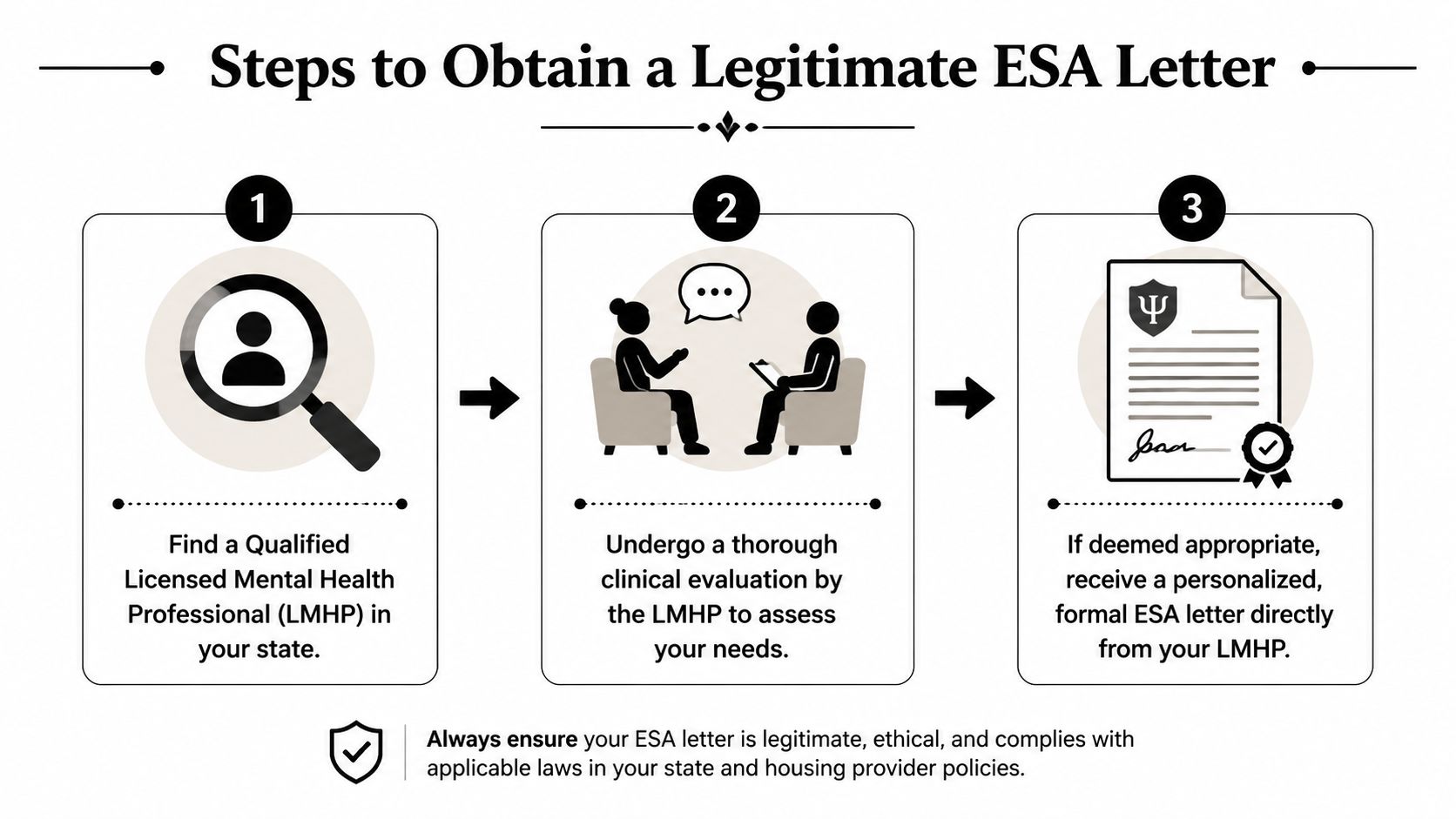
A workable sequence for clients and counsel
For clients, the sequence should look like this:
Find a licensed mental health professional in the relevant state.
The provider must be able to evaluate the person lawfully and issue documentation tied to their license.Participate in an actual evaluation.
The consultation should explore symptoms, functioning, treatment history, and the role of the animal. If the process feels like a purchase funnel instead of a health assessment, that's a warning sign.Receive an individualized letter only if clinically appropriate.
Not every client who wants an ESA should get a letter, and not every pet relationship qualifies.
For attorneys, document review should be as disciplined as review of any other assessment tool or professional opinion. The same habits used in evaluating the validity of assessment tools are useful here. Ask what method supports the conclusion, whether the provider is qualified, and whether the document answers the legal question presented.
A brief explainer can help clients understand the process:
The document review checklist
The legal validity criteria described in the earlier-cited provider standard require that the letter be signed and dated on official letterhead and include licensing information, diagnosis details, and contact information for verification.
Use this checklist before the letter is submitted:
- Letterhead and date: The document should appear on official professional letterhead and be dated.
- Signature: There should be a real provider signature, not just a typed name.
- License data: Check license number, credential, and state of issuance.
- Contact pathway: Confirm there is verifiable office contact information.
- Disability language: The letter should address disability status in legally meaningful terms.
- Need for the animal: The document should connect the disability to the need for the animal in housing.
What verification should and should not do
Verification is not cross-examination. The goal is to confirm authenticity, not to demand protected treatment records. Housing actors may verify provider identity and basic reliability. They should not turn the process into broad medical discovery.
For attorneys, that boundary matters. Over-disclosure can harm a client's privacy. Under-documentation can sink the request. The right balance is a concise, defensible letter supported by a real evaluation and limited verification of the provider's credentials.
Red Flags of ESA Certification Scams
Most ESA scams rely on speed, certainty, and official-looking design. They imitate legal formality while skipping clinical substance.
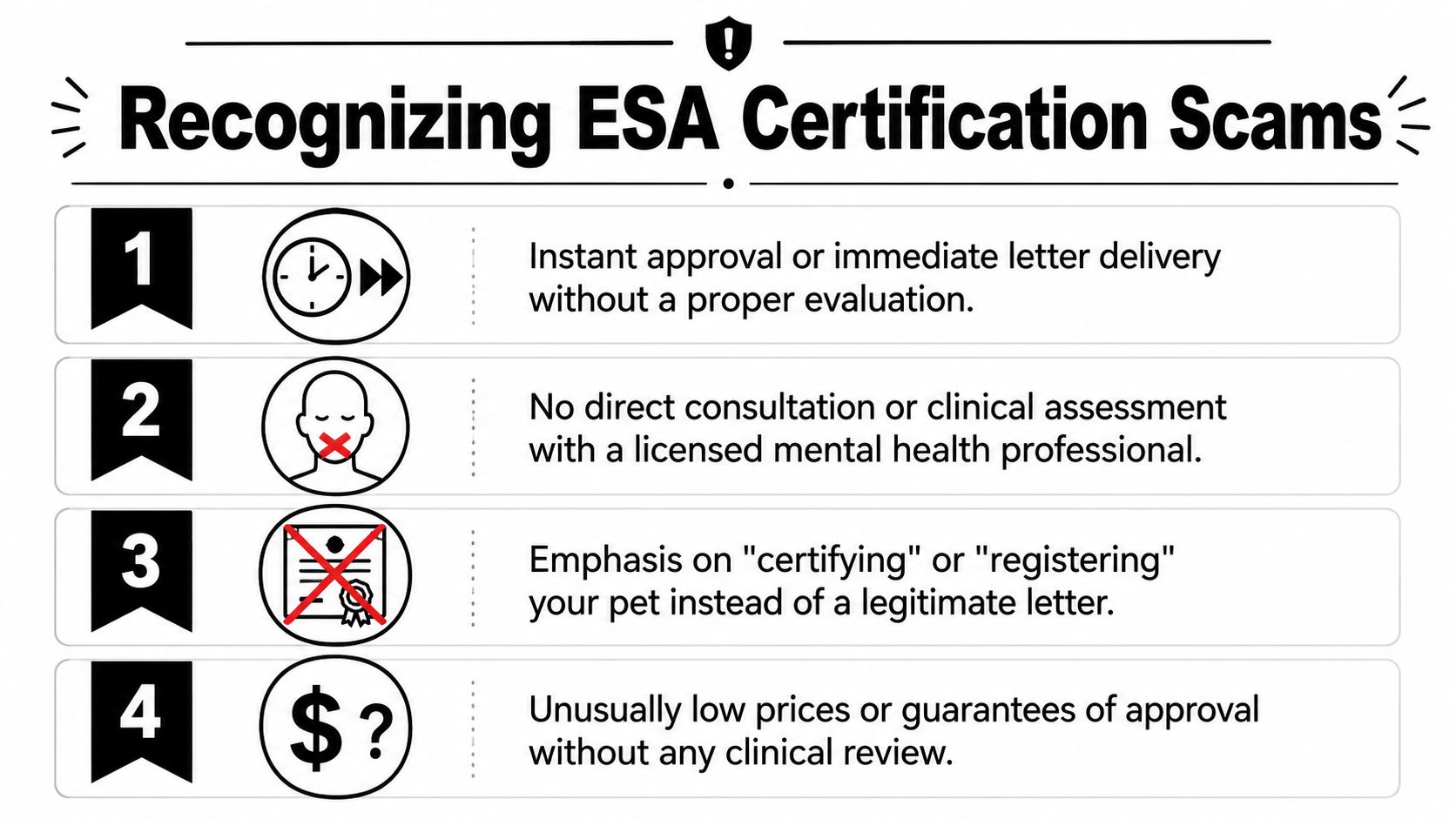
The warning from the American Counseling Association, as summarized in this discussion of invalid ESA letters and scam services, is direct: letters not issued after evaluation by a licensed professional are not valid. That same discussion also notes that landlords can legally refuse housing requests based solely on certificates.
The common scam pattern
These vendors usually market one or more of the following:
- Instant approval: They promise immediate certification, often before any clinician contact.
- Guaranteed outcomes: They imply that payment ensures a letter.
- Registry membership: They sell database enrollment as if it creates legal rights.
- ID packages: They bundle patches, cards, tags, or badges to make the pet look official.
- Minimal screening: They substitute a short questionnaire for an actual assessment.
A real clinical opinion doesn't work this way. A clinician cannot ethically guarantee a recommendation before evaluating the patient.
Why these offers are dangerous in legal settings
The harm isn't limited to wasted money. Fraudulent paperwork can trigger legitimate doubt about the entire request. In high-stakes cases, that doubt can spread beyond housing and into the attorney-client relationship, declarations, or corroborating evidence strategy.
If a website emphasizes the pet's certificate more than the provider's license, you're probably looking at a sales operation, not a clinical service.
A practical screening list for attorneys
When reviewing a service or document, ask these questions:
Who evaluated the client?
If the answer is unclear, that's enough to pause.Can the provider's license be checked?
No license data usually means no accountable author.Was there actual clinician interaction?
Automated forms don't substitute for professional judgment.What is being sold?
If the headline product is “certification,” “registration,” or an ID card, the service is focused on appearance.Does the language overpromise?
Claims that a document will grant public access or solve all landlord disputes should be treated skeptically.
Scam detection is part legal literacy and part common sense. The paper should follow the evaluation, not the other way around.
Guidance for Attorneys and Vulnerable Clients
For attorneys, the most important counseling move is often linguistic. Stop using the phrase ESA pet certification with clients unless you're correcting it. The phrase invites the wrong solution. Ask instead whether the client has a valid clinical letter from a licensed professional and whether the document is framed for housing accommodation.
What to look for in the letter
The most important legal phrase is often the simplest one. The document must explicitly state that the individual has a disability. According to the ADA FAQ resource discussed in ESA guidance, saying only that the person has “mental reasons” is legally insufficient for Fair Housing Act accommodation, and that failure can lead to denials.
That wording issue matters because many vulnerable clients are trying to protect privacy, avoid stigma, or communicate through interpreters. A clinician can preserve confidentiality while still using the legally necessary language. This is one reason informed consent and document purpose should be handled carefully in any clinician-attorney collaboration, particularly where informed consent procedures must account for trauma, language access, and the client's understanding of how the letter will be used.
How the letter can fit into a broader legal record
In immigration matters, an ESA letter usually shouldn't be treated as the centerpiece of the case. It can, however, serve as corroborating evidence of ongoing mental health treatment, symptom management, or functional impairment when it is clinically sound and consistent with the rest of the record.
That use requires restraint. Counsel shouldn't overstate what the letter proves. It does not establish every element of trauma, hardship, or disability by itself. It may support a narrower point, such as continuity of care, the presence of clinically recognized symptoms, or the treatment significance of the animal in the client's day-to-day stabilization.
For vulnerable clients, the safest path is rarely the fastest one. It is the path that produces documentation another professional can verify and defend.
Attorneys who keep the standard high protect both the client and the case. They also reduce the chance that a predatory vendor will insert junk paperwork into a file that needs precision.
If your firm needs rigorous, ethically grounded psychological documentation for immigration matters, Pro Psychological Analysis provides evidence-based evaluations aligned with USCIS and immigration court standards, with a focus on trauma-informed practice, confidentiality, and close coordination with counsel.