
You already know the scenario. The legal theory is solid, the client is credible, and the psychological evaluation arrives on time. On first read, it seems usable. Then the problems surface. Dates are buried. Test conditions aren't explained. The clinician describes symptoms well but never ties them cleanly to the immigration claim. A second report from the same office looks completely different, uses different headings, and omits records that were referenced in the first.
That kind of inconsistency doesn't just create editing work for counsel. It creates risk. In immigration matters, a report isn't merely clinical writing. It's an evidence document that has to survive scrutiny from USCIS, opposing counsel, and sometimes an immigration judge. When the format, content, and supporting documentation vary from case to case, the legal value of the evaluation varies too.
Documentation standardization is how firms stop treating evaluations as artisanal products and start treating them as reliable evidence packages. The point isn't to produce cookie-cutter reports. The point is to make sure every evaluation consistently addresses admissibility, credibility, confidentiality, and the specific legal question in front of the court or agency.
Table of Contents
- The Hidden Risk of Inconsistent Documentation
- What Documentation Standardization Really Means
- Navigating Compliance for Immigration Evaluations
- A Four-Part Framework for Implementation
- Essential Templates and Checklists for Your Practice
- Common Pitfalls and How to Avoid Them
- Leading the Change and Choosing the Right Tools
The Hidden Risk of Inconsistent Documentation
A weak evaluation rarely fails because the clinician lacked empathy or knowledge. It usually fails because the documentation was assembled inconsistently. One report contains a clear psychosocial history, diagnostic reasoning, collateral records list, interpreter notation, and functional impact analysis. Another leaves half of that implied. To a law firm, both may look acceptable until one gets challenged.
In immigration practice, inconsistency creates a special problem. Attorneys build declarations, legal briefs, and filing strategy around the assumption that the expert report is stable. If the evaluation format changes from matter to matter, counsel can't predict what they will receive, when key facts will appear, or whether the report will answer the actual legal question. That makes it harder to draft efficiently and harder to defend the record.
When a good report is not a defensible report
I've seen reports that were clinically thoughtful but legally fragile. They described trauma in compelling language, yet failed to document who was present for the interview, what records were reviewed, whether language interpretation affected administration, or how the symptoms connected to hardship, coercion, fear, or abuse dynamics relevant to the petition.
Those omissions invite avoidable attacks:
- Foundation attacks: The reviewer can't tell what sources informed the opinion.
- Method attacks: The file doesn't explain how the evaluation was conducted.
- Consistency attacks: Similar cases from the same practice look materially different.
- Weight attacks: The report reads like advocacy instead of disciplined forensic work.
A report can be compassionate and still be unusable if it doesn't show its work.
Variance is the real liability
Most firms don't have a quality problem in the abstract. They have a variance problem. The best report from a clinician may be excellent. The next one may be merely adequate. The one after that may omit a disclosure that matters. That spread is what hurts legal strategy.
A partner law firm needs to know that every evaluation will include the same core evidentiary architecture. That means a predictable intake process, a consistent report structure, and a repeatable method for documenting records, testing conditions, interpreter use, diagnostic formulation, and nexus to the legal claim. When those components are standardized, counsel spends less time repairing expert work and more time using it.
What Documentation Standardization Really Means
Documentation standardization is the difference between a component built from a blueprint and one shaped by instinct alone. Both might function. Only one is predictable under stress.
For immigration evaluations, standardization means every case moves through a defined documentation system. The client narrative remains individualized. The diagnosis remains individualized. The forensic opinion remains individualized. But the way the work is documented, labeled, reviewed, and delivered follows a reliable structure.
From customized writing to engineered evidence
Standardization doesn't mean forcing every case into identical language. It means deciding in advance what every legally defensible report must contain. In practice, that usually includes identity and referral information, informed consent language, limits of confidentiality, interview details, records reviewed, methods used, symptom history, trauma history when relevant, diagnostic impression, functional impact, and a direct opinion tied to the immigration issue.
That approach mirrors what other high-stakes fields learned long ago. In a study of 144 EHR notes, structured and standardized documentation improved mean quality scores from 64.35 to 77.2, a 12.8-point increase, with p < 0.001, as reported in this analysis of structured clinical documentation. The takeaway for immigration work is practical. When professionals document from a defined structure, important elements are less likely to be omitted.
What stays flexible and what should not
The mistake many practices make is standardizing the wrong thing. They standardize voice instead of process. That produces stiff reports and still leaves risk in the file.
What should stay flexible:
- Clinical interpretation: The evaluator must retain judgment.
- Case narrative: Every client history is different.
- Legal emphasis: Asylum, VAWA, T visa, U visa, and hardship cases need different framing.
What should not stay flexible:
- Core headings: Counsel shouldn't hunt for method, records, or conclusions.
- Required disclosures: Interpreter use, consent, and limits should never be optional.
- Record handling: The practice needs one way to log what was reviewed.
- File naming and versioning: Final means final. Draft means draft.
Practical rule: Standardize the container, not the client.
A standardized evaluation package lets attorneys predict what they'll receive and where to find it. It also helps the evaluator think more clearly. Good templates don't narrow professional judgment. They protect it by making sure the opinion rests on a complete record rather than memory, habit, or deadline pressure.
Navigating Compliance for Immigration Evaluations
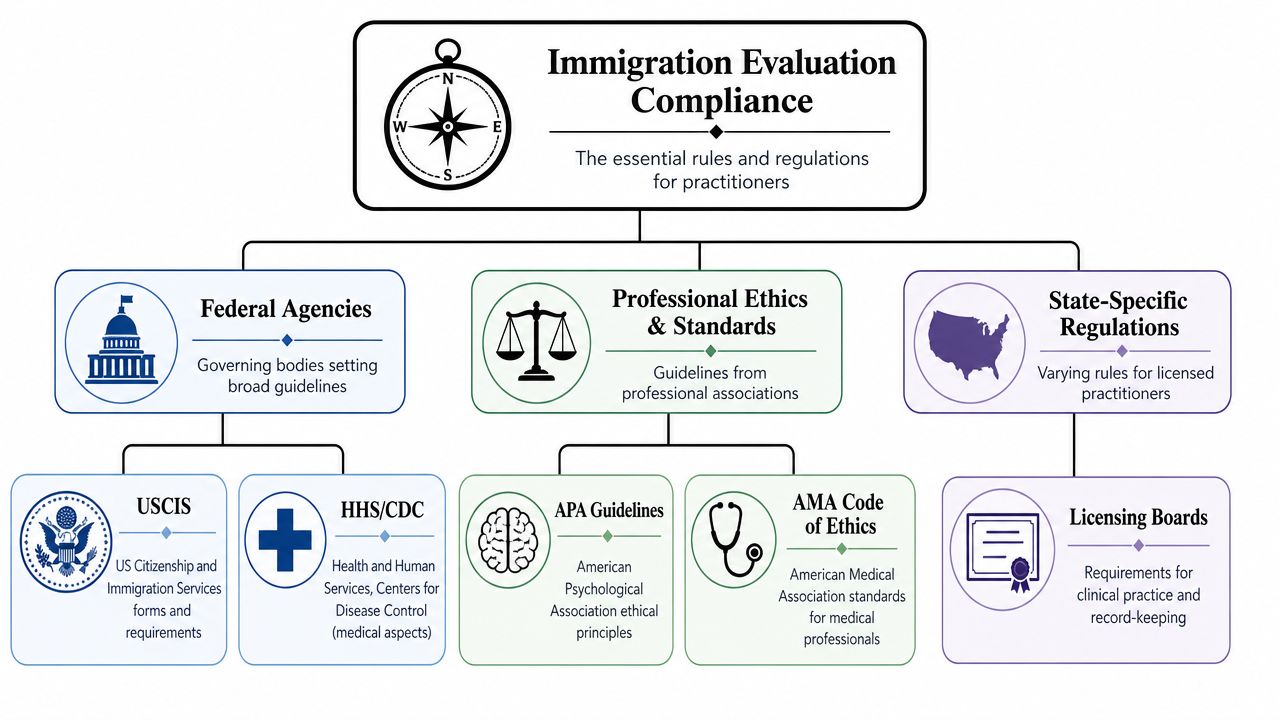
The compliance problem in immigration evaluations isn't that there are no rules. It's that the rules come from different directions at once. Attorneys think about admissibility and burden. Clinicians think about ethics, informed consent, confidentiality, and accurate diagnosis. Agencies and courts care about whether the document is clear enough to trust.
That is why documentation standardization matters. It creates one operating system for work that has to satisfy multiple audiences.
A useful process model looks like this:
Where legal teams lose ground
In practice, weak compliance usually shows up in ordinary places, not dramatic ones. The report may lack a clear statement of who referred the client and for what purpose. It may fail to separate client self-report from collateral information. It may discuss symptoms at length without explaining why they matter to the statutory or discretionary issue before the agency.
Counsel also runs into avoidable privacy and process problems when intake emails, draft reports, consent forms, interpreter notes, and collateral records live in different systems or are exchanged casually. A defensible file needs chain-of-custody logic, even if no one uses that phrase in daily practice. The firm should be able to show what was received, what was reviewed, what was relied upon, and what version of the report was submitted.
A useful benchmark comes from technical documentation. Frameworks like IEC/IEEE 82079-1 in technical documentation practice are not mandatory for every product, but they serve as a decisive benchmark in liability settings because they demonstrate clarity, structure, and safety. Immigration evaluations function similarly. A clear, disciplined document reduces exposure because it shows method, not just conclusion.
The training issue matters too. This short discussion is worth sharing with staff and contractors who touch evaluation files:
How standards affect admissibility and weight
Admissibility fights often begin as credibility fights. If the report is internally disorganized, the reviewer may doubt the evaluator's care. If testing conditions aren't documented, the reviewer may question validity. If records are mentioned but not identified, the reviewer may discount the opinion.
A standardized system helps law firms protect against those issues by requiring each file to answer the same core questions before release:
| Question | Why it matters legally |
|---|---|
| Who requested the evaluation and for what purpose? | Establishes context and avoids confusion about role |
| What information did the evaluator review? | Supports foundation and transparency |
| How was the interview conducted? | Addresses method, language access, and fairness |
| What clinical findings matter to the case theory? | Connects symptoms to the legal claim |
| What limits apply to the opinion? | Increases credibility by showing restraint |
The strongest reports don't sound absolute. They sound careful.
That is the strategic advantage. Standardization doesn't make the report more verbose. It makes the report easier to trust.
A Four-Part Framework for Implementation
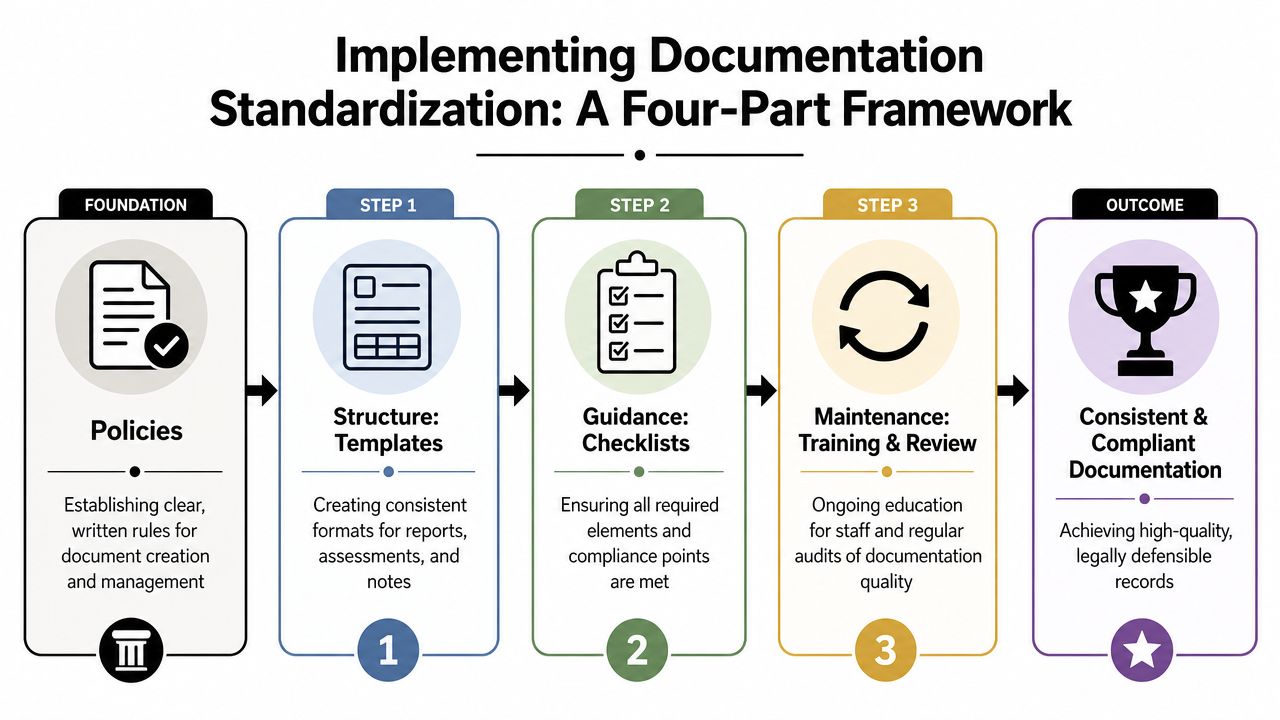
Most firms don't need a grand redesign. They need a system that's durable under deadline pressure. The fastest way to get there is to build documentation standardization around four parts: policies, templates, workflows, and quality assurance.
Policies that remove ambiguity
Policies answer the questions that otherwise get decided ad hoc. What must be in every referral packet? Who verifies interpreter arrangements? How are draft reports labeled? Who can transmit records? When is an updated evaluation required?
A good policy set is short and operational. It doesn't read like a textbook. It tells staff what to do when the file is active.
Borrow a lesson from IT operations. According to IT documentation standards for review cycles, naming, and version control, documentation should be updated immediately after system changes, disaster recovery plans should be reviewed quarterly, and user access should be audited annually. The same logic works in a legal-clinical practice. When a diagnosis changes, when new records arrive, or when counsel narrows the legal issue, the documentation should be updated at that point, not weeks later from memory.
Templates and workflows that hold up under pressure
Templates create consistency. Workflows create timing. You need both.
A workable setup usually includes:
- Referral template: Captures relief type, deadlines, legal questions, language needs, and available records.
- Consent template: Standardizes informed consent, limits of confidentiality, and disclosure of the evaluation's forensic purpose.
- Report template: Locks in required sections so critical content isn't skipped.
- Workflow map: Tracks intake, scheduling, records receipt, interview completion, draft preparation, attorney questions, finalization, and secure delivery.
Naming conventions matter more than most practices think. If one file is labeled "final report," another "revised final," and a third "court version latest," someone will eventually submit the wrong document. Adapt a convention that is simple and rigid. The IT example of a structured label format is useful because it eliminates guesswork. Version logs do the same.
For practices reviewing test selection and defensibility, this discussion of assessment tool validity in practice is a useful companion to template design because it forces the same question standardization should always ask: what exactly is this document trying to prove?
Quality assurance that catches defects before filing
Quality assurance is where most systems either become real or stay aspirational. A report should not go out because it feels done. It should go out because it passed review against a fixed checklist.
That checklist shouldn't only ask whether the report is grammatically clean. It should ask whether the file is legally complete.
Consider a QA review that checks for:
- Role clarity. Does the report define forensic purpose and limits?
- Source transparency. Are records, interviews, and collateral sources identified?
- Method notation. Are language access, test conditions, and interview logistics documented?
- Legal nexus. Does the conclusion answer the case question directly?
If a reviewer can't tell how the evaluator reached the opinion, the opinion will carry less weight no matter how experienced the evaluator is.
Essential Templates and Checklists for Your Practice
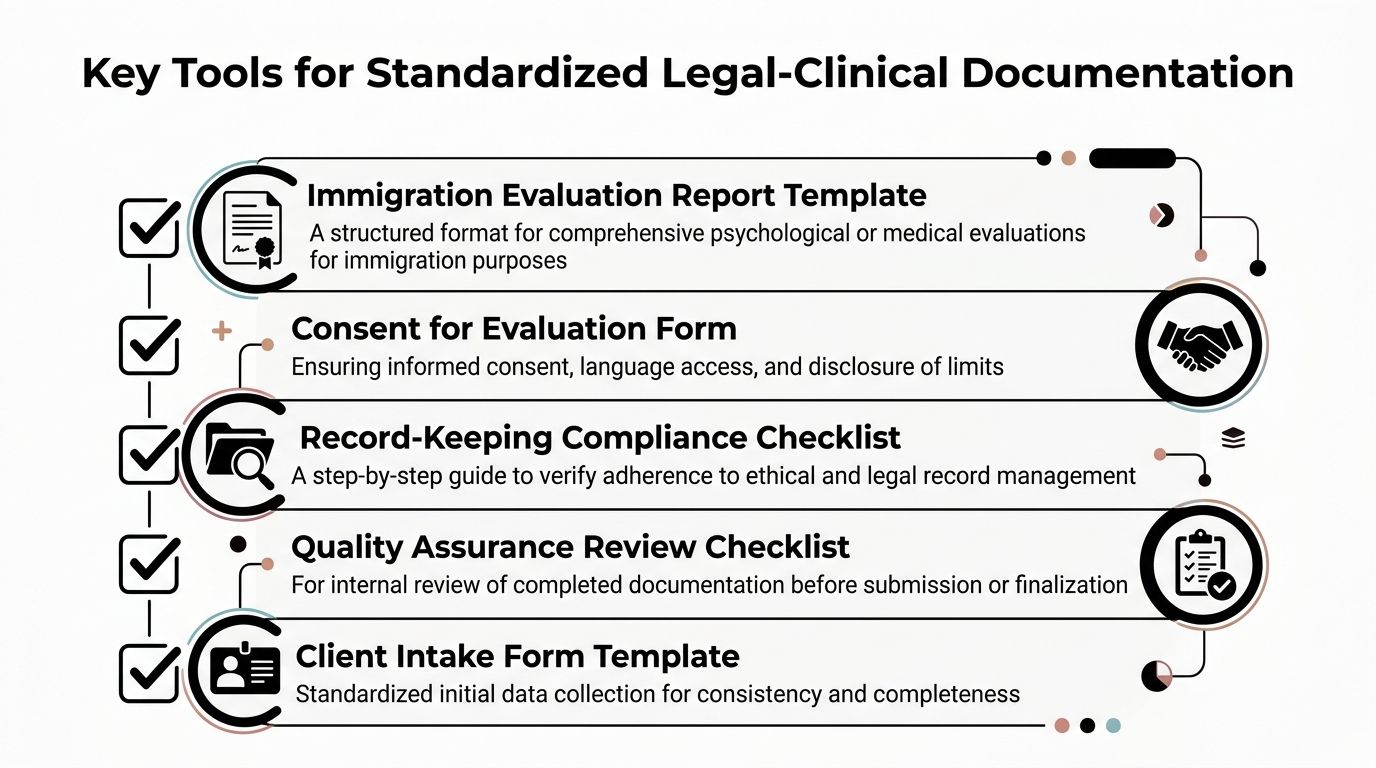
A standard only becomes useful when it turns into a form, checklist, or repeatable drafting pattern that staff can use without guessing. Most law firms and clinicians don't need more theory. They need fewer missing pieces.
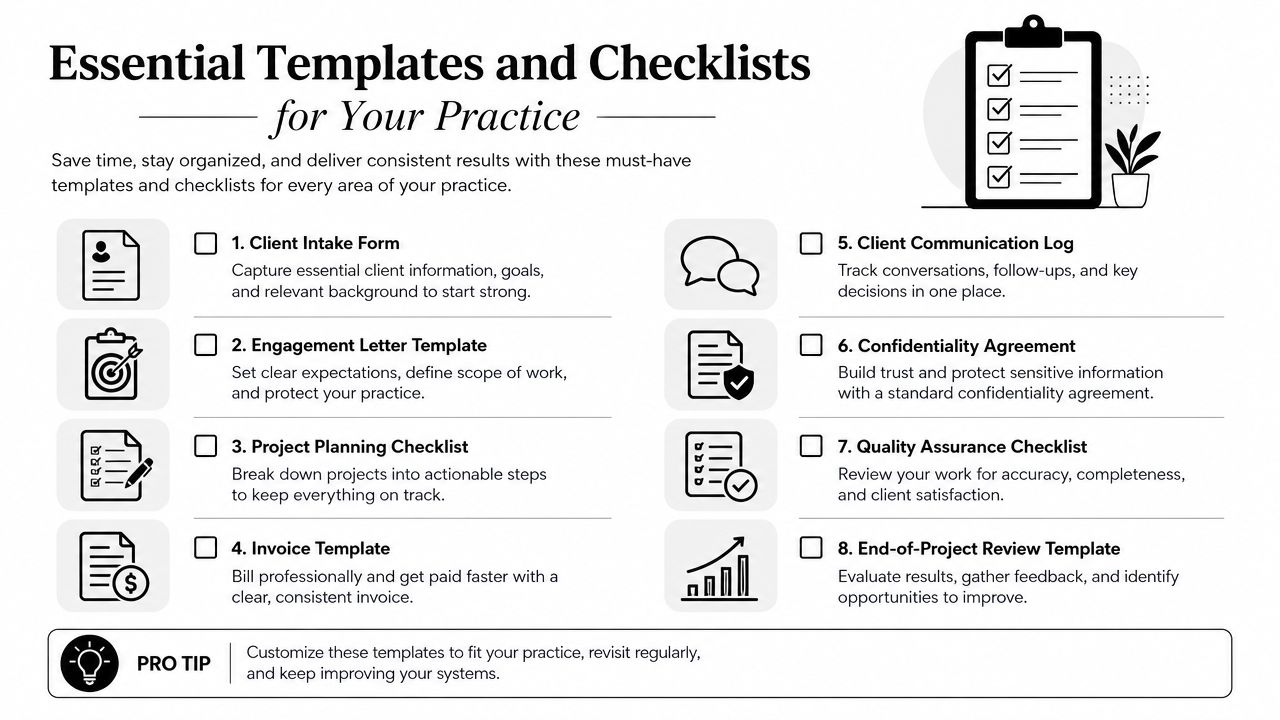
Referral checklist for counsel
Before the evaluator ever meets the client, the legal team should provide a structured referral. That referral should answer the questions the clinician would otherwise have to reconstruct from emails and partial notes.
A practical referral checklist includes:
- Case objective: Identify the form of relief and the precise legal issue the evaluation should inform.
- Procedural posture: Note filing deadlines, hearing dates, and whether the report is for initial submission, RFE response, appeal support, or litigation.
- Client logistics: Confirm language, interpreter needs, location, safety concerns, and preferred contact method.
- Available evidence: List declarations, police reports, medical records, school records, prior evaluations, and any country-condition materials the clinician should see.
- Specific attorney questions: State what counsel needs answered. For example, hardship impact, trauma sequelae, coercive control dynamics, or consistency of symptoms with the disclosed history.
That last point is where many referrals fail. If the attorney doesn't articulate the legal question, the evaluator may produce a clinically rich report that is only loosely connected to the filing theory.
Core structure for the evaluation report
The report itself should follow a stable architecture. Not identical prose. Identical structure.
A reliable template often includes these sections:
| Report section | What it does |
|---|---|
| Identifying and referral information | States who requested the evaluation and why |
| Informed consent and limits | Clarifies forensic role, confidentiality, and use of the report |
| Sources of information | Lists interviews, records, collateral data, and testing used |
| Relevant history | Organizes psychosocial, medical, trauma, family, and migration history as needed |
| Mental status and clinical observations | Documents observed presentation and functioning |
| Diagnostic formulation | Explains conclusions, not just labels |
| Functional impact and legal nexus | Connects findings to the immigration claim |
| Limitations | Shows professional restraint and strengthens credibility |
If you need a model for how a finished document can be organized for readability, this sample psychological evaluation report format is a useful reference point.
One additional template deserves attention: the pre-release review sheet. It should ask whether dates are internally consistent, whether all referenced records are attached or logged, whether interpreter use is documented, whether testing adjustments are noted if applicable, and whether the conclusion is framed in language that helps counsel rather than forcing them to rewrite the opinion into legal relevance.
Standardization should make the work easier to produce and easier to trust. If a template creates more confusion than it removes, it needs revision.
Common Pitfalls and How to Avoid Them
The biggest mistakes in immigration evaluation documentation are usually framed as isolated oversights. They're not. They are system failures.
Outdated reports and unexplained testing changes
One recurring problem is the stale evaluation. A report may have been solid when drafted but no longer fits the case timeline, current symptom picture, or procedural posture. The challenge in immigration practice is that there isn't one unified rule telling attorneys exactly how long psychological documentation remains fresh for every setting.
By contrast, the NCBE psychological disability documentation guidelines require evaluations within the preceding 12 months for most cases, with narrow exceptions. Immigration law doesn't give practitioners the same clean rule. That means firms need their own review trigger. If the case timeline stretches, treatment changes, new trauma is disclosed, or the filing posture changes, someone should decide whether the evaluation needs an update rather than assuming the old report is still fine.
Another major failure point is test administration. School psychology guidance is clearer than forensic and immigration practice on this issue. As explained in NASP guidance on ethical documentation of testing adjustments, adjustments to standardized procedures should be documented with the reason, the nature of the adjustment, and the likely impact. Immigration evaluations often skip that level of detail. That leaves a gap a reviewer can exploit.
The communication failures that weaken strong cases
Many report problems start before the first interview. Counsel doesn't send the declaration draft. The evaluator doesn't know which legal standard matters most. The case manager learns late that the client needed an interpreter of a specific dialect. Everyone is working hard, but no one is operating from the same checklist.
The fix is simple, but it has to be mandatory:
- Set a referral packet minimum: No scheduling until the packet contains the required legal and logistical information.
- Require a legal question memo: Even a short one prevents vague conclusions.
- Document every procedural adjustment: If interpretation, breaks, accommodations, or modified administration occurred, record them clearly.
- Use a refresh trigger: Re-review the file whenever a case is delayed or materially changed.
The report shouldn't be the place where the team discovers what the case is about.
When firms adopt those habits, they stop losing force through preventable defects.
Leading the Change and Choosing the Right Tools
Documentation standardization succeeds when one person owns it, but the whole team uses it. A partner can set the expectation. A senior clinician can define the report standard. A case manager can enforce intake completeness. If each group assumes someone else is handling the process, the system falls apart fast.
Start with one lane and make it repeatable
Don't try to standardize every document in the practice at once. Start with one case type and one document set. For many firms, that means referral packets, consent forms, and final immigration evaluations for the highest-volume relief category they handle. Run the process, collect friction points, and revise.
Early wins matter. If attorneys can locate key conclusions faster and clinicians spend less time rebuilding the same sections from scratch, people will keep using the system.
Choose tools that support evidence integrity
The best tool stack is not the one with the most features. It's the one that preserves confidentiality, version control, and retrieval discipline. In practice, that usually means secure client portals, template management inside a controlled document system, standardized intake forms, and HIPAA-conscious messaging rather than informal email chains. This overview of secure data management for sensitive clinical and legal records is a useful starting point when evaluating systems.
Choose tools that help your team answer simple questions without delay: Which version is current? Who reviewed it? What records were used? Was consent completed? Was the final transmitted securely?
If your current process can't answer those questions reliably, standardization isn't optional. It's overdue.
Law firms that handle immigration matters need evaluations that are clinically sound, strategically aligned, and built for scrutiny. Pro Psychological Analysis partners with attorneys to deliver evidence-based immigration evaluations for asylum, T visa, U visa, VAWA, and hardship cases, with careful attention to admissibility, confidentiality, and deadlines.