
Acculturation stress is the psychological distress that arises from the challenges of adapting to a new culture. In mainstream psychological literature, it has been treated as a distinct construct since 1974, and contemporary research still links it to depression, anxiety, and, in some youth studies, suicidal ideation over a 2-to-3-year period.
If you're building an immigration case, the gap in conventional thinking is usually this: the file describes a client as "stressed," "anxious," or "struggling to adjust," but it never shows why that suffering is clinically different from the ordinary difficulty of relocation. That omission matters. USCIS officers and immigration judges don't need a vague narrative of hardship. They need a structured explanation of cause, mechanism, and effect.
For forensic purposes, the acculturation stress definition gives you that structure. It ties symptoms to specific intercultural stressors such as language barriers, discrimination, family role disruption, identity conflict, and loss of support. In practice, that can make the difference between a report that sounds sympathetic and one that is legally useful.
Table of Contents
- Why This Definition Matters in Immigration Law
- The Core Acculturation Stress Definition
- Common Causes and Manifestations
- Distinguishing Acculturation Stress from Related Conditions
- Forensic Relevance in Immigration Proceedings
- How to Assess and Document Acculturation Stress
- Conclusion Translating Clinical Findings into Legal Arguments
Why This Definition Matters in Immigration Law
Many attorneys still treat stress as a generic background fact. That's a mistake. In immigration work, the question isn't whether a client feels overwhelmed. The question is whether the distress can be identified, documented, and linked to conditions that matter to the legal theory of the case.
A precise definition does that work. When a clinician identifies acculturation stress rather than using loose language about "adjustment problems," the report explains that the distress arises from intercultural transition itself, not from ordinary life strain. That distinction makes the evidence easier to evaluate and harder to dismiss as routine discomfort.
Practical rule: If the psychological harm is tied to migration-related adaptation, name the mechanism. Courts and agencies weigh specific formulations better than generalized suffering.
This matters across forms of relief. In asylum matters, the concept can help explain how ongoing marginalization, exclusion, and cultural dislocation sustain psychological symptoms after the original persecution. In VAWA, T visa, and U visa cases, it can clarify how dependency, fear, language isolation, and cultural barriers shaped vulnerability to abuse or blocked escape. In hardship matters, it can show why separation or relocation would create more than sadness. It would remove the client's coping structure in a setting already defined by cultural strain.
A strong legal record usually pairs facts, timelines, and mental-health evidence. Attorneys who understand the clinical language behind these reports tend to ask better questions, request more targeted evaluations, and present a cleaner theory of harm. The broader interaction between mental health evidence and immigration strategy is also discussed in this overview of mental health and immigration.
Why specificity changes the case narrative
Generic stress language often fails because it doesn't answer four forensic questions:
- What triggered the condition: Was the distress tied to discrimination, language barriers, family role reversal, or cultural conflict?
- Why this client is vulnerable: Did legal uncertainty, social exclusion, or dependence on an abuser reduce coping capacity?
- How the symptoms function: Did the client withdraw, become hypervigilant, somaticize distress, or develop depressive symptoms?
- Why the court should care: Does the condition corroborate persecution, coercive control, or extreme hardship?
When those answers are documented, the report becomes evidence rather than ornament.
The Core Acculturation Stress Definition
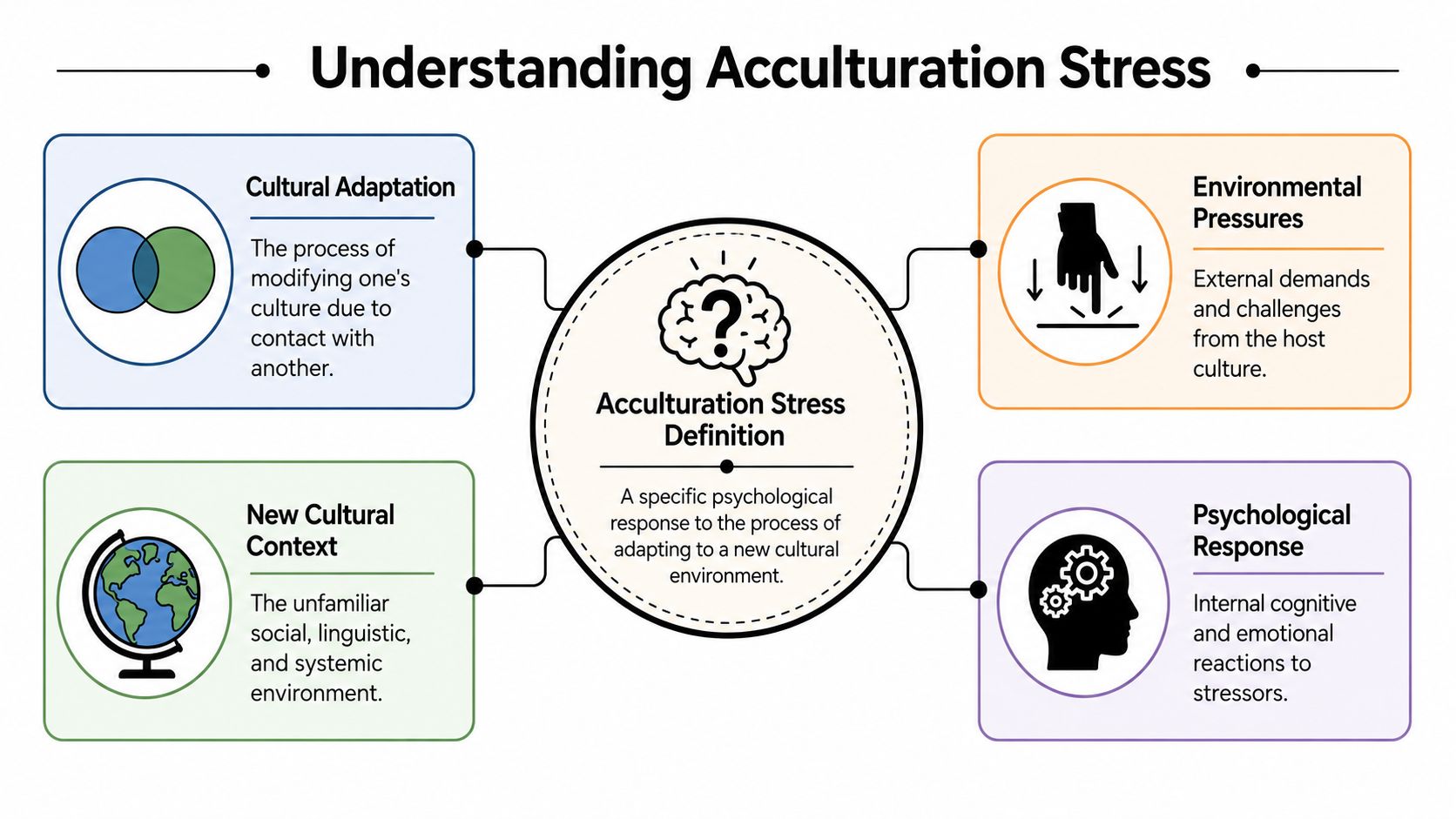
The acculturation stress definition is straightforward but clinically specific. It refers to the stress response that emerges when a person must adapt to a new host culture and that process creates unresolved conflict around language, norms, identity, belonging, family roles, or discrimination. The point isn't merely that life changed. The point is that intercultural adaptation itself became the stressor.
Psychology has treated this as a recognized construct for decades, not as a casual label. A review discussing contemporary use of the concept notes that acculturative stress can contribute to depression and anxiety, and a 2021 study of Chinese migrant children found that higher acculturation stress was associated with lower need satisfaction, higher need frustration, and more depression, as discussed in this article on acculturative stress and depression in migrant children.
What makes it a distinct stress response
Clinically, acculturative stress isn't just "being stressed after moving." It is a distinct stress response tied to intercultural contact. The relevant features usually include:
- Pressure to change: The person feels pushed to abandon language, values, customs, or identity markers in order to function or remain safe.
- Mismatch in demands and coping: The host environment demands adaptation faster than the person can realistically manage.
- Threats to belonging: The person experiences rejection, exclusion, or confusion about where they fit.
- Loss of familiar support: Family, community, and social roles no longer operate in the same way.
A useful analogy is the social immune system. A healthy adaptation process can absorb differences and build competence over time. But when pressure is constant and support is weak, the system stays on alert. The harm comes less from one new custom and more from a prolonged state of vigilance, conflict, and depletion.
What attorneys should listen for in client interviews
The legal value of the definition lies in mechanism. A client may not use clinical language, but they'll often describe the pattern plainly:
| Client statement | Possible forensic meaning |
|---|---|
| "I don't know how to act here anymore." | Identity conflict and belonging disruption |
| "My children speak for me everywhere." | Role reversal and dependency |
| "People treat me differently because of my accent." | Discrimination linked to adaptation stress |
| "I stopped going out because I can't communicate." | Isolation and shrinking coping resources |
A strong report doesn't stop at naming distress. It shows how the cultural environment produced it and why the symptoms persisted.
That is what turns definition into evidence.
Common Causes and Manifestations
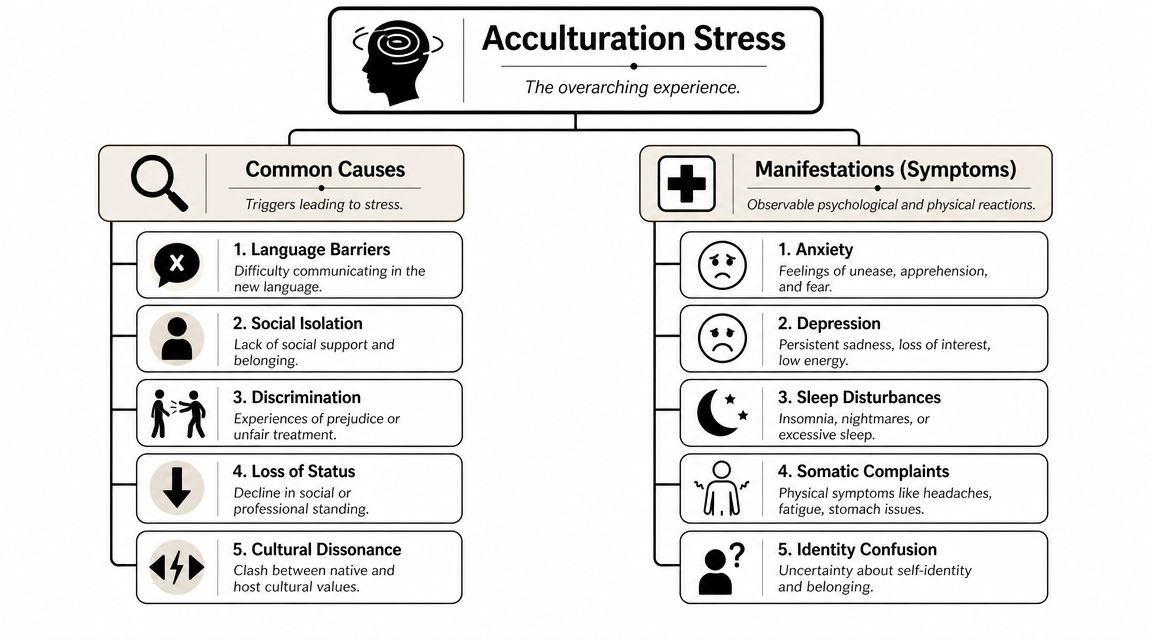
In practice, acculturation stress usually appears as a pattern, not a single event. Attorneys hear fragments during intake. The client reports headaches, poor sleep, withdrawal, irritability, shame, panic in public settings, or conflict at home. Those symptoms often make more sense once you sort the underlying stressors into categories.
External pressures that commonly drive the condition
Some triggers come from the environment. These are often the easiest for adjudicators to understand because they can be tied to concrete events and living conditions.
A recent summary notes that acculturation stress varies by adaptation style and social context. Integration is associated with lower stress, while discrimination, language barriers, immigration policy, and weak social support increase risk. The same source also notes that immigrant youth and those facing family-role pressures such as adultification may face increased risk for depression, anxiety, and suicidal ideation, as described by the National Hispanic and Latino Mental Health Technology Transfer Center's discussion of acculturation stress.
Common external drivers include:
- Language barriers: The client can't advocate for basic needs, understand institutions, or defend against mistreatment.
- Discrimination: Accent, dress, race, religion, or immigration status become daily points of exclusion.
- Legal uncertainty: The person lives in a prolonged state of fear about removal, family separation, or procedural instability.
- Social isolation: Community ties weaken, and there is no reliable network to normalize or buffer stress.
Internal conflicts that amplify symptoms
Other triggers are relational and psychological. They often surface later in an interview because clients may experience them as shame rather than stress.
Examples include identity confusion, guilt about "becoming too American" or "not adapting enough," tension between family expectations and host-culture norms, and abrupt changes in gender or parental roles. In some families, children become interpreters, decision-makers, or emotional mediators. That doesn't just create conflict. It changes the structure of dependence inside the household.
For attorneys who work with clients whose bodies carry stress as much as their words do, this can overlap with patterns discussed in this explanation of nervous system dysregulation. The overlap matters because some clients won't report "anxiety" directly. They'll report stomach pain, exhaustion, dizziness, headaches, or insomnia.
What symptoms tend to look like in real cases
The manifestations usually cut across emotional, cognitive, and physical domains:
- Anxiety symptoms: fear, hypervigilance, dread in public or institutional spaces
- Depressive symptoms: hopelessness, loss of interest, low motivation, withdrawal
- Somatic complaints: headaches, fatigue, gastrointestinal distress, diffuse body pain
- Identity symptoms: confusion about values, belonging, and self-presentation
- Family symptoms: conflict, role reversal, guilt, divided loyalty
When symptoms cluster around language, discrimination, family-role change, and belonging, acculturation stress should move high on the differential list.
What doesn't work is reducing all of this to "the client is having a hard time adjusting." That language strips away causation. It also makes the suffering sound ordinary when, clinically, the pattern is often much more specific.
Distinguishing Acculturation Stress from Related Conditions
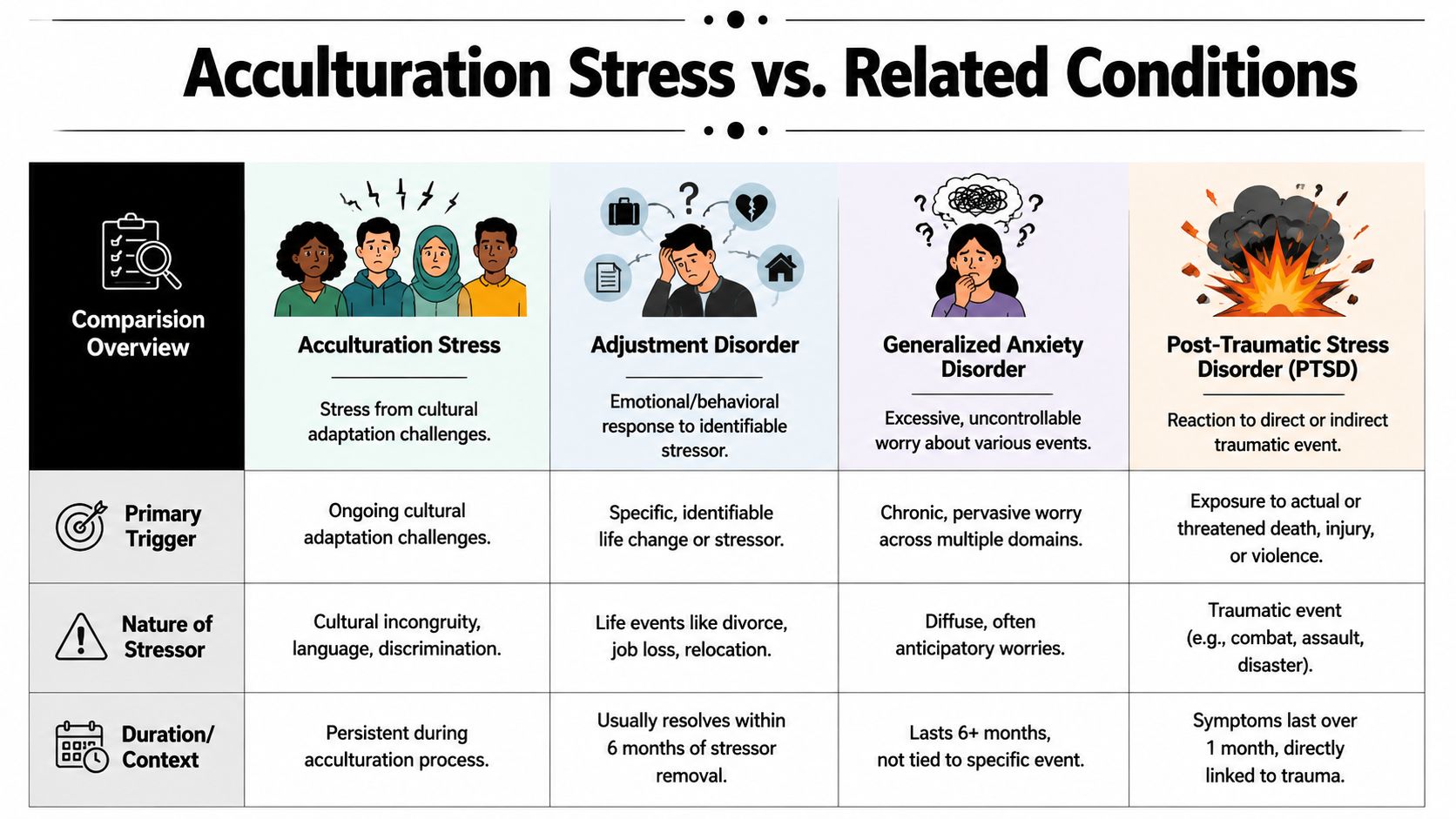
Mislabeling weakens reports. If the evaluation treats acculturation stress as culture shock, or folds it into trauma without identifying the intercultural mechanism, the legal narrative becomes blurred. A good forensic report separates related conditions by trigger, timeline, and symptom logic.
Historically, Berry and Annis explicitly distinguished acculturative stress from culture shock in 1974, framing it as a negative stress response tied to assimilation pressures rather than a vague phase of disorientation. Modern synthesis still ties the concept to major depression, anxiety disorders, psychological distress, and, in some youth studies, suicidal ideation over a 2-to-3-year period, as summarized in this review of acculturative stress and public health significance.
Culture shock is not the same thing
Culture shock is usually described informally. It captures disorientation, surprise, awkwardness, and temporary discomfort in a new setting. That can be part of an immigrant's experience, but it isn't precise enough for forensic use.
Acculturation stress is broader and often more persistent. It addresses what happens when adaptation demands remain unresolved because the person is confronting repeated exclusion, chronic language difficulty, family rupture, or pressure to abandon core identity elements. In legal work, that distinction matters because culture shock sounds transient. Acculturation stress can explain continuing impairment.
PTSD and adjustment disorder require different causal framing
PTSD is anchored to trauma exposure. The core question is whether the person experienced or witnessed actual or threatened death, injury, or violence, and whether symptoms follow from that traumatic event. Many immigration clients do meet trauma criteria. But if the report ignores the separate burden of cultural adaptation, it leaves part of the picture out.
Adjustment disorder is also different. It refers to an emotional or behavioral response to an identifiable stressor, but it doesn't explain why the stressor is intercultural, identity-based, or linked to minority status.
A concise comparison helps:
| Condition | Main driver | Typical forensic question |
|---|---|---|
| Acculturation stress | Ongoing cultural adaptation pressures | How is migration-related adaptation producing symptoms? |
| Culture shock | Temporary disorientation in a new environment | Is this short-term unfamiliarity rather than a clinical pattern? |
| PTSD | Traumatic event exposure | Are symptoms linked to persecution, assault, torture, or violence? |
| Adjustment disorder | Identifiable life stressor | Is the response nonspecific, or is there a culture-linked mechanism? |
If a client has both trauma symptoms and acculturation stress, the report should say both. Courts don't benefit from false either-or choices.
That kind of diagnostic precision helps attorneys cross-check whether the report supports the legal theory they intend to advance.
Forensic Relevance in Immigration Proceedings
The immigration value of acculturation stress isn't abstract. It becomes useful when the clinician links symptoms to legally relevant facts, then explains why those facts matter in a specific form of relief.
A report has forensic force when it does three things well. It identifies the cultural stressors, documents the resulting symptom pattern, and connects that pattern to the legal issue at stake. Without that third step, the evaluation may be clinically sound but procedurally underused.
Asylum and withholding contexts
In an asylum case, acculturation stress can help explain ongoing impairment after flight from persecution. The person may be physically safe from the original persecutor, yet remain psychologically destabilized because the host environment creates language isolation, distrust, fear of institutions, and loss of community anchors.
Consider a client who fled political violence and now avoids schools, hospitals, and public offices because every institutional interaction requires English proficiency and exposes him to humiliation. If the report only says "anxiety," the adjudicator learns very little. If it explains that cultural displacement, social exclusion, and the collapse of familiar support systems are maintaining the anxiety, the suffering becomes more coherent and more credible.
VAWA T and U visa contexts
In abuse-based cases, acculturation stress often helps explain coercive control. An abuser may exploit immigration dependence, language barriers, cultural shame, or the victim's fear of police and courts. A trafficker may isolate the victim from co-ethnic community members and convince her that she cannot survive in the host country without the trafficker's help. A crime victim may delay reporting because he doesn't understand institutions, expects mistreatment, or fears social exposure within his cultural community.
Those aren't side details. They often explain why the abuse was effective.
A clinically useful formulation might show that the victim's adaptation stress reduced coping capacity, increased dependency, and narrowed perceived options for escape. That doesn't replace evidence of abuse. It corroborates how the abuse operated.
A short practical checkpoint for these filings:
- Document dependency clearly: Who translated, handled money, arranged housing, or controlled transportation?
- Describe cultural manipulation: Did the abuser weaponize shame, gender expectations, or fear of authorities?
- Tie delay to mechanism: If disclosure came late, explain whether isolation, language limits, or distrust contributed.
- Separate trauma from adaptation stress: Both may be present, and each may support a different part of the narrative.
Later in the process, visual education can also help legal teams orient nonclinical readers to the concept:
Hardship waivers and qualifying relatives
Hardship cases often fail when the psychological evidence is generic. "Separation would be difficult" is almost always true. The stronger argument is narrower. It shows that the qualifying relative's functioning is already stabilized by a particular family member who serves as interpreter, cultural bridge, emotional regulator, or practical support in a setting that remains psychologically taxing.
For example, a U.S. citizen spouse may rely on the applicant not just for companionship but for navigation of a bicultural household, management of contact with extended family, childcare across language lines, and buffering against chronic exclusion. Removal can therefore trigger deterioration that is qualitatively different from ordinary grief.
The best hardship reports answer a judge's unspoken question: why would this family suffer in a way that is clinically significant, not merely painful?
That is where acculturation stress becomes powerful. It translates cultural strain into a concrete mechanism of impairment.
How to Assess and Document Acculturation Stress
Not every mental-health evaluation is fit for immigration court or USCIS review. A usable report must do more than diagnose. It must show how the evaluator reached the conclusion, why the symptoms are linked to culture-related stressors, and what facts support the opinion.
Clinically, acculturative stress is defined as a distinct response that arises when the adaptation process creates a perceived mismatch between demands and coping resources. Assessment therefore has to focus on culture-linked triggers such as language barriers and discrimination, because those mechanisms can escalate into depression and anxiety, as summarized in ScienceDirect's clinical overview of acculturative stress. Good forensic documentation follows that logic.
What a usable evaluation should cover
A strong assessment usually includes a culturally informed interview, careful symptom history, collateral context when available, and a clear formulation that ties symptoms to migration-related adaptation.
Attorneys should expect the evaluator to ask about:
- Language functioning: Can the client function in school, medical care, employment, and legal settings without fear or confusion?
- Belonging and identity: Does the client feel pressure to erase, hide, or split parts of identity to function?
- Family role change: Have children become interpreters, decision-makers, or emotional supports for adults?
- Discrimination and exclusion: What happened, how often, and what changed afterward?
- Support structure: Who provides practical help, emotional regulation, and cultural continuity?
A report also improves when the clinician documents consistency. If the client describes panic in public offices, shame about accent, and withdrawal from social contact, the write-up should connect those details rather than listing them as disconnected complaints.
Attorneys who want to evaluate report quality can compare it against broader standards for medical documentation in legal and clinical settings. The same principle applies here. Specific observations carry more weight than broad conclusions.
What weak reports often miss
Weak reports tend to make one of four errors:
- They treat the case as ordinary relocation stress.
- They describe symptoms without identifying culture-linked triggers.
- They mention migration history but ignore discrimination, language limitation, or role reversal.
- They use diagnostic labels without explaining functional impact.
A persuasive evaluation traces a line from stressor to symptom to legal relevance.
Some clinicians also use instruments that measure stress or depression generally but never assess the intercultural context. Tools can be helpful, including structured measures of acculturative stress, but they don't replace formulation. The key question isn't whether a score exists. It's whether the report explains why this person's distress is specifically rooted in cultural adaptation demands.
Conclusion Translating Clinical Findings into Legal Arguments
The value of the acculturation stress definition is that it gives attorneys a disciplined way to describe suffering that might otherwise sound vague, subjective, or ordinary. It names a recognized psychological response to intercultural adaptation and allows the evaluator to connect symptoms to specific stressors such as exclusion, language difficulty, identity conflict, and family-role disruption.
That matters because immigration adjudication rewards specificity. A judge or officer can do more with a report that explains mechanism than with one that states only that the client is distressed. In asylum matters, that can sharpen the story of continuing psychological harm. In VAWA, T, and U visa cases, it can clarify how dependency and isolation shaped vulnerability. In hardship filings, it can show why separation or relocation would destabilize a person whose coping already depends on fragile cultural and relational supports.
The practical lesson is simple. Don't ask only whether your client is anxious, depressed, or overwhelmed. Ask whether the distress is rooted in the demands of acculturation, and whether the evaluation documents that connection with forensic precision. When the answer is yes, the clinical record becomes far more useful to the legal record.
If you need immigration-focused psychological evaluations that translate complex clinical findings into persuasive evidence, Pro Psychological Analysis works with attorneys on asylum, VAWA, T visa, U visa, and hardship waiver cases. The practice provides evidence-based, court-ready reports, culturally informed assessments, and clear documentation meeting USCIS and immigration court standards.