
An attorney gets the school file on Friday afternoon. It contains an old IEP, a few teacher comments, and a letter saying the client “received support for reading issues.” For school placement, that may have been enough. For an ADA accommodation dispute, a workplace claim, or an immigration filing where cognitive limitations help explain hardship, it usually isn't.
In legal settings, learning disability documentation has to do more than show that a problem existed in school. It has to prove a diagnosable condition, document current functional limits, and connect those limits to the legal question in front of the decision-maker. That's where many cases weaken. The record may be sympathetic, but the evidence chain is incomplete.
Table of Contents
- Why a School IEP Is Not Enough for Your Case
- Defining Learning Disability Documentation
- Anatomy of a Legally Defensible Report
- Who Can Provide Documentation and How to Get It
- Context Is Key for Documentation Requirements
- Common Pitfalls That Invalidate Documentation
- Frequently Asked Questions About Documentation
- How current does the evaluation need to be
- Can school records still help if they aren't enough by themselves
- What should an attorney send to the evaluator
- Should the attorney tell the evaluator what diagnosis is needed
- What makes documentation persuasive in immigration cases
- When should counsel ask for an updated evaluation
Why a School IEP Is Not Enough for Your Case
The most common mistake I see is treating a school record as if it were a forensic report. An IEP can be useful history. It can show that a school recognized academic struggle, offered supports, or documented classroom impact. But it usually wasn't written to satisfy evidentiary standards outside the school system.
That distinction matters because learning disabilities are common in the population that attorneys already serve. Learning disabilities are the single largest category of disability in K-12 systems, affecting approximately 1 in 59 children and accounting for 47% of all students receiving special education services. Only 17% of students who received accommodations in high school continue to receive them in postsecondary education, often because their reports are inadequate or outdated (learning disability statistics compiled here). In practice, that drop captures a familiar problem. The student had support. The adult client has paperwork. The legal case still lacks defensible documentation.
What an IEP usually does well
An IEP often helps with background facts:
- Educational history: It can show early onset of reading, writing, or math difficulty.
- Observed need: It may document classroom accommodations, service minutes, or teacher concerns.
- Longitudinal pattern: It sometimes reveals persistent impairment across school years.
What an IEP usually does not do
For legal purposes, the gaps are often decisive:
- No formal diagnostic statement: The file may describe a category of school eligibility without a DSM-based diagnosis.
- No full test reporting: School summaries often omit the complete standardized data needed for scrutiny.
- No rule-out analysis: They may not address alternative explanations such as language factors, inconsistent schooling, or environmental causes.
- No legal nexus: They rarely explain why a particular accommodation is necessary under ADA standards or why the condition matters to an immigration hardship narrative.
Practical rule: Treat the IEP as corroboration, not as the final proof document.
In an immigration case, for example, an old school record may support a developmental history, but it won't carry the full burden if you need to show present-day limitations affecting employment, independent functioning, test-taking, or the demands of relocation. The same is true in workplace matters. Employers and reviewing agencies usually want current, clinically grounded evidence, not just evidence that someone once qualified for school support.
Defining Learning Disability Documentation
Learning disability documentation is not just a letter with a label. It is a structured clinical report that identifies a Specific Learning Disorder under the DSM framework and explains how that disorder limits major life activities in the setting that matters to the case.
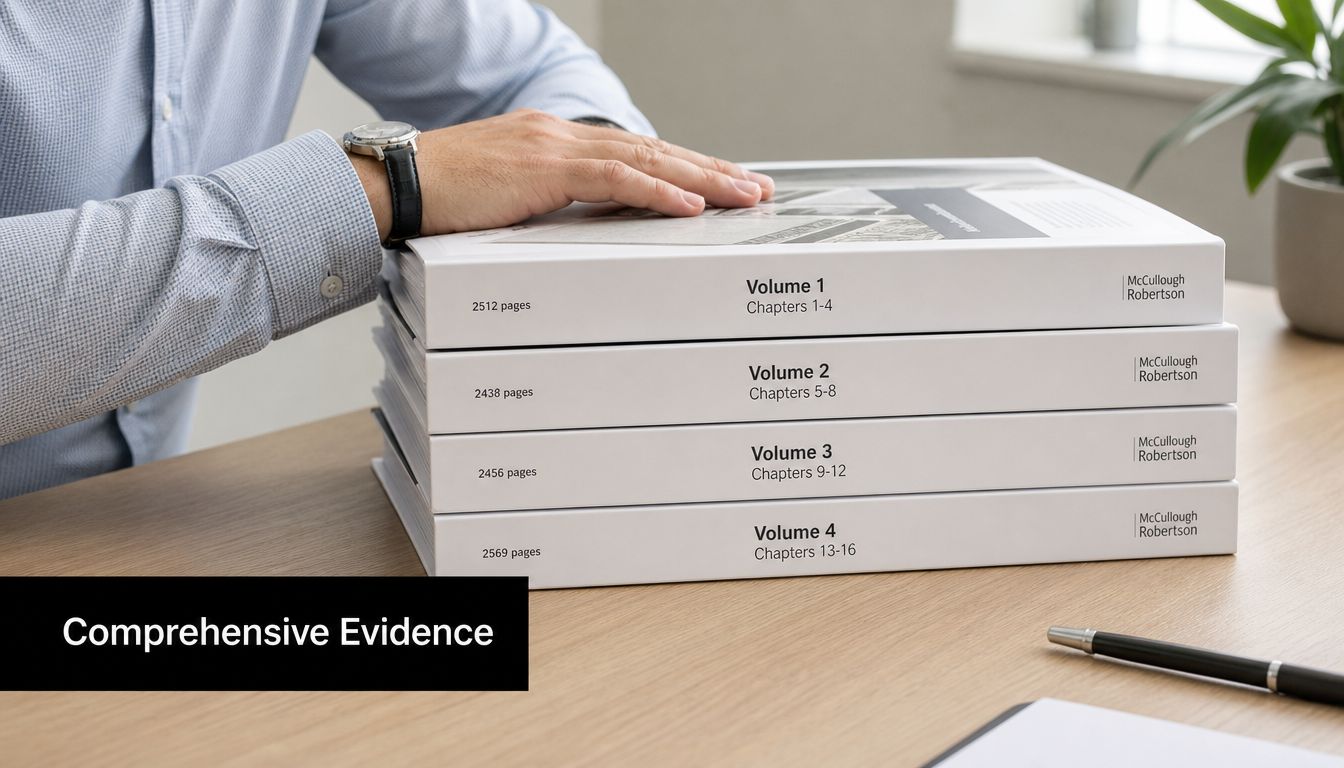
In legal practice, the report functions like a blueprint. It shows what the diagnosis is, what evidence supports it, how severe the limitation appears, and why a specific accommodation or legal conclusion follows from the findings. Without that bridge, the report becomes descriptive rather than persuasive.
What the document must establish
A valid report generally has to answer four questions:
What is the diagnosis?
The diagnosis should be specific and tied to recognized criteria, not phrased as a vague learning “issue” or “difference.”What data support it?
The evaluator should rely on a clinical interview, standardized testing, history, and behavioral observations.What does the person struggle with in real life?
The report should describe functional limits in reading, writing, mathematics, test-taking, work tasks, or other major life activities.Why does that matter legally?
A well-written report links those findings to the requested accommodation, to workplace functioning, or to the hardship issue in an immigration filing.
Why attorneys should read the report this way
The legal value of learning disability documentation doesn't come from the diagnosis alone. It comes from the reasoning. A court, employer, testing agency, or immigration adjudicator needs to see a coherent path from data to conclusion.
A useful report doesn't merely say the client has dyslexia. It shows how measured deficits affect timed reading, written output, error rate, comprehension under pressure, and the practical supports needed because of those deficits.
That is why two reports can look similar at a glance and perform very differently under review. One contains a label and recommendations. The other contains an evidentiary narrative. The second report is the one that holds up when the case becomes contested.
Anatomy of a Legally Defensible Report
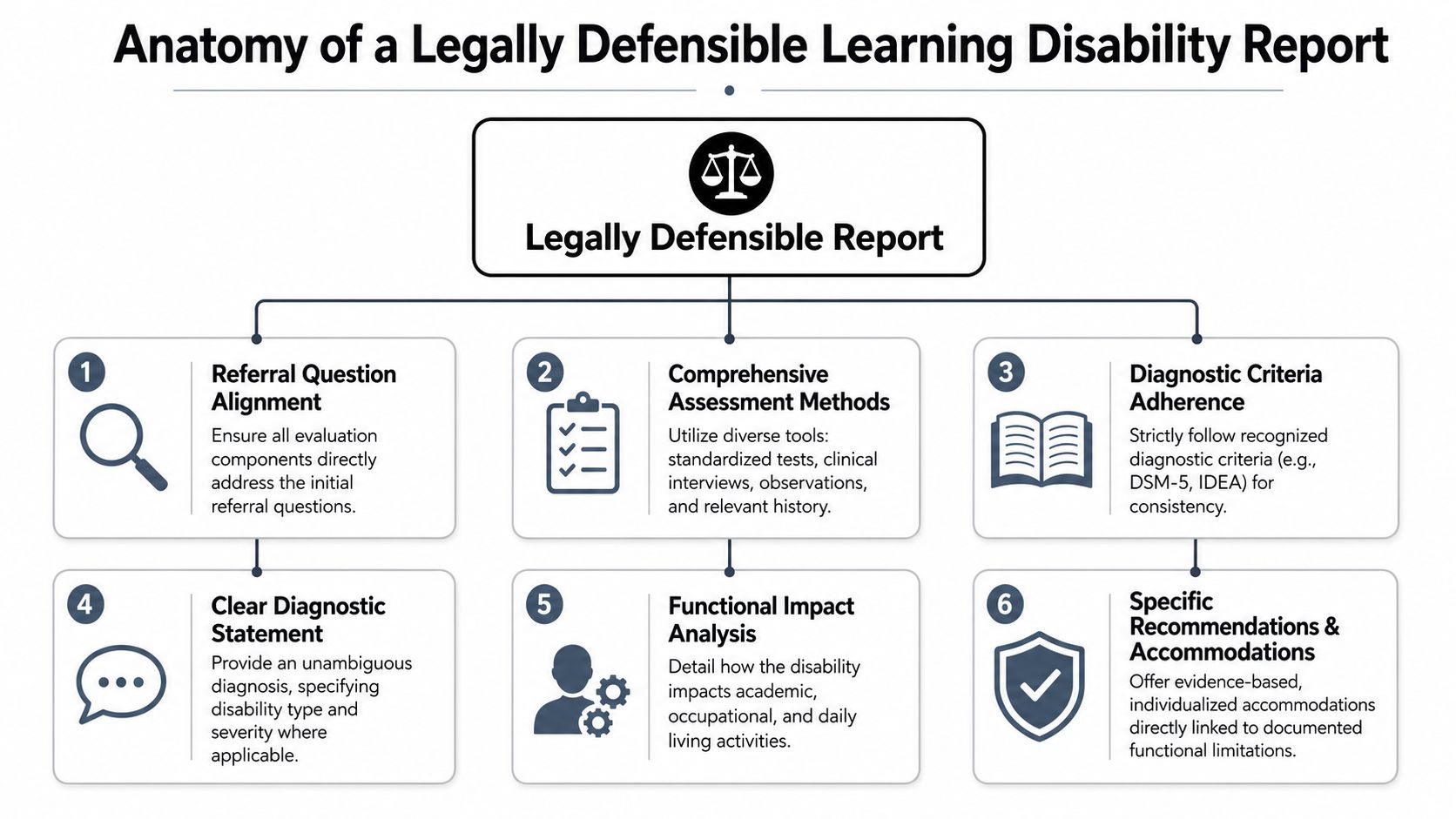
A defensible report has a visible structure. If you're reviewing learning disability documentation for litigation, an agency filing, or a negotiated accommodation request, you should be able to locate each core element quickly and understand why it is there.
A strong visual summary helps when you're screening a file before relying on it.
The diagnostic spine
The backbone of the report is the diagnosis itself. Authoritative guidelines require a triad of assessments: a complete intellectual assessment, a full academic achievement battery, and an evaluation of information processing domains such as memory and executive functioning. The report must use age-based standard scores, not just percentiles, and it must connect test results to the functional limitations supporting each requested accommodation (guidelines for documenting disabilities summarize that framework).
That matters because percentiles alone can mislead. A percentile gives relative standing. A legal reviewer often needs the full standardized context, including age-based scores and the pattern across measures, to evaluate whether the diagnosis is adequately supported.
The parts that cannot be missing
A legally useful report typically includes these components:
- Referral question alignment: The evaluator should identify why the person was referred. Accommodation review, workplace functioning, and immigration hardship are different forensic questions.
- Clinical interview: The interview should summarize educational history from early schooling forward, along with developmental, medical, and family context when relevant.
- Behavioral observations: These observations don't replace testing, but they help explain effort, frustration tolerance, reading approach, pace, and error pattern.
- Rule-out analysis: The evaluator should address whether other conditions or environmental explanations better account for the academic weakness.
- Clear diagnostic statement: The final diagnosis should be explicit, current, and tied to recognized criteria.
- Functional analysis: The report must explain how the condition affects everyday performance under standard conditions.
For attorneys who don't review these reports regularly, it helps to compare them to a model. A sample psychological evaluation report makes it easier to see how findings, interpretation, and recommendations should line up.
What the triad looks like in practice
The triad isn't academic box-checking. Each domain answers a different evidentiary question.
| Domain | What it helps prove | Why legal reviewers care |
|---|---|---|
| Aptitude or cognitive ability | Overall intellectual profile and relevant cognitive patterns | It helps distinguish broad intellectual issues from specific learning deficits |
| Academic achievement | Actual performance in reading, writing, and math | It shows whether the claimed impairment appears in the academic skill itself |
| Information processing | Memory, processing speed, executive functioning, and related processes | It helps explain the mechanism behind the functional impairment |
Later in the report, you want to see the evaluator synthesize those results rather than listing them mechanically.
This video gives a useful general orientation to how these evaluations are discussed in practice.
What a good conclusion does
The conclusion should not solely repeat test scores. It should answer the legal question in plain language. If the person seeks extra time, the report should explain why timed conditions interact with the diagnosed limitation. If the report is being used in an immigration matter, it should explain how the learning disorder affects employability, adaptation, literacy demands, medication management, or other tasks relevant to hardship.
The strongest reports translate clinical findings into consequences a judge, officer, or human resources reviewer can understand without specialized training.
When that translation is missing, the documentation may still be clinically interesting. It just won't be legally efficient.
Who Can Provide Documentation and How to Get It
Not every treating professional is qualified to produce learning disability documentation that will withstand legal review. A supportive letter from a therapist may help with background. A family physician may describe history or related treatment. But when the issue is diagnosis, cognitive testing, and differential assessment, the evaluator must have the training to perform and interpret that work.
Who is usually qualified
In most legal contexts, the most reliable evaluators are professionals who routinely conduct psychoeducational or neuropsychological assessments. That often includes licensed psychologists and neuropsychologists. In some matters, school psychologists can contribute useful data, especially when the issue is a student record, but their evaluations may still need supplementation if the case turns on adult functioning or a legal standard outside education.
Who often isn't enough on their own
Problems arise when the file depends on:
- A brief provider letter: Helpful for continuity of care, but usually not enough for diagnosis.
- A tutoring record: It may document struggle and response to intervention, but it isn't diagnostic proof.
- A school eligibility memo: It may support historical impairment, but it often doesn't address current adult limitations.
- A therapist statement without testing: Useful clinically, weak evidentially when the disputed issue is a learning disorder itself.
How attorneys should approach the referral
Start with the legal question, not the test battery. Before the evaluation begins, identify what the report must prove. That could be present functional limitation under the ADA, support for a testing accommodation request, or the role of cognitive limitations in an immigration hardship claim.
A neuropsychological assessment overview can help attorneys understand how these evaluations differ from routine therapy or medical visits.
Then ask targeted questions during referral:
- What diagnosis is being explored? Be specific about reading, written language, math, or broader cognitive concerns.
- What context matters most? Workplace duties, testing conditions, daily functioning, and immigration-related hardship require different emphasis.
- Does the evaluator assess adults? That becomes critical when the client is no longer in school.
- Will the report include explicit functional analysis? Without it, recommendations often sound generic.
Send the evaluator the referral question, relevant records, and the legal standard. Don't script the diagnosis. Do frame the issue the report must answer.
That collaboration improves the final product without compromising clinical independence. In my experience, the strongest attorney-clinician partnerships are clear about the evidentiary target and careful not to pressure the diagnostic outcome.
Context Is Key for Documentation Requirements
A report can be clinically solid and still miss the mark if it was written for the wrong setting. Learning disability documentation is always context-dependent. The same client may need one framing for a university disability office, another for an employer, and a different one again for an immigration filing.
Educational settings
Postsecondary reviewers often apply formal documentation rules that are stricter than what families expect after years in K-12. For standardized testing accommodations governed by the NCBE, documentation must typically be current within three years, include a specific DSM-5 diagnosis, report all standardized test scores rather than percentiles alone, and clearly link functional limitations to each requested accommodation (NCBE learning disability documentation guidelines).
That type of standard reflects a broader postsecondary pattern. Reviewers want current data, adult-relevant interpretation, and a direct rationale for each accommodation. A historical school file may support the background, but it won't substitute for a current diagnostic record if the policy requires present evidence.
Workplace ADA and 504 matters
Employers don't usually need an education-style narrative about school services. They need a report that documents a disability and explains how it substantially limits major life activities in relation to actual job tasks.
That changes the emphasis. In workplace claims, the report should describe functional effects such as slow reading speed, difficulty extracting information from dense written material, impaired written accuracy under time pressure, or reduced ability to complete standardized training modules. Recommendations should be adapted to the task environment. Generic language about “needs support” carries little weight.
U.S. immigration cases
Immigration cases raise a different evidentiary problem. The question often isn't accommodation entitlement by itself. It is how a learning disorder affects day-to-day functioning, employability, dependence, educational prospects, caregiving burden, or the practical consequences of relocation and family separation.
For hardship cases, that means the report should not stop at diagnosis. It should explain concrete effects. Can the qualifying relative manage paperwork independently? Does reading impairment limit access to services, medication instructions, or stable employment? Would disruption of support systems intensify those limits? Those are the kinds of links that make the documentation relevant.
A quick comparison
| Requirement | Educational (Postsecondary) | Workplace (ADA/504) | Immigration (Hardship Waiver) |
|---|---|---|---|
| Primary question | Does the record justify the requested academic or testing accommodation? | Does the condition substantially limit major life activities relevant to job performance? | How does the condition affect functioning, dependency, and hardship in the specific family and relocation context? |
| Most important framing | Diagnostic rigor plus accommodation rationale | Functional limitation tied to essential tasks or policies | Functional limitation tied to hardship facts, adaptation, and foreseeable consequences |
| Common weak point | Old school records without current adult analysis | Vague recommendations not tied to job duties | Diagnosis with little explanation of real-world impact |
| Best use of supporting records | Prior IEPs and school testing as developmental history | Job descriptions, performance demands, and prior accommodations | School records, family declarations, and collateral records showing lived impact |
The practical lesson is simple. Ask first what tribunal, agency, or institution will read the report. Then build the documentation around that audience's standard.
Common Pitfalls That Invalidate Documentation
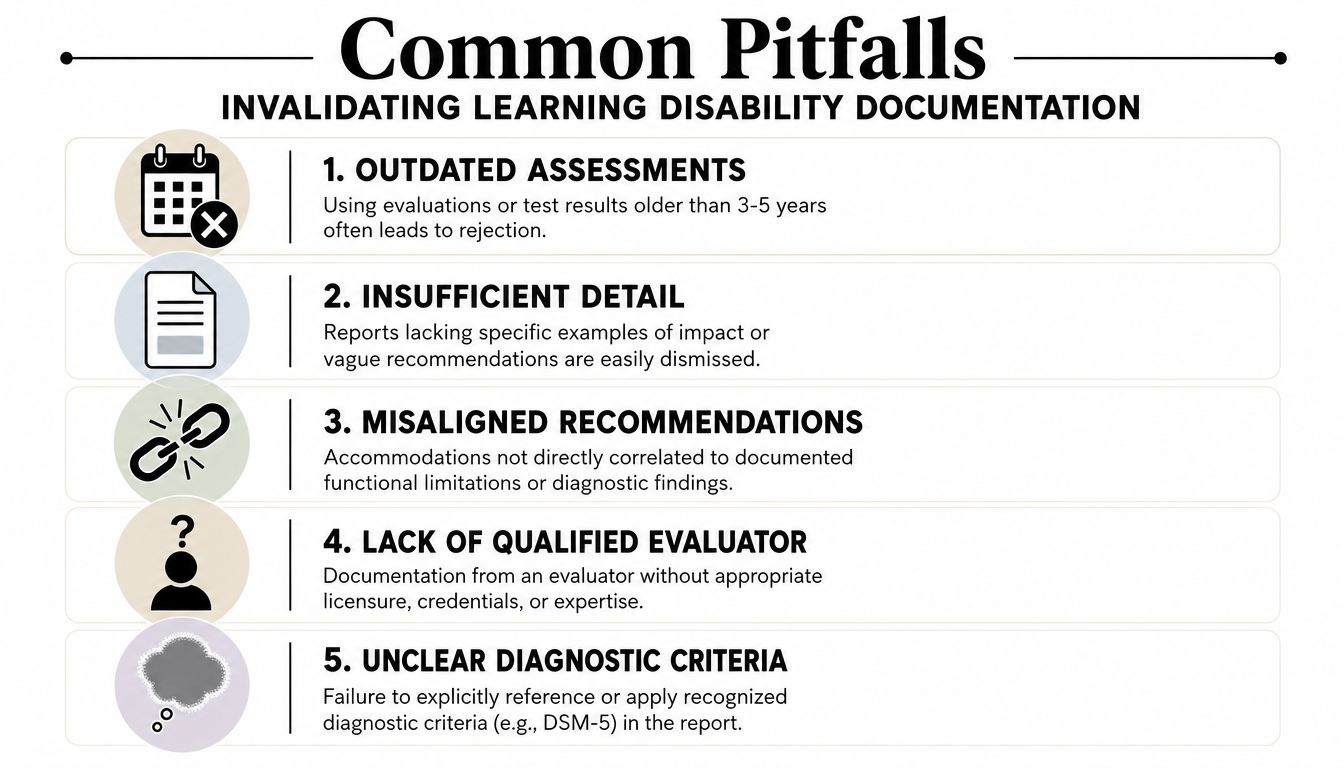
Most rejected learning disability documentation fails in predictable ways. The diagnosis may be plausible. The client may have a genuine history of impairment. But the report breaks down where legal reviewers need precision.
Outdated or misfit testing
A frequent problem is stale evaluation data. Timing standards vary by context, but many reviewers treat old testing as weak evidence of current functioning. Another recurring defect is the use of instruments or norms that don't fit the client's age or purpose. Even a well-written report can lose force if the testing framework doesn't match the setting in which the documentation is being used.
Diagnosis without proof
A report that says “Specific Learning Disorder” but doesn't show the data behind that conclusion invites challenge. The same is true when recommendations appear to be based on sympathy rather than measured impairment.
Use this screening approach when you're deciding whether a report is defensible:
- Read the diagnosis line first: Is it specific, current, and clearly stated?
- Check whether standardized scores are reported: Summaries without underlying data are hard to defend.
- Look for the reasoning chain: Do the findings explain the recommendations?
- Inspect the rule-out section: If there isn't one, the report may be vulnerable.
- Assess instrument quality: Careful attention to the validity of assessment tools is important.
Failure to rule out environmental causes
This issue is especially important in high-stakes reviews and in cases involving marginalized clients. A significant pitfall is documentation that fails to address systemic inequities. Research shows that 23% of students with learning disabilities from underserved racial groups are denied postsecondary accommodations because their evaluations do not sufficiently rule out environmental factors like poor prior education or socioeconomic status as the primary cause of academic underperformance (research on disproportionality and documentation issues appears here).
That doesn't mean socioeconomic adversity is a reason to dismiss genuine disability. It means the evaluator must do the differential work carefully. If the report ignores language history, educational opportunity, interrupted schooling, or other environmental barriers, reviewers may argue that the diagnosis is inadequately supported.
A weak report treats context as a footnote. A strong report confronts alternative explanations directly and explains why the diagnosis still stands.
Recommendations that don't match the findings
The final pitfall is overreaching. If the findings support reading impairment, but the recommendations sweep broadly across every possible accommodation, the report begins to look formulaic. In workplace and immigration settings, that disconnect becomes more obvious because the audience is looking for specific reasoning, not a template.
When I review reports for legal use, I ask one simple question: if I remove the diagnosis label and read only the data, would the requested accommodation or claimed functional impact still make sense? If the answer is no, the report needs work.
Frequently Asked Questions About Documentation
How current does the evaluation need to be
Recency depends on age and setting. For adults, a psychoeducational evaluation is typically considered current if it was conducted within the last five years using adult-normed tests. For high school students transitioning to postsecondary or other adult contexts, testing should generally be from within the past three years (University of Pennsylvania documentation guidelines describe those recency standards).
Can school records still help if they aren't enough by themselves
Yes. They are often useful as historical corroboration. An IEP, past testing, report cards, and teacher observations can help establish onset, persistence, and prior need for support. They become much more useful when a current evaluator incorporates them into a broader clinical analysis.
What should an attorney send to the evaluator
Send the referral question, relevant legal standard, prior records, and any documents that show functional demands in daily life. In a workplace matter, that may include job descriptions or training requirements. In an immigration matter, it may include declarations, school records, family affidavits, or evidence of caregiving demands.
Should the attorney tell the evaluator what diagnosis is needed
No. The attorney should identify the legal issue, not dictate the clinical conclusion. The evaluator's role is to assess independently. A report is stronger when it reflects objective reasoning rather than advocacy language.
What makes documentation persuasive in immigration cases
Specificity. The report should explain how the learning disorder affects concrete tasks that matter to the hardship analysis. Examples include literacy-related barriers, dependence on others for written communication, difficulty navigating forms and services, and reduced ability to adapt to a changed living or educational environment.
When should counsel ask for an updated evaluation
Ask early if the existing report is old, school-based, missing standardized data, unclear about diagnosis, or silent on current functioning. Waiting until after a denial or request for evidence often compresses timelines and limits your options.
If your case needs an evaluation that translates clinical findings into legally usable evidence, Pro Psychological Analysis works with immigration attorneys to produce detailed psychological assessments for hardship waivers, asylum, VAWA, T visa, and U visa matters. The practice focuses on clear diagnostic reasoning, functional impact analysis, and reports crafted to meet evidentiary standards that matter in USCIS and immigration court.