
You're probably in one of two positions right now. You either have a psychological report in hand and you're trying to decide whether it will help your immigration case, or you need to request one and want to avoid the all-too-common mistake of ordering a report that sounds clinical but does very little evidentiary work.
That distinction matters. In immigration practice, a report can't just describe distress. It has to translate lived experience into reliable clinical findings that a USCIS adjudicator, immigration judge, or opposing reviewer can follow. A strong psychological evaluation sample report doesn't read like therapy notes. It reads like disciplined forensic work. It answers the referral question, documents method, explains limitations, and connects findings to the legal theory without turning the clinician into an advocate.
Attorneys often ask for a template. Templates help, but they don't solve the fundamental problem. The fundamental problem is judgment: what to include, what to leave out, how to document trauma without overclaiming, and how to make the report understandable to non-clinicians while preserving scientific credibility. The most useful way to learn that isn't by staring at a blank form. It's by looking at a redacted immigration-focused sample and understanding why each section exists.
Table of Contents
- Why a Strong Psych Evaluation Report Wins Cases
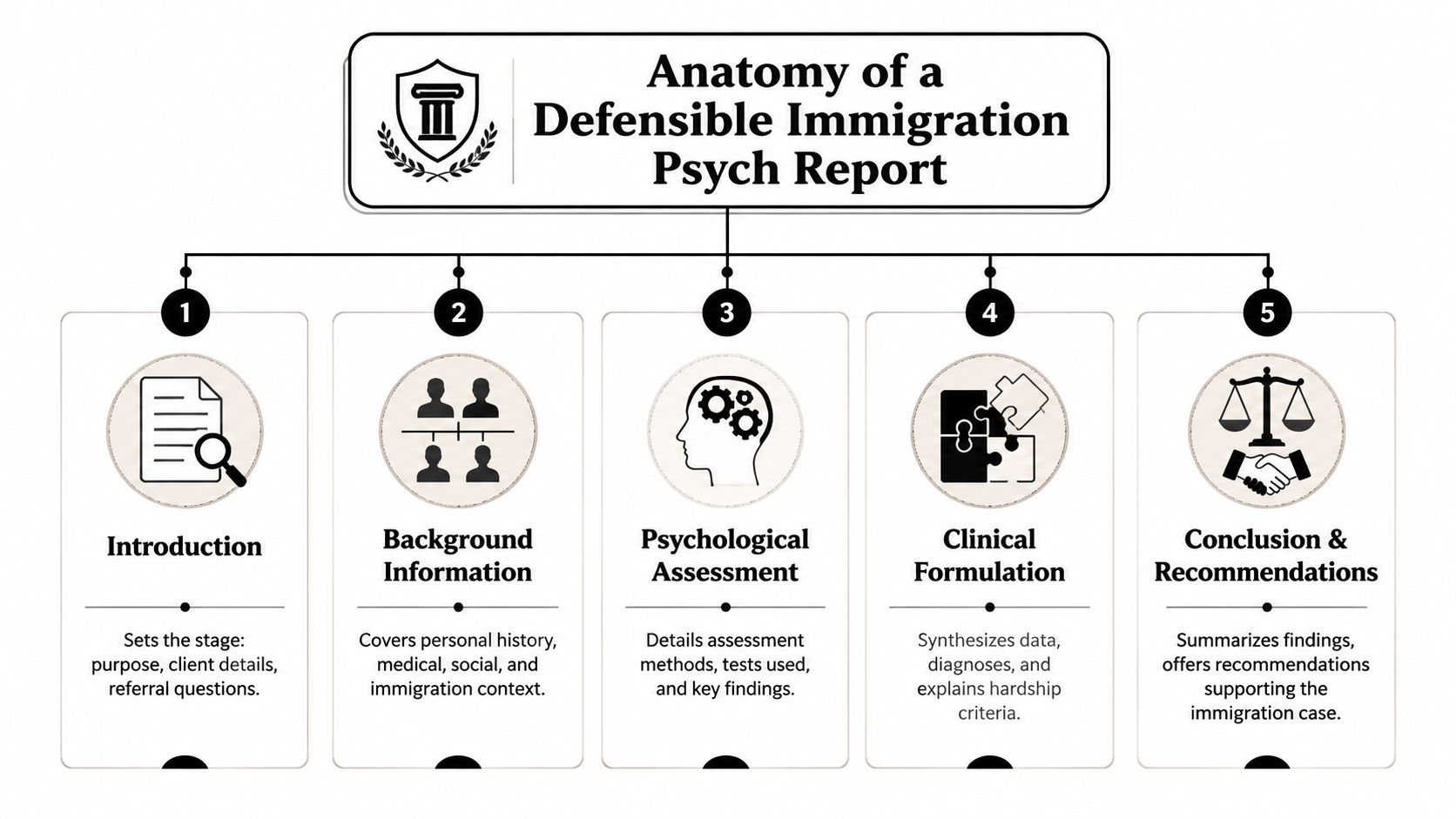
- Anatomy of a Defensible Immigration Psych Report
- The Sample Report A Redacted Immigration Case
- Deconstructing the Key Sections Annotations and Insights
- Meeting Evidentiary Standards for USCIS and Courts
- Ethical Practice HIPAA Confidentiality and Collaboration
- From Plan to Publication Creating Your Own Reports
Why a Strong Psych Evaluation Report Wins Cases
Put two reports side by side. The weak one says the client is anxious, depressed, and has a traumatic history. The stronger one identifies the referral question, documents the records reviewed, explains the interview conditions, notes behavioral observations, uses validated measures where appropriate, addresses alternative explanations, and ties the findings to the legal issue at hand.
Only one of those reports helps you litigate.
In immigration matters, the report often carries more weight than attorneys expect because it can do several jobs at once. It can establish psychological sequelae of trauma, clarify functional impairment, explain inconsistencies that might otherwise be misread as evasiveness, and document hardship in a way that is clinically grounded rather than purely rhetorical. That is why the report is not just supporting paperwork. It is often a central piece of legal strategy.
What weak reports usually get wrong
Weak reports tend to fail in predictable ways:
- They summarize symptoms without analysis. The clinician repeats what the client said but doesn't explain how the data support a diagnosis or a forensic opinion.
- They sound like treatment notes. Empathy is important, but legal evidence requires structure, corroboration, and disciplined language.
- They ignore the legal question. A report for asylum is not interchangeable with a report for VAWA, T visa relief, or an extreme hardship waiver.
- They overstate certainty. Overclaiming invites scrutiny. A careful report acknowledges limits and still reaches supported conclusions.
A clinically sympathetic report can still be legally weak if it never answers the question the case actually turns on.
The strongest reports do something more difficult. They stay independent while remaining useful. They don't argue like a brief, but they make it easier for the attorney to argue the case.
What strong reports do instead
A defensible report usually does four things well:
- Frames the referral precisely. Why was this person referred now, and what opinion is being sought?
- Builds a coherent narrative from multiple data points. Interview, records, observations, and testing should point in the same direction or the differences should be explained.
- Uses language non-clinicians can understand. Dense jargon weakens impact.
- Anticipates scrutiny. If there were interpretation limits, language barriers, or incomplete records, the report says so plainly.
That's why attorneys should read reports the way a reviewer would. Ask: Is this merely descriptive, or is it persuasive because it is methodical? If the answer is the latter, the report has a chance to carry real evidentiary weight.
Anatomy of a Defensible Immigration Psych Report
A good report has an architecture. If the structure is sloppy, the opinion usually is too. Clinical insight matters, but in forensic immigration work, structure is what lets the reader trust that insight.
According to the American Psychological Association's discussion of report writing, a well-structured psychological evaluation sample report is typically kept between six and 10 pages and should summarize the referral question and primary conclusion at the beginning so non-psychologists can follow the core findings without jargon.
What the overall structure should accomplish
In immigration cases, the report has to serve two audiences at once. The first is clinical. The second is legal. That means every section should pull double duty by documenting mental health findings and showing why those findings matter in the case.
A compact report is usually stronger than a sprawling one. Long reports often hide weak reasoning. The goal is not to impress the reader with volume. The goal is to make the logic easy to follow.
Core sections and why they matter
| Section | Clinical purpose | Legal purpose |
|---|---|---|
| Referral question | Defines what the examiner was asked to evaluate | Anchors relevance to the immigration claim |
| Background information | Provides developmental, medical, family, trauma, and social context | Supplies the factual setting that makes findings understandable |
| Assessment methods | Identifies interview procedures, records reviewed, and tests used | Shows the opinion rests on a recognizable methodology |
| Clinical formulation | Synthesizes symptoms, history, observations, and diagnostic reasoning | Connects data to hardship, trauma effects, or functional impact |
| Conclusions and recommendations | States diagnostic impressions and treatment needs | Gives adjudicators a clear takeaway tied to the referral issue |
That table looks simple, but the trade-offs are where the work happens. For example, background history must be selective. Too little context makes the report thin. Too much turns it into autobiography.
What belongs near the front
The first page should do more than identify the client. It should orient the reader immediately.
A useful opening section often includes:
- Who referred the matter: attorney, nonprofit, or self-referral through counsel
- Why the evaluation was requested: asylum, VAWA, T visa, U visa, hardship waiver, or another immigration purpose
- What materials were reviewed: interview, collateral records, declarations, treatment records when available
- What the preliminary conclusion is: a brief plain-language summary
Practical rule: If an adjudicator only reads the opening and the conclusion, they should still understand the central opinion.
A final point matters here. The report's order should feel inevitable. Each section should answer the question raised by the section before it. That's what makes a report readable, and in legal settings, readability is often inseparable from credibility.
The Sample Report A Redacted Immigration Case
Below is the kind of redacted sample I'd want an attorney to study. Not because it is formulaic, but because it shows how a report can move from history to findings to opinion without sounding inflated.

Opening pages that frame the case correctly
The opening should establish the examiner's role and the purpose of the evaluation without drifting into advocacy.
Identifying Information
Name: [Redacted]
Date of Evaluation: [Redacted]
Referral Source: Immigration counsel
Purpose of Evaluation: To assess psychological functioning, trauma-related symptoms, and the mental health impact of removal-related concerns in connection with pending immigration proceedings.
That opening is doing quiet but important work. It identifies scope. It doesn't promise a predetermined outcome. It tells the reader what the examiner evaluated and why.
The next excerpt should answer the legal question in clinical terms.
Referral Question
Counsel requested an evaluation of the client's psychological functioning, including trauma-related symptoms, current emotional and cognitive effects, and the extent to which these findings are consistent with the reported history and relevant to the immigration matter.
That's better than a vague referral line such as “for psychological assessment.” A report becomes useful when the referral question is narrow enough to guide the entire document.
Attorneys who want another point of comparison can review this adult neuropsychological evaluation sample to see how report structure changes when the referral issue is cognitive rather than immigration-related.
History assessment and formulation on the page
The history section should read like disciplined synthesis, not raw transcript.
Relevant Background
The client reported exposure to repeated threats and interpersonal violence in the country of origin. The client also described persistent fear, sleep disruption, intrusive recollections, hypervigilance, and avoidance of reminders associated with those events. Educational and occupational functioning reportedly declined after the traumatic experiences intensified. Available records were reviewed and considered alongside the clinical interview.
This kind of paragraph works because it groups facts into clinically meaningful domains. It does not list every event in chronological order. It selects what bears on diagnosis and function.
A strong report then shifts into direct observations.
Behavioral Observations and Mental Status
The client arrived on time, was appropriately dressed, and engaged cooperatively in the interview. Affect appeared constricted when discussing traumatic material. Thought process was goal directed. No gross disturbance in orientation was observed. Attention varied during emotionally charged portions of the interview, and the client became tearful when recounting specific events.
That language matters. “Constricted affect” means more than “sad.” “Goal directed thought process” tells the reader the person could answer coherently. “Attention varied during emotionally charged portions” helps explain why a survivor may give fragmented details without implying fabrication.
Later in the report, the methods section should identify how the assessment was conducted and whether any standardized instruments were used. If trauma measures are included, the report should state the administration conditions clearly and note any interpretive limitations.
Before showing the final opinion, it helps to see how clinicians present the flow of reasoning in spoken form. This overview is useful for that purpose:
The formulation section is where many reports either become persuasive or collapse.
Clinical Formulation
The client's presentation is consistent with a trauma-related condition characterized by intrusive re-experiencing, avoidance, heightened physiological arousal, and functional disruption. The reported symptoms were internally consistent across the interview and congruent with observed distress. The available information supports the conclusion that the client's current psychological difficulties are meaningfully related to the reported traumatic experiences.
That paragraph works because it synthesizes. It doesn't merely repeat the symptom list. It links symptom clusters, observations, and history.
A final excerpt should make the opinion accessible to legal readers.
Diagnostic Impressions and Opinion
Findings support trauma-related diagnostic impressions and indicate clinically significant emotional impairment. These findings should be considered in evaluating the psychological impact of past harm, the client's current functioning, and the likely mental health consequences associated with forced return or continued instability.
This is the tone attorneys should look for. It is clear, restrained, and useful. It doesn't try to decide the legal case. It gives the court or agency a clinically grounded record on which legal argument can stand.
Deconstructing the Key Sections Annotations and Insights
Reading a polished report isn't enough. You also need to know why certain sentences carry more weight than others.
Why wording choices matter
Take the mental status language from the sample. “Tearful when recounting specific events” is stronger than “very emotional.” The former is observable. The latter is interpretive and loose. In forensic work, observable wording usually holds up better because the clinician can defend exactly what was seen.
The same principle applies to causation. A careful report says symptoms are consistent with or supported by the reported history and available data. It avoids language that suggests impossible certainty. That restraint makes the opinion more credible, not less.
Here are phrasing choices that often improve a report:
- Use behavior-based descriptions: “Speech was soft and slowed” is better than “appeared severely depressed” unless the latter is supported elsewhere.
- Differentiate report from observation: “Client reported nightmares” is distinct from “client appeared fatigued.”
- Name limitations plainly: If an interpreter was used, or records were incomplete, say so and explain how that affects interpretation.
Reports become more persuasive when the reader can see which statements came from the client, which came from observation, and which are the clinician's synthesis.
What strong statistical reporting looks like
When a report includes testing, the numbers can't be dropped into the page without context. A sound report explains what the score means, how precise it is, and why it matters.
The clearest published example in the provided materials comes from a sample educational evaluation. In that report, a Full Scale IQ score of 62 was presented with the 95% confidence interval of 59 to 67 and a 1st percentile rank, as shown in the redacted sample educational evaluation. That is the kind of reporting that signals methodological care.
A few implications follow from that example:
| Weak reporting | Strong reporting |
|---|---|
| Lists a score only | Lists the score, confidence interval, and percentile rank |
| Assumes the reader knows what it means | Interprets the score in functional terms |
| Uses testing as decoration | Uses testing to support diagnostic reasoning |
Even when immigration evaluations are not primarily cognitive assessments, the principle still applies. If you include test data, report it in a way that another professional could evaluate. Bare numbers don't persuade. Interpreted numbers do.
A final annotation worth stressing: recommendations should never feel generic. “Continue therapy” may be clinically appropriate, but on its own it adds little. Better recommendations are linked to the actual findings. If the report documents trauma-related avoidance, sleep disruption, and concentration problems, the recommendations should reflect those specific impairments.
Meeting Evidentiary Standards for USCIS and Courts
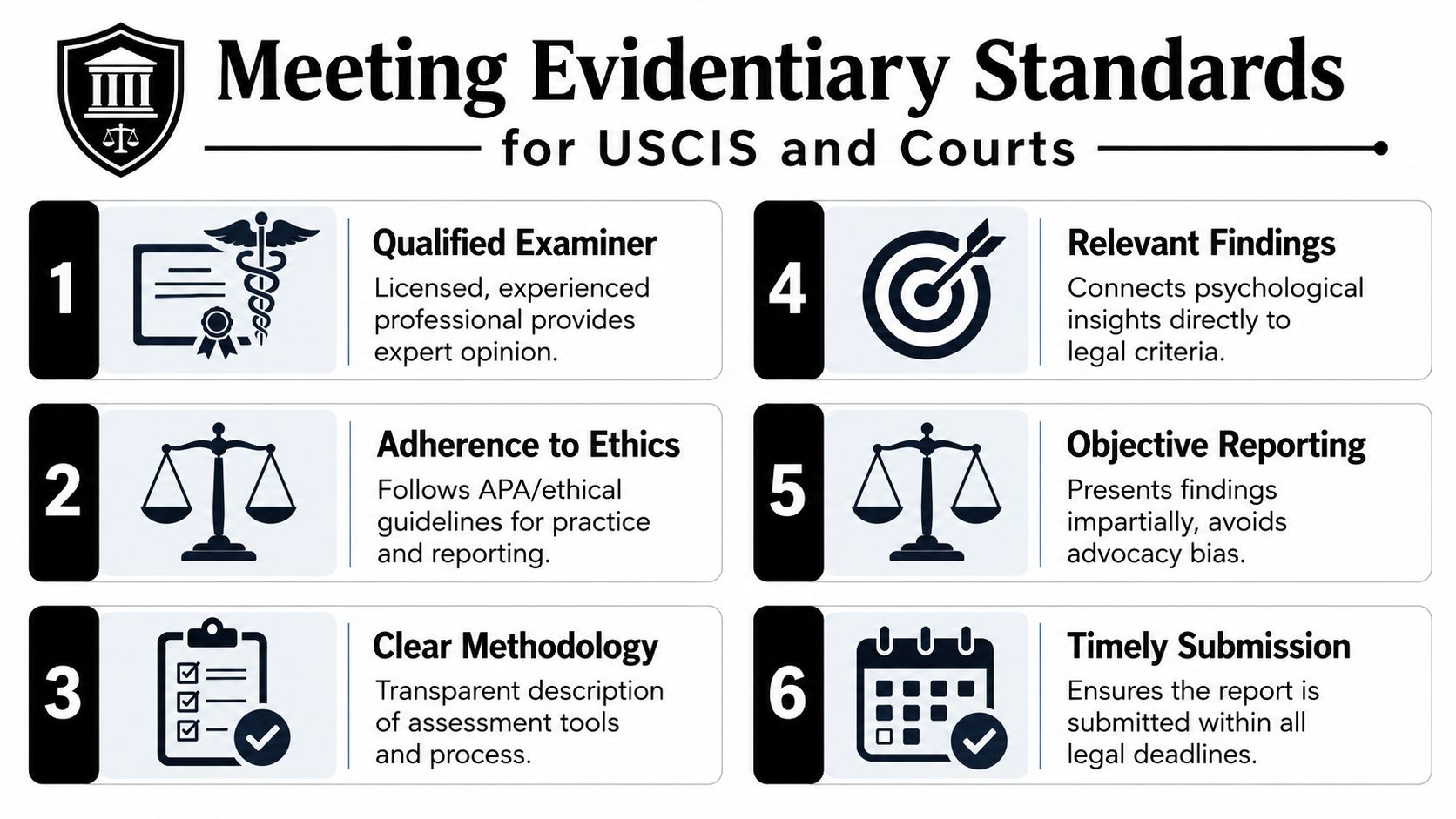
A report can be clinically thoughtful and still fail under scrutiny if the method is vague. In immigration work, the opinion is only as strong as the documented process behind it.
Method first opinion second
For trauma-based immigration cases, APA guidance requires use of validated instruments such as the PTSD Checklist for DSM-5 (PCL-5) and expects reporting of reliability information, including coefficients such as Cronbach's α ≥ 0.85, along with validity evidence relevant to the client's linguistic and cultural background, as described in the APA guidelines for psychological assessment and evaluation.
That requirement has practical consequences. If the clinician uses a measure developed in one language and applies it casually in another, or fails to explain whether administration conditions were standardized, the report becomes easier to attack. The problem is not only technical. It goes to fairness. A court or agency needs to know the findings came from a method suited to the person being assessed.
For attorneys and clinicians who want a focused discussion of instrument quality, this review of the validity of assessment tools is a useful companion.
What gets challenged
The most vulnerable reports usually have one of these problems:
- Unclear test selection: The reader cannot tell why a particular measure was chosen.
- No discussion of language or culture: The report ignores whether the tool fits the client's background.
- No limitations section: The opinion reads as though all data were perfect.
- Advocacy tone: The clinician sounds aligned with the legal outcome rather than with the evidence.
Courts and adjudicators don't need a clinician to sound forceful. They need the clinician to sound careful.
This is also where one practical vendor decision matters. If counsel is selecting an evaluator, the key question isn't whether the clinician “does immigration cases.” It's whether the clinician documents methodology, limitations, and forensic reasoning in a way that can survive review. Services such as Pro Psychological Analysis provide immigration-focused evaluations designed for USCIS and EOIR settings, but the same standard applies to any evaluator you retain. Ask for a redacted sample and review the method section before you refer the case.
Ethical Practice HIPAA Confidentiality and Collaboration
The fastest way to undermine a strong report is to mishandle the process around it. Immigration evaluations involve sensitive disclosures, often from clients who already have strong reasons to mistrust institutions. Ethical practice is not separate from legal usefulness. It is part of what makes the report dependable.

Confidentiality in a legal workflow
The attorney, clinician, interpreter, and client all need clarity about who will receive the report, what records may be shared, and how information moves between offices. In practice, that means written authorization, secure transmission, and careful explanation of the limits of confidentiality in a forensic setting.
Language access belongs in this same conversation. Ethical standards require clinicians to provide findings in a language the client understands. In some immigration matters, that means an English report for the court together with a written or spoken summary of key findings in the client's primary language, as discussed in this review of ethics and language access in forensic and immigration-related assessment.
That point is often missed by lawyers who focus only on the final PDF. If the client cannot understand the findings or the disclosure process, the workflow is already compromised.
Collaboration without coaching
Good collaboration is specific. Counsel should provide the referral question, procedural posture, relevant filings, and available records. The clinician should remain independent about conclusions. Once those roles are respected, the work becomes much stronger.
Useful collaboration usually includes:
- A focused referral memo: what legal issue the report should address
- Selected records: declarations, prior evaluations, relevant medical or police records when available
- Interpreter planning: if needed, arranged carefully and disclosed in the report
- Informed consent procedures: documented before the evaluation begins
Attorneys who want a practical intake reference can review these informed consent procedures as part of building a cleaner referral process.
The boundary to protect is simple. Lawyers frame the legal question. Clinicians answer it with independent clinical judgment. When either side crosses into the other's role, the report weakens.
From Plan to Publication Creating Your Own Reports
The most useful template is a structural guide, not a substitute for thinking. A persuasive psychological evaluation sample report is built from disciplined interviewing, appropriate assessment methods, clear writing, and a constant focus on the actual immigration issue.
If you're reviewing reports, read them backward as well as forward. Start with the conclusion, then ask whether the history, observations, methods, and formulation truly support it. If you're writing reports, keep them lean, explicit, and clinically defensible. State what you know, explain how you know it, and acknowledge what you cannot conclude.
That is what turns a report into evidence instead of ornament.
If your firm needs immigration-focused psychological evaluations that are clinically rigorous, clearly written, and aligned with the evidentiary needs of USCIS or immigration court, Pro Psychological Analysis offers trauma-informed assessments for asylum, VAWA, T visa, U visa, and hardship cases, with attention to confidentiality, methodology, and legally useful reporting.