
An adult cognitive assessment is a specialized evaluation that measures how a person's brain is handling tasks like memory, attention, and problem-solving. Think of it as a diagnostic scan for the mind, but its real power in a legal setting is how it provides objective data to support claims involving trauma, hardship, or cognitive decline.
This is far more than an IQ test. It’s a tool that generates concrete evidence for legal proceedings.
Table of Contents
- Demystifying the Adult Cognitive Assessment
- Why Cognitive Impairments Often Go Unnoticed
- Understanding the Components of a Forensic Assessment
- How an Assessment Strengthens Your Immigration Case
- Navigating the Assessment Process From Start to Finish
- Common Questions from Attorneys and Clients
Demystifying the Adult Cognitive Assessment
Imagine trying to explain a client's severe trauma during an immigration hearing without a doctor's report. You'd be left describing symptoms, but it would be hard to convey the true clinical impact. An adult cognitive assessment acts as that crucial report for the mind, translating complex psychological states into tangible, measurable evidence.
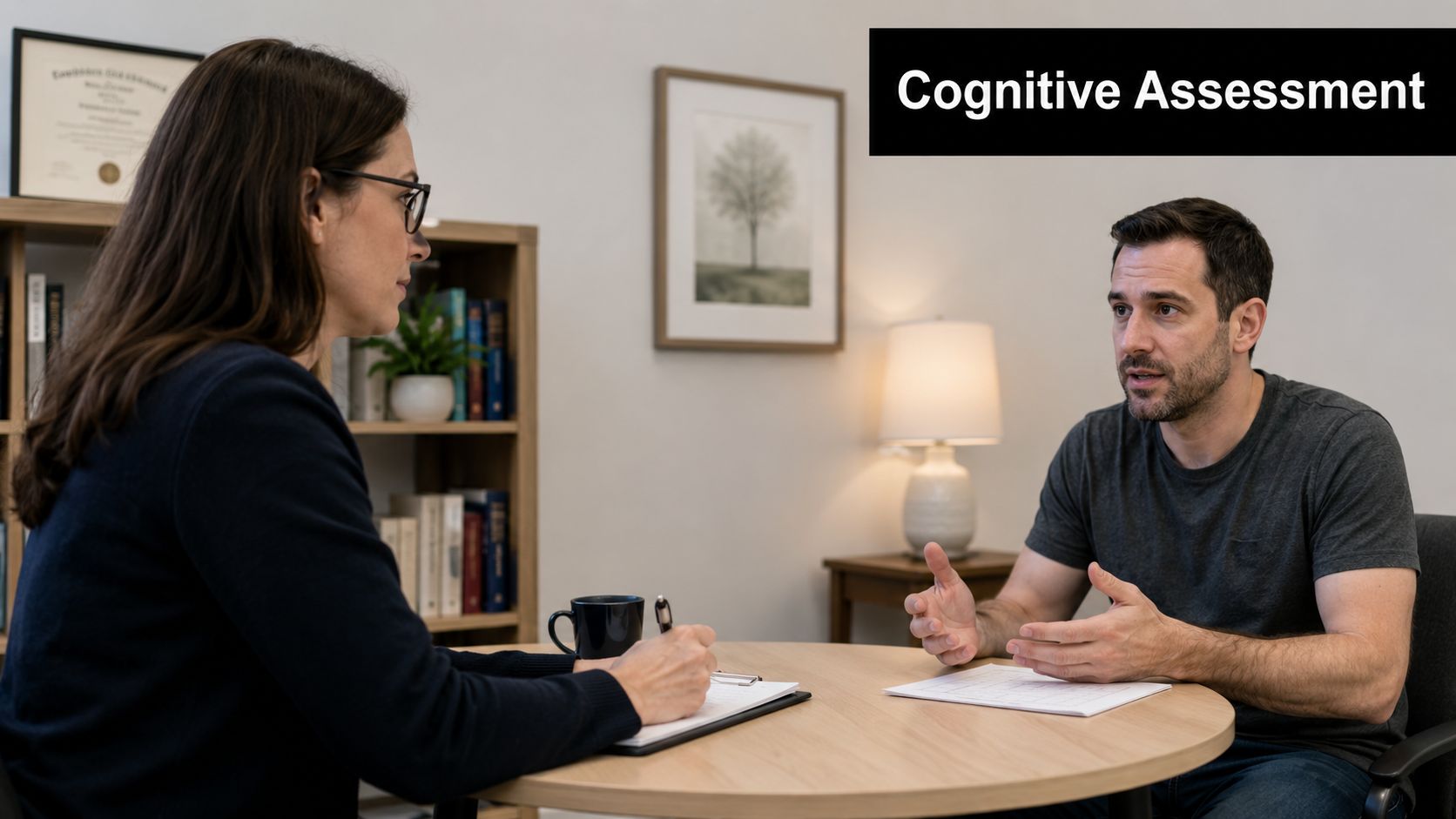
These evaluations provide objective data to back up claims of hardship, trauma, or cognitive impairment. That's especially valuable in immigration law, where a client's credibility and the extent of their suffering are often the central issues of the case.
Moving Beyond Subjective Claims
Legal cases often hinge on testimony, but when a client has endured significant trauma, their ability to recall events clearly and consistently can be compromised. This is where an adult cognitive assessment becomes an invaluable tool for counsel. It moves the case beyond subjective storytelling and provides standardized, evidence-based findings.
An assessment doesn't just take the client's word for it; it scientifically measures their cognitive functions. This process documents how conditions like PTSD or extreme hardship have measurably affected their brain's ability to operate, turning personal experiences into legally persuasive evidence.
For example, the evaluation can objectively demonstrate measurable deficits in areas that directly affect a client's credibility and performance, such as:
- Memory: Documenting difficulty recalling specific dates or details of traumatic events.
- Attention: Showing an inability to focus during interviews or court proceedings.
- Executive Function: Revealing impaired judgment or decision-making abilities that affect their life and case.
Applications in Immigration Law
By documenting these cognitive and emotional challenges, an assessment provides a solid foundation for various immigration petitions. It gives USCIS adjudicators and immigration judges a clear, clinical rationale for a client's behavior, testimony, and apparent inconsistencies.
This makes it a powerful asset in high-stakes cases, including:
- Extreme Hardship Waivers
- Asylum Claims
- VAWA Petitions
- U and T Visas
The final report helps explain why a client might seem confused, have trouble articulating their story, or give conflicting details. It reframes what an adjudicator might perceive as a lack of credibility into a verifiable symptom of their documented experience.
If you are interested in the broader field, you can learn more about what a neuropsychological assessment is and how it differs in scope and application. Ultimately, these evaluations help attorneys build a stronger, more compassionate, and scientifically-backed case for their clients.
Why Cognitive Impairments Often Go Unnoticed
It’s a common frustration for attorneys: a client struggles to recall dates or seems to contradict themselves during an interview. The immediate suspicion is often untruthfulness, but the reality is frequently more complex. These aren't necessarily signs of a client trying to mislead you; they can be symptoms of a verifiable, underlying cognitive deficit.
Many individuals, especially those who have survived significant trauma, develop powerful coping mechanisms just to get through the day. They learn how to manage conversations and social interactions in a way that masks their internal battles with memory, concentration, or decision-making. This creates a “hidden cognitive burden”—an invisible struggle that only becomes clear under the structured lens of a formal cognitive assessment.

This isn’t a rare phenomenon. A significant number of adults are living with undiagnosed cognitive impairments, a problem often magnified in immigrant populations who are also dealing with immense stress, cultural barriers, and the psychological weight of their legal cases.
The Problem of Undiagnosed Impairment
The core challenge is that many cognitive issues just aren't obvious without targeted testing. For example, a landmark study estimated that roughly 20.8% of adults aged 55 and older in primary care settings have undiagnosed cognitive impairment. What’s more alarming is that physicians were completely unaware of these issues in more than 40% of their impaired patients, which really drives home why systematic screening is so critical. You can read the full research on undiagnosed cognitive impairment to explore these findings.
This gap between how a person appears and their actual cognitive functioning is precisely where a forensic evaluation proves its worth. It delivers objective evidence that explains behaviors that might otherwise be completely misinterpreted.
An assessment can reframe a client's entire story for an adjudicator. Instead of seeing an unreliable narrator, they begin to see a trauma survivor with documented memory deficits that are consistent with their history.
Reframing Client Behavior for Legal Success
For attorneys, recognizing this hidden burden is a game-changer. It shifts the entire perspective from questioning a client’s credibility to seeing the need for objective verification. When a client’s testimony seems fragmented or disorganized, it might be a direct result of trauma-induced cognitive challenges.
An adult cognitive assessment provides the hard evidence needed to validate these observations. It can demonstrate that a client:
- Has genuine memory gaps: Proving that their inability to recall specific details is a clinical symptom, not an attempt to mislead the court.
- Struggles with concentration: Explaining why they may have trouble focusing during long interviews or find it difficult to provide a linear, chronological narrative.
- Experiences impaired executive function: Showing how trauma has directly affected their ability to plan, organize their thoughts, and make sound decisions under pressure.
By identifying these deficits, you can build a stronger, more compassionate case that accurately reflects your client's reality. It gives the court the context it needs to make a fair and informed decision.
Understanding the Components of a Forensic Assessment
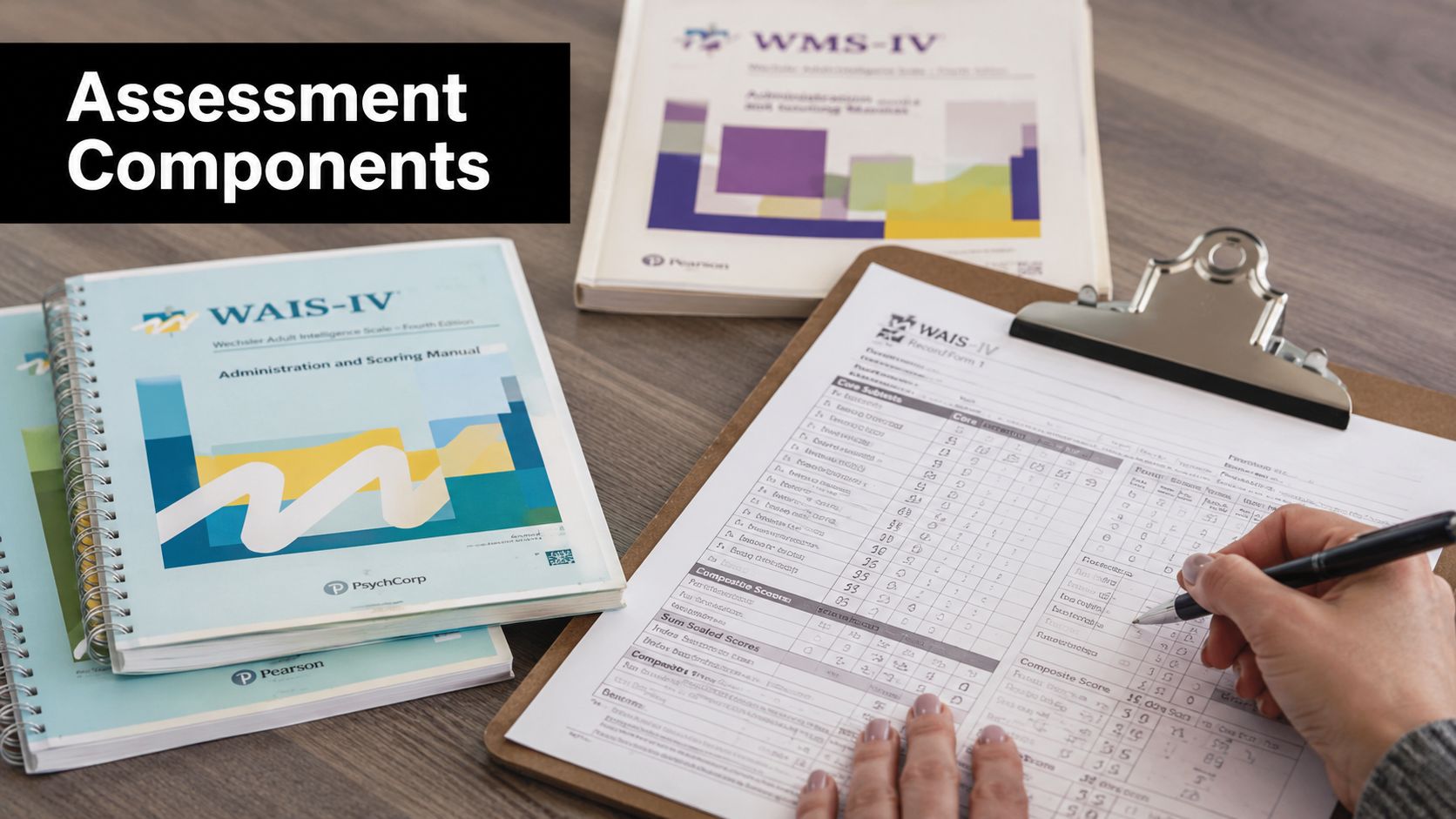
A comprehensive adult cognitive assessment is never just a single test. It’s a multi-faceted investigation into how a person thinks, reasons, and remembers. Think of it like a detective piecing together a complex case. One piece of evidence is a start, but a defensible conclusion requires multiple sources that all point in the same direction.
That’s exactly how a strong forensic assessment works. It integrates three core components to build a robust and legally sound picture of a client's cognitive world. Each piece provides a different kind of information, and when you put them together, you get a detailed portrait of the client's actual functioning.
The Three Pillars of a Strong Evaluation
The real strength of an evaluation comes from its methodical, multi-pronged approach. For attorneys, understanding these distinct but interwoven parts is key to appreciating the depth of the final report and using it effectively.
-
The Clinical Interview: This is the foundation. It’s a deep dive into the client's personal story—their medical, developmental, educational, and psychological history. The interview provides the essential "why" behind the numbers, giving crucial context to any cognitive struggles that show up in testing.
-
Behavioral Observations: Here, the psychologist acts as a careful observer. They note how the client approaches challenging tasks, their level of effort, frustration tolerance, and any behaviors that might signal anxiety, distraction, or fatigue. These observations are critical for interpreting test scores accurately. A low score might mean a cognitive deficit, or it might mean the client was too anxious to focus.
-
Standardized Testing: This is the most objective part of the process. Using validated and reliable instruments, the clinician gathers numerical data on specific cognitive domains. This gives you the "what"—a measurable snapshot of the client’s abilities in areas like memory, attention, and executive functioning.
This structured methodology is what ensures the integrity and validity of assessment tools, preventing any reliance on a single, potentially misleading data point. You can learn more about the validity of assessment tools to see why this is a cornerstone of ethical and defensible practice.
Common Tools and What They Tell You
While dozens of tests exist, you’ll frequently see a few key instruments mentioned in forensic reports. Today’s cognitive assessment tools are designed for both accuracy and efficiency. For example, screening tools like the Mini-Cog can quickly flag individuals who need a more thorough evaluation.
At the same time, informant questionnaires provide vital data from family members or caregivers who witness subtle but important behavioral shifts day-to-day. This dual approach, combining direct testing with informant data, is now recognized as a best practice for getting the fullest possible picture of a client’s functioning.
A forensic report synthesizes information from all three pillars. The interview provides the narrative, observations provide the real-world context, and standardized tests provide the objective, scientific evidence to support the clinical formulation.
Some of the most common examples you’ll encounter include:
- WAIS-IV (Wechsler Adult Intelligence Scale): This is often the workhorse for getting a broad, reliable measure of overall intellectual functioning.
- MoCA (Montreal Cognitive Assessment): A very popular and effective screening tool for detecting mild cognitive impairment before it becomes more severe.
Once you understand these components, it becomes clear that an adult cognitive assessment isn’t just about a score. It’s about a story—one that’s carefully constructed and backed by science, observation, and personal history.
How an Assessment Strengthens Your Immigration Case
An adult cognitive assessment is more than a clinical report; it's a powerful legal tool. For attorneys, its real value is in translating complex psychological findings into compelling, evidence-based legal arguments that immigration adjudicators can understand and act on.
The assessment connects the dots between a client's history and their present struggles. By providing objective data, it transforms a case narrative from a collection of subjective claims into a scientifically supported account. This is especially crucial in cases where a client's credibility, memory, or capacity is under scrutiny.
The report provides a clear, clinical explanation for behaviors that might otherwise be misinterpreted as dishonesty or non-compliance.
Applications for Extreme Hardship Waivers
In Extreme Hardship Waiver cases, the goal is to show the devastating impact an applicant's removal would have on a qualifying relative. An adult cognitive assessment provides concrete proof of this impact, especially when the qualifying relative suffers from cognitive decline or dementia.
The assessment can objectively document a relative's existing cognitive deficits, such as memory loss or impaired executive function. It then illustrates how the removal of their primary caregiver—the applicant—would lead to a catastrophic decline in their health, safety, and well-being.
This data moves the argument from a hypothetical "it would be difficult" to a documented "it would be catastrophic."
Historical data from the Aging, Demographics, and Memory Study (ADAMS) underscores how common these issues are. In 2002, the dementia prevalence among those over 70 was 13.9%, with another 22.2% experiencing cognitive impairment without dementia. More recent findings from 2016 show rates of mild cognitive impairment (MCI) remained alarmingly high at 22%, highlighting the persistent nature of cognitive decline in older adults. You can explore detailed findings on cognitive impairment trends to understand the prevalence of these conditions.
Corroborating Trauma in Asylum and VAWA Cases
For asylum, VAWA, or U/T Visa applicants, an assessment serves a different but equally vital purpose. These clients have often endured immense trauma, which directly impacts cognitive functions like memory and emotional regulation.
An evaluation can objectively document how trauma has impaired the applicant's ability to recall events chronologically or consistently. It explains why they might struggle to articulate their story, appear emotionally detached, or provide fragmented testimony.
This corroborates their account by showing their testimonial inconsistencies are a direct result of trauma-induced cognitive deficits, not a lack of credibility.
"Mr. X's performance on tests of executive function falls in the impaired range, consistent with difficulties in planning and decision-making. These findings are common in individuals with a history of complex trauma and explain his challenges in organizing a linear narrative of his experiences."
This kind of clinical language gives the adjudicator a scientific basis for understanding the applicant's behavior, thereby strengthening their claim. It also helps establish whether a client is competent to testify or may require specific accommodations during legal proceedings, ensuring their rights are protected and their story is heard fairly.
Navigating the Assessment Process From Start to Finish
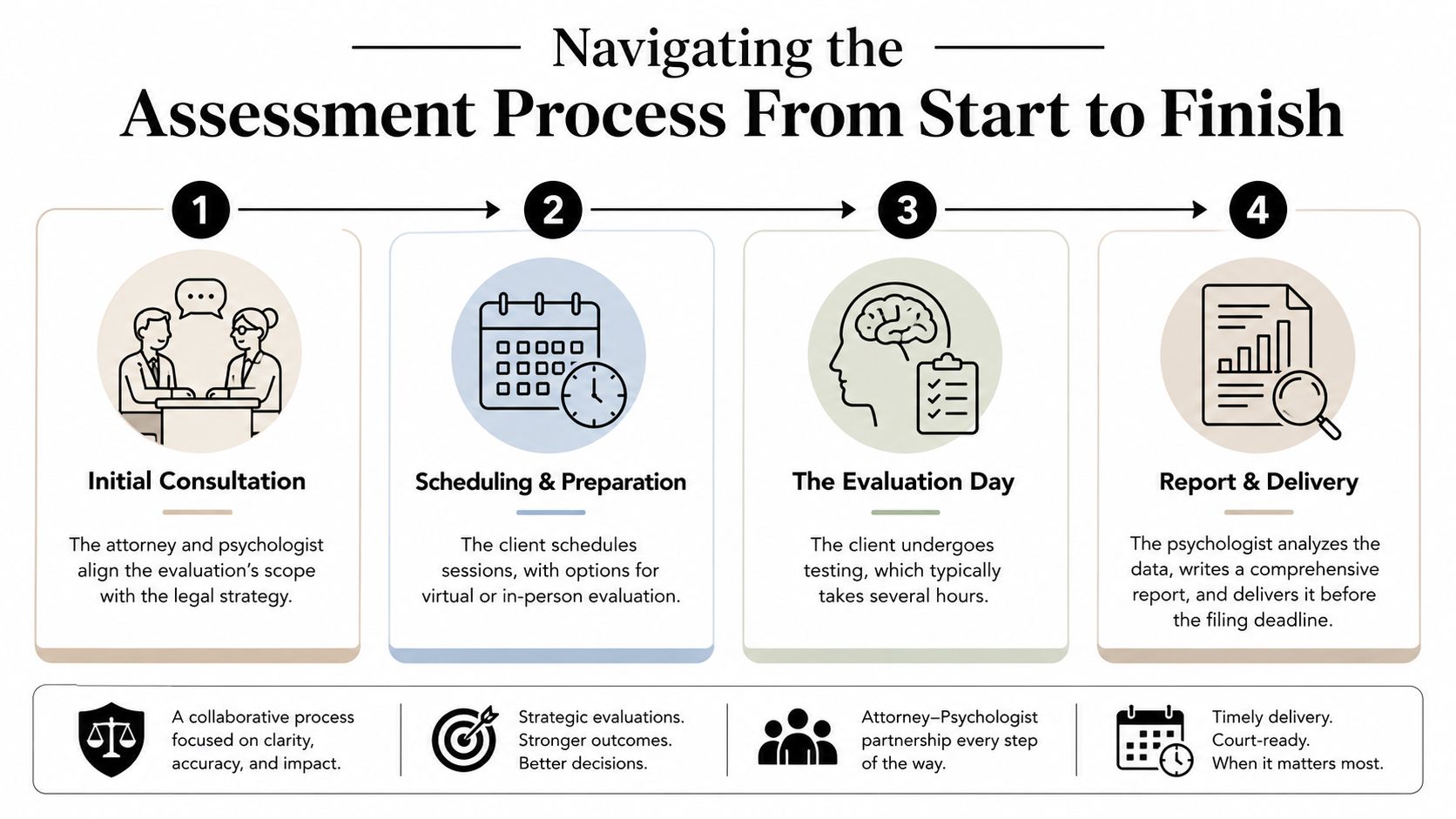
Knowing the roadmap for an adult cognitive assessment helps you manage expectations for your client and yourself. It makes the whole journey feel more predictable and less stressful. The process is really a structured partnership between the attorney, the client, and the psychologist, designed from day one to align with legal deadlines.
It all starts with the initial attorney consultation. This is more than just a phone call; it's a strategy session where you and the psychologist get on the same page. We'll talk through the specifics of your case to define the scope of the evaluation, ensuring the assessment will directly answer the legal questions at hand—whether it’s for a hardship waiver, an asylum claim, or another immigration matter. Getting this alignment right is what produces a targeted, persuasive report.
From Scheduling to Report Delivery
Once we've defined the scope, the next step is client scheduling and preparation. We’ll get your client scheduled for their evaluation, offering both in-person sessions and virtual appointments. Virtual assessments give us nationwide reach and have been validated to meet the exact same rigorous standards as face-to-face evaluations, so there’s no drop-off in quality.
Then comes the evaluation day itself. Your client can expect a series of tasks that might take several hours, often broken up into more than one session to keep them from getting fatigued. It’s important to reassure clients that these are not pass/fail tests. We’re simply trying to understand how their brain works. Before any testing begins, the psychologist will carefully review the procedures for informed consent. You can learn more about informed consent procedures to understand how this vital step protects your client.
The final phase is where the real work happens for the psychologist. This is where we turn raw data into a coherent, defensible legal document. It's a detailed process that involves scoring tests, interpreting the results against normative data, and writing the comprehensive report.
Finally, you receive the completed report with plenty of time before your filing deadline. The psychologist does the heavy lifting on the clinical side, leaving you with a clear, actionable report that’s ready to be integrated into your legal strategy. This approach keeps the process smooth for everyone involved.
Common Questions from Attorneys and Clients
When an adult cognitive assessment enters the picture for a high-stakes immigration case, practical questions from attorneys and their clients come fast. The logistics, validity, and costs all need to be clear before anyone can make a confident decision.
This is where we cut through the noise. Here are the direct answers to the most common questions we get, designed to give you clarity from the first consultation to the final report.
How Long Does the Entire Process Take?
The number one concern for most legal teams is the deadline. They see that the hands-on testing can take four to six hours and worry about fitting it in. We almost always split that testing time into two sessions anyway—it prevents client fatigue and gives us much more reliable results.
But the testing window isn't the real timeline. What matters for your case is the full turnaround, from the initial attorney consultation to the delivery of the final report.
Forensic psychologists who specialize in these evaluations live and breathe court and USCIS filing deadlines. We work backward from your timeline to make sure everything—interviews, testing, scoring, and analysis—is done with plenty of time to spare.
The entire process is built for both clinical accuracy and logistical reliability. Our job is to deliver a rock-solid, defensible report without adding last-minute stress to your case preparation.
Are Virtual Assessments as Valid as In-Person Ones?
The short answer is yes. The field has moved past this question, even if the concern is understandable. Modern tele-assessment isn't a "lite" version of the real thing; it’s a rigorously developed and validated protocol that meets the same high standards as a traditional in-person evaluation.
Specialized platforms and standardized procedures allow clinicians to conduct a full adult cognitive assessment from anywhere without compromising quality. These virtual evaluations follow the same legal and ethical rules, ensuring the final report holds up under scrutiny and meets admissibility standards like Daubert and Frye.
It's how we make expert psychological services accessible to clients across the country, no matter where they are.
Whether virtual or in-person, the assessment follows the same structured, four-step process to ensure a professional and seamless experience.
The mode of delivery does not change the depth or quality of the evaluation.
What if My Client Does Not Speak English?
This is a non-negotiable point. All cognitive testing must be done in the client's primary language to be valid, reliable, and culturally competent. Anything else is malpractice.
This is why we use qualified, clinically trained interpreters for every non-English-speaking client. An interpreter isn't just someone who happens to be bilingual. They are professionals trained in the specific demands of a clinical setting, ensuring instructions and responses are conveyed with total accuracy, without influencing the results.
This commitment to language access is critical for a few key reasons:
- Diagnostic Accuracy: A client can't show their true cognitive abilities if they don't understand the questions.
- Cultural Competence: It’s a basic sign of respect that helps build the rapport needed for an honest evaluation.
- Legal Defensibility: An assessment done in the wrong language is easily challenged and can be thrown out in court.
How Much Does a Cognitive Assessment Cost?
It’s better to think of a cognitive assessment as an investment in the credibility of your case. The fee isn't for the time the client is sitting in a chair; it’s for the extensive professional work required to build a legally defensible report.
The total cost covers a comprehensive service from start to finish, including:
- The Initial Consultation: Where we align the evaluation with your legal strategy.
- The Clinical Interview: A deep dive into the client's full history.
- Test Administration: Several hours of direct, one-on-one testing.
- Scoring and Analysis: Comparing the client's data against standardized norms.
- Data Interpretation: Synthesizing every piece of information into a coherent clinical picture.
- Detailed Report Writing: Crafting a comprehensive, persuasive document that directly addresses the legal questions in your case.
Each step is there to build a stronger, evidence-based case. The final report delivers objective data that can powerfully influence an outcome, making the cost a strategic part of your legal approach.
At Pro Psychological Analysis, we partner with immigration attorneys to deliver comprehensive, evidence-based reports that meet the rigorous standards of USCIS and immigration courts. If you're ready to strengthen your cases with scientifically backed psychological evaluations, visit https://ppanalysis.com to learn how we can help.