
You're awake at 2 a.m., replaying the same argument. Maybe your partner shut down again. Maybe you said too much, or not enough. Maybe they've refused couples therapy, or maybe the relationship feels so tense that bringing it up seems impossible. The question that follows is usually painfully simple: Can anything change if I'm the only one willing to work on it?
Yes. Sometimes that is exactly where meaningful relationship change begins.
People often assume relationship therapy only “counts” if both partners are in the room. Clinically, that's too narrow. Individual therapy for relationship issues can be a strategic intervention in its own right, especially when one person needs to process trauma, regulate reactivity, clarify boundaries, or decide what is and is not repairable. In practice, that work often changes the entire emotional climate of a relationship.
Table of Contents
- Starting Relationship Work on Your Own
- What Individual Therapy for Relationship Issues Really Means
- Individual vs Couples Therapy A Clear Comparison
- When to Choose Individual Therapy for Your Relationship
- What to Expect in Sessions and Typical Outcomes
- Finding the Right Trauma-Informed Therapist
- Common Questions About Solo Relationship Work
Starting Relationship Work on Your Own
A common starting point looks like this: one partner is exhausted, confused, and trying to keep the peace, while the other says they don't want therapy, don't have time, or don't think talking will help. The stuck partner often assumes they have only two options. Wait, or leave.
There's a third option. Start with your own work.
That doesn't mean taking all the blame. It means focusing on the one part of the relationship system you can directly influence. For many people, that turns out to be the most productive first move anyway. Individual counseling for relationship-specific concerns often serves as the primary entry point for at least 49% of couples to eventually engage in relationship work, according to reported couples therapy statistics.
What solo work can change
When therapy is done well, the early gains are often practical:
- You stop arguing on autopilot: You notice the sequence. Trigger, panic, protest, withdrawal, escalation.
- You get clearer about your part: Not “everything is my fault,” but “this is what I do when I feel abandoned, controlled, unseen, or afraid.”
- You become less dependent on the next conversation going perfectly: That alone can reduce pressure inside the relationship.
Practical rule: If the relationship feels chaotic, start by making your own responses more predictable.
Sometimes clients come in hoping for a script that will finally make their partner listen. What usually helps more is slower, deeper work. Why this comment hits so hard. Why silence feels dangerous. Why you overexplain, pursue, appease, detach, or explode. Those patterns don't begin and end with one disagreement.
Outside therapy, simple stabilizing routines matter too. If your nervous system is running hot every day, relational insight won't stick. Small, repeatable habits like the ones described in these self-care rituals that support emotional regulation can help you show up to conflict with more steadiness and less desperation.
What Individual Therapy for Relationship Issues Really Means
Individual therapy for relationship issues isn't a private courtroom where a therapist helps you build a case against your partner. Good therapy doesn't recruit you into blame. It helps you understand your side of the bridge well enough to strengthen it.
Think of a relationship as a suspension bridge. You can't repair the whole structure alone. But if your side is frayed, unstable, or overloaded, reinforcing it changes how tension travels across the entire span.
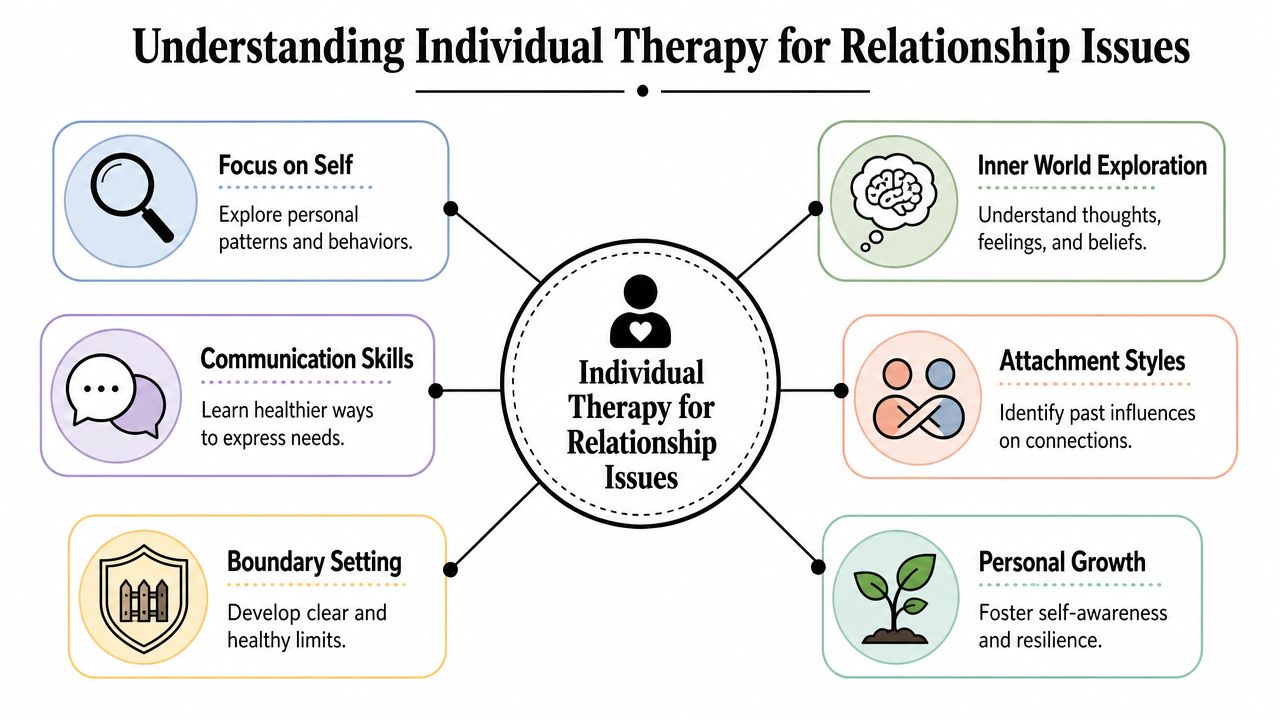
What the therapist is actually listening for
A trained clinician usually listens on at least three levels at once:
The surface problem
The recurring fight, the shut-down pattern, the jealousy, the emotional distance.The emotional engine under it
Fear of rejection, shame, helplessness, rage, grief, old betrayal.The learned strategy
Pursuing, avoiding, caretaking, people-pleasing, testing, controlling, dissociating.
That structure matters because most relationship distress isn't just about the visible disagreement. The visible disagreement is often the delivery system for something older and more vulnerable.
How Couple-Sensitive Individual therapy works
One useful clinical model is Couple-Sensitive Individual therapy, often shortened to CSI therapy. Its basic discipline is simple but important: the therapist validates your pain without confirming every conclusion you've drawn about your partner. The Family Institute description of CSI therapy highlights a key intervention: validating the client's emotional distress, such as “This sounds very painful for you,” rather than validating maladaptive beliefs about the partner.
That difference is not semantic. It is clinical.
If a therapist says, “Yes, your partner is selfish and impossible,” you may feel briefly understood, but you usually leave with more heat than skill. If the therapist says, “This sounds painful. Let's slow down what happens inside you in those moments,” the work becomes usable.
Pain needs validation. Blame needs examination.
What this approach targets
CSI-oriented work often includes:
- Attachment patterns: How you seek closeness, protect yourself, or anticipate abandonment.
- Communication habits: Not just what you say, but when, how fast, how intensely, and with what expectation.
- Family-of-origin learning: The relationship templates you absorbed early.
- Trauma triggers: Reactions that feel disproportionate now because they're connected to older injuries.
- Boundaries: Where your responsibility ends and someone else's begins.
The point is not to become calmer so you can tolerate anything. The point is to become clear enough, regulated enough, and self-aware enough to respond rather than react.
Individual vs Couples Therapy A Clear Comparison
People often ask which approach is better. That's usually the wrong question. A better one is: What job does each form of therapy do best?
Individual therapy is built to examine your internal world in depth. Couples therapy is built to observe and reshape interaction in real time. Those are different tasks.
Individual Therapy vs. Couples Therapy at a Glance
| Factor | Individual Therapy | Couples Therapy |
|---|---|---|
| Primary focus | Your emotions, beliefs, habits, triggers, and personal history | The interaction between partners |
| Core goal | Greater self-awareness, emotional regulation, clearer boundaries, better choices | Mutual understanding, conflict repair, shared agreements |
| Best use case | You need privacy to process trauma, ambivalence, shame, or confusion | Both partners are willing to examine the pattern together |
| Session dynamic | One person and one therapist | Two partners and one therapist |
| What gets explored deeply | Attachment history, trauma, self-worth, internal narratives | Communication loops, misunderstanding, conflict cycles, relational roles |
| Confidentiality frame | Your therapy space is centered on your disclosures and goals | The work is oriented toward the relationship and shared process |
| Main limitation | It can't directly change your partner's behavior | It may not be the right place for deeper individual trauma processing |
| Typical outcome marker | You respond with more clarity and less reactivity | The couple communicates and repairs more effectively together |
What individual therapy can do that couples therapy often can't
Some material needs privacy before it can be relationally useful. Examples include childhood trauma, sexual shame, complicated grief, or fear that you might want to leave but feel guilty admitting it. In a couples session, people often censor that material because they're managing the room.
In individual work, there's more space to be disorganized before you become clear.
What couples therapy can do that individual therapy can't
Couples therapy lets a clinician watch the dance happen live. One partner interrupts. The other shuts down. Someone pursues. Someone becomes vague. These moments are hard to reconstruct accurately after the fact.
That live process can be powerful. It's also why couples therapy is often the better fit when both people are safe, willing, and able to participate authentically.
Neither format is “more serious.” They solve different problems.
If you're deciding between them, use a simple filter. If the central question is “Why do I keep doing this, and how do I change it?” individual therapy may be the stronger starting point. If the central question is “How do we stop this pattern between us?” couples therapy may be the better container.
When to Choose Individual Therapy for Your Relationship
Sometimes solo work is one good option among several. Sometimes it's the clearest and safest place to begin.
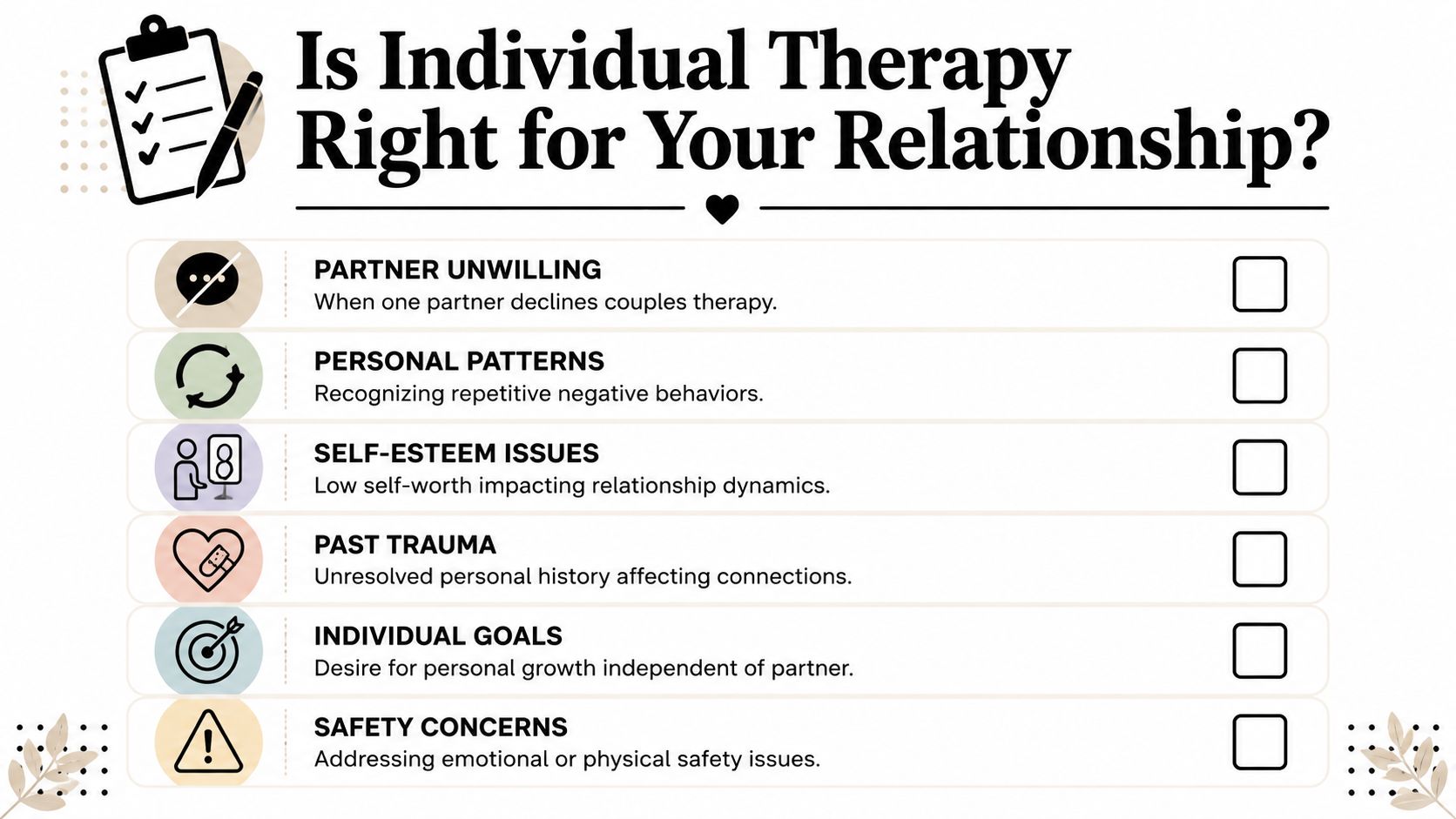
Strong reasons to start on your own
If your partner refuses therapy, you don't need to postpone care until they agree. If you have unresolved trauma that predates the relationship, that work often belongs in an individual setting first. If you're trying to determine whether the relationship is difficult, unhealthy, or unsafe, privacy matters.
This path is common, not unusual. A Verywell Mind relationships survey reported that approximately 36% of individuals in couples therapy are also in individual therapy, and 29% explicitly started individual therapy first to prepare for relationship work.
Situations where individual therapy is often the better first move
Your partner is unwilling or unready
Waiting for a reluctant partner can keep you frozen for months or years. Your own work doesn't have to wait.You need to assess safety
If there is intimidation, coercion, emotional abuse, or physical violence, joint therapy may be the wrong setting. Safety planning and individual support come first.You're carrying older trauma into present conflict
A current disagreement may activate wounds that have little to do with the immediate topic. That's not fake. It means the nervous system is linking present stress to past danger.You want clarity about staying or leaving
Therapy can help separate fear, guilt, hope, grief, obligation, and genuine desire.You notice repeating patterns across relationships
If the names change but the emotional story stays the same, that's useful data.
If your first goal is to understand yourself clearly, individual therapy is often the more efficient route.
One caution matters here. Solo work can improve your functioning, but it cannot make another person become honest, empathic, accountable, or safe. That distinction protects clients from overinvesting in self-improvement as a way to control what only the partner can change.
What to Expect in Sessions and Typical Outcomes
Individuals often want to know what transpires once therapy starts. The answer is less mysterious than many expect. Early sessions usually focus on mapping the pattern, not fixing it in one dramatic insight.

A clinician will usually ask about the relationship, but also about your stress responses, attachment history, prior relationships, family modeling, and moments that feel disproportionately activating. The point is to identify whether the current conflict is primarily a skills problem, a trauma problem, a boundary problem, or some combination.
What the work often looks like
Different therapists use different methods, but common approaches include CBT, DBT-informed skills, attachment-focused work, and trauma-informed treatment. CBT helps identify the thought patterns that intensify conflict. Attachment-focused work helps clarify the needs and fears under your reactions. Trauma-informed care helps you distinguish current threat from old alarm.
The process is often practical. You might track what happens in your body before you text repeatedly, shut down, or say something cutting. You might practice pausing before confrontation, naming one feeling instead of six accusations, or tolerating uncertainty without forcing immediate resolution.
For clients processing trauma, pacing matters. Work that moves too fast can flood the system instead of helping it integrate. If you're wondering about that risk, this discussion of whether EMDR can make things worse in some situations gives a useful overview of why therapist fit and preparation matter.
The spillover effect in real life
One of the most important outcomes is the spillover effect. As described in Tandem Psychology's discussion of individual therapy for relationship issues, improvements in one partner's ability to interrupt old reactivity patterns and manage emotions can create a positive trajectory in relationship satisfaction that can rival direct couple therapy.
That often looks ordinary from the outside:
- You stop chasing every conflict to conclusion.
- You answer the actual question instead of the feared one.
- You set a limit without escalating.
- You recover faster after feeling triggered.
- You notice when the old script is pulling you in, and you don't follow it all the way.
Those shifts can change the relationship climate because people respond differently when they're no longer interacting with the same version of you.
A helpful explanation is below.
What progress does and doesn't mean
Progress doesn't always mean the relationship survives. Sometimes therapy helps someone repair a partnership. Sometimes it helps them stop abandoning themselves inside one. Both are meaningful outcomes.
A good therapist keeps the measure of success anchored to your functioning. Are you more regulated, more honest, more discerning, and less trapped by old patterns? That's real progress, even before the relationship outcome is fully known.
Finding the Right Trauma-Informed Therapist
Not every therapist who treats anxiety or depression is skilled at relationship-focused individual work. And not every therapist who talks about trauma is trauma-informed in practice.
A trauma-informed therapist understands that present reactions may be shaped by past experiences, and they work in a way that prioritizes emotional safety, pacing, consent, and collaboration. A culturally competent therapist understands that family roles, gender expectations, immigration history, religion, race, and community norms all influence how someone experiences conflict, loyalty, and separation.
What to look for in a consultation
You're not looking for the perfect clinician. You're looking for someone who can hold complexity without rushing to simplistic advice.
Ask questions like these:
- How do you approach relationship issues when only one partner is present?
- How do you avoid reinforcing blame while still taking my experience seriously?
- What is your experience with attachment trauma, emotional abuse, or chronic conflict?
- How do you decide whether solo work is enough or whether couples therapy is needed later?
- How do you handle situations where a client is uncertain whether the relationship is safe?
A thoughtful therapist should be able to answer clearly, without jargon and without overpromising.
Signs of a good fit
Some answers matter more than credentials alone. You want a therapist who can tolerate ambivalence. One week you may want repair. The next week you may want distance. That doesn't make you inconsistent. It often means you're finally telling the truth about the full picture.
Look for these qualities:
They ask about safety directly
Especially if control, fear, or coercion may be present.They can explain their method
Terms like CBT, attachment work, or somatic work should come with plain-language explanations.They don't immediately pathologize your partner or idealize the relationship
Either extreme can distort treatment.They respect context
Culture, trauma history, family obligation, and practical dependence all matter.
For a deeper sense of what trauma-informed practice should include, this trauma-informed care assessment overview is a useful reference point when evaluating a provider.
The right therapist doesn't just make you feel heard. They help you think more clearly while you're distressed.
Common Questions About Solo Relationship Work
Do I have to tell my partner I'm in therapy
The answer depends on the relationship climate.
In a stable relationship, telling your partner can reduce secrecy and confusion. In a controlling, punitive, or emotionally unsafe relationship, privacy may be the healthier choice. I usually frame this as a safety decision, not a morality test. If disclosure is likely to lead to intimidation, monitoring, ridicule, or pressure to stop, keeping therapy private can protect the work.
What if I do all this work and my partner still doesn't change
That happens.
Individual therapy can change your side of the pattern. It can help you regulate faster, communicate more clearly, notice red flags sooner, and set limits you can maintain. It cannot produce accountability in someone who avoids it, nor can it create empathy where there is persistent contempt or manipulation.
The value of solo work is often the spillover effect. As you become less driven by fear, guilt, or old trauma responses, the relationship becomes easier to assess accurately. Sometimes that supports repair. Sometimes it makes the mismatch impossible to ignore. Both outcomes can be clinically useful.
Can individual therapy make my relationship worse
It can increase tension if the relationship was organized around your overfunctioning, silence, or self-abandonment.
For example, a partner may complain that you have "changed" when you stop apologizing for reasonable needs or stop absorbing all the emotional labor. That friction does not automatically mean therapy is harming the relationship. It may mean the old arrangement benefited one person more than the other.
This is one of the harder trade-offs in treatment. Growth tends to expose patterns that were easier to ignore when you were exhausted, confused, or trying to keep the peace at any cost.
Does solo relationship work help
Often, yes.
Its value is not that it gives you better talking points for the next argument. The deeper benefit is that it changes the internal conditions you bring into the relationship. People who understand their triggers, recover from conflict more effectively, and hold firmer boundaries usually make better decisions in love. Sometimes the relationship improves because the dynamic shifts. Sometimes the improvement is clarity about what the relationship can and cannot offer.
If you need documentation of trauma, abuse dynamics, or psychological symptoms for an immigration matter, Pro Psychological Analysis provides evidence-based psychological evaluations for asylum, VAWA, T visa, U visa, and extreme hardship cases. Their reports are built for legal use, grounded in clinical rigor, and designed to support attorneys and clients navigating high-stakes immigration proceedings.