
A traumatized client in the immigration system usually doesn't need to be told to “take a bubble bath.” They need a way to get through the next panic surge, the next sleepless night, the next attorney meeting, and sometimes the next unsafe housing situation without losing functional stability.
That's why generic wellness advice often misses the mark. Self care rituals are useful only when they respect trauma, culture, poverty, legal stress, and the reality that many survivors don't have privacy, free time, or a sense of safety. In practice, a ritual is not a luxury. It's a repeatable action that helps the body recognize the present moment and helps the person reclaim some control over it.
For immigration attorneys, this matters beyond wellbeing. A client who can regulate enough to participate in interviews, remember key details, and tolerate the legal process is often better able to support their own case. For survivors, a safe ritual can become one small daily proof that the nervous system isn't completely at the mercy of the past.
Table of Contents
- Reclaiming Self-Care from the Wellness Industry
- Why Standard Self-Care Can Fail Trauma Survivors
- The Four Pillars of a Trauma-Informed Ritual
- How to Design Your Safe Self-Care Rituals
- Integrating Rituals for Daily Stability and Legal Cases
- When Rituals Are Not Enough Seeking Professional Support
Reclaiming Self-Care from the Wellness Industry
The wellness market often treats self-care as a performance. For a trauma survivor in the immigration system, that model is often useless, and sometimes unsafe.
A photogenic routine does not help much if the client is drafting an affidavit after midnight, sharing space with people who do not respect privacy, or trying to stay regulated on the way to a USCIS interview. In practice, self-care has to work under pressure, in small spaces, with limited money, and without drawing unwanted attention.
That is why many survivors dismiss polished advice that looks good online but does not hold up in lived conditions.
Rituals are not indulgences
A ritual should be judged by function, not appearance. If someone drinks warm tea in the same cup each night because the sequence lowers startle and helps them sleep before a legal appointment, that is a valid ritual. If someone presses a smooth stone in a pocket during a panic spike on the bus to court, that is also a valid ritual.
Clinical point: The best ritual is the one a survivor can repeat safely in ordinary life, including on high-stress legal days.
In trauma-informed practice, care is measured by outcome. Does the ritual reduce distress? Does it restore orientation to time and place? Does it increase agency without exposing the person to new triggers, family conflict, or shame? Those questions matter more than whether the practice looks calming to an outsider.
This standard also protects cultural dignity. Some clients will regulate through prayer, washing, music, cooking, fabric, scent, or brief movement. Some will reject anything labeled "wellness" because it feels foreign, expensive, or disconnected from their faith and history. That does not mean they are resistant. It means the ritual has to fit the person rather than the market.
Why this reframing matters for legal practice
Attorneys do not need clients to adopt a lifestyle brand. They need clients to have repeatable practices that support sleep, recall, attendance, and recovery after hard conversations. That is a practical legal concern, not a luxury issue.
I often advise professionals to look for rituals that are discreet, culturally familiar, and easy to document. A two-minute grounding practice before a declaration meeting is more useful than a long routine the client cannot sustain. The same principle applies when you consider how complex trauma affects daily functioning.
A trauma-informed ritual can be quiet and ordinary. It may involve stepping outside for air, rubbing lotion into the hands with full attention, reciting a prayer, listening to one familiar song, or holding a cloth associated with safety. The point is dependable regulation that can survive the conditions of an immigration case.
Why Standard Self-Care Can Fail Trauma Survivors
Standard self-care advice often assumes the person has privacy, choice, safety, spare time, and a body that settles when asked to slow down. Many people in the immigration system do not have those conditions. A practice can sound calming on paper and still leave a trauma survivor more activated, more ashamed, or less able to function after.
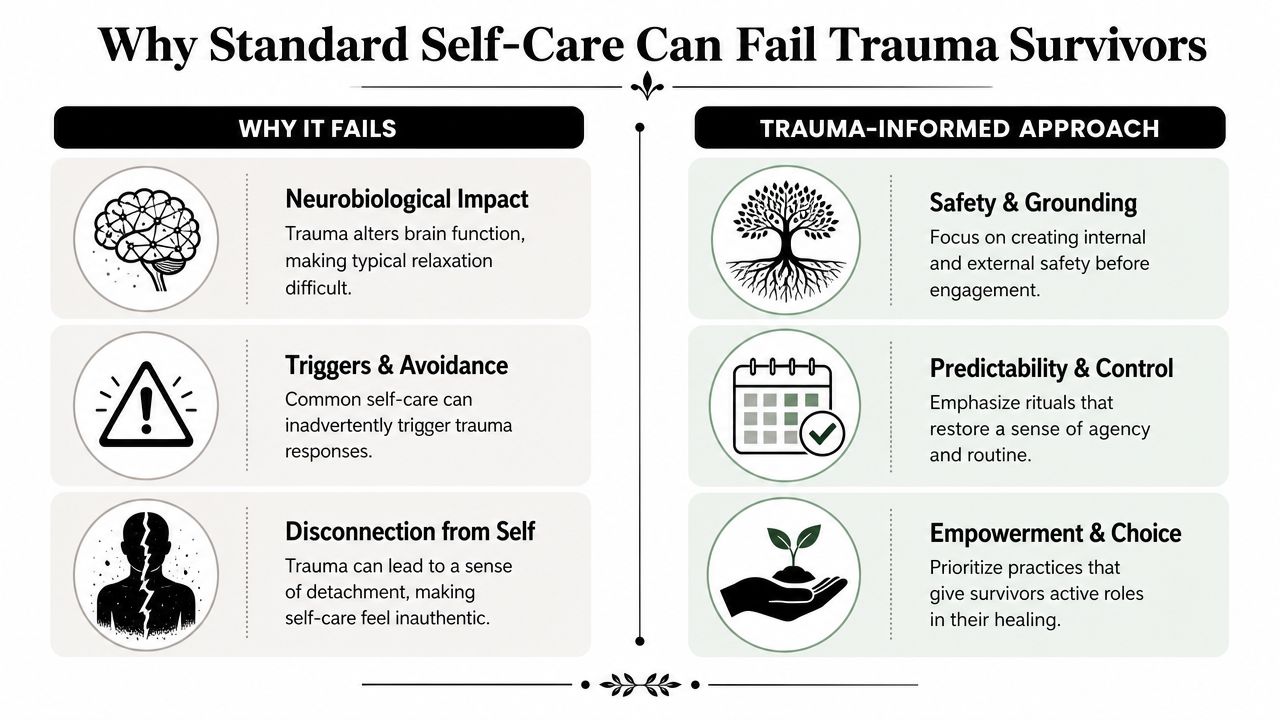
I see this problem regularly around legal preparation. A client is told to meditate, journal, stretch, or “listen to your body.” Then the practice increases flashbacks, dissociation, panic, or avoidance. The issue is not lack of effort. The method asked for more internal contact than the person could tolerate safely that day.
Mainstream advice also tends to treat self-care as private and apolitical. For survivors of persecution, domestic abuse, trafficking, or forced displacement, distress is often tied to surveillance, coercion, sexual boundary violations, family separation, and unstable housing. In that context, stillness may feel exposed. Silence may sound like danger. Closing the eyes may reduce orientation instead of improving it.
These reactions are common in people living with nervous system dysregulation after trauma. Hypervigilance can make relaxation feel unsafe. Dissociation can make body-based guidance feel vague or unreal. Shame can turn an unfinished ritual into evidence, in the survivor's mind, that they are failing everywhere.
When common advice becomes a trigger
Meditation is a good example. For some people it improves attention and lowers stress. For others, especially those with trauma histories, unsupervised meditation can intensify distress, depersonalization, or intrusive material. Researchers have documented meditation-related adverse effects in a range of practitioners, as reviewed in this NIH-indexed article on unwanted effects of meditation.
The same pattern shows up in other popular practices:
- Silent meditation: Too much unstructured internal space can pull the person toward fear, memory fragments, or collapse.
- Journaling about painful events: Writing can become repetition without containment, which is different from processing.
- Yoga or movement classes: Mirrors, touch, commands from an instructor, or being observed in a room can reduce a sense of control.
- Rigid routines: A plan that depends on privacy, money, or predictable mornings often fails during shelter living, shift work, caregiving, or court stress.
- Advice detached from culture or faith: A ritual will not hold if it feels alien, embarrassing, spiritually wrong, or associated with a group the survivor does not trust.
Some survivors need less introspection and more orientation to the present.
That distinction matters in legal cases. Before an asylum declaration meeting or VAWA affidavit review, the goal is not deep emotional excavation for its own sake. The goal is enough regulation to stay present, recall events with less fragmentation, and recover after the meeting without losing the next two days to panic or shutdown.
What trauma-informed care changes
A trauma-informed approach starts with tolerability. It asks whether the practice helps the person stay oriented, whether it can stop quickly if distress rises, and whether it fits the realities of the case. Brief, concrete, externally anchored rituals usually work better than ambitious routines built for ideal conditions.
In practice, that may mean cold water on the hands before opening legal mail, a familiar prayer said with eyes open, one song in the client's first language, holding a textured object during a difficult phone call, or stepping to a doorway to name five visible details in the environment. These are small interventions. They are also easier to repeat, safer to document, and more compatible with the pressure of immigration proceedings.
A survivor can follow common advice and still feel worse. Good care adjusts the ritual to the survivor, the setting, and the legal task at hand.
The Four Pillars of a Trauma-Informed Ritual
A trauma-informed ritual is less about the activity itself and more about the conditions around it. The same action can be regulating for one person and destabilizing for another. Four pillars help sort that out.
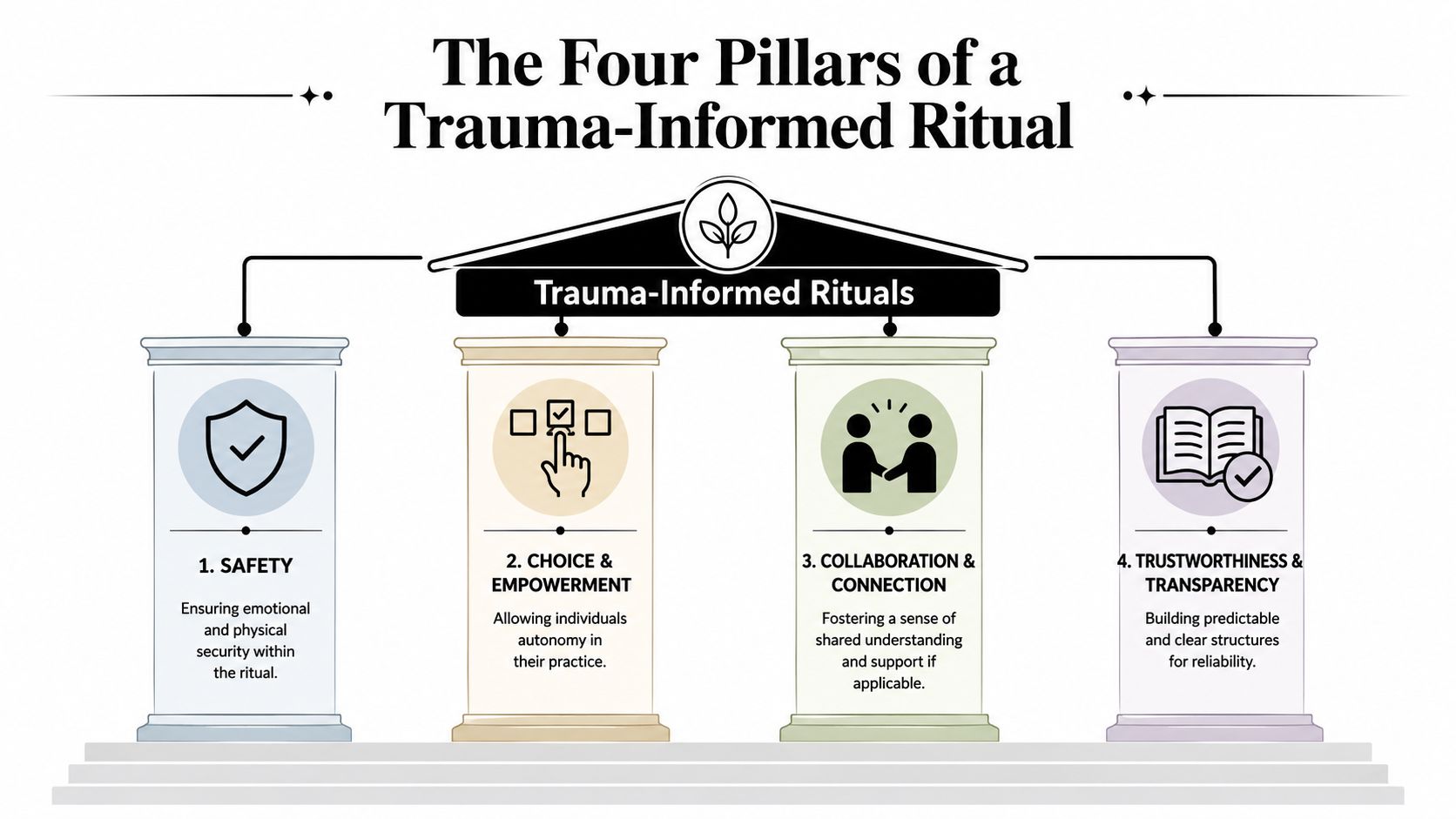
Adaptability matters because many survivors don't have ideal conditions. Recent U.S. Department of Health and Human Services data from 2025 found that 74% of refugees in resettlement programs reported being unable to engage in recommended self-care because of barriers such as unstable housing or lack of private space, as described in this article on why self-care rituals matter.
Choice and agency
Trauma often involves coercion, violation, or entrapment. A useful ritual restores decision-making, even in small doses.
A client should be able to answer yes to basic questions: Can I skip this today? Can I shorten it? Can I modify it if something feels wrong? If the answer is no, the ritual may recreate pressure instead of restoring control.
Examples of agency-centered design:
- Offer options: Tea or cold water. Sitting or standing. Eyes open or closed.
- Use opt-out language: “Try this for ten seconds and stop if it increases distress.”
- Keep ownership clear: The ritual belongs to the client, not the attorney, therapist, or advocate.
Pacing that prevents overwhelm
Trauma work often fails when the dose is too high. Self care rituals should begin at a level the person can repeat, not at the level that looks impressive.
A survivor who freezes easily may do better with ten seconds of hand pressure against a wall than a full movement sequence. A person with panic may tolerate two slow exhales better than a long breath practice that makes them focus too hard on bodily sensations.
Practical rule: Start below the point of resistance, not at the edge of ambition.
Grounding through the senses
Grounding works because it helps the brain sort “now” from “then.” The body often responds faster to sensory cues than to verbal reassurance.
Useful options include:
- Touch: Holding a mug, rubbing lotion into hands, pressing feet into shoes.
- Sound: One familiar song, soft prayer recitation, white noise, or naming nearby sounds.
- Smell: Soap, tea, citrus peel, or a fabric with a safe familiar scent.
- Temperature: Cool water on wrists, warm tea, stepping into shade or sunlight.
This is embodiment in a trauma-informed form. It doesn't force deep body awareness. It uses tolerable sensory contact to re-establish present-time orientation.
Cultural attunement and dignity
A ritual should fit the person's values, language, religion, migration history, and family norms. If a practice feels culturally alien, it may not only fail. It may increase distance from the self.
For one client, a grounding ritual may involve reciting scripture. For another, braiding hair slowly. For another, preparing rice, lighting a candle, touching a rosary, or listening to music from home. None of these are lesser than commercial wellness practices.
Attorneys and clinicians should avoid prescribing a single “correct” ritual. Safety increases when the person recognizes the ritual as their own.
How to Design Your Safe Self-Care Rituals
A good ritual should be brief, repeatable, and attached to real life. It should survive fatigue, legal stress, and limited privacy. Individuals benefit more from a small action they perform than from an ideal routine they abandon.
One principle is especially useful here. Simplifying the process and attaching the new action to an existing habit improves adherence. Linking a new habit to a post-shower routine increases retention by 65% compared with treating it as a standalone task, according to this explanation of behavioral stacking.
Start with the smallest workable action
Don't begin by asking, “What is the perfect ritual?” Ask, “What can I do even on a bad day?”
Use this sequence:
- Identify one predictable daily anchor. After brushing teeth, after prayer, before opening email, when sitting on the bus, after showering.
- Choose one sensory or physical action. Press both feet down, hold a warm cup, apply hand cream, name five blue objects, listen to one song.
- Set a tiny duration. One breath cycle. Ten seconds. One minute.
- Add a stop rule. If distress increases, switch to a simpler grounding action.
This approach protects against the “all or nothing” trap. A ritual should lower the barrier to starting.
Match the ritual to the nervous system state
Not every survivor needs calming. Some need activation because trauma can also produce numbness, collapse, and disconnection.
If the person is anxious or overactivated, try rituals that reduce intensity:
- Exhale-focused breathing
- Warm drink held with both hands
- Slow handwashing with attention to water temperature
- One repetitive prayer or phrase
If the person feels numb, foggy, or unreal, use rituals that increase orientation:
- Chewing mint gum
- Standing up and pressing palms to a wall
- Naming date, location, and next task aloud
- Listening to one energizing song
The right ritual doesn't always calm. Sometimes it wakes the system up enough to function.
Adapting Common Self-Care for Trauma Survivors
| Common Suggestion | Potential Trigger | Safe, Adapted Ritual |
|---|---|---|
| Journaling freely at night | Rumination, intrusive memory replay, sleep disruption | Write three concrete lines only: what happened today, what helped, what happens next |
| Silent meditation | Flashbacks, dissociation, panic in stillness | Keep eyes open and orient to five visible objects while breathing normally |
| Long bath | Feeling trapped, exposed, or physically unsafe | Use a brief handwashing ritual with warm water and textured soap |
| Group yoga class | Body exposure, touch concerns, shame, loss of control | Do one seated stretch at home with shoes on and the door unlocked |
| Gratitude list | Guilt, forced positivity, emotional invalidation | Name one tolerable thing in the present, such as “this chair supports me” |
| Deep body scan | Heightened distress from internal sensations | Focus on one neutral external contact point, such as feet in socks |
Build one example ritual
A practical example for a client preparing for immigration appointments:
- Anchor: Before leaving for any legal or medical appointment
- Action: Place both feet on the floor, hold identification documents, inhale normally, exhale slowly, look around the room and name three objects
- Phrase: “I am going to an appointment. I can return afterward.”
- Duration: Under one minute
That's enough. If it works, repeat it before each appointment until the body begins to recognize the sequence.
Integrating Rituals for Daily Stability and Legal Cases
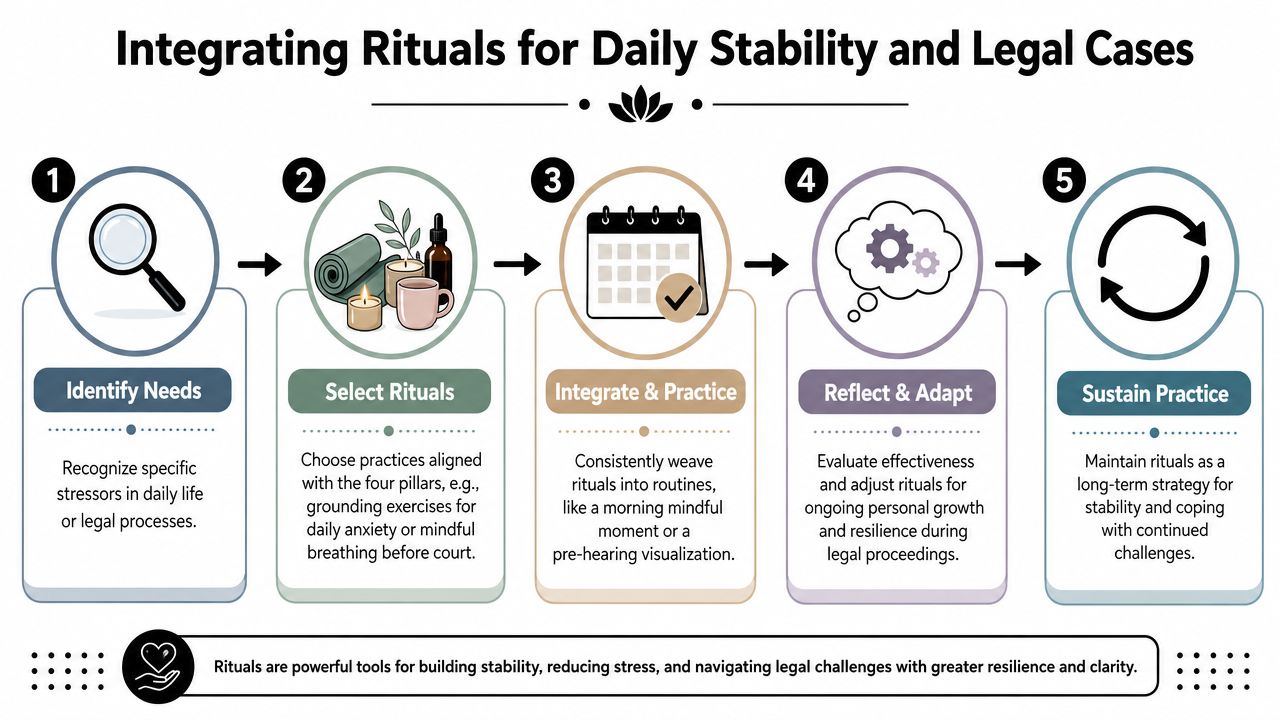
Self care rituals become more useful when they are ordinary enough to survive hard weeks. They don't need to be separate from life. They can be woven into transitions that already happen.
That matters in a broader social context. The global self-care market has reached $41.2 billion annually, reflecting a shift in which people turn everyday routines into intentional rituals, as described in this report on routines becoming rituals. For immigration clients, the useful version of that trend is not curated products. It is converting unavoidable moments into stabilizing ones.
What attorneys can say without becoming therapists
Attorneys should stay in role. The goal isn't to provide treatment. It's to support conditions that help the client participate and to notice when a referral is needed.
Useful attorney language tends to be simple and non-prescriptive:
- Before a meeting: “Would it help to take one minute before we start?”
- During distress: “Do you want water, a pause, or to keep going?”
- Before difficult testimony: “Is there something you already do that helps you stay present?”
This keeps control with the client. It also avoids implying that a client must look calm to be credible.
How clients can document rituals for a case record
A ritual log can sometimes support a broader narrative of trauma, impairment, and effort toward stability. It should never become forced self-surveillance. Keep it simple.
A useful log might include:
- Date and time
- Trigger or context
- Ritual used
- What happened afterward
- Whether the client could continue with the day's task
This kind of note can help a clinician understand symptom patterns. In some cases, it may also help corroborate how trauma affects functioning around interviews, court dates, family care, sleep, concentration, and safety. That can matter in asylum, VAWA, T visa, U visa, or hardship contexts when psychological evidence is being developed.
Keep documentation factual. “Used music before attorney call and was able to complete it” is stronger than vague statements about “feeling better.”
Rituals can also be tied to legal milestones. A client may use one before reading notices, one before testimony preparation, and one after recounting abuse. Over time, those patterns show not only suffering, but adaptive effort under pressure.
When Rituals Are Not Enough Seeking Professional Support
Self care rituals help many people. They are not treatment for all trauma conditions, and they should not carry that burden alone.

The desire for self-guided care is widespread. In the U.S., 93% of youths practice self-care, and among Americans overall, 73% say they need more self-care while 69% intend to add more practices in the next year, according to these compiled self-care statistics. That broad acceptance is encouraging, but popularity does not erase clinical limits.
Signs the client needs more than self-guided care
A referral is important when rituals stop helping, or when they were never enough to contain symptoms safely. Watch for patterns such as:
- Worsening symptoms: More nightmares, panic, dissociation, self-neglect, or inability to leave home.
- Functional collapse: Missed legal appointments, inability to complete declarations, or severe concentration problems.
- Trauma flooding: Rituals trigger spiraling, flashbacks, or prolonged shutdown.
- Risk concerns: Suicidal thoughts, self-harm, escalating substance use, or danger from others.
If a client asks whether a trauma therapy could backfire, a balanced discussion of possible challenges in EMDR treatment can help frame expectations without discouraging care.
How to look for support without making the process harder
Not every client can access a private therapist immediately. Start with realistic pathways.
- Community mental health clinics: Many offer low-cost or sliding-scale services.
- Nonprofit immigrant organizations: Some provide trauma-informed counseling, case management, or referrals in the client's language.
- Telehealth options: These can reduce transportation and child care barriers.
- Culturally responsive providers: Ask whether the clinician has experience with trauma, migration, domestic violence, trafficking, or asylum-related stress.
- Practical screening questions: “Do you work with interpreters?” “How do you handle trauma disclosure pacing?” “What do you do if grounding exercises become triggering?”
Seeking help is not a sign that the client's rituals failed. It means the symptoms deserve a wider net of support. In many immigration cases, that support also improves the quality of legal participation and the accuracy of psychological documentation.
If your case needs clinically rigorous psychological evidence, Pro Psychological Analysis provides immigration-focused evaluations for asylum, VAWA, T visa, U visa, and extreme hardship matters. The practice works with attorneys and survivors nationwide to document trauma, functional impairment, and abuse dynamics in a form that supports legal strategy while protecting client dignity and confidentiality.