
A client sits in your office with a history that would move any reasonable adjudicator. Torture. Domestic violence. Forced labor. Family separation. Panic attacks every time they see a uniform. Memory gaps when you ask for dates. They're credible in the human sense, but your file still has a problem. It lacks structured evidence showing how the trauma impairs daily functioning.
That gap matters in immigration practice. USCIS officers and immigration judges don't decide cases based on sympathy alone. They decide them on records, consistency, nexus, functional impact, and whether the evidence answers the legal question in front of them. A generic therapist letter often doesn't do that. A broad mental health diagnosis without a functional analysis often doesn't do it either.
Psychology rehabilitation services prove strategically useful. In the immigration context, they can do more than describe distress. They can document how trauma affects concentration, memory, emotional regulation, work capacity, parenting, social functioning, treatment compliance, and ability to manage legal proceedings. They convert suffering into clinically organized, legally relevant evidence.
That bridge is missing in most standard guidance. Research on refugees and asylum seekers shows higher rates of post-traumatic stress and depression, yet major rehabilitation psychology guidance seldom details culturally adapted or trauma-informed frameworks designed for this population, creating a serious gap in care and documentation, as noted by UPMC's overview of rehabilitation psychology and psychological issues.
Table of Contents
- Introduction From Client Trauma to Legal Evidence
- Defining Psychology Rehabilitation Beyond the Textbook
- Inside the Evaluation Key Clinical Components
- The Critical Link to US Immigration Law
- Anatomy of a Legally Admissible Psychological Report
- Navigating Referrals and Accessing Services
- Selecting a Qualified Provider and Ensuring Ethical Practice
Introduction From Client Trauma to Legal Evidence
Immigration lawyers see the same pattern constantly. The client's suffering is obvious in interview. The legal standard, however, requires more than obvious suffering. It requires proof that connects the history to present impairment, future risk, or hardship in a way a decision-maker can use.
That's why attorneys shouldn't think about psychology rehabilitation services as “therapy with a nicer label.” In legal practice, the better frame is functional documentation. Rehabilitation-oriented work asks a different set of questions than a routine counseling intake. Not just what happened, but what the client can no longer do reliably because of what happened.
A strong rehabilitation-informed evaluation can help answer questions such as:
- Memory and narrative consistency: Is the client's fragmented recall clinically consistent with trauma, head injury, depression, or anxiety?
- Daily functioning: Can the client manage appointments, work tasks, childcare, transportation, or medication routines without substantial support?
- Emotional regulation: Do panic, hypervigilance, shame, or dissociation interfere with testimony, treatment, or community integration?
- Future consequences: Would separation, return, or loss of a caregiver predictably worsen functioning?
Practical rule: If the legal claim turns on impairment, hardship, or the consequences of trauma, you need more than diagnosis. You need a functional formulation.
That distinction changes case strategy. A therapist letter often says the client is anxious, depressed, or traumatized. A rehabilitation-focused report should go further. It should explain how symptoms affect task completion, reliability, judgment, endurance, social engagement, and independence.
For attorneys, that difference can determine whether a report feels supplemental or central. When done well, psychology rehabilitation services don't just support the case. They help organize it.
Defining Psychology Rehabilitation Beyond the Textbook
Rehabilitation psychology isn't mainly about labeling symptoms. It's about restoring function after illness, injury, disability, or chronic psychological burden. For immigration lawyers, the simplest analogy is physical therapy for the mind and behavior. The issue isn't only whether trauma occurred. The issue is what capacities were disrupted and how those disruptions shape everyday life.
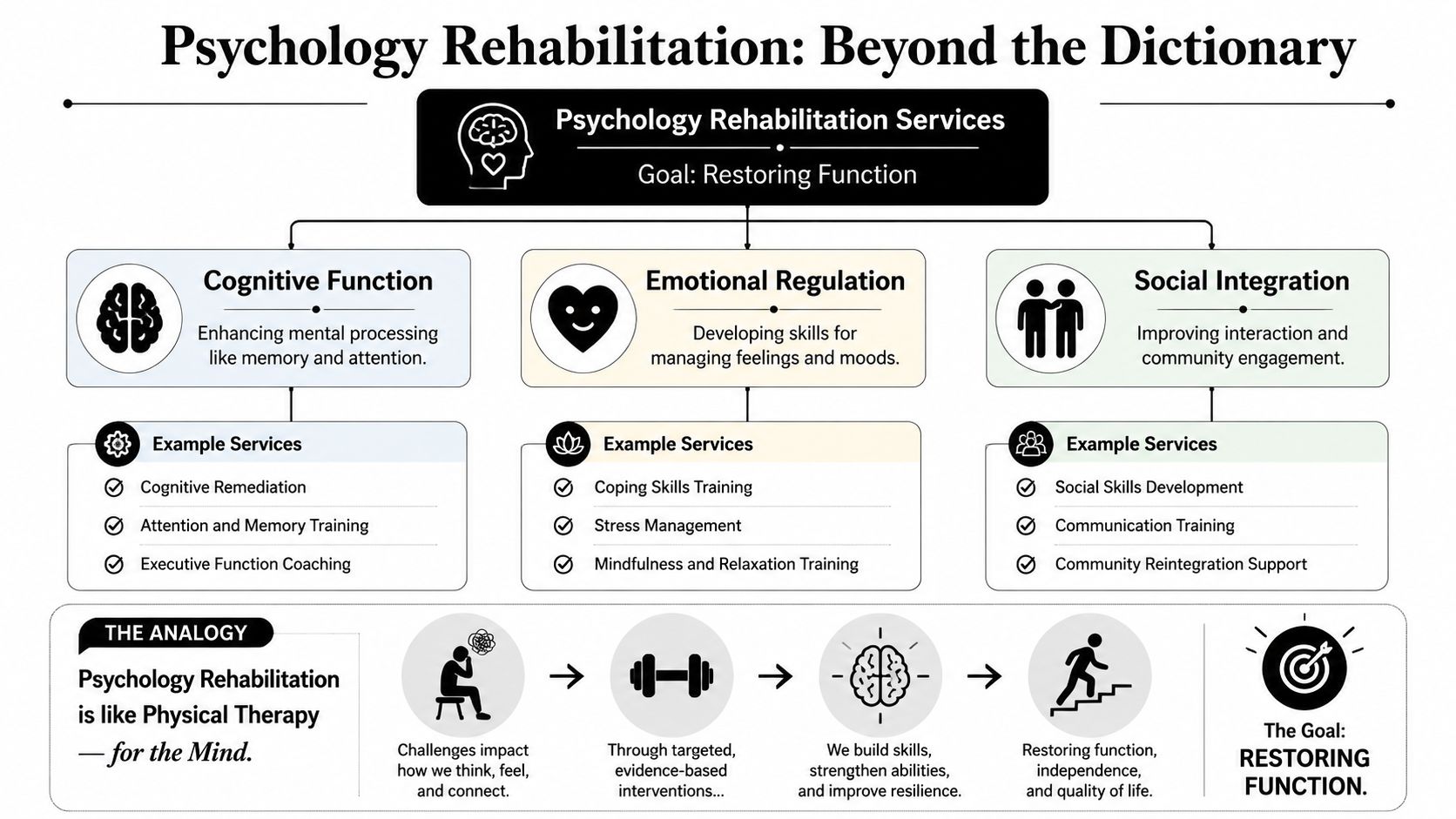
What rehabilitation psychology actually targets
A standard diagnostic evaluation may stop after identifying PTSD, major depression, or an adjustment disorder. Rehabilitation psychology asks what those conditions do to functioning across settings.
Think in three practical domains:
| Domain | What the clinician examines | Why it matters legally |
|---|---|---|
| Cognitive function | Attention, memory, processing speed, planning | Supports claims involving work limits, testimony problems, or inconsistent recall |
| Emotional regulation | Panic, irritability, shutdown, avoidance, dissociation | Explains barriers to disclosure, treatment engagement, and daily stability |
| Social integration | Isolation, mistrust, conflict, dependence on caregivers | Helps document hardship, vulnerability, and impaired community participation |
In practice, that means the report should address whether the client can sustain routines, respond to stress, manage family roles, and adapt to change. Those are legal facts dressed in clinical clothing.
Why the field carries weight
This is not a fringe subspecialty. Rehabilitation psychology formally developed after World War II to address veterans' long-term needs and is now a recognized specialty focused on quality of life and functional outcomes. Training programs with rehabilitation psychology involvement increased by about 200% between 2007 and 2013, reflecting expansion in formal training and professional recognition, according to the APA Division of Rehabilitation Psychology review indexed on PubMed.
That history matters because immigration cases often involve the exact kind of long-tail consequences rehabilitation psychologists are trained to analyze. Not just fear. Not just sadness. Functional disruption over time.
The most persuasive rehabilitation evidence doesn't dramatize symptoms. It shows how symptoms interfere with ordinary tasks that adjudicators already understand.
What works and what doesn't
What works is a function-first framework. The evaluator ties symptoms to concrete limitations, then ties those limitations to the legal issue. What doesn't work is importing a purely treatment-oriented note into a forensic setting and hoping the adjudicator fills in the gaps.
Attorneys often get stronger evidence when they ask for analysis in plain terms:
- Can the client remember and recount events consistently?
- How does trauma affect work, parenting, or self-care?
- What support does the client rely on to remain stable?
- What deterioration is likely if that support is removed?
Those aren't soft questions. They're the backbone of many immigration claims.
Inside the Evaluation Key Clinical Components
A rehabilitation-focused psychological evaluation should never feel like a black box. If you're retaining an evaluator, you should know what methods they're using and why those methods matter. The best reports combine interview data, behavioral observations, records review, and targeted testing. Each part does a different job.
Interview, records, and observation
The clinical interview gathers the timeline. That includes trauma history, migration stress, prior treatment, education, work history, family roles, and current symptoms. In immigration work, records review is just as important. Declarations, medical files, police reports, school records, detention notes, and affidavits often reveal patterns the client cannot narrate cleanly in one sitting.
Behavioral observation fills another gap. An experienced evaluator notes pacing, emotional constriction, tearfulness, slowed responses, confusion, distractibility, and whether the client can tolerate difficult topics. Those details matter because they show how the person functions in real time, not just what they report.
Standardized testing and why attorneys should care
Rehabilitation psychologists often use standardized neuropsychological tools such as the WAIS, WMS, and D-KEFS to quantify cognitive impairment. These measures can assess memory, executive functioning, attention, and processing speed. According to APA guidance on rehabilitation psychology specialization, integrating those findings into rehabilitation planning can increase functional independence and return-to-work rates by 15% to 25%.
For attorneys, the point isn't the test name alone. It's what the score pattern helps establish. A client who struggles to remember dates may not be evasive. A client who can't organize documents may not be noncompliant. A client who misses appointments may be impaired in planning, recall, or emotional tolerance.
If you want a useful primer on how psychologists think about sound measurement, review this discussion of the validity of assessment tools in psychological evaluations.
What a robust evaluation includes
A solid rehabilitation-oriented evaluation typically contains:
- Referral-specific questions: The examiner knows whether the legal issue is asylum, hardship, abuse dynamics, trafficking consequences, or capacity concerns.
- Targeted test selection: Tools are chosen because they answer the referral question, not because they're routinely administered.
- Functional synthesis: The report explains how findings affect work, parenting, communication, independent living, and legal participation.
- Cultural caution: The evaluator avoids overpathologizing language differences, educational interruption, or culturally shaped distress expression.
A symptom list is descriptive. A functional analysis is probative.
What doesn't work is overtesting without interpretation. Another weak approach is relying entirely on self-report checklists while ignoring records, behavior, and context. In immigration cases, the strongest evaluations are rarely the longest. They're the ones that explain how the clinical data answer the legal question.
The Critical Link to US Immigration Law
Immigration law doesn't ask whether a client has been through something terrible in the abstract. It asks whether the evidence proves persecution, substantial harm, abuse-related coercion, extreme hardship, or some other legally recognized consequence. Psychology rehabilitation services matter because they map psychological injury onto functional and foreseeable impairment, which is often where legal arguments become concrete.
Early in case development, many attorneys benefit from seeing the clinical-legal alignment visually.
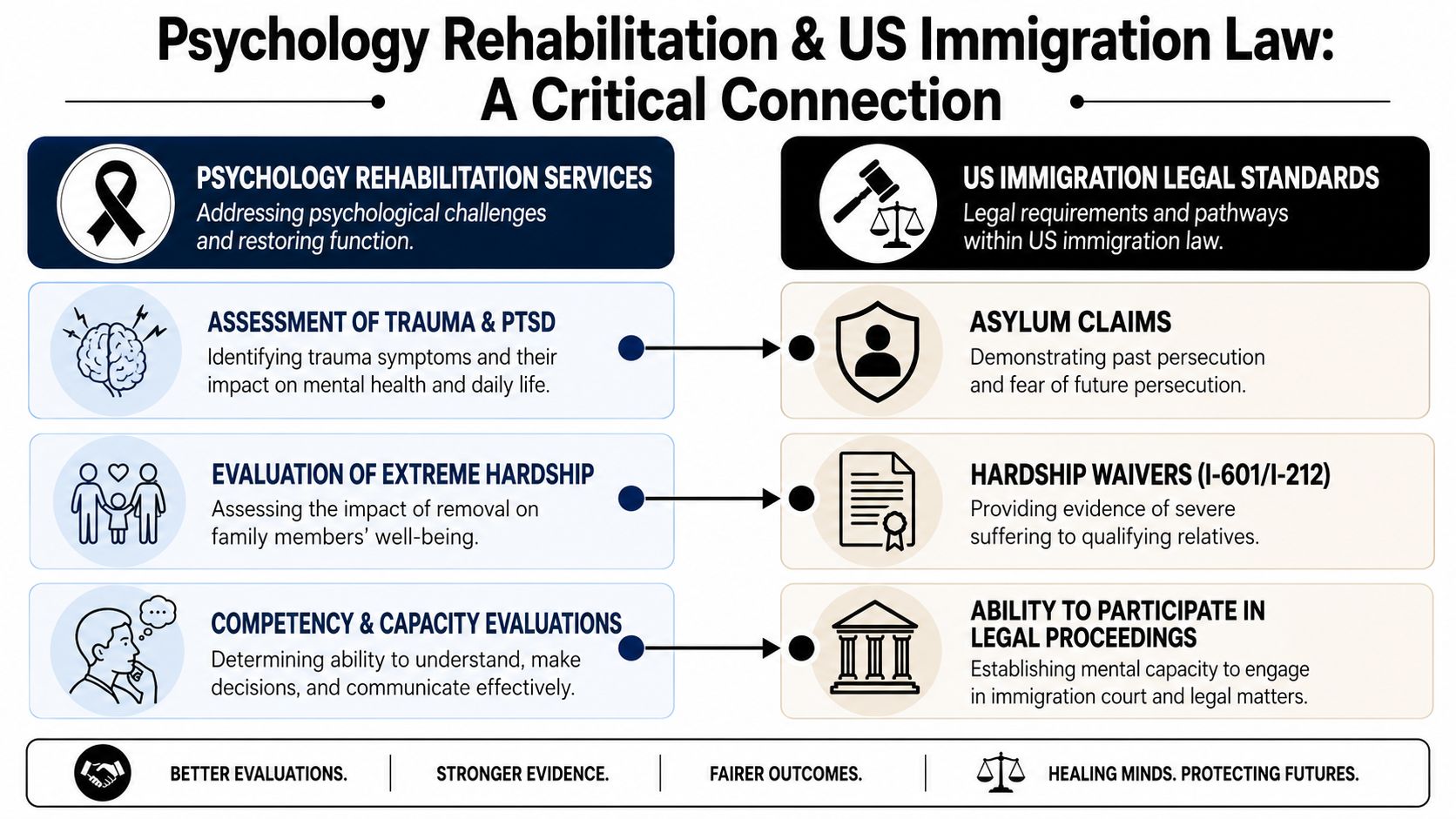
Asylum cases
In asylum matters, rehabilitation evidence can explain why a client's presentation doesn't match lay expectations. A survivor of political violence may appear detached rather than emotional. A torture survivor may recall sensory fragments but not chronology. A person with trauma-related concentration problems may offer a declaration that looks uneven on paper yet is clinically coherent when evaluated properly.
The rehabilitation angle is especially helpful when the question isn't only past harm, but ongoing functional consequences. If the client remains unable to work steadily, trust others, travel alone, or tolerate authority figures, the report gives the adjudicator a grounded account of why.
VAWA and coercive control
In VAWA cases, the key issue often isn't just that abuse occurred. It's how coercive control reshaped the victim's behavior and functioning. Rehabilitation-informed evaluations can show how chronic intimidation, isolation, financial dependence, and threats produced cognitive overload, fear-based compliance, and loss of independent functioning.
That matters when the file contains facts that a government reviewer might otherwise misread. Delayed reporting. Return to the abuser. Missed appointments. Ambivalence. These are often framed against victims. A functional analysis can place them in context.
A short explainer can help orient clients and legal teams before deeper review.
T visas, U visas, and substantial harm
For survivors of trafficking or qualifying crimes, the legal question often centers on the seriousness of psychological and practical injury. Rehabilitation evidence proves unusually useful in such contexts. It documents not just symptoms, but what the symptoms now prevent.
Consider a trafficking survivor who startles at workplace supervision, dissociates under pressure, and cannot maintain routine attendance. A generic diagnosis tells part of that story. A rehabilitation-focused report can show why employment instability, social withdrawal, sleep disruption, and impaired concentration are downstream effects of the trauma.
Extreme hardship waivers
Hardship arguments often become persuasive when they move from emotion to function. The issue is not “the family will suffer.” Nearly every separation causes suffering. The issue is how, to whom, and with what consequences.
In the U.S., inpatient rehabilitation facilities had an average successful discharge-to-community rate of 65.5%, underscoring the role rehabilitation services play in functional recovery and community reintegration, according to this review of mental health and rehabilitation services. In waiver cases, that reintegration logic carries over. If a qualifying relative relies on the applicant for emotional regulation, transportation, appointment management, medication support, or daily stability, the evaluation should spell out what community functioning would likely look like after separation.
Don't ask the evaluator only whether the qualifying relative is depressed or anxious. Ask what tasks, relationships, and safety routines would break down if the applicant were removed.
The legal force comes from specificity. Who cooks. Who supervises medication. Who buffers panic symptoms. Who manages school communication. Who keeps the household functioning when symptoms spike. That is where hardship becomes legible.
Anatomy of a Legally Admissible Psychological Report
Attorneys don't need a report that sounds overly complex. They need one that survives scrutiny and helps the reader decide the case. A legally useful psychological report is organized around the referral question, transparent about methods, and explicit about how the clinical findings relate to the legal standard.
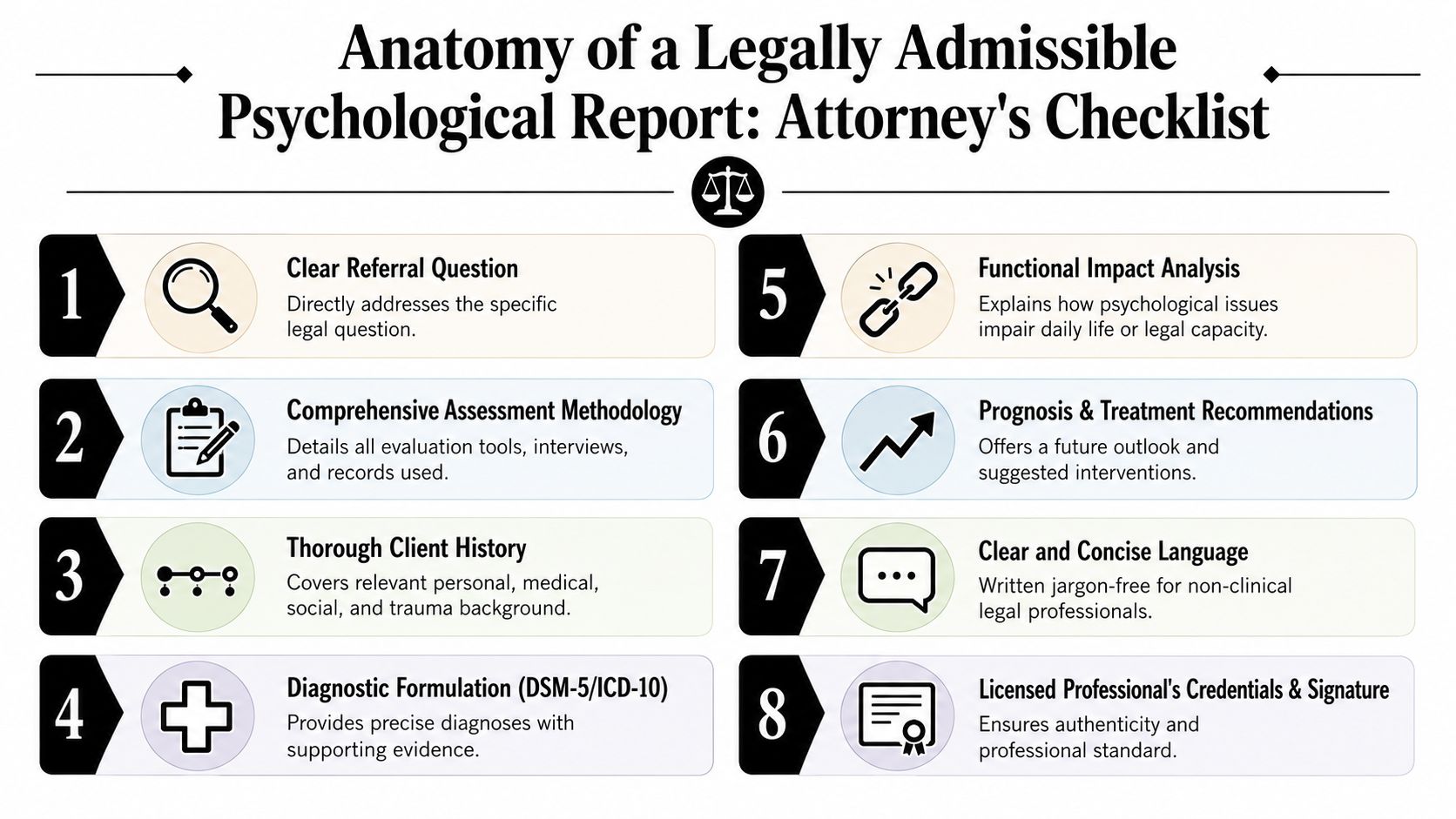
The nonnegotiable sections
At minimum, the report should contain these core parts:
Clear referral question
The opening must identify why the evaluation was requested. A report written for treatment can't be recycled into a forensic filing.Records reviewed
The examiner should identify which declarations, medical records, affidavits, or legal materials were considered.Methodology
Interviews, behavioral observations, and any testing should be named and described in usable terms.Diagnostic formulation
Diagnoses should be supported, not dropped into the report as labels without explanation.Functional impact analysis
This is the heart of the report. It should address activities of daily living, work, education, parenting, self-care, social functioning, or legal participation, depending on the case.Clinical nexus
The evaluator should explain how the reported events connect to the symptoms and impairments observed.
What adjudicators can actually use
A persuasive report translates specialized findings into ordinary language. It doesn't drown the reader in jargon. It tells the judge or officer what the symptoms mean in practice.
A useful way to review a draft is to ask whether each section answers one of these questions:
| Question from the decision-maker | What the report should provide |
|---|---|
| What happened clinically? | History, symptoms, observations, and diagnoses |
| How do we know? | Methodology, records, and testing basis |
| Why does it matter legally? | Functional impact tied to the case standard |
Common weaknesses attorneys should catch
Some reports look polished but remain weak evidence. Watch for these problems:
- No explicit nexus: The report lists trauma and then lists symptoms, but never connects the two analytically.
- No functional discussion: It says the client has PTSD or depression without showing how daily life is impaired.
- No forensic framing: It reads like a therapy progress note instead of a legal evaluation.
- No limits acknowledged: Strong experts note constraints, such as limited records, interpretation issues, or cultural considerations.
The most valuable paragraph in many reports is the formulation. That's where the clinician turns raw information into an explanation the law can use.
Attorneys should read that formulation closely. If the report's theory of the case isn't clear there, the rest of the document usually won't save it.
Navigating Referrals and Accessing Services
The referral process doesn't need to be complicated, but it does need to be deliberate. Cases go sideways when attorneys wait until the filing deadline is near, send no records, or refer clients without explaining the purpose of the evaluation. Psychology rehabilitation services work best when the legal team treats the evaluation as part of case architecture, not an add-on.
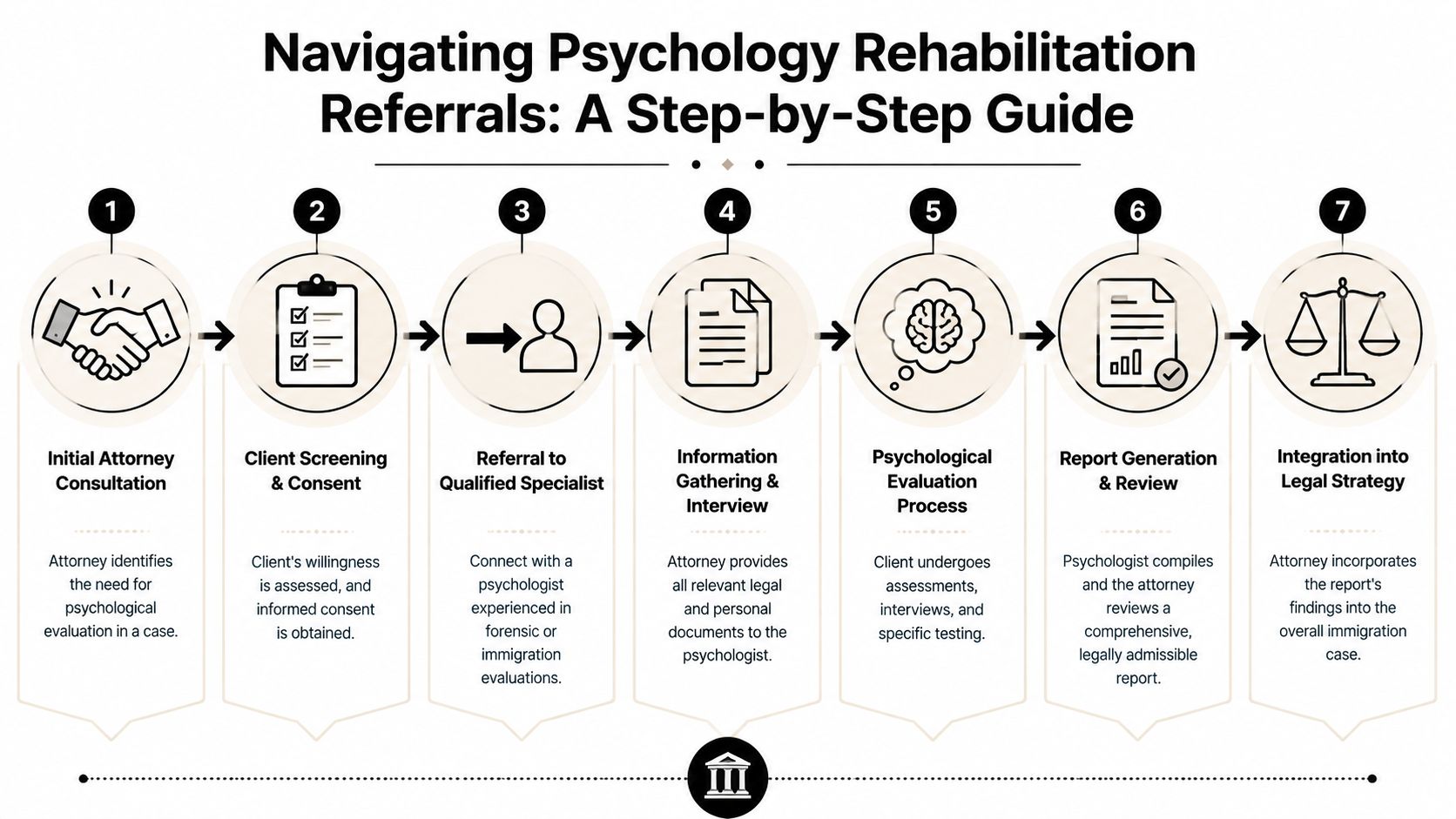
Attorney-led referrals versus client-initiated contact
An attorney-led referral usually produces the cleaner result. Counsel can frame the legal issue, provide records, and clarify deadlines. The evaluator starts with context rather than trying to reverse-engineer the case from the client's memory.
A client-initiated approach can still work, especially when representation is limited or the client seeks help before retaining counsel. The drawback is that important legal questions may never be asked. The clinician may produce a perfectly competent report that doesn't answer what USCIS or the court needs.
For many firms, this practical guide to finding a psychological evaluation for immigration near me is a useful starting point when building a referral workflow.
What to send the evaluator
The fastest way to improve report quality is to send better input. Useful referral packets often include:
- Case theory summary: One page explaining the legal posture and core issues.
- Key records: Declarations, prior filings, medical records, police reports, and affidavits.
- Timeline notes: Important dates, even if approximate, plus known gaps or inconsistencies.
- Language needs: Preferred language, interpreter requirements, literacy concerns, and cultural factors.
Preparing the client for the process
Clients often think an evaluation is a test they can fail. That misunderstanding creates anxiety and guarded responses. They should know the evaluator isn't grading morality or immigration worthiness. The task is to understand functioning, symptoms, and history as accurately as possible.
Attorneys can improve participation by telling clients:
- Be concrete: Examples help more than conclusions.
- Don't guess when unsure: “I don't remember” is better than forced precision.
- Expect difficult topics: Distress during interview doesn't invalidate the process.
- Bring support planning: If the client decompensates after discussing trauma, plan transportation, childcare, or a quiet recovery period.
Virtual evaluations have made access easier for clients who face distance, transportation barriers, disability, or caregiving burdens. The key isn't whether the appointment is virtual or in person. The key is whether the evaluator structures the process carefully and documents any limits clearly.
Selecting a Qualified Provider and Ensuring Ethical Practice
Many attorneys assume any licensed psychologist can write a strong immigration report. That assumption causes real damage. Clinical licensure alone doesn't establish forensic competence, cultural competence, or rehabilitation expertise. Immigration cases require all three.
What to look for in a provider
A qualified evaluator should have a working grasp of trauma, functional assessment, and medico-legal writing. In rehabilitation-oriented matters, it's especially helpful if the clinician understands how cognitive symptoms, emotional dysregulation, and social impairment interact.
Look for these markers:
- Forensic orientation: The psychologist can distinguish treatment goals from evidentiary questions.
- Experience with trauma survivors: Not just diagnosis, but interviewing and documenting trauma without contaminating the account.
- Cross-cultural skill: The evaluator knows that symptom expression, help-seeking, and distrust of authorities vary across communities.
- Functional focus: The report addresses what the client can and cannot do, not just what diagnoses appear.
The dual-role problem
One of the most common mistakes is asking a treating therapist to serve as the forensic expert. Sometimes that's unavoidable. Often it's unwise. Treatment and forensic evaluation have different goals, different pressures, and different expectations around objectivity.
Professional guidance in rehabilitation psychology often doesn't provide detailed instruction for the dual roles that arise when findings are used both for treatment and for legal decision-making, highlighting the need for specialized forensic expertise, as discussed in this overview touching on rehabilitation and legal-role complexity.
That gap has practical consequences. A treating therapist may advocate, reassure, and preserve alliance. A forensic evaluator must assess, test explanations, and write for scrutiny. Those roles can conflict.
A good treating clinician may be the wrong expert witness. Those are different jobs.
Ethical safeguards attorneys should ask about
Before retaining a psychologist, ask direct questions about process and boundaries. You want clarity, not vague assurances.
Use a checklist like this:
| Issue | What to ask |
|---|---|
| Consent | Does the client understand the purpose, limits of confidentiality, and who receives the report? |
| Confidentiality | How will records be stored and transmitted? |
| Role clarity | Is this clinician treating, evaluating, or both? |
| Interpreter use | How are language access and interpreter reliability handled? |
For a practical overview, attorneys should understand basic informed consent procedures in psychological evaluations, especially when clients are vulnerable, traumatized, or unfamiliar with legal-medical boundaries.
Red flags are easy to miss when deadlines are tight. Be cautious if the provider promises a specific diagnosis before interview, guarantees case outcomes, refuses to discuss methods, or treats every immigration case as interchangeable. Strong experts don't sell certainty. They document carefully, explain limits, and stay in their lane.
If your firm needs immigration-focused psychological evaluations that are methodologically rigorous, clinically careful, and legally usable, Pro Psychological Analysis provides thorough assessments for asylum, T visa, U visa, VAWA, and extreme hardship cases. The practice works with attorneys nationwide, offers virtual evaluations, and delivers clear, evidence-based reports that connect trauma and functional impairment to the legal standard while maintaining HIPAA-compliant confidentiality and strong forensic ethics.