
An attorney sends the intake packet over the night before a psychological evaluation. The client arrives with a signed consent form, but when you ask what they understood, they say they thought the meeting was therapy, or that everything discussed will stay private no matter what, or that the report goes only to the lawyer and never to the government. None of those misunderstandings are minor.
In immigration work, consent failures don't just create legal risk. They distort the evaluation itself. A frightened asylum seeker may withhold trauma details. A trafficking survivor may agree outwardly while not understanding they can pause, decline, or ask for an interpreter. A parent may consent for a minor without anyone checking whether the child understands, in age-appropriate terms, why a stranger is asking about abuse, fear, or family separation.
That's why informed consent procedures matter long before a report is drafted. Done poorly, they feel like paperwork imposed on a vulnerable person at the worst possible time. Done well, they become the first clinical intervention in the case. The client learns whether the evaluator is clear, predictable, respectful, and safe. The attorney gets a stronger foundation for a credible report. The record shows that the evaluation was not only legally defensible, but ethically sound.
Table of Contents
- More Than a Signature The Role of Consent in Immigration Cases
- The Three Pillars of Defensible Informed Consent
- A Step-by-Step Protocol for the Consent Conversation
- Adapting Consent for Language Access Telehealth and Minors
- Assessing Capacity and Verifying True Understanding
- Bulletproof Documentation and Recordkeeping Practices
- From Legal Hurdle to Therapeutic Alliance
More Than a Signature The Role of Consent in Immigration Cases
The rushed version is common. A client sits down, visibly tense. An interpreter may or may not be present. Someone places a dense form in front of them and asks for a signature before the actual conversation begins. On paper, consent exists. In reality, the client may not know the purpose of the evaluation, the limits of confidentiality, or how the report may affect the case.
That approach fails both clinically and forensically.
In immigration evaluations, many clients have learned that authority figures can be dangerous, unpredictable, or coercive. If the first minutes of the appointment feel opaque or pressured, the evaluator has already lost something important. The client starts guarding information, agreeing reflexively, or tracking risk instead of listening.
A better process looks different. The evaluator slows the pace, explains who they are, states plainly that this is an assessment rather than treatment, names who will likely read the report, and checks whether the client wants clarification before moving on. The client hears structure instead of jargon. They see choice instead of pressure.
The consent conversation is often the first proof that the evaluator will say difficult things clearly and won't hide the rules of the process.
For an immigration attorney, that distinction matters. Reports are stronger when the underlying interview was built on informed, voluntary participation. Histories are usually more coherent when the client knows why certain questions are being asked and what will happen with the answers. The evaluation also becomes easier to defend if anyone later asks whether the client agreed to participate.
The practical point is simple. Informed consent procedures are not a liability ritual. In this setting, they are the opening test of trustworthiness. If the evaluator passes that test, rapport improves, disclosure becomes more accurate, and the final work product carries more credibility.
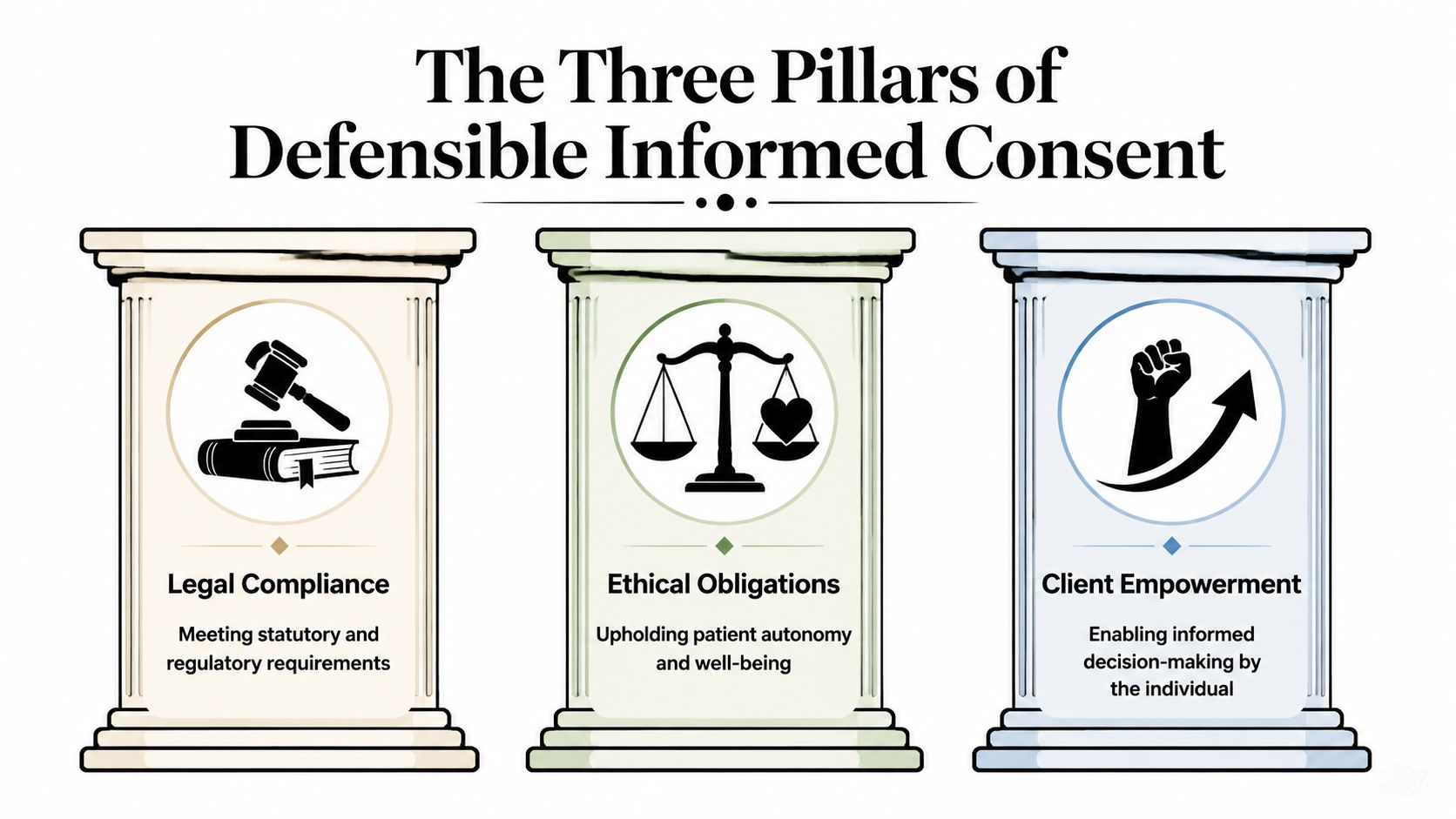
The Three Pillars of Defensible Informed Consent
A defensible consent process in immigration work rests on three separate supports. If one is missing, the whole structure weakens. Legal compliance keeps the process valid. Ethical obligations keep it principled. Trauma-informed practice makes it usable for the people who most need protection.
Legal compliance must be visible
In the United States, the modern research framework for informed consent is anchored in the Common Rule, and the revised rule requires a concise key information section at the beginning of consent materials so a reasonable person can understand the process. The same framework also requires consent to be prospective, legally effective, and presented in a way that facilitates understanding and voluntariness, as summarized in the regulatory requirements for informed consent.
Even when an immigration psychological evaluation is not a research study, that structure is a useful benchmark because it captures what courts, boards, and careful practitioners care about. Was the information disclosed before the evaluation began? Was it understandable? Was the person free to say no?
A legally sound process usually includes clear disclosure of:
- Purpose: This is a forensic or immigration-related evaluation, not general therapy.
- Procedures: The client should know the interview may involve trauma history, mental health symptoms, family background, and functional impact.
- Risks and benefits: Distress may increase temporarily when discussing painful events. A potential benefit is that the evaluation may document clinically relevant evidence for the case.
- Alternatives and rights: The client can ask questions, pause, or decline to answer certain questions, subject to the limits of whether enough information remains to complete the evaluation.
Ethics require more than disclosure
Ethically, consent protects autonomy and supports beneficence. Those aren't abstract values in immigration work. They shape whether the client is treated as a participant in the process or as raw material for a report.
The weakest version of consent sounds like this: “Sign here so we can begin.” The stronger version sounds like an invitation to make a decision. It gives the person enough information to weigh whether to proceed, and it leaves room for questions that may feel basic but are often decisive.
The process should also fit the client's actual circumstances. A person with limited literacy, a person who fears authority, and a person who dissociates under stress do not benefit from the same presentation style. That's where a clinician's judgment matters.
For attorneys who want a useful companion framework, trauma-informed assessment principles belong in the consent stage too, not only in the diagnostic interview. This broader lens is reflected in work on trauma-informed care assessment, where safety, predictability, and collaboration are not extras. They shape whether the evaluation yields reliable information at all.
Trauma-informed practice changes the tone and timing
Trauma-informed consent does not water down informed consent procedures. It makes them more accurate.
A trauma-informed evaluator pays attention to pacing, sensory cues, authority dynamics, and shame triggers. That may mean offering the form in advance, reading key parts aloud, checking whether the client wants an interpreter before discussing sensitive topics, or telling the client explicitly that confusion is normal and questions are welcome.
What doesn't work is flooding the client with legal language and mistaking silence for agreement.
Practical rule: If a client can repeat back the evaluation's purpose, confidentiality limits, and right to pause in their own words, the process is on solid ground. If they only nod, it isn't.
These three pillars reinforce each other. Legal rules tell you what must be covered. Ethics tell you why it matters. Trauma-informed practice determines whether the person in front of you can use the information you gave them.
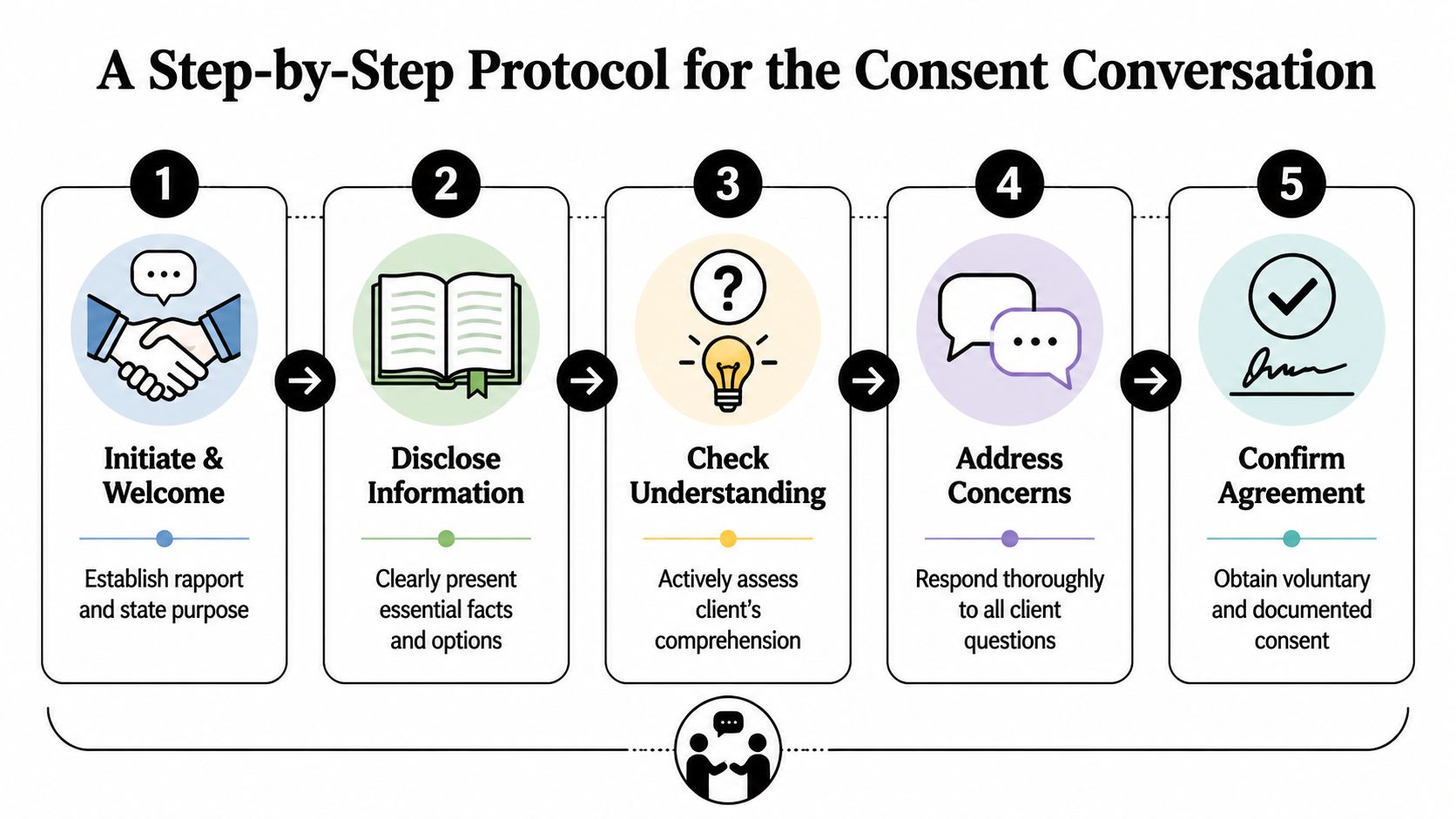
A Step-by-Step Protocol for the Consent Conversation
A good consent conversation is sequential, but it shouldn't sound robotic. The strongest informed consent procedures follow a clear order: disclose the essential information first, verify comprehension with open-ended questions or teach-back, and only then obtain the signature before any evaluation activity begins, as outlined in Boise State's guidance on the informed consent process.
Place the visual workflow early so everyone involved sees the logic of the sequence.
Start by defining the evaluation clearly
The first task is orientation. Clients need to know what this meeting is, who requested it, and what role the evaluator plays.
I'm meeting with you to conduct a psychological evaluation for your immigration case. This is different from weekly therapy. My role is to assess your history, symptoms, and functioning, and then prepare a report that may be used by your attorney in your case.
That statement does several things at once. It names the purpose. It corrects the common misunderstanding that the session is treatment. It reduces later confusion about why the interviewer is gathering detailed history.
After that, explain what the process will involve.
I'll ask questions about your background, health, stress, trauma experiences, and how these events have affected you. Some questions may be difficult. You can tell me if you need a break, if you don't understand a question, or if you need me to slow down.
This wording promotes choice without promising that the evaluation can proceed no matter what information is withheld. If the person declines major areas of inquiry, the evaluator may not have enough basis for an opinion. That should be stated plainly when relevant.
Disclose the practical details that clients actually need
Clients usually care about a short list of concrete issues. If those issues are skipped, the consent wasn't informative even if the form was signed.
Explain confidentiality in plain language, especially the exceptions and the report's audience.
What you tell me is treated as confidential within the evaluation process, but this is not the same as private therapy. I may prepare a written report for your attorney, and that report may be filed with immigration authorities or reviewed in court. There are also situations where I may have to act to protect safety or comply with the law.
Then explain duration and logistics.
The evaluation may take more than one meeting. If we need additional sessions, I'll tell you why. If you're tired, overwhelmed, or need a pause, say so. I'd rather slow down than have you agree to something you don't understand.
At this point, some practitioners find it useful to give clients a short explanatory video or orientation resource before moving into questions. If you use multimedia, it should support the conversation, not replace it.
Verify understanding before any signature
Many otherwise careful clinicians fall short when they ask, “Do you understand?” and receive an automatic yes. That answer proves almost nothing.
Use teach-back instead.
Before we sign anything, can you tell me in your own words what this evaluation is for, who may read the report, and what you can do if a question feels too hard or confusing?
If the client can't answer, revise the explanation. Don't repeat the same language louder or faster. Simplify it. Break it into shorter units. Ask one concept at a time.
Useful follow-up questions include:
- Purpose check: What do you understand my role to be today?
- Use-of-report check: Who do you think may receive or review the report?
- Voluntariness check: If you decide you don't want to continue, what options do you have?
- Risk check: What do you expect might feel difficult about this interview?
Only after this exchange should the form be signed and dated. If an interpreter is involved, the same teach-back must come from the client, not merely from the interpreter.
Informed Consent Disclosure Checklist
| Element | Purpose & Sample Question |
|---|---|
| Nature of the evaluation | Clarifies that this is a forensic immigration evaluation, not ordinary treatment. Sample question: “Can you tell me what you understand this appointment is for?” |
| Role of the evaluator | Prevents role confusion and unrealistic expectations. Sample question: “What do you understand my job is in your case?” |
| Topics to be discussed | Prepares the client for trauma, symptom, and history questions. Sample question: “Do you have any concerns about the kinds of questions I may ask?” |
| Duration and structure | Reduces uncertainty and supports pacing. Sample question: “Do you understand whether this may take more than one meeting?” |
| Confidentiality and its limits | Corrects the common assumption that nothing leaves the room. Sample question: “Who do you believe may see the report?” |
| Voluntary participation | Confirms that agreement is not coerced. Sample question: “What can you do if you want to pause or stop?” |
| Questions and clarifications | Invites active participation rather than passive compliance. Sample question: “What would you like me to explain again before we proceed?” |
A consent conversation should sound calm, direct, and repetitive in the right way. Not repetitive as bureaucracy. Repetitive as clarification.
Adapting Consent for Language Access Telehealth and Minors
Standard informed consent procedures break down fastest when the setting adds complexity. In immigration practice, three situations repeatedly require modification: language discordance, remote evaluations, and work with minors. If the process isn't adapted, the form may still look complete while the client's understanding remains thin.

Language access requires more than translation
The existence of consent in writing does not guarantee its readability. Expert guidance recommends keeping consent forms brief and at about an eighth-grade reading level, often paired with translation into local languages and teach-back to improve understanding, as described in the peer-reviewed discussion of informed consent comprehension.
In practice, language access has three parts:
- Written access: Provide forms in the client's strongest reading language when possible.
- Oral access: Use a qualified interpreter when spoken communication would otherwise be partial or error-prone.
- Conceptual access: Check whether the client understands legal and clinical terms that may not map neatly across cultures.
For immigration evaluations, conceptual access is often the missing piece. A client may understand the words “evaluation” and “confidentiality” in literal translation but still assume the evaluator works for the government, the police, or the court. That misunderstanding can derail the entire interview.
A cross-cultural lens helps here. Clinicians who routinely work across languages and systems benefit from practical guidance on cross-cultural assessment, especially when symptoms, authority relationships, and help-seeking norms differ from U.S. expectations.
Ask the client to explain the process back in their own language through the interpreter. If the explanation comes back vague, the issue is not solved by asking the interpreter, “Did you translate that?”
Telehealth consent needs operational detail
Remote evaluations add specific risks that don't exist in an office. Privacy may be compromised on the client's end. Another person may be present off camera. The connection may fail during emotionally intense material. The evaluator may also need to confirm identity and location at the start.
A telehealth consent discussion should address:
- Privacy in the room: Ask who is present, whether anyone can overhear, and whether the client wants to relocate or use headphones.
- Technology failure: Agree on what happens if the platform disconnects.
- Identity and location: Confirm who the client is and where they are during the session in case safety concerns arise.
- Limits of the medium: Explain that some communication is harder to read remotely, and the evaluator may pause more often to check understanding.
What doesn't work is treating telehealth as if it were a simple office substitute. The medium changes how consent should be verified because the evaluator cannot assume privacy, attention, or emotional containment.
Minors need consent and assent
When the client is a minor, informed consent procedures become a dual-track process. A parent or legal guardian may provide permission, but the child still deserves an explanation matched to their age, language, and developmental level.
Children often agree reflexively because adults have told them to cooperate. That is not the same as assent.
Use simpler language with minors. Avoid legal abstractions. Tell them what kind of questions may be asked, that some topics may feel upsetting, and that they can say when they don't understand. Also explain confidentiality. A child should not be told that everything is secret if the adult decision-maker and the legal case structure mean some information will be shared.
A practical approach is to separate the conversations briefly:
- With the parent or guardian: Cover permission, purpose, report use, and limits of confidentiality.
- With the minor: Explain the interview in age-appropriate terms and ask them to describe what they think is happening today.
- With both present if appropriate: Clarify what information may be included in a report and how questions or breaks can be requested.
This adaptation protects the validity of the evaluation. It also shows respect. In immigration matters involving family violence, trafficking, or persecution, minors notice very quickly whether adults are making decisions around them or speaking with them.
Assessing Capacity and Verifying True Understanding
A signed form doesn't prove comprehension. That gap is well recognized. HHS guidance emphasizes that the consent process should be revised when new information emerges, and AMA guidance requires physicians to assess a patient's ability to understand the information. The same guidance highlights that routine workflows often do not reliably measure comprehension beyond a signature, as summarized in the HHS FAQ on informed consent.
In immigration evaluations, that gap matters more than many practitioners admit. Clients may be exhausted, dissociative, highly anxious, culturally unfamiliar with the role of a psychologist, or eager to please anyone they view as connected to their legal case. None of that automatically means they lack capacity. It does mean the evaluator should assess understanding actively rather than assume it.
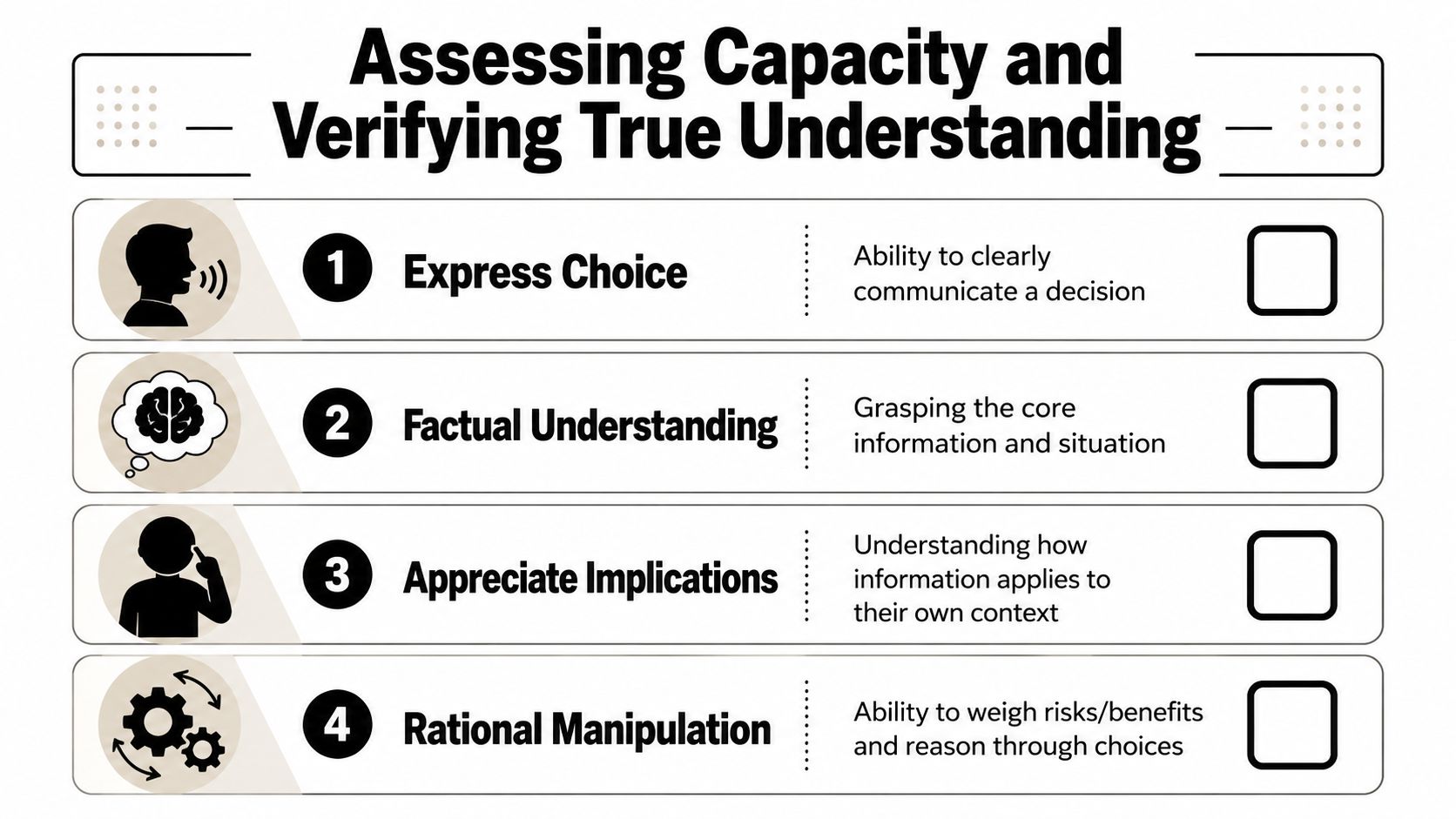
What understanding looks like in practice
A workable clinical screen looks for four abilities. Can the person express a choice? Can they grasp the basic facts of the evaluation? Can they appreciate how those facts apply to their own situation? Can they reason about the decision in a simple, coherent way?
These are practical judgments, not a demand for polished language. A traumatized client may speak haltingly and still understand perfectly well. Another client may smile, nod, and say yes to everything while showing almost no grasp of the process.
Warning signs that call for slowing down include:
- Parroting: Repeating the evaluator's words without showing personal understanding.
- Role confusion: Believing the evaluator is the attorney, therapist, judge, or government official.
- Concrete misunderstanding: Thinking consent is mandatory for the immigration case to continue.
- Severe emotional flooding: Becoming so distressed that the person can no longer track basic explanations.
Questions that reveal comprehension
Open-ended questions work better than leading ones. They show whether the client can put the information together, not merely recognize familiar phrases.
Tell me what this appointment is for, in your own words.
If you decide you want to stop today, what do you think would happen next?
Who do you think might read the report, and what makes you think that?
What concerns do you have about talking with me today?
A useful pattern is to ask for explanation, then ask for application. First ask what the person understood. Then ask how that understanding affects their choice to proceed.
If a client answers partially, don't jump straight to incapacity. Clarify, simplify, and ask again. Trauma, language mismatch, and stress often interfere with first-pass comprehension. The question is whether understanding improves with reasonable support.
How to document the assessment
Documentation should show more than “client appeared to understand.” That phrase is weak because it doesn't tell anyone what the evaluator checked.
Record the client's own words when possible. Note whether teach-back was used, whether an interpreter participated, what misconceptions were corrected, and whether the client could explain the purpose, confidentiality limits, and voluntary nature of participation. If understanding was initially limited but improved after clarification, document that sequence.
Capacity assessment in this context is not about gatekeeping for its own sake. It is about showing that agreement was meaningful, not merely compliant.
Bulletproof Documentation and Recordkeeping Practices
A defensible record has two parts. The signed form documents that consent was obtained. The note documents how it was obtained. Many files contain the first and neglect the second.
That's a mistake. Major health-system guidance describes informed consent as a process involving disclosure, competency, voluntariness, and documentation of the procedure, risks, benefits, alternatives, and understanding. It also notes that consent elements should be documented in the medical record, as reflected in Cleveland Clinic's overview of informed consent.
The form is not the full record
The form should capture the essential terms, but the progress note should capture the interaction. If the case is ever scrutinized, the note is what shows the evaluator did more than collect a signature.
The strongest note usually includes:
- Setting and participants: Whether the meeting was in person or by telehealth, and who was present.
- Language access details: Whether an interpreter was used and in what language.
- Core disclosures made: Purpose of the evaluation, report use, confidentiality limits, risks, and client rights.
- Comprehension check: The questions used to verify understanding and the client's responses.
- Voluntariness and decision: Whether the client agreed freely and when the form was signed.
For a broader discussion of defensible clinical records, many attorneys and clinicians find it useful to review practical guidance on what medical documentation is, especially where legal review and healthcare standards intersect.
A progress note should capture the process
A short template keeps this manageable.
Informed consent reviewed verbally before any evaluation activity. Explained nature and purpose of immigration-related psychological evaluation, distinction from psychotherapy, expected topics, potential emotional discomfort, approximate structure of interview, limits of confidentiality, likely recipients and uses of written report, and client's right to ask questions, pause, or decline participation.
Client was given opportunity to ask questions and did so regarding confidentiality and report use. Responses were provided in plain language. Teach-back used to assess comprehension. Client accurately described the purpose of the evaluation, identified that the report may be shared with counsel and potentially filed in immigration proceedings, and stated they could request breaks or stop the interview.
[Interpreter name/ID, if applicable] assisted in [language]. Client's understanding was assessed through direct response, not interpreter summary alone. Client appeared able to make a voluntary decision and agreed to proceed. Consent form signed and dated before substantive interview began.
If the client withdraws consent, document that clearly. Note what stage the process had reached, whether any partial information was obtained, what explanation was provided about the consequences for the evaluation, and what steps were taken regarding storage or nonuse of materials. Keep the form and note securely, consistent with the privacy rules governing the practice.
From Legal Hurdle to Therapeutic Alliance
The most effective informed consent procedures do two jobs at once. They satisfy legal and ethical requirements, and they begin the relationship in a way that helps vulnerable clients feel oriented rather than exposed.
That shift matters in immigration practice. These evaluations often involve people who have been interrogated, silenced, threatened, disbelieved, or forced to sign things they did not understand. A hurried, opaque consent process can echo those experiences. A careful one can interrupt them.
For attorneys, the payoff is practical. A client who understands the evaluation is more likely to participate meaningfully. An evaluator who checks comprehension is less likely to build a report on misunderstanding. A file that documents the consent conversation, not just the signature page, is easier to defend if the process is ever challenged.
The larger point is worth keeping in view. Consent is not the obstacle standing between intake and the substantive work. In many immigration cases, it is the initial critical undertaking. It establishes whether the evaluation will proceed through pressure and confusion or through clarity, dignity, and informed choice. When that foundation is strong, the alliance is stronger, the history is usually more reliable, and the resulting evidence carries more weight.
If you need immigration-focused psychological evaluations grounded in careful consent, trauma-informed interviewing, and defensible documentation, Pro Psychological Analysis provides specialized assessments for asylum, T visa, U visa, VAWA, and hardship cases, with collaboration designed for attorneys who need clear, credible reports.