
You're likely handling a case right now where the client's story makes clinical sense but doesn't present neatly on paper. The timeline shifts. Important events emerge late. The client seems flat when discussing horrific experiences, then becomes overwhelmed by a minor procedural question. An adjudicator could read that as inconsistency, evasiveness, or lack of credibility.
A trauma clinician reads it differently.
That gap matters in immigration practice. Understanding complex trauma helps attorneys distinguish deception from fragmentation, reluctance from shame, and poor chronology from the way repeated interpersonal harm alters memory, self-concept, and relationships. In asylum, T visa, U visa, VAWA, and hardship matters, that distinction can shape declarations, corroboration strategy, expert selection, and the entire theory of the case.
Table of Contents
- What Is Complex Trauma and Why Does It Matter in Law
- How Chronic Trauma Reshapes the Brain and Behavior
- Identifying the Core Symptom Clusters of C-PTSD
- How Complex Trauma Manifests in Immigration Contexts
- Documenting Complex Trauma for Legal Audiences
- Eliciting Accurate Histories Without Causing Retraumatization
- Translating Clinical Findings into Persuasive Legal Arguments
What Is Complex Trauma and Why Does It Matter in Law
A client sits through a USCIS interview, answers calmly for twenty minutes, then shuts down when questions turn to family control, sexual coercion, or captivity. Dates become vague. The sequence shifts. Affect flattens. In court, that presentation is often misread as evasion or coaching. Clinically, it often signals a history of prolonged traumatic exposure that has altered how the person stores memory, manages fear, and relates to authority.
Complex trauma refers to repeated, usually interpersonal harm that occurs under conditions of dependency, entrapment, or limited escape. The pattern matters. So does the relationship to the perpetrator. This is why many survivors of trafficking, chronic domestic violence, childhood abuse, forced labor, organized persecution, or coercive family systems present differently from clients whose trauma followed a single discrete event.
For legal purposes, that distinction has real consequences. Complex trauma often affects credibility markers that adjudicators expect to see. A survivor may recall sensory details but struggle with chronology. Another may describe severe abuse in flat, practical language because emotional numbing became adaptive. A third may protect the perpetrator, minimize danger, or omit key facts until trust has been established. Those responses create evidentiary problems if counsel treats them as simple inconsistency instead of trauma-related impairment.
Why the legal system often misreads it
Immigration proceedings reward coherent narrative, stable memory, and predictable demeanor. Complex trauma can interfere with each one.
That mismatch matters in affidavits, forensic evaluations, credible fear interviews, and testimony. I have seen attorneys spend hours trying to force a linear timeline from a client whose history was encoded around threat, secrecy, and survival. The trade-off is familiar. Push too hard for detail too early, and the account may become more fragmented, not more reliable. Stay too general, and the record may omit facts needed to meet the legal standard.
Practical rule: If a client's account is disorganized in a patterned way, especially around control, dependency, and repeated harm, assess for complex trauma before treating the problem as poor preparation or deceit.
The difference between clinical relevance and legal relevance
Attorneys do not need to diagnose C-PTSD. They do need to recognize when chronic trauma may explain behavior that a judge or officer could otherwise view unfavorably.
In practice, the legal question is often functional. How has repeated trauma affected memory retrieval, help-seeking, attachment, trust, emotional regulation, and the ability to testify under stress? That framing is more useful than a label alone because it connects clinical findings to the parts of the record that matter. Delay in disclosure, fragmented recall, continued contact with an abuser, inconsistent affect, and apparent passivity can all become understandable and probative when they are tied to a coherent trauma formulation.
A narrow single-incident PTSD model often leaves those issues unexplained. Complex trauma gives counsel a sharper framework for showing why unusual presentation may still be fully consistent with prolonged coercion, abuse, and captivity.
How Chronic Trauma Reshapes the Brain and Behavior
A client sits through a preparation session, answers basic background questions, and appears composed. Then counsel asks for the sequence of abuse, detention, or coercive control. The client loses track of time, gives details out of order, agrees too quickly with leading prompts, or goes blank. In immigration practice, that shift is often treated as a credibility problem first. Clinically, it is often a stress-response problem.
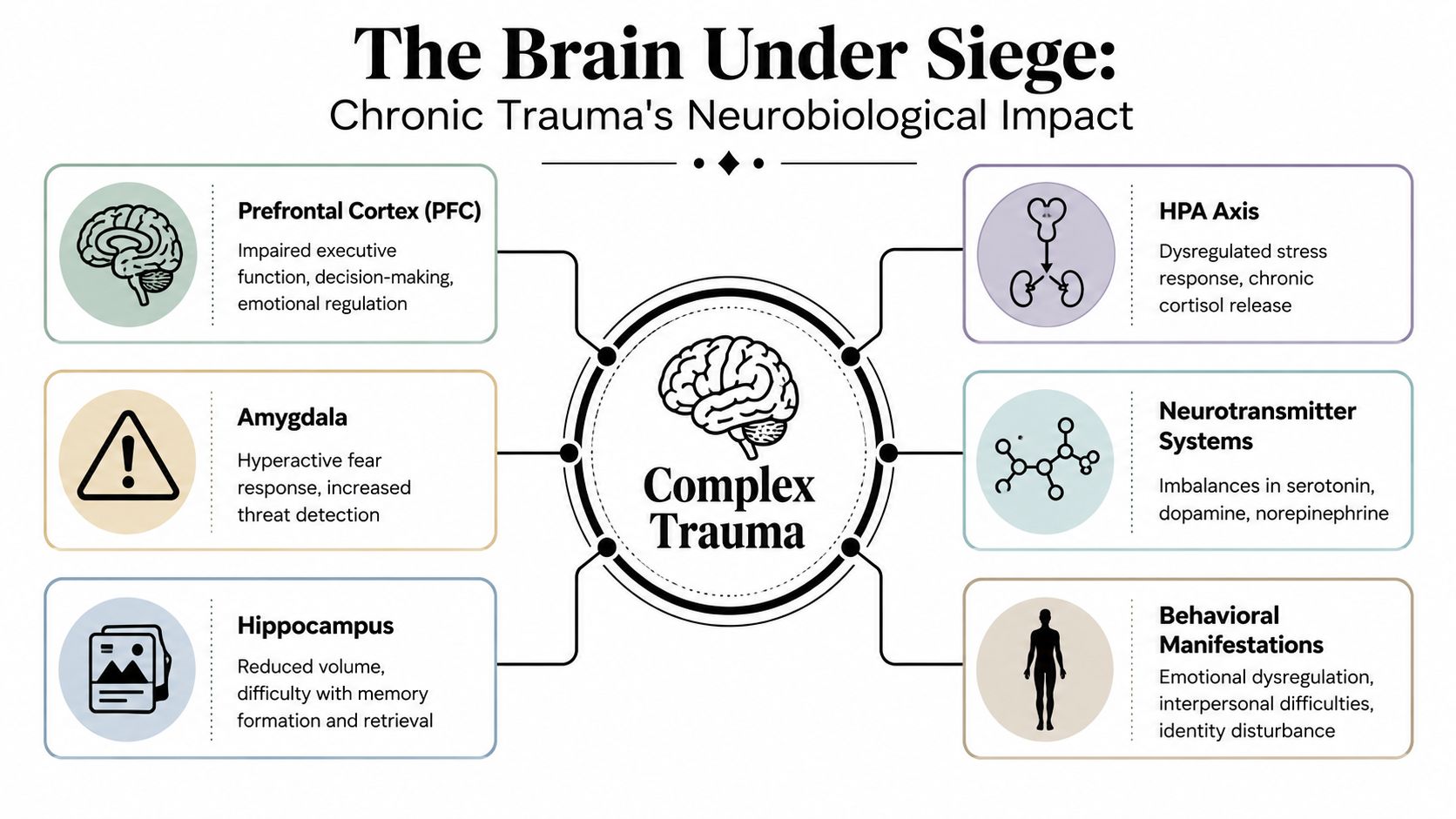
Chronic trauma changes how a person anticipates danger, encodes experience, and functions under pressure. Those changes are adaptive during prolonged abuse or captivity. In legal settings, the same adaptations can interfere with testimony, declarations, and attorney-client communication.
Threat detection stays on high alert
With repeated interpersonal trauma, the nervous system becomes highly efficient at spotting risk. That can present as scanning the room, tracking exits, mistrusting authority, reacting strongly to closed doors, or bracing when questions become specific. What looks like irritability or evasiveness may be a learned survival response.
For attorneys, this matters because interview conditions can trigger the very behavior later cited as suspicious. A client may become guarded with male interpreters, uniformed officers, time pressure, or an abrupt change in tone. The issue is often persistent hypervigilance after chronic trauma, not unwillingness to cooperate.
Memory becomes fragmented and state dependent
Repeated threat interferes with how experience is stored and retrieved. Survivors may recall sensory fragments, isolated episodes, or bodily reactions with striking clarity while struggling to place events in order. Dates, intervals, and transitions are often the first things to break down under stress.
This has direct legal consequences. Immigration adjudicators often expect a linear account. Complex trauma often produces a layered account instead, where chronology improves only after the person feels safer and the questioning is paced well.
A fragmented narrative can still be clinically coherent.
Counsel should also expect state-dependent recall. Details available in a calm office meeting may disappear in a formal interview. Other details may surface later after a sensory cue, a follow-up meeting, or more trust. That pattern does not automatically indicate fabrication. It often reflects how traumatic memory is retrieved.
Regulation and executive control drop under pressure
Chronic trauma also affects concentration, inhibition, planning, and emotional control. Under ordinary conditions, some clients compensate well. Under threat, those higher-order functions can deteriorate quickly.
In practice, that may look like freezing on simple timeline questions, giving inaccurate yes-or-no answers to stop the questioning, or becoming unusually compliant with suggestions that are incorrect. I often warn attorneys about false consistency. A client who agrees too smoothly after visible overwhelm may be trying to end the stress, not confirm accuracy.
That trade-off is common in case preparation. More pressure can produce more words while reducing reliability.
What attorneys actually observe
You rarely need to explain neurobiology in detail to USCIS or the court. You do need to translate it into observable behavior and functional impact.
| Brain-behavior issue | What it may look like in legal practice |
|---|---|
| Persistent threat monitoring | Guardedness, startle, mistrust, difficulty settling into the interview |
| Fragmented trauma memory | Nonlinear narrative, weak chronology, later recall of important facts |
| Reduced executive control under stress | Blanking out, confused sequencing, impulsive or overly agreeable answers |
| Chronic physiological arousal | Fatigue, headaches, concentration problems, irritability, somatic complaints |
That framing is usually more persuasive than abstract statements about trauma affecting the brain. It shows why a client may present poorly in a high-stakes interview while still giving an account that is clinically consistent with prolonged abuse.
What tends to work and what usually backfires
Law offices often respond to disorganization by increasing pressure. They schedule longer sessions, demand exact dates early, confront discrepancies before rapport is established, and repeat the same question in several forms. That approach can worsen confusion, shutdown, shame, and dissociation.
More productive methods are simpler and more disciplined:
- Reduce cognitive load: Separate chronology, symptom history, and legal elements into different parts of the interview.
- Use concrete anchors: Ask about school year, season, housing location, pregnancy, detention period, religious holidays, or who was living in the home.
- Track signs of overload: A glazed stare, sudden passivity, monotone speech, or abrupt agreement often signals overwhelm.
- Re-interview strategically: Later sessions frequently produce better sequencing once the client has predictability and trust.
- Document the pattern: If recall improves unevenly across meetings, record that process. It can help explain later why early omissions do not necessarily undermine credibility.
As noted earlier, repeated interpersonal trauma is associated with broader functional effects than a single-incident trauma model usually captures. For immigration cases, the practical point is straightforward. If counsel understands how chronic trauma reshapes behavior under stress, apparent inconsistencies become evidence to analyze, not defects to assume.
Identifying the Core Symptom Clusters of C-PTSD
For legal work, the cleanest way to identify complex trauma is to look beyond standard PTSD and assess whether the client shows disturbances in self-organization. In current diagnostic literature, ICD-11 complex PTSD is defined by PTSD symptoms plus persistent problems in affect regulation, negative self-concept, and relationships, while DSM-5 doesn't include a separate CPTSD diagnosis. The VA overview of complex PTSD and DSO features is a useful reference point because those added domains often explain why a client struggles in legal settings.
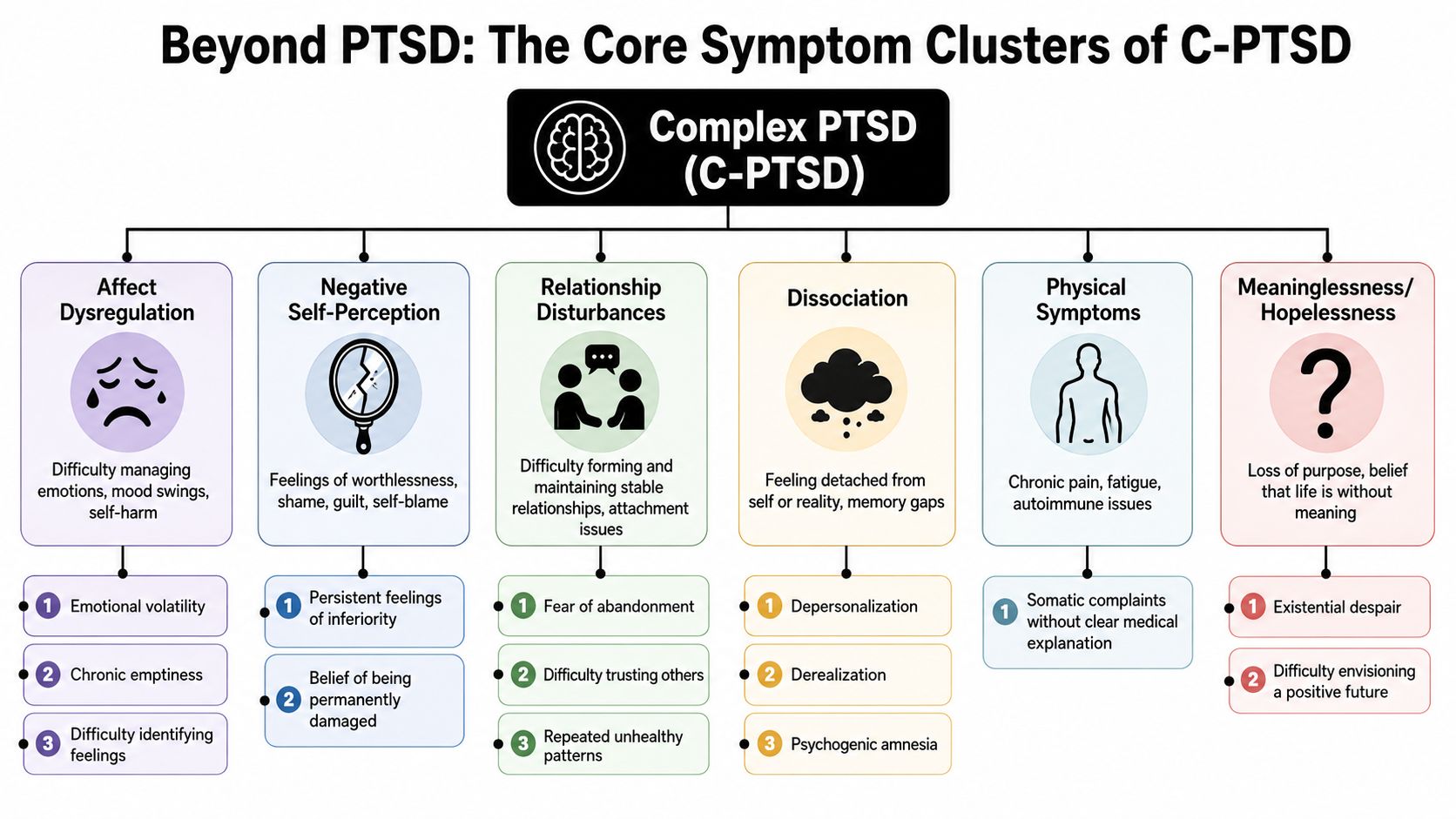
Affect regulation problems
This cluster is broader than “the client cries easily.” Some clients become flooded. Others go numb. Both can reflect dysregulation.
Signs attorneys often notice include:
- Sudden escalation: The client is composed, then abruptly panics when discussing a routine detail.
- Flatness or shutdown: There's little visible emotion when describing severe abuse.
- Rapid oscillation: The client moves from calm to anger to confusion within one meeting.
- Self-protective overcontrol: Speech becomes robotic, rehearsed, or emotionally detached.
If hyperarousal is part of the picture, it helps to understand related trauma responses such as hypervigilance in trauma survivors. That pattern can make a client scan the room, misread neutral questions as threats, or become exhausted by ordinary interview demands.
Negative self-concept
This is one of the most legally significant and most overlooked features. A client with a severely damaged self-concept often won't present as someone seeking justice. They may present as someone convinced they deserved what happened.
That can distort evidence gathering. The client may minimize rape, forced labor, coercive control, or child abuse because they regard those experiences as normal, deserved, or not important enough to mention. They may also apologize for “wasting your time” while describing facts that are central to relief.
Clinical marker: When shame organizes the narrative, the client often understates the strongest facts and overstates their own blame.
Relationship disturbance
Repeated interpersonal trauma teaches people that closeness is unsafe, dependence is dangerous, and authority is unpredictable. In a legal representation, that may show up as missed calls, guardedness, inconsistent engagement, or intense attachment followed by withdrawal.
A lawyer who expects quick trust can easily misread this pattern. The client may want help but still experience every request for detail as a risk. If the trauma involved family, police, gangs, traffickers, smugglers, or intimate partners, mistrust can become the default setting.
Presentations that don't look like classic PTSD
Not every survivor leads with flashbacks or obvious panic. Some present with dissociation, confusion, chronic shame, identity disruption, or severe relational difficulty. Those are often the clients whose records contain vague labels like anxiety, depression, adjustment disorder, or personality concerns without a formulation that accounts for chronic trauma.
A short comparison helps:
| If you only screen for | You may miss |
|---|---|
| Re-experiencing | Dissociation, numbing, memory gaps |
| Avoidance | Chronic submission, minimization, appeasement |
| Hyperarousal | Shame-based collapse, hopelessness, identity damage |
| Single event exposure | Repeated coercion across years and relationships |
The presence of DSO changes case formulation. It helps explain why the client's suffering isn't limited to fear symptoms. It often affects parenting, employment, concentration, help-seeking, and ability to participate consistently in the legal process.
How Complex Trauma Manifests in Immigration Contexts
Immigration practice sits at the intersection of chronic danger, dependency, and authority. That's exactly where complex trauma often becomes visible. Many clients have not only experienced violence. They have endured violence within relationships of control, over time, with few avenues of escape.
In that setting, attorneys often encounter symptoms before they recognize them as symptoms.
The credibility trap
A client gives a declaration that seems thin. Weeks later, major details appear. During prep, the chronology shifts again. Counsel worries about impeachment. The adjudicator may see embellishment.
Clinically, repeated trauma often produces a different explanation. The trauma literature notes that people may meet complex-trauma criteria without showing standard PTSD symptoms, and primary presentations may include dissociation, shame, and relational impairment. The AAETS overview of complex trauma reactions and treatment approaches is particularly relevant here because it highlights how a narrow PTSD lens can miss survivors whose coping style is emotional numbing or memory fragmentation.
How this shows up by case type
Different forms of immigration relief bring different trauma patterns to the surface.
- Asylum cases: The client may have survived repeated persecution, detention, family-targeted violence, or coercion by state and non-state actors. Testimony may be fragmented because fear was chronic, not episodic.
- T visa matters: Trafficking survivors often normalize exploitation, especially where coercion was mixed with dependency, debt, threats, or intermittent care.
- VAWA cases: Survivors of intimate partner abuse may still defend the abuser, return to the relationship, or struggle to name coercive control as abuse.
- U visa cases: Crime survivors may avoid police-related topics, omit sexual details, or appear emotionally detached when describing severe victimization.
Behaviors that are often misread
Attorneys can protect the record by recognizing common trauma-linked behaviors before they become credibility problems.
| Attorney observation | Common legal interpretation | More clinically informed reading |
|---|---|---|
| Inconsistent sequence | Fabrication | Fragmented traumatic memory |
| Flat affect | Exaggeration or lack of impact | Numbing or dissociation |
| Delayed disclosure | Strategic omission | Shame, fear, or relational mistrust |
| Dependence on others for answers | Coaching | Learned helplessness or cognitive overload |
The key legal move is not to excuse every inconsistency. It is to distinguish the inconsistency that undermines credibility from the inconsistency that trauma predicts.
Why symptom presentation matters more than labels
Some clients will never use the language of trauma. They may complain about headaches, insomnia, “forgetting,” not trusting anyone, or feeling permanently damaged. Others may focus only on practical concerns like housing, children, work authorization, or fear of return.
That doesn't make the trauma less central. It means the attorney has to listen for function, not just diagnosis. The legal question is usually whether trauma helps explain behavior, impairment, fear, dependency, delayed reporting, or difficulty testifying. A precise clinical formulation can do that even when the client doesn't resemble a textbook PTSD case.
Documenting Complex Trauma for Legal Audiences
A standard therapy note rarely answers the questions an immigration judge or USCIS officer has. A forensic evaluation should. That difference is where many otherwise strong cases lose force.
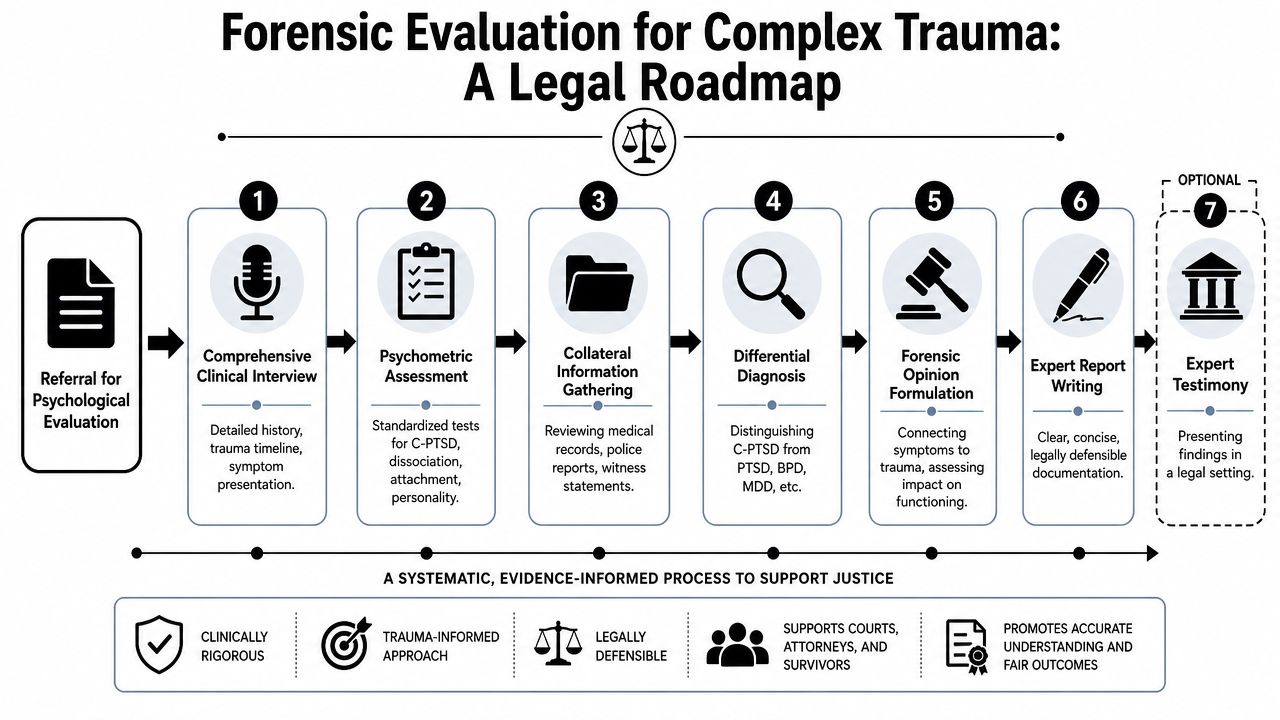
For legal audiences, documentation has to do more than diagnose. It has to explain how the clinician reached the opinion, how the trauma pattern fits the symptom picture, what alternative explanations were considered, and why the findings matter to the legal issues in dispute.
Pattern beats isolated incident
The APA guidance treats complex trauma as a continuum of exposure marked by repeated, interpersonal trauma that often occurs early across developmental stages. The APA guidelines for adults with complex trauma histories are especially important for lawyers because they support documenting the pattern of adversity, not just a single index event.
That means a strong report usually maps exposure across time. It doesn't stop at the most dramatic incident. It identifies chronic threats, captivity dynamics, dependency, grooming, coercive control, family violence, childhood abuse, and repeated betrayals by caregivers or authority figures where relevant.
What a defensible report should contain
When I review evaluations for legal use, the strongest reports usually show a multi-method process rather than a single interview and a conclusory diagnosis.
Look for these elements:
- Clear referral question: The evaluator identifies the legal context and the forensic purpose of the assessment.
- Detailed trauma history: The report documents repeated exposures, timing, relational context, and barriers to escape or disclosure.
- Symptom-function link: Findings connect symptoms to daily impairment, memory, concentration, parenting, work, or testimony.
- Collateral review: Medical records, declarations, police reports, affidavits, country materials, or prior treatment notes are considered where available.
- Differential diagnosis: The evaluator addresses whether other conditions could explain the presentation.
- Forensic reasoning: The report explains why fragmented recall, affective presentation, or delayed disclosure are or are not consistent with trauma.
If you're assessing whether records are adequate, it helps to compare them against what lawyers usually need from medical documentation in legal cases. Immigration filings often fail not because documentation is absent, but because it is clinically thin or legally misaligned.
What weakens a report
Some reports are sympathetic but not persuasive. Common weaknesses include unsupported diagnostic labels, no discussion of alternative explanations, vague references to “trauma,” and no analysis of functional impact. Another frequent problem is overreliance on a single event when the presentation is clearly cumulative.
A persuasive evaluation doesn't ask the adjudicator to trust the clinician's intuition. It shows the clinician's reasoning.
What attorneys should ask before retaining an expert
Use practical screening questions:
- Does the evaluator understand immigration-specific credibility issues?
- Will the report address trauma pattern, not just one event?
- Can the evaluator explain discrepancies without becoming an advocate?
- Is the methodology transparent enough to survive skeptical review?
- Will the final opinion connect symptoms to legally relevant functioning?
A good forensic report doesn't replace legal argument. It strengthens it by giving the court a clinically coherent explanation for behavior that might otherwise look suspicious or irrelevant.
Eliciting Accurate Histories Without Causing Retraumatization
Most immigration attorneys don't need to perform therapy. They do need to conduct interviews in ways that increase accuracy rather than suppress it. With complex trauma, those are often the same thing.
The practical reason is simple. A dysregulated client remembers less, not more. If the interview format triggers shame, panic, or dissociation, the factual record usually gets worse.
A large share of youth are exposed to trauma. The U.S. Department of Veterans Affairs reports that 15% to 43% of girls and 14% to 43% of boys experience at least one trauma, with 3% to 15% of girls and 1% to 6% of boys developing PTSD after trauma exposure, as summarized by PTSD UK's compilation of trauma and PTSD statistics. For immigration attorneys, the lesson is practical. Trauma-related interviewing issues are common, not exceptional.
Techniques that improve both safety and disclosure
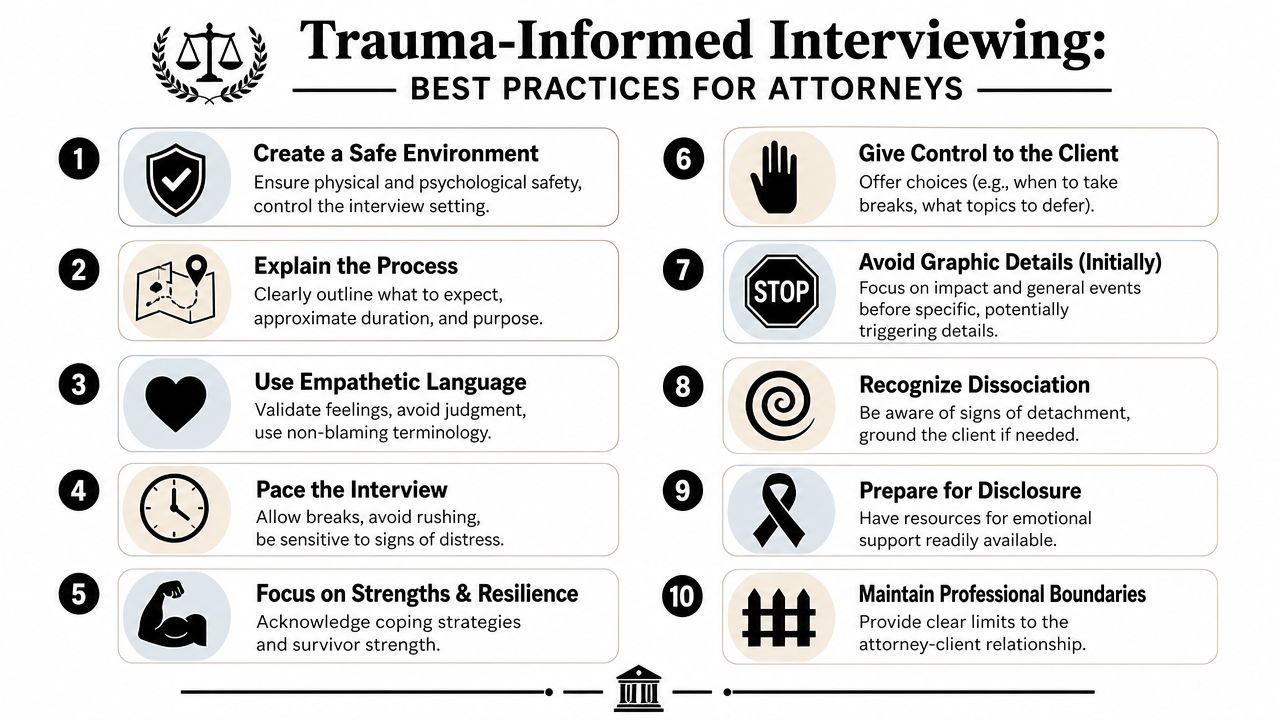
Trauma-informed interviewing is not soft. It is disciplined. It reduces noise in the evidence.
- Set control early: Tell the client how long the meeting will last, what topics you need to cover, and that breaks are allowed.
- Start with structure, not the worst event: Build orientation first. Who was in the household, where did they live, who controlled money, documents, transport, or communication.
- Ask open questions before narrow ones: “What made it hard to leave?” often produces more useful facts than “Did he threaten you?”
- Separate impact from detail: You can establish fear, coercion, dependency, and impairment before asking for graphic specifics.
- Name common trauma reactions: Brief psychoeducation can reduce shame. Many clients speak more freely once they hear that fragmented memory and delayed disclosure are common trauma responses.
- Track signs of dissociation: If the client becomes distant, monotone, confused, or unreal, stop and reorient before continuing.
For a fuller legal practice framework, many firms benefit from using principles from trauma-informed care assessment in client services.
A pacing model attorneys can use
The sequence matters. This model works better than jumping directly into violence details:
- Present safety and logistics
- Household and relationship structure
- Control, threats, dependency, and barriers to escape
- General chronology
- Symptom and functional impact
- Specific incidents needed for legal elements
That order often produces a more coherent record because the client has context before detail.
Here is a concise training resource worth reviewing with staff:
What to avoid
Some habits increase distortion:
- Rapid-fire challenge questions: These can push a survivor into compliance or shutdown.
- Demanding exact dates too soon: It's often better to establish sequence first and refine dates later.
- Mistaking calm for stability: A flat client may be highly distressed.
- Pursuing graphic detail without purpose: If the fact doesn't serve a legal element or clinical referral need, don't force it.
“Tell me what you remember first, and we can organize it together” is often more productive than “Start from the beginning and don't leave anything out.”
Translating Clinical Findings into Persuasive Legal Arguments
The strongest use of a complex trauma evaluation is not diagnostic decoration. It is translation. The report should convert a confusing human presentation into a legally intelligible account of exposure, symptoms, function, and credibility-relevant behavior.
That translation usually has four parts.
Link the trauma pattern to the symptom pattern
If the history shows chronic interpersonal abuse, captivity, repeated threats, or developmental exposure, the legal argument should connect that pattern to the client's observed problems. Not in abstract language. In the facts of the case.
For example, if the client delayed disclosure, the argument should explain why shame, fear, dependency, or dissociation made delay clinically understandable. If the timeline shifted, the argument should connect that problem to fragmented memory rather than letting the inconsistency stand alone.
Tie symptoms to legally relevant functioning
Courts and adjudicators need more than distress. They need relevance.
That relevance may include impaired ability to report abuse, difficulty trusting authorities, inability to leave an abuser, problems recalling chronology, persistent fear on return, or reduced functioning in parenting, work, or daily life. A good legal argument uses the clinical findings to explain conduct that might otherwise be misread.
Preempt the wrong inference
Many briefs become stronger through this method. Instead of waiting for the government or the court to attack inconsistencies, address predictable misreadings directly.
A concise framework works well:
| Clinical finding | Likely misreading | Better legal framing |
|---|---|---|
| Memory fragmentation | Dishonesty | Trauma-consistent recall difficulty |
| Emotional numbing | Lack of suffering | Protective detachment |
| Ongoing contact with abuser | No real fear | Trauma bond, coercion, dependency |
| Delayed disclosure | Fabrication | Shame, mistrust, survival adaptation |
Use the expert report as an educational tool
The best reports educate without overreaching. They don't tell the court what result to reach. They explain why the client's presentation makes sense in light of chronic trauma.
That is often the difference between a report that gets cited and a report that gets ignored. Legal decision-makers are more likely to rely on expert evidence when it is methodical, neutral in tone, and closely tied to the record.
Understanding complex trauma helps counsel build that bridge. It sharpens intake, improves declarations, guides corroboration, informs witness prep, and gives the court a framework for interpreting behavior that might otherwise look suspicious. In high-stakes immigration matters, that isn't ancillary. It can be case-defining.
If you need a forensically grounded psychological evaluation that translates complex trauma into clear, persuasive evidence for asylum, T visa, U visa, VAWA, or hardship cases, Pro Psychological Analysis works with immigration attorneys to produce detailed, evidence-based reports specific to the legal issues in dispute.