
You're likely dealing with a client who wants citizenship, has every reason to move forward, and still cannot pass the English or civics testing despite repeated effort. The problem isn't motivation. It isn't laziness. It may not even be education level. The core issue is whether a medically determinable condition prevents the client from learning, retaining, or demonstrating the required material.
That distinction is where many N-648 filings succeed or fail. Attorneys often receive a diagnosis, a short doctor's note, or a sympathetic explanation from family members and assume that should be enough. It usually isn't. USCIS is looking for a medically supported explanation that ties the condition to the applicant's functional inability to meet the testing requirements. If that causal link is weak, the form becomes vulnerable.
For practitioners, the uscis n 648 form is best approached as an evidence problem, not a paperwork problem. The strongest filings translate medical facts into legal relevance.
Table of Contents
- What Is the USCIS N-648 Form
- Defining Eligibility for the N-648 Waiver
- The Clinician's Role and Certification Standards
- Building a Sufficient N-648 Evidence Packet
- The Power of Specialized Psychological Evaluations
- Common Reasons for N-648 Denials and How to Avoid Them
- Integrating the N-648 into Your Legal Strategy
What Is the USCIS N-648 Form
An attorney files an N-400 for a client who has failed the civics test before, has a long history of cognitive decline, and cannot retain even basic orientation information from week to week. The case does not turn on sympathy. It turns on whether the record proves a medically determinable condition is the reason the client cannot learn or demonstrate the English and civics material. Form N-648 is the document USCIS uses to evaluate that question.
The uscis n 648 form is the medical certification for a naturalization applicant seeking an exception to the English and/or civics requirements based on a physical or developmental disability or a mental impairment. Its function is narrow and highly specific. The form is meant to document that the applicant's condition causes functional limits that prevent compliance with the testing requirement.
That distinction matters in practice. USCIS is not deciding whether the applicant faces hardship, has limited schooling, is advanced in age, or feels anxious about the exam. USCIS is deciding whether a qualifying condition creates an actual inability to learn, retain, or communicate the information required for naturalization.
Filing timing also affects case posture. USCIS has stated that applicants seeking the exception should generally submit Form N-648 with Form N-400, although it may be accepted later as additional evidence, as noted in CLINIC's update on the revised Form N-648 and related policy guidance. In stronger cases, concurrent filing usually helps the officer understand from the outset that the naturalization case includes a disability-based waiver issue, not a routine test preparation problem.
Why the current version matters
The current form is shorter than prior editions, and that has changed how weak cases fail. Attorneys and clinicians now have less space to explain the condition, the clinical basis for the diagnosis, and the functional effect on test-related abilities. Brevity can help a well-prepared case. It hurts a vague one.
I see the same mistake repeatedly in deficient submissions. The clinician lists a diagnosis, adds a short conclusion that the client cannot take the test, and leaves the causal reasoning unstated. USCIS often reads that as an unsupported opinion rather than a documented medical finding.
What the form is really asking
The N-648 primarily asks for one thing. Show the nexus between the diagnosed condition and the applicant's inability to meet the English and/or civics requirement.
That nexus is where many applications become vulnerable. A diagnosis of dementia, intellectual disability, traumatic brain injury, major neurocognitive disorder, schizophrenia, PTSD, or severe depression may support the waiver, but the diagnosis alone does not answer the legal question. The record must explain how the condition affects memory, attention, language, executive functioning, comprehension, processing speed, or other abilities required to learn or demonstrate the material.
A strong N-648 does more than identify illness. It gives USCIS an objective, medically grounded explanation for why this applicant cannot do what the naturalization process normally requires. That is the difference between a form that merely asserts disability and one that demonstrates the waiver claim.
Defining Eligibility for the N-648 Waiver
A common file looks workable at intake. An older client has failed the naturalization test more than once, speaks very little English, and carries a long history of depression, trauma, or cognitive decline. The case still fails if the record cannot show one specific point: the medical condition causes the inability to learn or demonstrate English and civics.

USCIS is evaluating legal eligibility for a disability-based exception, not general difficulty with the test. The applicant must have a medically determinable physical or developmental disability, or mental impairment, that prevents compliance with the English requirement, the civics requirement, or both. The practical question for counsel is narrower than many clients expect. Can the evidence tie the diagnosed condition to a concrete failure in learning, memory, comprehension, language, attention, or communication?
What the waiver actually covers
The waiver covers disability-related inability to learn or show the required knowledge. It does not excuse the test because the applicant is older, poorly educated, fearful of testing, or has always struggled academically.
Those facts may still matter. They often help explain history and baseline functioning. They do not establish N-648 eligibility unless a qualifying condition is also causing the test-related limitation.
Attorneys should screen out these weak theories early:
- Advanced age by itself does not qualify.
- Illiteracy by itself does not qualify.
- Limited schooling by itself does not qualify.
- Ordinary test anxiety without documented impairment usually does not qualify.
That distinction protects the case. It keeps the filing centered on impairment rather than sympathy.
The real issue is the nexus
In practice, the hardest part is rarely naming the diagnosis. It is proving the nexus between the condition and the applicant's inability to meet the naturalization requirements.
A diagnosis answers, "What condition does this person have?" USCIS also needs an answer to a second question. "What does that condition stop this person from doing that matters for this test?"
For example, major depressive disorder may support a waiver in one case and fail in another. The difference is functional proof. If the record shows severe slowed processing, impaired concentration, poor retention, reduced initiation, and inability to sustain mental effort long enough to learn basic material, the diagnosis begins to matter legally. If the form only lists depression and states that the client cannot pass, the opinion is exposed.
This is why I often tell attorneys to test the file the way an adjudicator will. Identify the impaired function first. Then connect that function to a test demand. Memory affects retention of civics facts. Receptive and expressive language affect learning and answering questions in English. Executive dysfunction affects studying, organizing, and retrieving information under questioning. Without that chain of reasoning, the application is easy to challenge.
Diagnosis is not enough
The same rule applies across conditions. Dementia, intellectual disability, traumatic brain injury, schizophrenia, PTSD, autism spectrum disorder, and severe mood disorders can all support an N-648. None of them wins the waiver automatically.
The record needs to show severity, duration, and functional consequence. It should explain why the applicant cannot learn the material, cannot retain it over time, cannot communicate it reliably, or cannot do all three. In cases involving mental health and cognitive symptoms, a clinician with training in functional assessment can make that analysis much more persuasive. Attorneys who want a better sense of how that expertise is applied can review this overview of clinical psychology practice in San Diego.
Two screening questions usually expose whether the case is ready to file:
- Which specific functions are impaired?
- How do those impairments prevent this applicant from learning or demonstrating English or civics?
If counsel cannot answer both questions with facts, not conclusions, the case needs more development before submission.
The Clinician's Role and Certification Standards
An attorney receives a polished N-648 with a clear diagnosis, a sympathetic history, and a licensed provider's signature. It still gets challenged because the form does not do the one job USCIS cares about most. It does not connect the condition to the applicant's inability to learn or demonstrate English or civics.
That is the clinician's role. The certifier must provide a medically grounded opinion that satisfies the waiver standard, not a general statement that the applicant has been ill or has struggled for years.
Who may certify the form
USCIS limits certification to three types of professionals: medical doctors (M.D.), doctors of osteopathy (D.O.), and clinical psychologists, as stated in the USCIS Form N-648 instructions for medical certification. Therapists, counselors, and social workers may add useful background, but they are not authorized to certify the form.
Licensure alone does not make a provider a good N-648 witness.
The better question is whether the clinician can assess function and explain causation in plain terms. A provider may be fully qualified on paper and still produce a weak form if the narrative stays broad, relies on diagnosis labels, or fails to describe how the impairment shows up during learning, memory, language, attention, or test response. In cases involving psychiatric symptoms, cognitive decline, developmental limitations, or trauma-related impairment, attorneys usually get a better product from a clinician who regularly performs functional and forensic-style assessments. For a practical sense of how that work differs from routine treatment, this overview of clinical psychology practice in San Diego is a useful reference point.
What USCIS needs from the clinician
USCIS expects more than a diagnosis and more than a statement of hardship. The form has to show the nexus. The clinician should identify the relevant symptoms or deficits, describe how those findings were reached, and explain why those deficits prevent the applicant from meeting the naturalization testing requirement.
That explanation should answer a few practical questions:
- What impairment is present?
- What clinical interview findings, records, exam findings, or testing support that opinion?
- Which mental or cognitive functions are affected?
- How do those functional limits interfere with learning, retaining, understanding, or expressing the required material?
Weak certifications usually fail at the same point. They jump from condition to conclusion. A sentence like “the patient cannot learn English due to anxiety” is rarely enough because it skips severity, functional effect, and the mechanism of impairment.
A stronger certification is specific. It may explain that severe PTSD produces marked concentration problems, panic under questioning, and impaired short-term retention, which in turn prevents the applicant from studying, consolidating new information, and answering reliably in an interview setting. That is the level of reasoning attorneys should look for before filing.
Review the draft N-648 as if an officer will ask, “Why this applicant, and why these tasks?” If the language could apply to almost anyone with the same diagnosis, the form is too generic. If it ties this person's documented impairments to the English or civics requirement with concrete clinical support, the certification is much harder to dismiss.
Building a Sufficient N-648 Evidence Packet
An attorney has a treating doctor, a sympathetic client, and years of medical history. The case still gets into trouble because the packet proves illness, but not the specific reason the applicant cannot learn or demonstrate English or civics. That gap is the problem.
A sufficient N-648 packet is built around one question. Can USCIS follow the line from diagnosis, to functional impairment, to the testing task the applicant cannot perform? If the answer is unclear, the file is exposed even when the applicant is genuinely impaired.
What to include before filing
Before filing, review the packet as a single piece of evidence rather than a stack of documents. The strongest submissions are consistent across the N-648, the medical records, the client declaration, and the legal theory in the case.
Confirm that the packet does the following:
- Addresses the actual waiver standard: The evidence should focus on the applicant's inability to meet the English and/or civics requirement, not broad hardship or poor school history.
- Uses the correct form and a valid certification: Check the edition date, signatures, dates, licensure, and whether the certifying clinician falls within the permitted category.
- Shows the nexus clearly: The clinician should explain how the condition causes the learning, memory, comprehension, communication, or test-taking limitation at issue.
- Remains internally consistent: Records should not conflict on diagnosis, severity, onset, language ability, educational history, or day-to-day functioning.
- Identifies the basis for the opinion: Clinical interview, record review, mental status findings, bedside cognitive screening, or formal psychological testing should be identified where appropriate.
USCIS can treat a form as insufficient when key portions are incomplete, vague, or unsupported. In practice, the avoidable failures are usually simple. Missing dates, generic diagnoses, unexplained conclusions, and records that point in different directions.
If you want a useful comparison for how medical evidence can strengthen or weaken an immigration filing, this collection of a sample medical hardship letter shows why functional detail matters more than sympathetic wording.
N-648 Evidence Standards Weak vs. Strong
| Evidence Aspect | Weak/Insufficient Example | Strong/Sufficient Example |
|---|---|---|
| Diagnosis statement | “Patient has depression.” | “Patient has a depressive disorder with clinically significant concentration and memory problems that interfere with learning new information.” |
| Functional impact | “Has difficulty with tests.” | “Becomes confused during structured questioning, cannot retain newly presented material, and loses focus during even simple instructional tasks.” |
| English requirement | “Cannot learn English.” | “Despite repeated exposure, the applicant cannot reliably acquire or retain basic English vocabulary because of documented cognitive and attentional deficits.” |
| Civics requirement | “Cannot study civics.” | “The applicant cannot retain historical facts or government concepts over time and cannot accurately retrieve them during questioning.” |
| Basis of opinion | “Seen in clinic.” | “Opinion is based on clinical interview, record review, mental status findings, and any appropriate assessment data documented by the certifier.” |
| Causation | “Condition affects life.” | “The impairment directly prevents the applicant from learning or demonstrating the knowledge required for the naturalization exam.” |
The stronger examples do more than sound detailed. They tie a documented medical or psychological condition to a specific failure of memory, attention, comprehension, language, or retrieval. That is the point many packets miss.
A practical review sequence
When I review a draft N-648, I look for four things.
First, the diagnosis has to make medical sense. It should fit the records, history, observed presentation, and any testing data.
Second, the file needs functional findings, not just labels. PTSD, depression, intellectual disability, neurocognitive disorder, or traumatic brain injury do not answer the waiver question by themselves.
Third, the packet must show the nexus in plain language. What exactly prevents this person from learning basic English, retaining civics content, understanding questions, or responding accurately under interview conditions?
Fourth, I check whether the rest of the file helps or hurts that story. If the client affidavit describes independent daily functioning at a high level, or prior records describe intact memory and normal learning ability, the attorney should address that before filing rather than hope USCIS overlooks it.
Trade-offs matter here. A larger packet is not always a better packet. Fifty pages of loosely related treatment notes can weaken a case if they contain normal findings that are never reconciled. A shorter submission with targeted records, a precise certification, and a clear explanation of functional impairment is often stronger.
One filing decision also deserves attention. Submitting the N-648 with the N-400 is usually the cleaner strategy when the evidence is ready. Later submission may still be allowed, but it can create avoidable credibility questions and force the case into a more defensive posture.
The Power of Specialized Psychological Evaluations
Some N-648 cases are straightforward. Severe dementia, profound developmental disability, or another obvious condition may already be well documented. Many others are not. The difficult cases involve impairments that are real but less visible on casual observation.
Why a routine medical note often falls short
A family physician may know the client well and still produce a weak N-648. That's not a criticism of primary care. It reflects the difference between treatment documentation and forensic-style explanation.
Treatment notes often prioritize diagnosis, symptom management, medication response, and general functioning. USCIS needs something narrower and more legally targeted. It needs objective support for the proposition that the applicant cannot learn or demonstrate English or civics because of impairment.
That's where routine notes often fail. They may say the client has PTSD, depression, a brain injury history, or chronic psychiatric symptoms. They may not explain whether the client has measurable problems with memory, attention, processing speed, executive functioning, expressive language, or comprehension. Without that bridge, the nexus remains weak.
A short demonstration can help. This video gives a broad look at the subject before you decide whether the case needs a deeper evaluation.
What a specialized evaluation adds
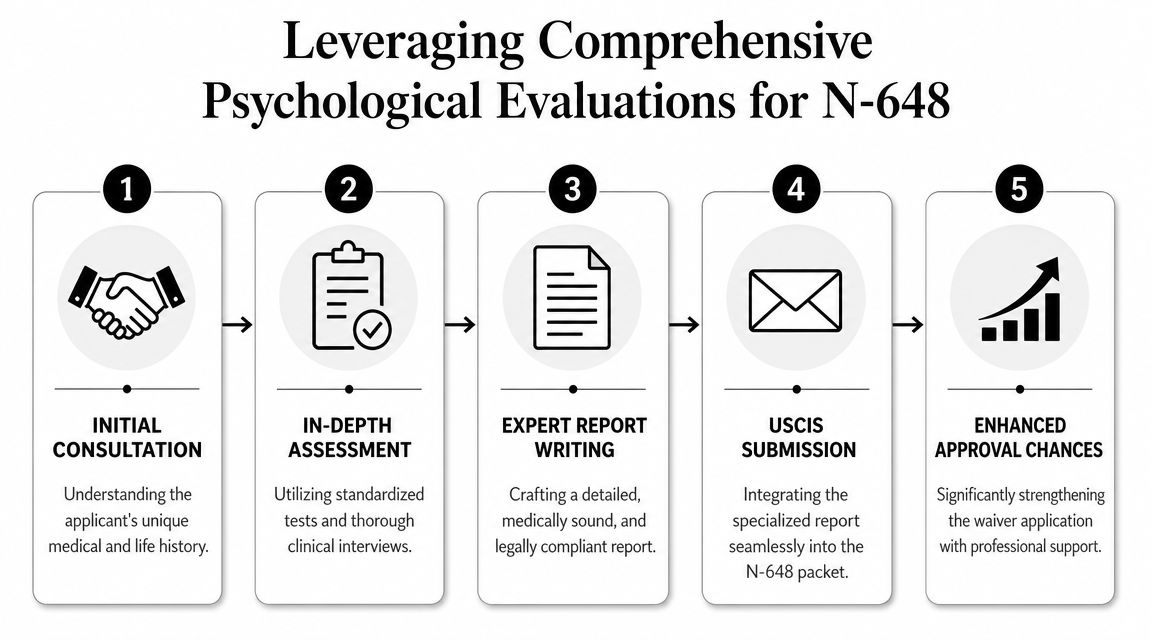
A specialized psychological evaluation can strengthen the file because it does more than repeat the diagnosis. It documents the applicant's functioning in a way that answers the actual USCIS question.
In stronger evaluations, the clinician usually integrates several sources of information:
- Clinical interview: Symptom history, educational background, language history, trauma exposure, medical course, and day-to-day functioning.
- Records review: Medical records, psychiatric records, prior evaluations, and relevant collateral documents.
- Mental status examination: Orientation, concentration, memory, thought process, language output, and observed comprehension.
- Standardized assessment when appropriate: Tools selected to evaluate cognitive and emotional functioning in a way that supports the functional conclusions.
This matters most in cases involving PTSD, traumatic brain injury, severe depression, anxiety conditions with major cognitive interference, or mixed psychiatric and neurological presentations. These applicants can appear conversational and socially intact while still being unable to retain tested material or perform reliably under structured questioning.
A polished diagnosis is not objective evidence. A careful evaluation that shows why the applicant cannot encode, retain, or retrieve information is.
A specialized report also helps attorneys translate medicine into adjudication. It can describe how symptoms impair learning in concrete terms, such as reduced sustained attention, compromised working memory, slowed processing, or executive dysfunction. Those are the kinds of findings that make the nexus credible.
If you're evaluating whether a more detailed cognitive workup may be useful, this sample discussion of a neuropsychological evaluation for adults illustrates the type of functional analysis that can support difficult immigration cases.
The trade-off is simple. A specialized evaluation takes more effort than getting a signature from a treating provider. But in borderline or non-obvious cases, it often produces the objective structure the file was missing.
Common Reasons for N-648 Denials and How to Avoid Them
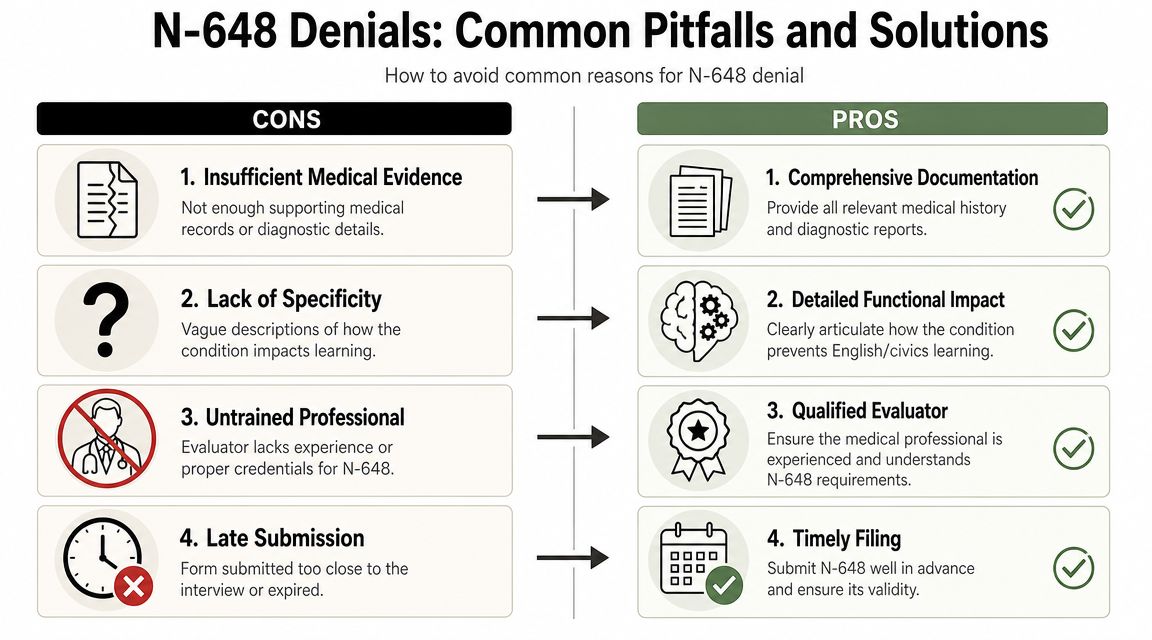
Most weak N-648 filings don't fail because the client is undeserving. They fail because the record leaves USCIS with unanswered questions.
Nexus failures
This is the most common problem I see. The form identifies a condition but never explains the route from diagnosis to inability.
Example of weak language: “Applicant has anxiety and cannot take the civics exam.”
Why it fails: The statement skips over the functional analysis. Anxiety can affect people in many different ways and at many different levels. USCIS needs to know why this applicant's symptoms prevent learning or test performance.
Preventive tip: Describe the impaired functions and connect them directly to the English or civics task.
Procedural errors
These errors are less interesting, but they still sink cases. Unauthorized certifiers, stale paperwork habits, and sloppy review all create avoidable exposure.
Examples include:
- Wrong certifier: Someone other than an M.D., D.O., or clinical psychologist signs the form.
- Filing mismatch: The packet does not align with the client's naturalization posture or supporting records.
- Incomplete responses: Key parts of the form are thin, skipped, or internally inconsistent.
Preventive tip: Treat the N-648 like expert evidence, not clerical paperwork.
Lack of detail
A conclusory narrative invites doubt. Officers read many forms. Generic language stands out for the wrong reason.
Weak example: “Due to mental impairment, patient cannot learn English.”
Stronger approach: identify the condition, the observed deficits, the evaluation basis, and the reason those deficits prevent acquisition or demonstration of knowledge.
The phrase “cannot learn English” is a conclusion. USCIS still needs the medical explanation that earns the conclusion.
The cleanest pre-filing review question is this: Would a reader who has never met the client understand why the impairment blocks the required testing? If the answer is no, the form probably needs revision.
Integrating the N-648 into Your Legal Strategy
The uscis n 648 form shouldn't sit on the edge of the case as an administrative add-on. It should be built into the naturalization strategy from the beginning.
When the issue is identified early, attorneys can screen for true eligibility, choose the right certifier, gather records that support functional impairment, and decide whether a specialized evaluation is necessary. That approach usually produces a cleaner filing and spares vulnerable clients from being pushed into a testing process they cannot effectively handle.
The strategic mistake is treating the N-648 as a form-completion exercise. It is an evidentiary submission with a medical expert component. The legal question is narrow, and the proof must be equally disciplined.
A strong filing usually has four qualities:
- The legal standard is correctly framed
- The certifier is qualified and careful
- The narrative proves the nexus
- The packet is consistent from top to bottom
When those pieces line up, the waiver request reads as credible, medically grounded, and usable by the adjudicator. That's what you want. Not just sympathy for the client, but a record that gives USCIS a solid basis to approve.
Immigration cases involving disability waivers are strongest when legal strategy and clinical evidence are developed together. Pro Psychological Analysis works with attorneys to provide specialized, evidence-based psychological evaluations for immigration matters, translating complex clinical findings into clear documentation that fits USCIS standards. If your N-648 case turns on memory, concentration, trauma, cognitive decline, or another less visible impairment, a rigorous evaluation can help clarify the nexus and strengthen the overall filing.