
A file lands on your desk late in the afternoon. The young person has already told their story three different ways, once to a school counselor, once to a family court attorney, and once during intake at your office. On paper, the case looks like a standard special immigrant juvenile status matter. In practice, it rarely is.
The state court needs findings that are precise, not sympathetic. USCIS needs a record that is complete, not merely compelling. The child may be safe enough for the moment, but safety alone doesn't prove that reunification with a parent is legally non-viable. That gap is where many SIJS cases weaken.
As a forensic psychologist working alongside immigration counsel, I see the same problem repeatedly. Lawyers often have real trauma, real neglect, and real family dysfunction in the file, but the evidence is organized around what happened, not around what the court must find. Special immigrant juvenile status cases become much stronger when legal theory and clinical proof are aligned from the start.
Table of Contents
- An Introduction to SIJS Cases
- Core Eligibility for Special Immigrant Juvenile Status
- The State Court Phase Securing the Predicate Order
- The Federal Phase The USCIS I-360 Petition
- Building a Persuasive Evidentiary Record
- Navigating Backlogs and Common Legal Hurdles
- SIJS Practitioner Checklist and Final Strategy
An Introduction to SIJS Cases
Special immigrant juvenile status is often introduced as a humanitarian pathway for children who can't reunify with one or both parents because of abuse, neglect, abandonment, or a similar basis. That's accurate, but it doesn't capture how these cases unfold in practice.
A workable SIJS case lives in two systems at once. State court makes the child welfare findings. Federal immigration adjudication decides whether that order satisfies the immigration statute. If those two tracks aren't coordinated, the case can fail even when the underlying facts are strong.
The cases that worry practitioners most are rarely the obvious ones. They involve emotional abuse without police reports, long-term abandonment with inconsistent caretaking, or a surviving parent who isn't overtly violent but remains profoundly unsafe for reunification. In those files, the question isn't whether hardship exists. The question is whether the record translates hardship into findings a judge can sign and USCIS can later accept.
Practical rule: A sympathetic narrative doesn't substitute for a legally usable record.
That matters because SIJS is conditional at each stage. The youth may qualify factually but still lose momentum if the court order is too vague, the supporting declarations are thin, or the clinical evidence discusses trauma generally without connecting it to parental harm and non-viable reunification.
When counsel approaches SIJS strategically, the case theory becomes much cleaner. The child is not solely asking for protection. The child is presenting a state court record that establishes dependency or custody, parental non-viability, and best interest, then carrying that record into the federal process without contradiction or drift.
Core Eligibility for Special Immigrant Juvenile Status
A 20-year-old client arrives with a strong abuse history, a caring aunt ready to take custody, and only a few months before the state court may lose jurisdiction. On paper, the case looks promising. In practice, SIJS eligibility turns on whether counsel can align age, marital status, court posture, and evidence fast enough to produce findings that will hold up under later federal review.
Age and marital status
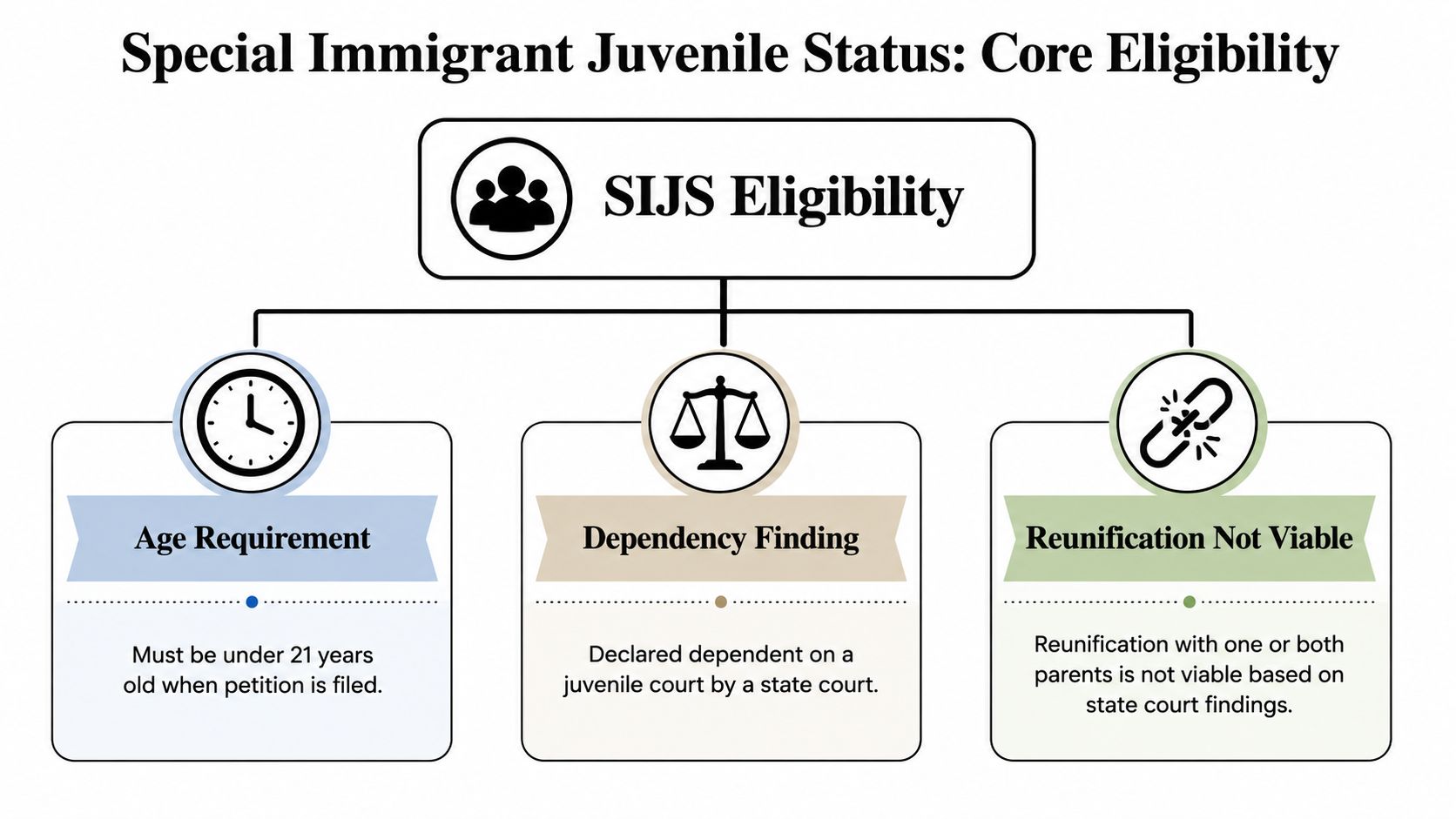
Start with the screening points that can end a case before the facts are ever developed. The youth must be under 21 when the SIJS petition is filed and unmarried. Those are threshold requirements, but they are not merely clerical. They shape filing sequence, urgency, and whether the state court can still act in time.
The problem is usually not confusion about the federal age cutoff. It is the gap between federal eligibility and state court jurisdiction. Some youth remain SIJS-eligible for federal purposes but are about to age out of the court that must issue the predicate order first. Counsel should map both timelines at intake, then decide immediately whether the case requires emergency filing, a guardianship strategy, or rapid evidentiary development.
Eligibility starts with a legally usable court posture
SIJS cases succeed or fail on the fit between the legal standard and the evidentiary record. A youth may have endured years of parental maltreatment, yet still lack a case posture that allows the court to enter the required findings. That is why intake should identify more than hardship. It should identify the exact custody, dependency, or guardianship vehicle that puts the child before a qualifying court and supports the necessary findings under state law.
This is also where clinical evidence becomes strategic. A psychological evaluation is not filed to show that the child is suffering in a general sense. It should help establish why reunification with a parent is not viable, how the parental conduct affected functioning and safety, and why return would place the youth at further risk. In cases involving chronic neglect, coercive control, trauma bonding, or emotional abuse without police documentation, that clinical bridge often separates a persuasive record from a thin one.
A similar discipline appears in a parenting capacity assessment, where broad concerns about caregiving are translated into specific findings about protection, judgment, and a child's needs. SIJS evidence benefits from that same level of precision.
The findings that drive the case
The predicate order must support three judicial findings that carry the SIJS case forward:
- Dependency, custody, or placement: The child must be before a qualifying juvenile court in a posture that authorizes the court to make child welfare findings.
- Reunification not viable with one or both parents: The record must tie that conclusion to abuse, neglect, abandonment, or a comparable basis under state law.
- Best interest against return: The evidence must support the conclusion that returning to the country of origin is not in the child's best interest.
The second finding usually requires the most care. "Reunification not viable" is not a label. It is a conclusion that should rest on facts showing why the parent cannot safely resume care. Sometimes the proof is straightforward, such as long-term abandonment or severe physical abuse. Harder cases involve a parent who has intermittent contact, provides occasional money, or expresses a wish to reunify despite a long history of instability, intimidation, untreated mental illness, or failure to protect.
Those are the cases where lawyers and clinicians need the same theory of harm. If declarations describe fear, disrupted schooling, hypervigilance, regression, or persistent avoidance, the evaluation should connect those symptoms to the parent's conduct and to the practical question before the court: whether reunification is realistically and safely possible. The distinction is important because SIJS is conditional at each stage. Strong facts alone do not carry the case if the record does not convert them into findings the court can sign and USCIS can later accept.
The strongest SIJS files do not simply tell a sad story. They assign each fact, document, and clinical opinion to a required legal finding.
The State Court Phase Securing the Predicate Order
A teenager arrives for evaluation after years of irregular contact with her father. He sends money some months, calls when he is sober, and now says he wants her back. On paper, that can look like a reunification case. In court, the core question is narrower and harder: can the record support a finding that reunification is not viable under state law, and can that finding survive federal review later.
That is the work of the state court phase. The predicate order is not a formality. It is the document that fixes the theory of the case. If the order is vague, if it recites conclusions without facts, or if it blurs which parent is at issue, the problem usually cannot be repaired by a cleaner federal filing.
What the order must say
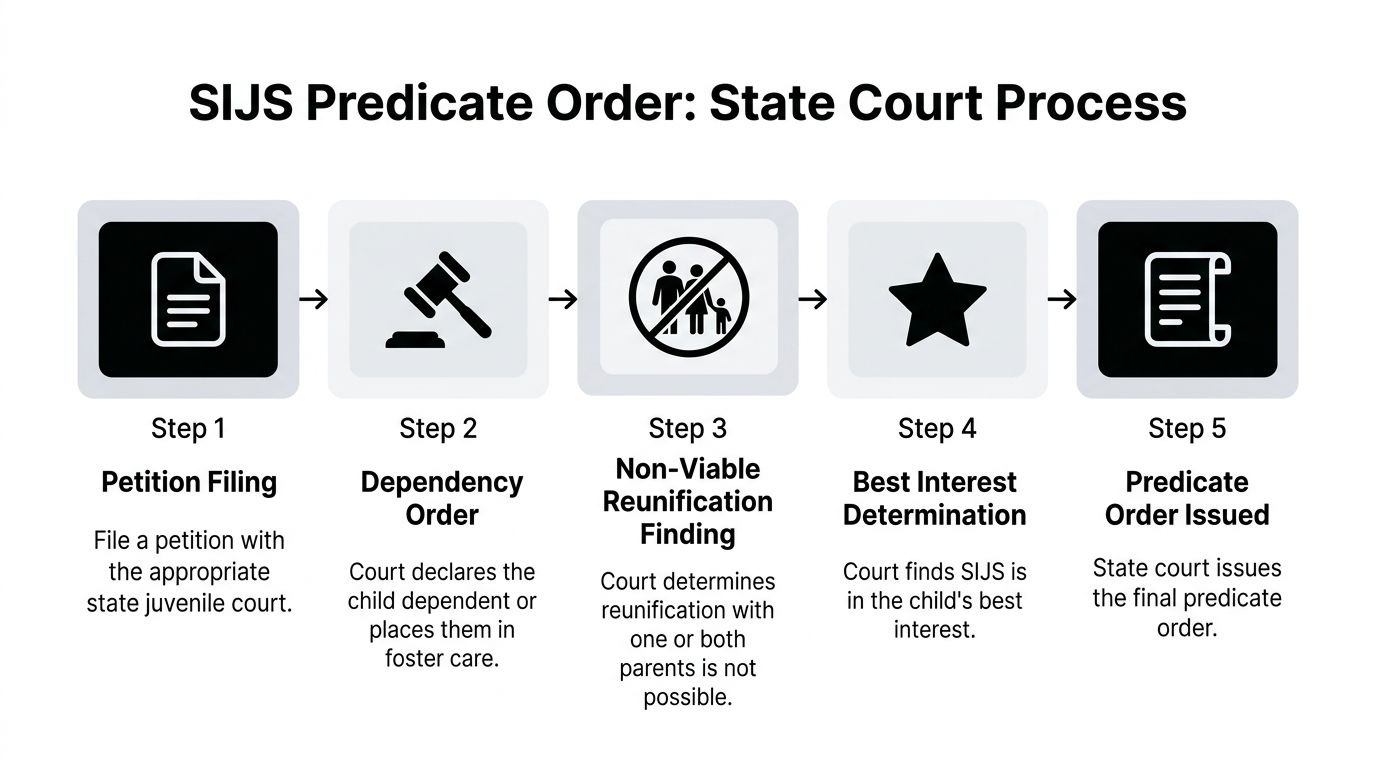
The predicate order should contain three findings with enough detail that a later reader can see how the court got there: (1) the child is dependent on the court or placed in the custody of a state agency or an individual; (2) reunification with one or both parents is not viable because of abuse, neglect, abandonment, or a similar basis under state law; and (3) return to the child's country of origin is not in the child's best interest.
Courts usually handle the first finding without much trouble. The friction is usually in the second finding, and sometimes in the third, because both require a theory supported by facts rather than a general sense that the child has had a difficult life.
A usable order does more than repeat statutory language. It identifies the parent or parents at issue, names the state-law basis, and points to conduct that supports the finding. If the theory is abandonment, the order should reflect abandonment as behavior. If the theory is neglect, the order should tie the parent's failures to supervision, protection, support, or care recognized in that state.
Facts have to do legal work
Legal drafting and clinical evidence must align. A declaration may describe nightmares, panic, school refusal, extreme compliance, or fear of contact with a parent. An evaluation should not stop at diagnosis or distress. It should explain how the parent's conduct affected functioning, why the symptoms are consistent with the reported history, and why those facts matter to the legal question of reunification.
That distinction matters in close cases.
If a parent has intermittent contact, occasional financial support, or recent claims of reform, the file needs more than a chronology of bad events. It needs a disciplined explanation of why reunification remains unrealistic or unsafe despite those surface facts. In my work, the strongest evaluations in SIJS cases do not solely confirm trauma. They help the court connect conduct, impairment, caregiving history, and current risk to the specific finding the judge is being asked to sign.
A practical state court record often includes:
- Caretaker declarations: Statements that establish who has provided daily care, who has not, and what happened when the parent was expected to protect or support the child.
- Child declaration or affidavit: A focused account organized around the required findings, with dates, locations, and concrete examples rather than broad character judgments.
- School, medical, or treatment records: Documents that show instability, behavioral change, fear responses, interrupted attendance, or other functional effects.
- Clinical evaluations where they add value: Reports that translate symptoms and behavior into evidence relevant to non-viable reunification and best-interest analysis.
- Proposed findings and order language: Drafting that is specific enough for the court to adopt and clear enough for later federal review.
The best predicate orders read as reasoned judicial findings, not as copied statutory phrases.
Choose the narrowest theory the evidence can carry
Overclaiming hurts SIJS cases. If the evidence strongly supports non-viability as to one parent, counsel does not improve the case by forcing a weak theory against the other. A narrower theory is often the better strategic choice because it keeps the proof clean and the testimony consistent.
That choice affects every part of the file. The child's declaration, caretaker statement, evaluation, and proposed order should all identify the same parent, the same course of conduct, and the same state-law basis. I see avoidable problems when one document frames the case as abandonment, another suggests abuse, and a third drifts into a general hardship narrative. Judges may still sign the order. Later review becomes harder if the theory is not coherent.
Draft for two audiences at once
The order has to work in state court first. It also has to hold up when a federal officer reads it cold, without the benefit of live testimony or local practice norms. That means names, dates, parent identities, living arrangements, and chronology need to stay precise throughout the record.
Pronouns create problems. So do phrases like "the parent was unstable" or "reunification would be harmful" without facts attached. Better drafting says what happened, when it happened, what the child experienced, and how that conduct fits the state-law ground the court is using.
Counsel and clinicians also need to address reporting obligations early. Abuse disclosures made during litigation preparation can trigger duties that affect timing, safety planning, and the shape of the evidence. A working knowledge of mandatory reporting rules in abuse-related evaluations helps avoid preventable disruptions.
A predicate order is usually in good shape when it does four things well:
| Issue | What works | What often fails |
|---|---|---|
| Dependency or custody | Clear statement of legal status | Informal references to current living arrangement |
| Non-viable reunification | State-law basis tied to specific conduct | Generic statement that reunification is not advisable |
| Best interest | Reasoned finding tied to safety, care, and stability | Bare conclusion with no factual basis |
| Federal durability | Consistent declarations, records, and proposed findings | Thin order that depends on assumptions or missing context |
The state court phase decides whether the SIJS case has a durable core. When the order and evidence are aligned, the later federal filing becomes a record-confirmation exercise. When they are not, the weaknesses are usually visible from the first page.
The Federal Phase The USCIS I-360 Petition
By the time a SIJS case reaches USCIS, the core fact-finding should already be done. The federal phase is not the moment to reinvent the theory. It's the moment to present a clean, internally consistent record that allows the adjudicator to confirm the statutory requirements have been met.
USCIS is reviewing, not retrying
USCIS looks to the predicate order and the supporting record to determine whether the petition satisfies federal SIJS requirements. That distinction matters. If the state court order is solid, the I-360 package should reinforce it, not expand beyond it.
Problems start when the federal filing adds details that were never developed in state court, changes the theory about which parent is the subject of non-reunification, or introduces documents that conflict with the timeline already presented. Inconsistency is one of the fastest ways to invite scrutiny.
What belongs in a careful I-360 filing
A disciplined SIJS filing package usually includes the Form I-360, the predicate order, and the related state court materials that show how the court reached its findings. The point is to make the federal review easy to follow.
I advise attorneys to think of the package as a record assembly task, not a storytelling exercise. That usually means checking for consistency across names, dates, parent identities, addresses, and prior custodial arrangements. It also means making sure translations, certifications, and court copies are complete and legible.
A practical filing review often asks:
- Does the order clearly contain all required findings?
- Do the affidavits support the exact parent-specific theory used in court?
- Is the factual chronology consistent across all exhibits?
- Have you included enough of the court record for USCIS to understand the order's basis?
USCIS doesn't need a more dramatic case. It needs a coherent one.
What doesn't work at this stage
Some weaknesses can't be fixed with a cover letter. If the order omits the abuse, neglect, or abandonment nexus, or fails to state the best-interest finding, federal filing won't cure the defect. If the state record is ambiguous, the solution is usually to repair the underlying order where state procedure allows, not to argue around the omission.
Another common error is attaching large volumes of material that don't help adjudication. More paper isn't better if it obscures the key findings. The strongest I-360 packages are selective, accurate, and aligned with the judicial record.
This phase rewards restraint. A practitioner who treats the federal filing as a careful documentary bridge from state court to USCIS will usually avoid the problems that come from over-arguing, over-supplementing, or drifting away from the predicate order.
Building a Persuasive Evidentiary Record
The most underdeveloped part of many special immigrant juvenile status cases is the evidentiary bridge between parental harm and the legal conclusion that reunification isn't viable. Lawyers often have declarations describing abuse, neglect, or abandonment. What they don't always have is disciplined proof of how that parental conduct has affected the child's functioning, safety, attachment, and capacity for return to the parent.

A key gap in SIJS guidance is how to use clinical evidence to satisfy the abuse, neglect, or abandonment predicate. A psychological evaluation can bridge that gap by documenting the clinical impact of trauma and providing a basis to argue that reunification isn't viable due to the severity of parental harm, which is especially important in cases involving emotional or subtle abuse, as discussed in Immigration Equality's SIJS overview.
Why reunification fails as a legal issue
The phrase best interest is broad. Courts use it all the time. But SIJS requires something more specific regarding reunification. The inquiry isn't just whether life would be better with a different caregiver. It is whether reunification with one or both parents isn't viable because of abuse, neglect, abandonment, or a similar basis.
That distinction is where clinical evidence becomes valuable. A child may say, truthfully, "I don't want to go back." Standing alone, that statement may sound like preference. A thorough evaluation can show whether the child's fear reflects trauma reactivity, coercive family dynamics, chronic emotional maltreatment, or impaired attachment rooted in parental behavior.
The law needs a nexus. Clinical work can help supply it.
What a psychological evaluation should actually do
A useful SIJS evaluation is not a generic trauma letter. It should answer case-specific questions in a way that remains clinically responsible. In practice, that means the report should identify the relevant history, describe symptoms and functioning, and connect those findings to the parental relationship at issue.
The most persuasive reports usually address several domains:
- Trauma history: What the youth experienced, from whom, and over what period.
- Functional impact: How the history affects sleep, concentration, school performance, mood, behavior, trust, and daily regulation.
- Relational consequences: Whether contact with the parent triggers fear, shutdown, hypervigilance, confusion, or destabilization.
- Clinical meaning: Why those reactions support the conclusion that reunification isn't viable, rather than merely undesirable.
A child who has been chronically terrorized may still express loyalty to a parent. That doesn't weaken the case. In many trauma presentations, attachment and fear coexist. A strong evaluation explains that complexity instead of flattening it.
One example of a case-specific tool in this space is a special immigration juvenile evaluation, which is designed to translate trauma and family dynamics into findings that attorneys and courts can use in SIJS matters.
Here is a useful overview of how that evidence is often framed in practice:
How to use clinical language without overclaiming
In this context, experienced practitioners separate strong evidence from overstated evidence. A psychologist shouldn't decide the legal question. The report should inform it. That means avoiding conclusory phrases that sound like ultimate legal findings without foundation.
What works better is disciplined translation. For example:
| Clinical observation | Legal relevance |
|---|---|
| The youth shows pronounced fear responses when discussing return to a parent | Supports the argument that reunification is not presently viable |
| The youth describes chronic humiliation, threats, or controlling conduct | Helps document emotional abuse even without physical injury |
| The youth's symptoms intensify around parental contact | Shows ongoing psychological harm, not just past adversity |
| The youth has developed stability only after separation from the parent | Supports the claim that forced reunification would be clinically unsafe |
Good SIJS clinical evidence doesn't say, "the child suffered." It shows how parental conduct changed the child's ability to function, attach, and safely reunify.
Attorneys can strengthen use of the evaluation by coordinating early with the clinician. The referral question should be precise. Which parent is at issue. What state-law theory is being advanced. Whether the main challenge is abandonment, emotional abuse, neglect, or mixed maltreatment. Without that framing, even a careful clinician may produce a report that is accurate but only partially useful.
What doesn't help is using a mental health report as a substitute for legal drafting. The evaluation should support the predicate order, not rescue a vague one. It is most effective when declarations, school records, treatment notes, and the proposed findings all point in the same direction.
Navigating Backlogs and Common Legal Hurdles
A SIJS approval is significant, but it doesn't deliver immediate permanent residence. For many youth, the hardest strategic work begins after the I-360 is approved because the case shifts from proving eligibility to managing time, exposure, and uncertainty.
The backlog changes the case strategy
As of mid-2026, over 120,000 youth with approved SIJS petitions were stuck in the visa backlog, federal law limits annual visas to 10,000, and more than 300,000 petitions have been filed since 2013, creating a 5 to 10 year wait between petition approval and the ability to apply for a green card, according to Safe Passage Project's explanation of SIJS status.
That backlog isn't just a scheduling issue. It affects how lawyers advise clients about work, school, travel, removal risk, and long-term planning. If the client believes I-360 approval ends the case, disappointment comes quickly. If counsel sets expectations early, the client is better positioned to make realistic decisions during the waiting period.
In practice, this means lawyers should track priority-date consequences, preserve records, and evaluate whether any parallel forms of relief should remain under consideration. The longer the delay, the more likely it is that new issues arise outside the original SIJS filing.
Deferred action is no longer a simple assumption
A major change in SIJS practice is the loss of the once-expected interim protection for many approved youth. The backlog period already left applicants in limbo. Recent policy changes made that period riskier.
Verified guidance reflects that approved SIJS applicants historically received deferred action allowing them to seek work permits, but USCIS discontinued that benefit for new approvals on June 6, 2025, and a federal court ruling in A.C.R. v. Noem has ordered the resumption of deferred-action determinations pending litigation, as summarized in Foster Power's SIJS classification overview.
The practical consequence is that attorneys can't assume the client has a stable protective cushion after I-360 approval. That is especially serious for youth who are older teens or young adults and no longer have the day-to-day shelter of an active juvenile court matter.
Approved SIJS status can be real protection without being complete protection. Clients need that explained plainly.
Problems that derail otherwise strong SIJS filings
Not every hard SIJS case is hard for the same reason. The obstacles usually fall into a few recurring categories.
- Predicate order defects: The order may omit a required finding, fail to identify the parent involved, or rely on broad language that doesn't tie back to abuse, neglect, abandonment, or a similar basis.
- Record mismatch: Affidavits, clinical reports, and court filings may tell the same story differently. Small inconsistencies become larger problems once USCIS reviews the full file.
- Parental litigation pressure: A parent may contest custody or attempt to reframe the case as a family disagreement rather than maltreatment.
- Timing pressure near age limits: A delay in state filings, service, hearings, or document collection can compress the whole strategy.
These cases respond best to front-loaded planning. The lawyer who identifies the likely weak point early, then builds around it, usually has more options than the lawyer trying to patch a defect after filing.
SIJS Practitioner Checklist and Final Strategy
Special immigrant juvenile status rewards careful sequencing. The strongest cases don't rely on a dramatic final declaration or an optimistic cover letter. They are built through disciplined quality control, with each document serving a precise purpose and reinforcing the same legal theory.
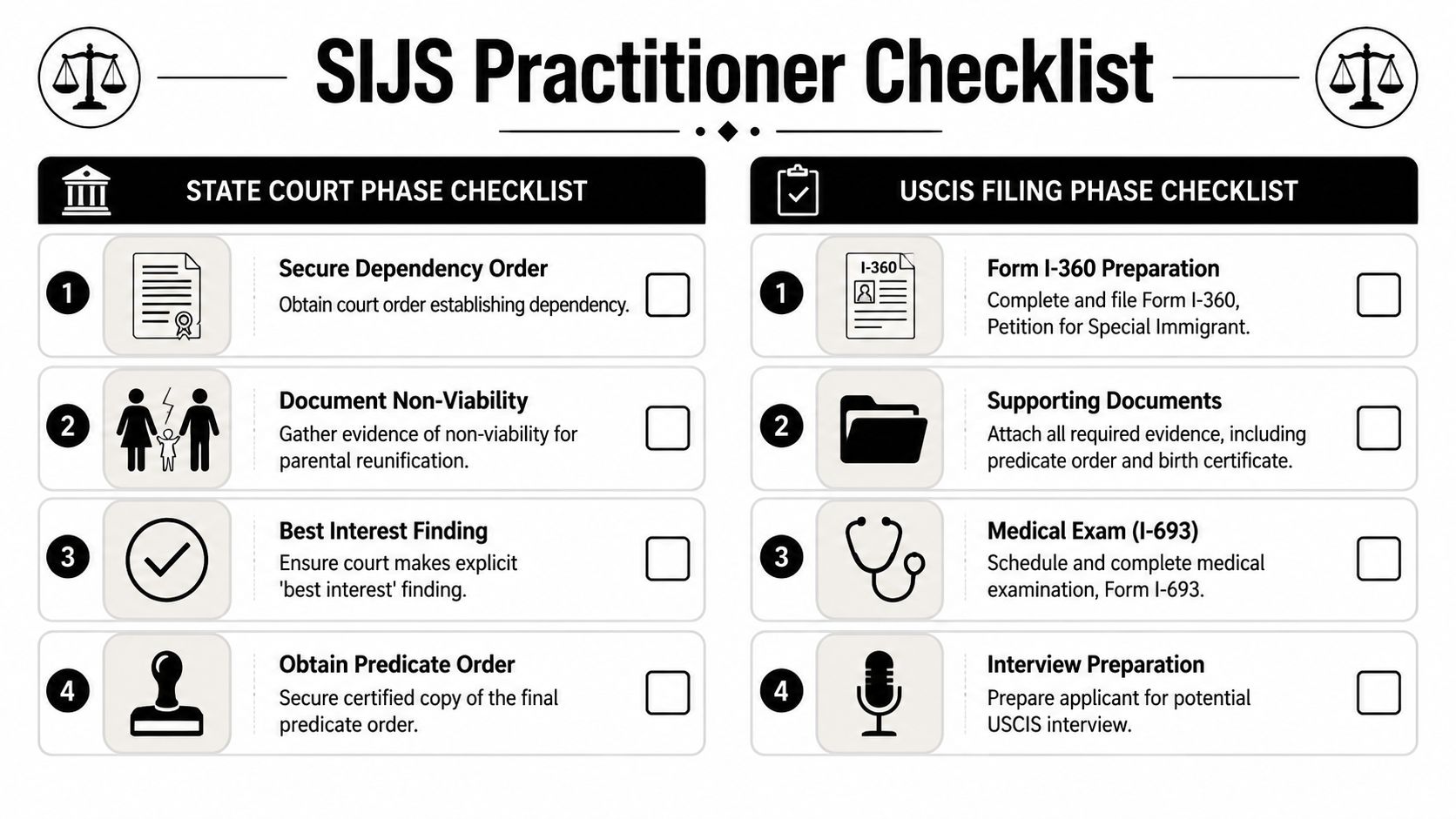
State court checklist
Start with the predicate order because everything downstream depends on it.
- Confirm court posture: Make sure the youth is before a qualifying court in a posture that supports dependency, custody, or placement findings.
- Choose the parent-specific theory: Decide early whether the case is about one parent or both. Don't broaden the theory unless the evidence supports it.
- Draft facts, not labels: Proposed findings should describe conduct that constitutes abuse, neglect, abandonment, or a similar basis under state law.
- Tie best interest to the record: Show why return to the country of origin is unsafe or contrary to the child's welfare based on actual facts in the file.
- Secure a complete record: Obtain certified copies and preserve the declarations, motions, and supporting materials that explain the order.
Federal filing checklist
The I-360 package should read like a coherent record transfer from state court to USCIS.
- Review for consistency: Check names, dates, family relationships, chronology, and translations across all exhibits.
- Match the filing to the order: The federal petition should follow the exact theory established in state court.
- Include enough supporting material: Give USCIS the documents needed to understand the predicate order's factual basis.
- Audit for avoidable contradictions: Remove or clarify materials that create confusion without adding probative value.
A brief office-use version can help with case review:
| Phase | Core question | Warning sign |
|---|---|---|
| State court | Does the order expressly support every required SIJS finding? | Conclusions appear without factual support |
| Evidence | Does the file prove non-viable reunification, not just hardship? | Records show distress but not parental nexus |
| USCIS filing | Does every exhibit align with the court theory? | New facts or changed framing appear late |
| Post-approval planning | Has the client been advised about limbo and risk? | Client believes approval ends the process |
The attorneys who handle SIJS matters well tend to share one habit. They don't treat psychology, affidavits, school records, and court findings as separate silos. They build them into one narrative with one legal destination. In difficult cases, that integration is often what turns a sympathetic file into an approvable one.
If your firm is handling SIJS matters that need tighter clinical support, Pro Psychological Analysis provides court-ready psychological evaluations for immigration cases, including child-centered SIJ evaluations that attorneys can use to document trauma, family dynamics, and the clinical basis for non-viable reunification.