
Why does a client who plainly presents as traumatized still give a fragmented declaration, omit key facts in one interview, then remember them later in another? In immigration practice, that problem is often treated as a credibility defect when it is a translation defect. The legal system asks for linear narrative, stable recall, and prompt detail. Trauma often disrupts all three.
The fight flight freeze response gives attorneys a workable framework for that mismatch. It explains why a person may become passive during danger, why memory can come back in pieces, and why a survivor may look flat, detached, confused, or inconsistent without being deceptive. That matters in asylum, VAWA, T visa, and U visa work, where adjudicators often focus on omissions, demeanor, and chronology.
For immigration counsel, this isn't academic psychology. It's evidentiary strategy. If you can connect observed trauma symptoms to a well-grounded clinical model, you can explain behavior that might otherwise be read as implausible, evasive, or noncooperative. The stronger approach is not to ask the court to excuse inconsistency. It is to explain it.
Table of Contents
- Why Credible Trauma Survivors Give Inconsistent Testimony
- The Brains Ancient Alarm System Explained
- Beyond Fight or Flight Understanding Freeze and Appease
- Recognizing Trauma Symptoms in Your Client
- How to Document Survival Responses for Immigration Cases
- Sample Phrasing for Reports and Declarations
- Conclusion From Clinical Fact to Legal Strategy
Why Credible Trauma Survivors Give Inconsistent Testimony
Immigration attorneys hear the same concern in different forms. Why did the client leave out a major assault in the credible fear interview? Why can't she place events in order? Why does he become blank when asked for sensory detail, then later disclose more in a psychological evaluation?
Those are fair legal questions. They become bad clinical assumptions when the answer is reduced to dishonesty.
A major gap in immigration advocacy is the failure to translate trauma science into evidentiary language. Courts and USCIS often treat dissociation, memory gaps, and fragmented recall as reasons to doubt credibility, even though the American Psychological Association notes that 60 to 80% of torture survivors experience significant dissociation and memory fragmentation in immigration-related contexts (APA discussion of undocumented immigrants and trauma effects).
Credibility and memory do not move in parallel
Trauma memory is often uneven. Survivors may recall the threat clearly but not the sequence. They may remember what the perpetrator wore but not the date. They may report one episode in detail and speak vaguely about another episode that was more severe. None of that is unusual in a highly traumatized person.
What trips up many cases is the legal expectation that a truthful witness will be chronological, emotionally steady, and internally complete from the first telling. In practice, traumatized clients often present the opposite way.
Practical rule: If the behavior is clinically predictable, don't let the adjudicator frame it as moral failure.
The wrong question creates the wrong record
Attorneys sometimes ask, "Why didn't you say this earlier?" That question invites shame and defensiveness. A better question is, "What made it hard to talk about this before?" That phrasing opens the door to dissociation, fear, body shutdown, coercion, and confusion.
Three patterns commonly undermine testimony when they are left unexplained:
- Fragmented recall: The client remembers pieces, not a polished story.
- Flat presentation: The client sounds emotionally distant while describing severe abuse.
- Shifting detail over time: Additional facts emerge only after safety, repetition, or clinical interviewing.
These aren't random defects. They are often signs that the nervous system prioritized survival over narrative organization. When counsel identifies that pattern early, the case moves from "inconsistent witness" to "traumatized witness whose presentation is clinically understandable."
The Brains Ancient Alarm System Explained
Why does a truthful client sometimes sound confused, go blank, or give an answer that seems poorly thought out? In many cases, the problem is not credibility. It is neurobiology under threat.
The fight flight freeze response predates any legal standard for how fear should look. In case preparation, the useful point is simple. A person under perceived threat does not process information the way a calm witness does. The body shifts into survival mode first, and reflective, organized narration often comes later.
What the alarm system does
Under threat, the autonomic nervous system reallocates resources. Sympathetic activation raises heart rate, breathing, blood pressure, muscle tension, and stress hormone release, including adrenaline and cortisol. Those changes prepare the body to survive danger rather than give a linear account of what is happening (Medical News Today explanation of autonomic activation in the fight-flight-freeze response).
That distinction matters in immigration practice. USCIS officers, asylum officers, and immigration judges often evaluate behavior through a common-sense lens. They expect prompt answers, orderly sequencing, and stable affect. A trauma-exposed client may present with the opposite pattern because the nervous system is handling danger, not helping counsel build a clean record.
For a broader clinical framework, attorneys can connect this physiology to nervous system dysregulation in trauma presentations. I use that framework when I need to explain why a client's body-based reactions are predictable consequences of trauma exposure, not signs of manipulation.
A short visual explanation can help when preparing clients or educating referral sources.
Why this matters in legal interviews
The legal value of this section is not the general science alone. It is the translation from physiology to admissible explanation. If counsel can show that threat activation plausibly affected recall, pacing, or bodily presentation, the factfinder has a clinically grounded alternative to assuming deceit.
| Interview behavior | Common legal misread | Better clinical explanation |
|---|---|---|
| Long pauses | Evasion | Threat activation can interrupt retrieval and speech initiation |
| Shallow breathing, visible tension | Defiance or resistance | Sympathetic arousal consistent with fear |
| Disorganized chronology | Fabrication | Stress can impair sequencing and coherent narrative formation |
This does not mean every inconsistency has a trauma explanation. Good forensic work requires restraint. The stronger opinion is usually the narrower one. Identify the behaviors that fit known survival responses, tie them to the client's history and presentation, and avoid claiming more than the record supports.
That approach strengthens both credibility analysis and case strategy. It gives attorneys language that courts and adjudicators can use without asking them to accept a vague claim that the client was "too traumatized to remember."
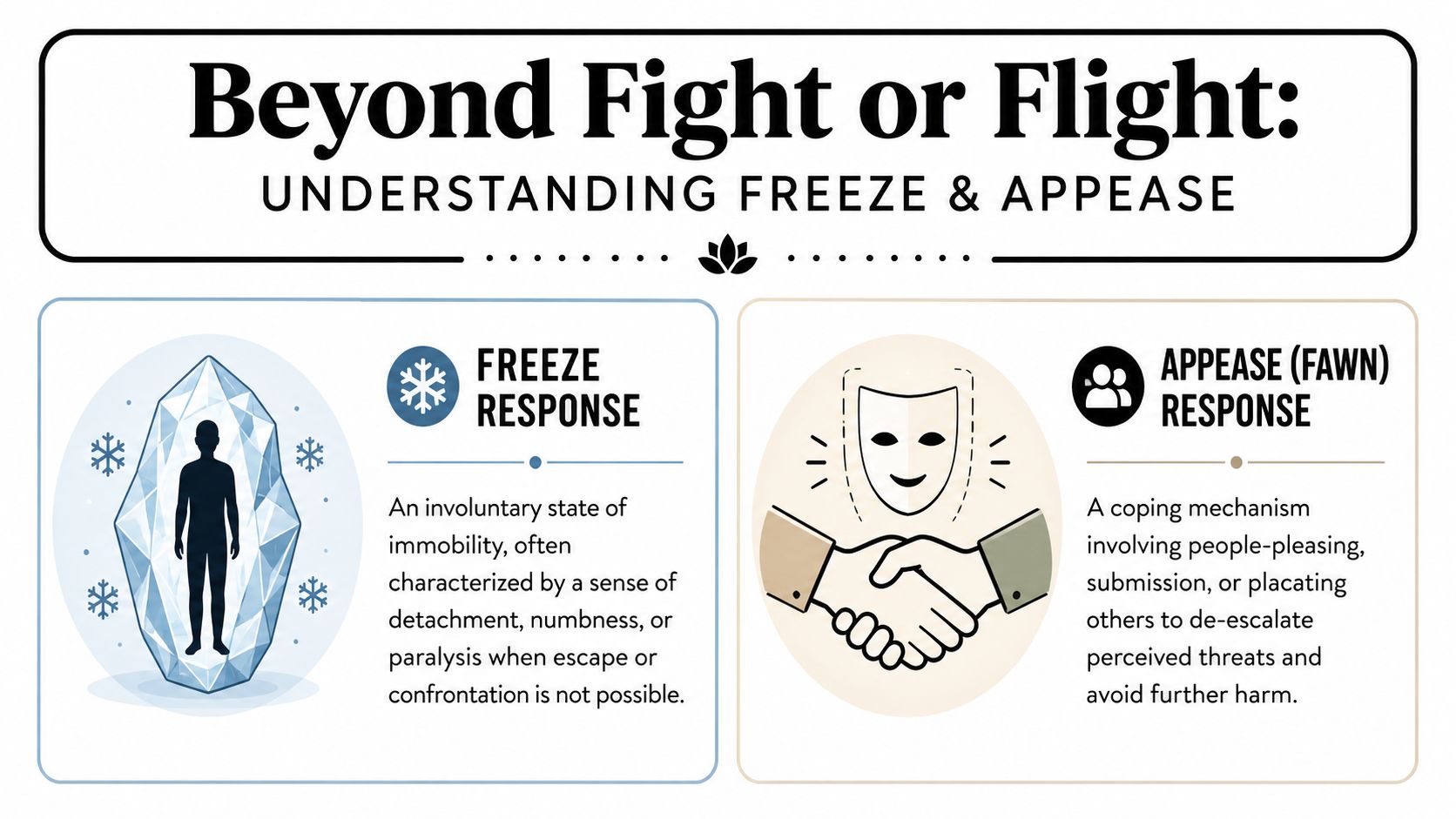
Beyond Fight or Flight Understanding Freeze and Appease
Most legal decision-makers understand fight and flight at a basic level. They understand resistance. They understand escape. The harder cases involve people who did neither.
That is where freeze and appease become essential. These are often the most misunderstood survival responses in immigration cases involving trafficking, domestic violence, gang coercion, torture, and prolonged control.
Freeze is behavior, not metaphor
Freeze is not just "feeling stuck." It is a documented stress response. In one study of threat responses, 13% of participants reported immobility, while 20% reported a significant desire to flee. The same research line also supports the point that untrained individuals show stronger freezing reactions, while highly skilled participants are less likely to freeze under high-intensity conditions (published study on immobility and flight responses under threat).
That has obvious legal implications. Many immigration clients are civilians with no training for violence, captivity, interrogation, or sexual assault. If they froze, that does not weaken the account. It often makes the account more clinically coherent.
A trafficking survivor may describe becoming numb, silent, or unable to move when a trafficker entered the room. A VAWA self-petitioner may report "going blank" during repeated abuse rather than yelling, leaving, or calling police. Those facts should be documented as adaptive survival responses, not gaps in courage.
A survivor's immobility during danger should not be confused with consent, agreement, or absence of fear.
Appease can look like cooperation
Appease, often called fawn in clinical discussion, matters whenever the safest available option is to reduce danger by pleasing the aggressor. In legal files, this often appears as continued contact with an abuser, calm speech toward a persecutor, compliance with instructions, or delayed disclosure.
That behavior is easy to misread. Adjudicators may ask why the client acted polite, returned messages, accepted rides, stayed in the home, or followed orders. The answer is often survival logic, not genuine willingness.
A few examples show the distinction:
- Domestic violence context: The survivor agrees, apologizes, and minimizes conflict because direct resistance increases the risk of harm.
- Trafficking context: The victim obeys commands, appears compliant, and does not flee because coercion, fear, dependency, and prior punishment narrow perceived options.
- Asylum context: A person speaks respectfully to armed actors or local authorities because confrontation is dangerous and escape is impossible.
Counsel should be careful with labels. Not every compliant act is appeasement, and not every passive presentation is freeze. But where the pattern fits, naming it can neutralize a damaging inference. The client's behavior then reads as organized around immediate survival rather than free choice.
Recognizing Trauma Symptoms in Your Client
Attorneys usually notice trauma before they have words for it. The client stares at the floor. He misses simple questions. She gives a precise answer about one event, then cannot recall the order of the next. Another client agrees with every suggestion, then later says the declaration is wrong but seemed unable to correct it in the meeting.
Those observations are not peripheral. They are data.

What attorneys often observe first
Start with what happens in the room, not with diagnostic labels. In immigration practice, the most useful observations are concrete and repeatable.
- Flat or constricted affect: The client describes severe events with limited visible emotion.
- Memory fragmentation: Important details come in pieces, often out of order.
- Body shutdown: The client becomes still, quiet, and slow when discussing a particular event.
- Scanning and startle: The client looks toward the door, reacts to hallway noise, or struggles to settle.
- Over-accommodation: The client agrees quickly, avoids correction, or seems afraid to say "I don't know."
When this pattern appears, it often overlaps with trauma-related arousal, shutdown, or dissociation. Related presentations can also include hypervigilance in trauma survivors, which attorneys frequently mistake for distraction or mistrust.
What those observations can mean
Consider three common interview moments.
A client is asked for dates and immediately becomes confused, apologetic, and silent. Counsel may think the person is unprepared. A clinical reading is different. Date retrieval can collapse when trauma recall activates fear, shame, or dissociation.
A second client recounts detention abuse without crying and with an oddly monotone voice. That can look detached or rehearsed. It may also reflect emotional numbing, a defensive state that lets the person speak without fully re-entering the experience.
A third client misses deadlines, does not return calls, and seems unable to complete simple document requests despite repeatedly stating a desire to proceed. That pattern can reflect chronic freeze rather than indifference.
When a client's presentation changes sharply around trauma topics, treat that shift as evidentiary information, not attitude.
A practical office checklist helps:
| Observable feature | Why it matters |
|---|---|
| Sudden silence during key topics | May indicate shutdown tied to trauma recall |
| Repeated "I don't remember" for sequence details | May reflect fragmented encoding and retrieval |
| Agreeing to inaccurate summaries | May reflect appeasement or fear of displeasing authority |
Attorneys don't need to diagnose these reactions. They do need to recognize them, record them accurately, and know when a clinical evaluation can convert those observations into persuasive evidence.
How to Document Survival Responses for Immigration Cases
Good trauma documentation does not begin with theory. It begins with better questions.
Many immigration records are weakened by framing the event as a test of rational behavior. "Why didn't you run?" "Why didn't you call the police?" "Why did you go back?" Those questions may be legally relevant, but they often produce shame, self-blame, and thin answers. They also miss the most probative issue, which is what the client's body and mind were doing at the time.
Ask body-based questions, not blame-based questions
A stronger interview asks for lived experience from the inside out.
Try prompts like these:
- During the event: "What did you notice happening in your body?"
- At the moment of danger: "Were you able to move, speak, or think clearly?"
- Afterward: "What happened when you tried to remember or talk about it later?"
- In ongoing functioning: "What becomes hardest when you have forms, appointments, or deadlines?"
These questions often produce more accurate testimony than direct "why" questions. They also create a record that links behavior to trauma response rather than to character.
The record should capture both action and non-action. If the client froze, write that down specifically. If the client complied to reduce harm, document the context that made compliance safer than resistance.
Document function, not just diagnosis
For legal purposes, diagnosis alone is rarely enough. Counsel needs functional impact. The file should show how the fight flight freeze response affects recall, disclosure, communication, and case participation.
The clinical and legal record is stronger when it describes:
- Interview presentation: pauses, visible distress, blankness, confusion, or overcompliance.
- Recall pattern: sensory fragments, missing sequence, delayed disclosure, or variable detail across retellings.
- Current impairment: difficulty organizing paperwork, keeping appointments, answering calls, or tolerating questioning.
- Threat-linked triggers: authority figures, enclosed rooms, discussion of abuse, or reminders of perpetrators.
Chronic freeze can impair executive functioning in ways that directly affect immigration cases. The Veterans Affairs PTSD guidance supports the broader point that chronic trauma activation can interfere with concentration, daily functioning, and follow-through, which helps explain missed deadlines, communication failures, and stalled participation in legal processes (VA PTSD professional guidance relevant to trauma-related impairment).
If you're building the evidentiary file, use the same discipline you would use for medical proof. Detailed, contemporaneous records carry more weight than broad conclusions. A useful companion framework is medical documentation for legal cases, especially when you need symptoms tied to functional consequences rather than listed in isolation.
A practical documentation sequence often works best:
- Capture the observable behavior in the meeting.
- Tie it to the trauma topic that triggered it.
- Describe the legal effect on testimony, deadlines, or communication.
- Support it clinically through evaluation when the issue is central to credibility.
Courts rarely infer trauma dynamics on their own. If the record doesn't explain freeze, the record usually defaults to blame.
Sample Phrasing for Reports and Declarations
What language helps an adjudicator see trauma evidence as clinically grounded, rather than as an excuse for inconsistency?
The answer is usually not more theory. It is better phrasing. In immigration cases, the report or declaration has to connect observable behavior to a recognized trauma response and then tie that response to the legal issue in dispute, often credibility, delay, memory gaps, or continued contact with a perpetrator.
Historical background can help, but only briefly. As noted earlier, the fight flight freeze response is a well-established physiological survival system. For case purposes, the more persuasive move is to show how that system appeared in this client, in this interview, and in this record.
A translation table attorneys can actually use
Use language that is restrained, specific, and tied to function. Adjudicators tend to respond better to careful explanation than to broad advocacy phrased as clinical certainty.
| Observed Symptom / Behavior | Common Adjudicator Misinterpretation | Clinically-Informed Framing for Reports |
|---|---|---|
| Inconsistent sequence of events | Fabrication | The applicant's account is fragmented in a way that is clinically consistent with trauma-related disruption in sequencing and recall during highly threatening events. |
| Flat affect during severe disclosures | Lack of genuine fear | The applicant presented with constricted or blunted affect while recounting traumatic material, a pattern that can occur in survivors who recall events in a numbed or detached state. |
| Failure to flee or resist | Consent or lack of danger | The applicant's immobility and limited resistance are consistent with an involuntary freeze response under overwhelming threat. |
| Continued contact with perpetrator | Willing participation | Continued contact can be clinically consistent with coercive control, fear-based compliance, dependency, or appeasement strategies used to reduce danger. |
| Late disclosure of major abuse | Strategic embellishment | Delayed disclosure may reflect shame, dissociation, fear of retaliation, or difficulty putting traumatic experiences into words, rather than recent fabrication. |
| Missed appointments or document delays | Lack of interest in the case | The applicant's difficulty with follow-through is consistent with trauma-related impairment in concentration, organization, and task completion. |
Sample language for declarations and reports
The strongest phrasing does three jobs at once. It describes what was observed. It avoids overstating causation. It explains why the behavior matters in the immigration record.
For attorney declarations or briefs
- The respondent's omissions are better understood in the context of trauma-related recall problems than as independent proof of deception.
- Her difficulty presenting events in strict chronological order is clinically compatible with a survival response during the underlying abuse and with fragmented recall during later retelling.
- His lack of active resistance during the incident does not rule out fear. Under acute threat, some survivors become immobile or compliant because resistance is experienced as more dangerous.
For psychological reports
- When discussing the index trauma, the applicant became markedly still, slowed her speech, and had difficulty retrieving sequential details. This presentation is consistent with trauma-related shutdown.
- The applicant described episodes of mental blankness, partial recall, and sensory fragments surrounding the abuse. Those symptoms help explain discrepancies across prior statements.
- The evaluation findings support the opinion that the applicant's memory pattern and behavior are more consistent with a stress-based survival response than with intentional fabrication.
For client declarations drafted with counsel
- When he threatened me, I could not think clearly or make my body move the way I wanted.
- I did not fight back because I believed resisting would make the violence worse.
- I remember parts of what happened in pieces. Some images and physical sensations are clear, but the order is harder for me to explain.
Word choice matters.
Phrases such as "consistent with," "clinically compatible with," "may help explain," and "supports the opinion that" usually carry more weight than absolute conclusions. They show discipline. They also protect the report from overstating what the evaluator can truthfully say.
There is a real trade-off here. Language that is too cautious can sound empty. Language that is too certain can sound partisan and invite attack on cross-examination or rebuttal review. The best reports stay close to observed facts, accepted trauma mechanisms, and the specific credibility problem the court or agency must decide.
Conclusion From Clinical Fact to Legal Strategy
The fight flight freeze response becomes powerful in immigration work when attorneys stop treating it as background education and start using it as a framework for proof. The central problem in many cases is not that the client lacks credibility. It is that the record lacks a clinically literate explanation for behavior the system is predisposed to distrust.
Memory gaps, delayed disclosure, passive behavior, continued contact with an abuser, missed deadlines, and inconsistent detail should never be waved away. They should be analyzed. Sometimes they reflect ordinary inconsistency. In many trauma cases, they reflect a nervous system organized around survival rather than orderly narration.
That distinction matters most where the adjudicator is deciding whether the client is believable. If counsel can show that the presentation is clinically coherent, the case shifts. The question stops being, "Why didn't this person act like a rational, untraumatized witness?" The better question becomes, "Is this exactly how a severely traumatized person might present under pressure?" Often, the answer is yes.
The strongest files usually share three features:
- Trauma-informed interviewing: counsel asks questions that elicit embodied experience, not just polished chronology.
- Specific documentation: the record captures observable behavior, recall pattern, and functional impact.
- Expert translation: a qualified psychological evaluation connects symptoms to established clinical knowledge in language the court can use.
When those pieces are in place, the fight flight freeze response stops being an abstract concept. It becomes admissible context. And in many cases, that context is the difference between apparent inconsistency and understandable survival.
If you need a psychological evaluation that translates trauma symptoms into clear, persuasive immigration evidence, Pro Psychological Analysis works with attorneys nationwide on asylum, VAWA, T visa, U visa, and hardship cases. Their evaluations are built for USCIS and immigration court use, with clinically grounded findings that connect memory fragmentation, dissociation, freeze responses, and functional impairment to the legal issues in the case.