
The interview notice arrives after months of waiting, document gathering, medical exams, biometrics, and second-guessing every line of the filing. For many applicants, that envelope brings two reactions at once. Relief, because the case is moving. Anxiety, because now there's a date, a location, and a real conversation with a USCIS officer on the calendar.
That reaction is normal. By the time a case reaches the adjustment of status interview, a great deal has already been invested emotionally and practically. Spouses worry about being separated during questioning. Employment-based applicants worry about technical inconsistencies in a packet they signed months earlier. Survivors in humanitarian cases often worry about something deeper: whether stress, memory gaps, or the pressure of the setting will make truthful testimony sound uncertain.
The right way to think about this stage is not as a performance. It's a consistency test. USCIS is usually not meeting you to rebuild the case from zero. The officer is checking whether your testimony, your documents, and the record already in the file line up cleanly. That is why some applicants walk out thinking the interview felt straightforward, while others get pulled into follow-up questions over details they assumed were minor.
A strong preparation plan does more than tell you what to bring. It helps you understand why each item matters, how officers use questions to verify eligibility and credibility, and when additional evidence becomes strategically important. In more complicated cases, that can include corroborating records, legal explanations, and sometimes a psychological evaluation that explains how trauma affects recall, presentation, and consistency.
Table of Contents
- Introduction Your Guide to the Final Step
- Understanding the Interview Purpose and Timeline
- Navigating Interview Day Logistics
- Preparing Your Essential Documents and Evidence
- Answering Common Interview Questions Strategically
- Handling Special Circumstances and Complex Cases
- Strengthening Your Case with Advanced Evidence
Introduction Your Guide to the Final Step
By the time someone reaches the adjustment of status interview, they've usually already heard too much generic advice. Bring your documents. Dress neatly. Tell the truth. All of that is correct, but it's incomplete.
What matters in practice is understanding what USCIS is testing. Officers use the interview to compare the live testimony in front of them against the written record, the supporting civil documents, and the eligibility basis for the case. That is why a well-prepared applicant doesn't just know the facts. They know where those facts appear in the filing, what supporting evidence exists, and which parts of the case deserve extra attention.
A marriage-based case illustrates this well. One spouse may focus on gathering recent photos and joint records, assuming quantity will carry the day. But if the officer asks about prior addresses, dates of employment, past marriages, entries into the United States, or who lives in the household, internal consistency becomes the primary issue. The same is true in employment-based and humanitarian matters. The core problem usually isn't lack of paper. It's mismatch.
Practical rule: Preparation should make the interview more boring, not more dramatic. If the file is coherent and the testimony is steady, officers often move through the case efficiently.
That's also why complex cases need a different level of preparation. A past arrest, an old immigration filing, a derivative family member with a separate schedule, or trauma-related recall issues can all change how the interview should be approached. In those situations, the question isn't merely “what do we bring?” It's “what could be misunderstood, and how do we clarify it before that misunderstanding harms the case?”
Understanding the Interview Purpose and Timeline
A common interview scenario looks like this. An applicant walks in focused on proving the case is genuine, but the officer starts with older addresses, prior entries, a past marriage, or an arrest disclosure from years ago. That sequence surprises people who prepared for a conversation and not for comparison.
What the officer is doing
An adjustment of status interview is best understood as a consistency test. The officer compares live answers against the Form I-485, prior filings, identity records, civil documents, and any updates submitted after filing. USCIS describes the interview as part of its review process for determining eligibility and verifying the information in the application, as reflected in the USCIS adjustment of status guidance.
That distinction is important because many applicants prepare for the wrong task. They try to predict every possible question instead of mastering their own record. In practice, over-rehearsing creates two avoidable problems. Answers start to sound scripted, and small deviations from the filed paperwork can look larger than they are.
The officer also has limited time to make sense of the file. Interviews are often brief, which means a clean, internally consistent case tends to move more smoothly than a case that requires on-the-spot explanation. If there is a point of tension in the record, the better strategy is to identify it in advance, document it clearly, and prepare a concise explanation that matches the file.
Why the short format changes your preparation
A short interview rewards organization and punishes drift. Officers rarely use the appointment to reconstruct a confusing timeline from scratch. They use it to confirm eligibility, resolve specific questions, and assess whether the testimony in the room holds together with the paper record.
That is why preparation should be built around function, not volume.
- Confirm identity and eligibility. Originals and updated records allow the officer to match the person, the documents, and the eligibility basis without delay.
- Protect credibility. A careful review of the filed packet reduces the risk that an innocent memory error becomes a perceived inconsistency.
- Control known problem areas. Prior arrests, old immigration filings, status violations, trauma-related memory gaps, and derivative-family timing issues should be addressed deliberately, not improvised under oath.
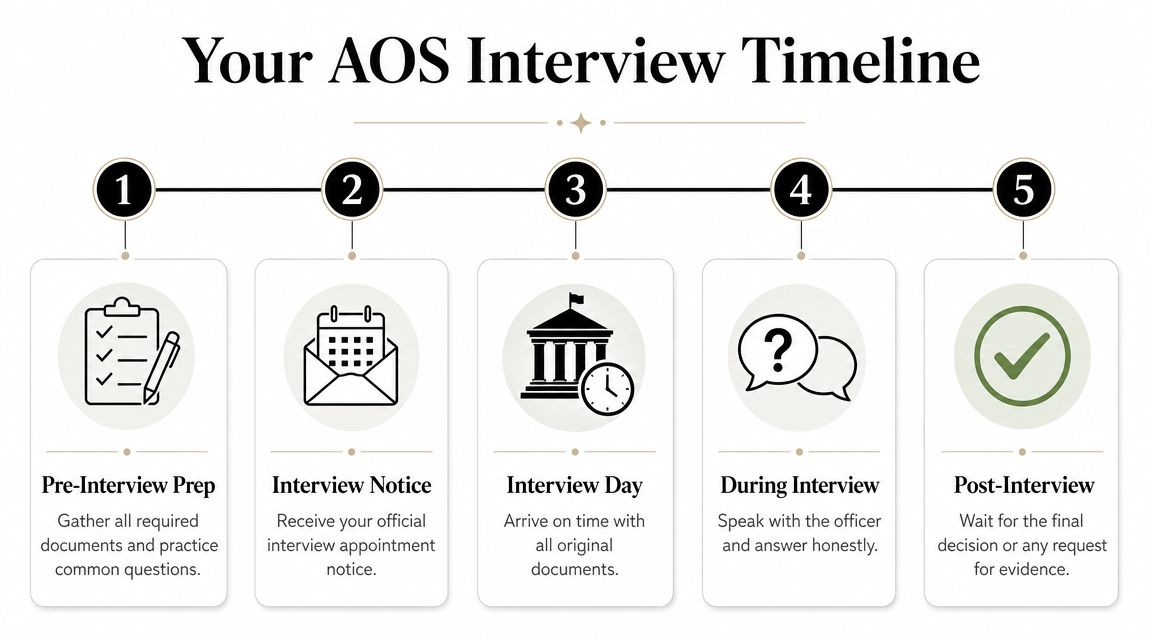
A practical timeline usually works best:
- Review the interview notice closely. Confirm the location, who must appear, and whether USCIS requested any specific documents.
- Rebuild the case file. Work from the exact submission, including supplements, responses, and later updates.
- Mark pressure points. Any fact that could trigger follow-up should be matched to supporting evidence and a clear explanation.
- Update stale evidence. New tax records, recent joint documents, disposition records, or corrected civil documents can matter more than another stack of general paperwork.
- Prepare for more than one result. Approval can happen quickly, but continued review, a request for evidence, or supervisory review are all common outcomes.
Complex cases need one more layer of planning. If trauma affects recall, if criminal history requires careful wording, or if derivative applicants have facts that do not line up neatly with the principal case timeline, the goal is not to memorize better. The goal is to explain accurately, support the explanation with corroborating evidence, and decide in advance whether a psychological evaluation or other expert record should be part of the case.
The strongest interview preparation produces answers that are calm, specific, and consistent with the file.
Navigating Interview Day Logistics
From arrival to the waiting room
A strong case can still have a rough start if the morning is chaotic. An applicant who arrives flustered, cannot find the interview notice, or tries to sort family documents at the security line is more likely to carry that stress into sworn questioning. USCIS officers notice demeanor, but they also notice whether a case appears orderly from the first minute.
Plan for extra time. Security screening, parking, elevators, and check-in can all take longer than expected. Keep the appointment notice, photo identification, and any case-specific originals in an outer pocket or clearly labeled section so they are immediately available. If medical or mental health evidence may matter in your case, review in advance what qualifies as supporting medical documentation for an immigration case so nothing important is left behind.
Families scheduled on the same day should coordinate the practical details before leaving home. Decide who is carrying passports, civil documents, and updated records. If a spouse or derivative applicant is called separately, that person should not be discovering the file structure for the first time in the waiting room.
The waiting area is not the place to rehearse a script. It is the last chance to settle your breathing, silence your phone, and confirm where key documents are located. For marriage-based and family-linked cases especially, last-minute efforts to "get answers straight" can create the exact inconsistency problem the interview is designed to expose.
What happens once your case is called
The interview usually becomes formal quickly. The officer will identify the applicant, place the person under oath, and begin testing whether the testimony matches the filing history and supporting record. That is why I treat the interview as a consistency test, not a memory contest.
Officers may question relatives together or separately. USCIS explains that interviews are used to verify eligibility, confirm information in the application, and resolve issues before adjudication, as described in the agency's adjustment of status interview guidance. Separate questioning is not proof that something is wrong. It is one of several ways an officer checks whether each person knows the facts from personal knowledge rather than from coaching.
A useful interview-day posture comes from a few disciplined habits:
- Answer the question asked. Extra detail can create new lines of inquiry that the file did not need.
- Pause before responding. A short pause is better than answering too fast and correcting three times.
- Correct errors plainly. If you misspeak about a date, address, arrest history, or travel, say so immediately and give the accurate answer.
- Ask for clarification if a question is unclear. Guessing under oath creates avoidable inconsistency.
- Keep your papers organized. An officer should not have to wait while you search through loose documents.
This matters even more in difficult cases. Trauma can affect recall. Criminal history often requires precise language. Derivative applicants may know the family story differently from the principal applicant because they lived parts of it from a different vantage point. Those differences are manageable if they are expected, documented, and explained clearly. They become a problem when interview-day confusion makes them look invented.
The applicants who do best are rarely the ones who try to sound perfect. They are the ones who stay accurate, steady, and consistent with the record already in front of the officer.
Preparing Your Essential Documents and Evidence
An adjustment interview often turns on a simple question: does the paper record hold together under live review? Officers already have the filing. What they test in the room is whether your identity, eligibility, and case story stay consistent when they compare forms, civil records, prior filings, and your answers side by side.
That is why document preparation deserves strategy, not just accumulation. A strong interview file lets the officer verify key facts quickly and reduces the chance that a correct case starts to look uncertain because a document is missing, outdated, or buried in a stack of unrelated papers.
Start with the filed packet. Review the Form I-485 and supporting exhibits line by line against what is true today. If anything has changed since filing, identify it before the interview and prepare the update in a clean, documented way. Common examples include a new address, job change, international travel, marriage issues, birth of a child, arrest, citation, or an expired medical exam.
Organization matters because it affects credibility. I tell clients to build the interview set so that any fact in the application can be matched to supporting evidence within seconds. Keep originals separate from copies, but in the same order. If counsel filed the case, the interview folder should track the filing structure closely enough that the officer can move from the application to the proof without confusion.
This becomes even more important in complex cases.
If trauma affects memory, if there is prior criminal history, or if a derivative applicant knows events from a different perspective, the record needs to explain those issues before the interview creates avoidable doubt. In those cases, corroboration does more than fill gaps. It gives the officer a reason to understand why a date was hard to recall, why certain records are incomplete, or why two truthful accounts may differ in detail. This overview of medical documentation used in legal and evaluative settings is helpful for understanding the difference between a record that merely exists and one that effectively explains a fact USCIS needs to assess.
Essential document checklist for AOS interview
| Document Category | Required Documents | Notes |
|---|---|---|
| Identity and appointment records | Interview notice, passport, government-issued identification, travel documents | Keep originals accessible for check-in and officer review |
| I-485 support file | Complete copy of the filed Form I-485 packet and attachments | Review carefully so testimony stays aligned with the record |
| Civil documents | Birth certificate, marriage certificate, divorce decrees or other proof of prior-marriage termination | Bring originals even if copies were submitted earlier |
| Immigration documents | I-94, visa documents, EAD, prior approval notices if relevant | Use these to clarify status history, entries, and prior benefits |
| Medical records | Form I-693 when required and any updated sealed materials | Confirm before the interview whether a new or replacement exam is needed |
| Family-based relationship evidence | Joint lease, joint bank records, insurance records, photos, shared bills, other bona fide marriage evidence | Select documents that show an actual shared life over time |
| Case-specific corroboration | Court records, certified dispositions, legal briefs, hardship materials, clinical records where appropriate | Organize by issue so the officer can follow the explanation without guessing |
Quality beats volume. Ten well-chosen records that confirm the same timeline usually carry more weight than a disorganized bag full of duplicates.
For marriage-based cases, choose evidence that shows continuity across different parts of life. Shared residence, finances, insurance, tax treatment, travel, and family photographs should point to the same relationship timeline. For employment-based cases, bring documents that confirm the offered position, your maintenance of status where relevant, and any updates that affect admissibility or eligibility. For humanitarian or hardship-related cases, include corroboration that connects the legal standard to actual lived circumstances, especially where the file involves mental health, trauma, or functional impairment.
A psychological evaluation can be particularly important in the right case. It is not routine evidence for every adjustment interview. It can be highly persuasive when the file involves trauma-related memory issues, fear responses, domestic abuse, severe anxiety, hardship to qualifying relatives, or other clinical factors that help explain behavior, inconsistency risk, or the severity of consequences tied to a denial. Used correctly, that kind of report does not replace testimony. It supports testimony with a professional explanation the officer can evaluate against the rest of the record.
The strongest files are coherent. Dates match. Addresses match. Prior filings, civil documents, and live testimony point in the same direction. That is what helps an officer conclude that the case is credible, understood, and ready for approval.
Answering Common Interview Questions Strategically
A strong interview answer does two jobs at once. It responds to the officer's question, and it fits cleanly with the rest of the record already in front of them.
That is the right way to view this part of the process. USCIS is not grading style. The officer is testing consistency across forms, civil documents, prior filings, and live testimony. In practice, many problems at adjustment interviews do not start with a bad fact. They start with an avoidable mismatch, an imprecise date, a guessed answer, or an explanation that expands beyond the question asked.
For that reason, preparation should focus on categories of questioning, not memorized lines. A useful model is a structured interview format for sensitive or high-stakes questioning. The goal is to organize the facts by topic, identify pressure points in advance, and practice answering truthfully in a steady way when the same subject is approached from different angles.
Officers usually ask questions for one of four reasons. They are confirming identity and biographical facts. They are checking eligibility under the category you filed in. They are screening for admissibility issues from the I-485. They are assessing whether your account remains coherent when discussed in person.
That last point matters.
A marriage-based applicant may be asked about the apartment layout, a recent family event, or who pays a particular bill. An employment-based applicant may be asked about the offered role, the petitioning employer, or periods of prior status. An applicant with a humanitarian or hardship-related record may face questions where trauma, fear, or memory gaps affect how events are recalled. Different case types. Same test. Does the answer align with the filing, and does it make sense in context?
Good answers usually share four traits:
- Accurate: State the fact as it is, even if it is awkward or unfavorable.
- Consistent: Keep your testimony aligned with the forms and supporting records.
- Focused: Answer the question asked, then stop.
- Natural: Use your own words instead of sounding rehearsed.
What backfires is just as predictable. Applicants often add extra detail because silence feels tense. That can open unnecessary areas of inquiry. Others guess when they are unsure. Guessing creates contradictions that look avoidable. Some try to argue the case through long explanations. The interview is primarily a fact-finding exercise, and legal framing belongs with counsel and the written record.
If you do not know an answer, say so plainly. If you do not remember an exact date, give the portion you do remember and identify what document would refresh it.
Compare these two responses:
- Stronger: “I do not remember the exact date, but it was after we moved to our current address, and that move is reflected in our lease and utility records.”
- Weaker: “I think it was in May, or maybe June, because a lot was happening then and we were changing jobs and family was visiting.”
The first answer is limited, honest, and anchored to evidence. The second invites follow-up on several subjects that may have nothing to do with the officer's real concern.
This is especially important in cases involving trauma, anxiety, prior arrests, derivative family members, or older filings with inconsistent details. In those cases, preparation is not about sounding polished. It is about reducing the risk that a truthful applicant presents as unreliable because memory is fragmented, stress affects recall, or family members understand the timeline at different levels. Where a psychological evaluation is already part of the record, answers should remain consistent with that report without trying to recite clinical language. The report explains the pattern. The applicant still needs to answer as a witness to their own life.
The best approach is disciplined and calm. Listen carefully. Answer directly. Do not fill silence. Do not guess. Do not try to fix every weakness in one response. A credible interview usually sounds simple because the facts, the documents, and the testimony all point in the same direction.
Handling Special Circumstances and Complex Cases

When the case carries added scrutiny
Some adjustment of status interviews are straightforward. Others are shaped by issues that require a more deliberate strategy before anyone walks into the field office. A past arrest, prior removal history, status problems, old filings with inconsistent facts, or derivative applicants with different knowledge levels can all increase the importance of preparation.
In those cases, don't prepare broadly. Prepare surgically. If there is a criminal issue, bring certified dispositions and a clean explanation of what happened and how it was resolved. If there are derivatives, make sure each family member understands the facts that relate to them directly. If the case involves hardship or family impact, supporting statements should be concrete and organized. A well-prepared hardship letter can help frame the human consequences in a way that is easier for adjudicators to follow.
Cases with older inconsistencies need special care. Applicants often want to “fix everything” by explaining too much at the interview. That usually fails. The better approach is to identify which discrepancy matters legally, which document addresses it, and what short truthful explanation can be given if asked.
Trauma changes testimony dynamics
Trauma-affected applicants are often judged by a standard that does not fit their experience. Stress can narrow concentration. Avoidance can make a truthful witness seem hesitant. Fragmented recall can produce an account that is accurate in substance but uneven in presentation.
Guidance for abuse-related adjustment interviews warns that over-rehearsed or overly expansive answers can increase inconsistency risk and recommends helping clients prepare a brief, consistent narrative and carefully review the I-485 so they can answer comfortably under stress, according to Tahirih's client-preparation guide.
That guidance has a broader lesson. More detail is not always better. In trauma-related cases, the safer and more reliable approach is often a grounded summary supported by corroborating records.
This discussion is helpful for firms training clients and staff on credibility-sensitive interviews:
When trauma is part of the case, preparation should include pacing, clarification techniques, and a plan for what to do when memory becomes uneven. That is a legal strategy issue, not just an emotional support issue.
Strengthening Your Case with Advanced Evidence
When corroboration does real work
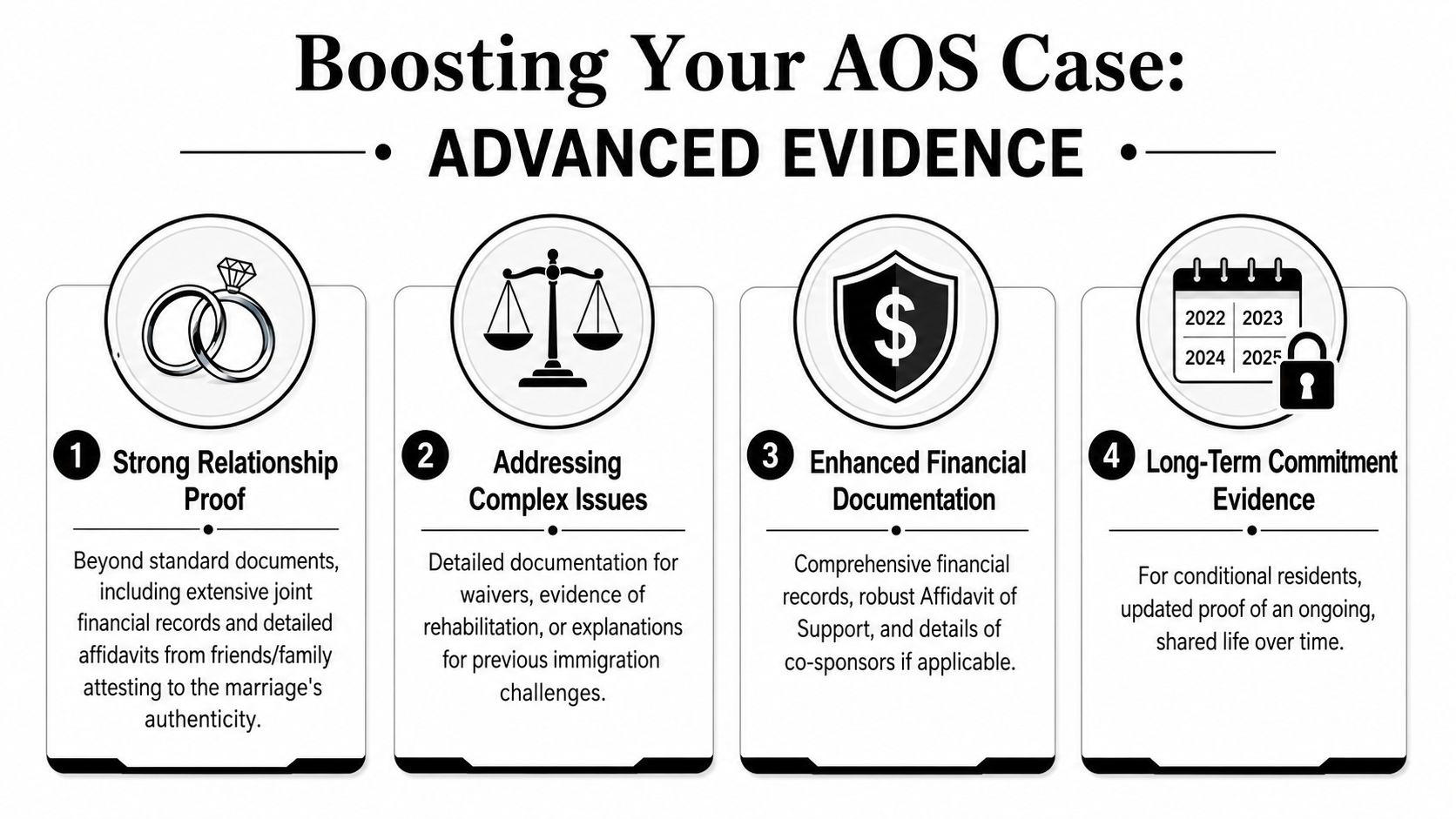
Advanced evidence matters most when the case includes a fact that live testimony alone may not explain well. That includes trauma symptoms, memory fragmentation, abuse dynamics, hardship severity, or a history that could be misread as inconsistency rather than impairment or fear.
A strong psychological evaluation can be especially useful in those cases. It can document clinical symptoms, connect those symptoms to trauma or abuse, and explain why a truthful applicant may present with avoidance, dissociation, hypervigilance, or fragmented recall. That does not replace testimony. It helps adjudicators interpret testimony correctly.
Thinking strategically about waivers and accommodations
Not every case will require an interview. USCIS regulations allow interview waivers on a case-by-case basis, and policy shifts around waivers have been used to manage backlogs, as discussed in this analysis of adjustment interview waivers. For practitioners, that means interview strategy begins before the notice arrives. It affects medical timing, filing completeness, and how much corroboration should be front-loaded into the record.
Even when a waiver is possible, applicants should prepare as if an interview could still be scheduled. That is especially true in cases involving humanitarian relief, admissibility concerns, or facts that benefit from contextual explanation. In some matters, reasonable accommodations or supplemental clinical evidence can make the interview fairer and the record clearer.
The strongest cases don't rely on hope that an officer will infer the right conclusion. They put the explanation in the file.
If your case involves trauma, abuse, memory issues, or hardship factors that need clinical explanation, Pro Psychological Analysis provides immigration-focused psychological evaluations that attorneys can use to corroborate complex facts with clear, evidence-based reporting. Their work is designed for legal settings and can help translate symptoms, trauma history, and functional impact into documentation that supports a stronger USCIS record.