
You're likely dealing with one of two case postures right now. In the first, the government or an opposing party has cast doubt on your client's judgment, stability, or ability to care for a child. In the second, your client's role as a reliable, protective parent is one of the strongest facts in the record, but the file doesn't yet translate that reality into admissible, persuasive clinical evidence.
That gap matters. In immigration practice, parenting facts often sit inside larger legal theories. A child's dependence on a parent can support hardship arguments. A survivor's efforts to protect and organize a child's life can sharpen a VAWA narrative. A family's functioning can also become vulnerable to attack when trauma, displacement, language barriers, or inconsistent records make normal parenting look suspicious on paper.
A well-executed parenting capacity assessment gives the court or USCIS something better than character letters and broad assertions. It converts day-to-day caregiving into a structured forensic analysis tied to child safety, emotional availability, supervision, and stability. For an attorney, that's where the advantage lies. A good report doesn't merely say a parent cares. It shows how that care operates under stress, how risks do or do not impair functioning, and why the child's real needs are met.
Table of Contents
- When Parenting Becomes Part of the Legal Strategy
- Defining the Parenting Capacity Assessment for Court and USCIS
- The Role of PCAs Across Different Immigration Cases
- Core Components of a Defensible Assessment
- Strategic Preparation for Attorneys and Clients
- Common Assessment Pitfalls That Weaken Immigration Cases
- The Pro Psychological Analysis Difference in Immigration Cases
- Frequently Asked Questions About Parenting Capacity Assessments
When Parenting Becomes Part of the Legal Strategy
A mother is applying for relief after prolonged abuse by a spouse. The legal theory is sound, but the record is thin where it counts. School attendance improved after separation. The child is calmer in the mother's care. The mother keeps medical appointments, manages routines, and shields the child from conflict. Yet the file also contains fragmented mental health treatment, inconsistent housing history, and a few ugly allegations from the abuser. Without clinical framing, those facts can be twisted either way.

That's where attorneys often need something more precise than a general psychological evaluation. The legal question usually isn't whether the parent has suffered, or whether the parent presents well in an interview. It's whether the parent can provide safe, responsive, stable care to this particular child, in this actual family context, despite the stressors in the case.
What the assessment does for the legal record
A strong parenting capacity assessment helps when the case turns on issues like these:
- Protective functioning: Did the parent recognize danger, respond to it, and organize the child's care despite trauma or coercion?
- Hardship evidence: What would happen to the child's day-to-day emotional and practical stability if this caregiver were removed?
- Credibility under pressure: Are inconsistencies better explained by trauma, language barriers, or chaotic living conditions than by parental unreliability?
- Risk clarification: Does a diagnosis, abuse history, or past instability indeed impair parenting, or is that inference unsupported?
Practical rule: If parenting is central to the relief sought, don't leave it buried in affidavits and school records. Put it into a functional forensic framework.
The strategic value isn't abstract. Immigration decision-makers respond better when clinical findings are tied to behavior they can understand: supervision, routines, emotional availability, safety planning, and the child's developmental needs. That's what turns family reality into legal traction.
Defining the Parenting Capacity Assessment for Court and USCIS
A parenting capacity assessment is a specialized forensic evaluation. Its job is narrow and practical. It asks whether a caregiver has the functional ability to meet a child's needs safely and adequately.
That may sound similar to a standard psych eval, but it isn't. A general psychological evaluation may identify symptoms, diagnoses, personality features, or trauma effects. A parenting capacity assessment goes further by connecting those findings, if they matter at all, to actual caregiving behavior. It is less like a routine medical checkup and more like a focused specialist consult on one legally significant question.
What the evaluator is actually measuring
Foundational guidance explains that modern parenting-capacity evaluation should focus on parenting itself, use a functional approach, and apply a minimal parenting standard rather than an idealized one, assessing what the caregiver “understands, believes, knows, does, and is capable of doing related to childrearing” in relation to the specific child's needs, as described by the NSW Judicial Commission review of assessing parenting capacity.
That point matters for immigration lawyers. The law often gets distorted by moral language. Opposing parties may imply that an unusual household structure, poverty, trauma history, or cultural difference means the parent is deficient. A proper parenting capacity assessment asks a different question. Not whether the parent is ideal. Whether the parent is good enough to meet the child's concrete needs.
For attorneys who want a broader distinction between forensic and general clinical assessments, this overview of the definition of evaluation in psychology is a useful companion.
What it is not
A parenting capacity assessment is not:
- A lifestyle audit: The evaluator shouldn't punish a parent for not fitting middle-class or culturally dominant norms.
- A custody popularity contest: The purpose isn't to decide who is more polished or more verbally articulate.
- A diagnosis-driven shortcut: Depression, PTSD, or anxiety may be relevant, but only if they affect parenting function.
- A generic best-interests opinion: The analysis should remain tied to the legal referral question and the child's actual needs.
The best reports don't moralize. They explain how the parent functions with the child.
Why this distinction matters in immigration matters
USCIS officers and immigration judges don't need a broad character sketch. They need reliable, behavior-based analysis. If the parent has trauma symptoms but still maintains routines, responds to distress, and protects the child from unsafe adults, that distinction can change how the record reads. If the parent is overwhelmed in some areas, the report should specify where, how often, under what conditions, and with what practical consequences for the child.
That level of specificity is what makes the evaluation legally useful instead of merely descriptive.
The Role of PCAs Across Different Immigration Cases
The same parenting capacity assessment can serve very different legal aims depending on the case. The mistake I see most often is using one generic referral question for every matter. That weakens the report before the interview even begins.
In immigration work, the assessment should be built around the claim you need to prove. In one case, the central issue may be the child's dependence on a stabilizing caregiver. In another, it may be the parent's protective functioning after abuse. In another, it may be whether trauma-related presentation is being misread as dangerous or neglectful parenting.
Where the evidentiary focus shifts
Here's the quick-reference version attorneys need:
| Immigration Case Type | Primary Goal of the PCA | Key Questions to Address |
|---|---|---|
| Asylum | Document how trauma, displacement, and fear affect parenting presentation without collapsing function into incapacity | Does the parent remain able to provide safety, responsiveness, and structure? Would forced return disrupt the child's security and caregiving environment? |
| VAWA | Show the client's strengths as a protective parent despite coercion, abuse, or psychological injury | How did abuse affect decision-making, help-seeking, and household control? What protective actions did the parent take for the child? |
| Extreme Hardship Waiver | Demonstrate the child's dependence on this caregiver's daily functioning | What caregiving tasks, emotional regulation, supervision, and stability would be lost if the parent were removed? |
| T Visa or U Visa related family context | Clarify how victimization affects family functioning while preserving a grounded view of current parenting ability | Does trauma history impair parenting in a functional way, or is the parent maintaining adequate care with identifiable supports? |
Attorneys working in related psychological evidence issues may also find this discussion of mental health and immigration helpful when deciding how to integrate clinical evidence across forms of relief.
The referral question drives the report
A strong referral question is targeted. It doesn't ask, “Is this a good parent?” It asks things like:
- For hardship: How does the parent currently meet the child's emotional, practical, and safety needs?
- For VAWA: What is the functional relationship between abuse dynamics and parenting, including protective behavior?
- For asylum: How should trauma, acculturation stress, and migration-related instability be distinguished from actual parenting incapacity?
When the legal theory is clear, the clinical work becomes sharper. The evaluator knows what nexus must be established. The attorney receives a report that can be cited for a defined proposition instead of mined for stray favorable sentences.
What a PCA can add that other evidence often cannot
Records can show attendance, treatment, housing changes, or police contact. They rarely explain how those facts affect a child's lived experience. A parenting capacity assessment fills that gap by organizing the evidence around parenting tasks. It shows whether the parent can supervise, soothe, set boundaries, protect, and maintain continuity.
That's often the difference between a record that feels sympathetic and a record that is legally persuasive.
Core Components of a Defensible Assessment
A defensible parenting capacity assessment is multi-method. That isn't a stylistic preference. It's the minimum structure needed to keep the report from collapsing under scrutiny.
A Canadian fact sheet notes that four of the most common assessment methods are checklists, observation, interviews, and psychological tests, while also noting that these tests are not always accurate and have not been properly validated for all populations, as summarized in the University of Toronto parenting capacity fact sheet.
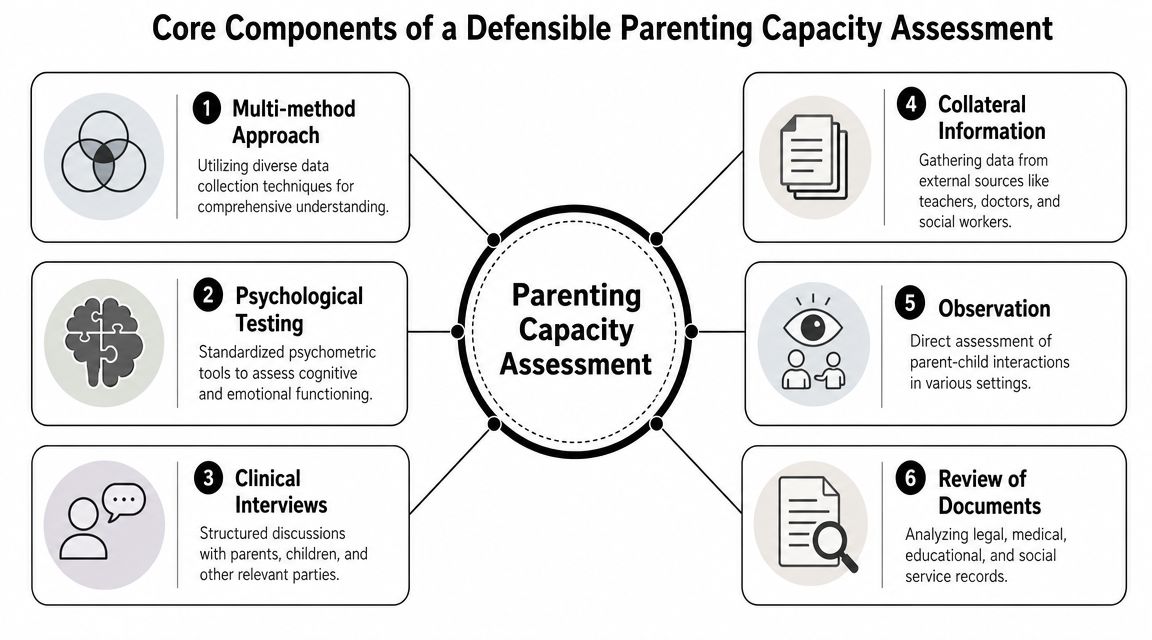
Clinical interview and history
The interview does more than collect biography. It tests the parent's understanding of the child, grasp of routines, awareness of safety concerns, and capacity for reflection. I want to know how the parent describes discipline, schooling, medical care, distress episodes, sleep, feeding, supervision, and the child's specific temperament.
A shallow interview produces a shallow report. If the clinician never gets past symptom history and immigration stress, the parenting analysis will be little more than opinion.
Observation and interaction data
Observation is where claims meet behavior. You learn whether the parent tracks the child's cues, responds to bids for comfort, sets limits without escalation, and repairs disruptions in real time.
This video offers a useful overview of how these evaluations are approached in practice:
Observation is especially important in immigration cases because many clients are disadvantaged by language, education, or trauma-related presentation in formal interviews. A parent may appear guarded with an evaluator and still be organized, responsive, and emotionally available with the child.
Records and collateral information
The assessment should test the parent's self-report against outside information. That can include school documents, pediatric records, therapist notes, shelter records, affidavits, and communications from teachers or case workers.
Not every collateral source is equal. Some know the family well. Some know only one incident. The evaluator's job is to weigh relevance, consistency, and context, not to stack paper and call it analysis.
For attorneys who regularly work with layered records and complex testing questions, a comprehensive neuropsychological evaluation offers a useful comparison point for understanding how structured multi-source assessment should work.
Testing and its limits
Testing can help, but only when it answers a real question. It shouldn't be inserted as a reflex. In culturally diverse or trauma-affected populations, overconfident test interpretation can mislead the case.
Bench standard: The report should explain what each method contributes, what its limits are, and how the findings connect to parenting behavior.
What makes the report defensible
A solid report usually shows these features:
- Methodological range: More than one data source, with clear integration.
- Child-specific analysis: Findings linked to this child's age, needs, vulnerabilities, and daily care demands.
- Behavioral nexus: Conclusions tied to the parent's actions.
- Stated limitations: Gaps, language issues, cultural questions, and record constraints acknowledged rather than hidden.
If those features are missing, the report may still sound polished. It just won't hold up as well when someone starts pushing on it.
Strategic Preparation for Attorneys and Clients
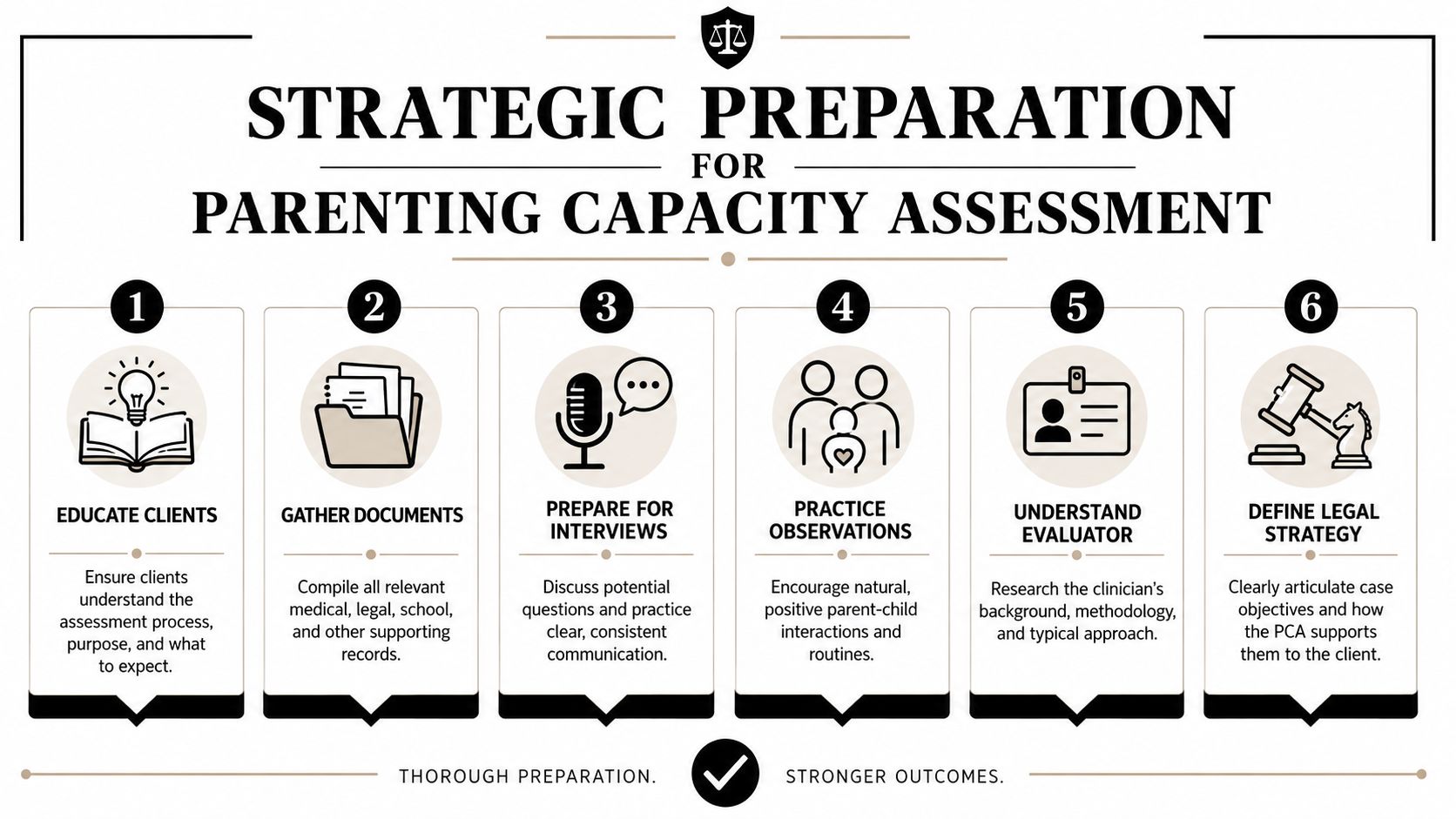
Most weak parenting capacity assessments don't fail because the parent performed poorly. They fail because the referral was vague, the records were incomplete, or the client arrived confused about the purpose of the evaluation.
Preparation is where attorneys create value. You're not coaching testimony. You're making sure the evaluator receives the right question, the right context, and the right documents.
What attorneys should do before the first interview
Start with the legal theory. If the case is about hardship, the evaluator should know exactly which child-centered consequences matter. If it's a VAWA matter, the evaluator should understand the abuse dynamics that shaped parenting decisions.
A strong attorney packet usually includes:
- Key records: School reports, medical records, prior declarations, treatment summaries, and any documents showing caregiving responsibilities.
- Timeline materials: A clean chronology of abuse, separation, migration, caregiving changes, and child functioning.
- Targeted referral questions: Narrow questions tied to statutory or evidentiary needs.
- Context on allegations: If the file contains abuse allegations, neglect concerns, or mental health claims, identify them clearly so they can be tested, not ignored.
How to prepare the client without coaching
Clients need clarity, not scripting. Tell them the evaluator isn't grading charm, education level, or English fluency. The task is to understand how they care for the child.
Good preparation sounds like this:
- Be concrete: Describe routines, responsibilities, and what happens on hard days.
- Don't guess: If you don't know something, say so.
- Expect uncomfortable topics: Trauma, conflict, discipline, substance use in the home, and prior child welfare concerns may come up.
- Stay natural with the child: Observation works best when the parent interacts as they ordinarily would.
Don't train a client to sound perfect. Perfect answers often sound manufactured. Specific answers sound credible.
What to watch during and after the assessment
Attorneys should review the final report with an eye toward legal usability, not just clinical thoroughness. Ask whether the report:
- Answers the referral questions
- Explains the link between symptoms or stressors and parenting function
- Separates allegation from verified observation
- Identifies both strengths and concerns
- Uses plain language that a judge or officer can follow
If a draft or final report contains broad conclusions without examples, push for clarification. A single sentence that ties a finding to a parenting behavior can make the difference between a useful exhibit and a decorative one.
Common Assessment Pitfalls That Weaken Immigration Cases
A flawed parenting capacity assessment can do real damage because it gives weak reasoning a professional cover. Once a bad opinion is in the record, counsel has to spend time limiting, explaining, or attacking it.
One recurring problem is narrow methodology. Expert guidance recommends combining historical records, collateral information, behavioral observation, and clinical interview, then evaluating both strengths and concerns. It also stresses that every finding should be tied to specific parenting behaviors before it is given analytic weight, and that adversities such as domestic abuse and mental health problems must be linked to functional capacity rather than diagnosis alone, as explained in this expert overview of parental capacity and fitness evaluations.
The shortcuts that should concern counsel
Watch for these red flags:
- Diagnosis as conclusion: The report treats PTSD, depression, or anxiety as proof of poor parenting without showing actual caregiving impairment.
- Single-source opinions: The evaluator relies almost entirely on the client interview or one third-party narrative.
- Thin observation: The report makes strong statements about attachment or responsiveness without meaningful parent-child interaction data.
- Unexamined cultural assumptions: The evaluator labels behavior as problematic without asking how caregiving norms operate in that family or community.
- Conclusive language without examples: The parent is called unstable, defensive, or unsafe, but the report doesn't say what happened, when, or why it matters for the child.
Why these flaws hit immigration cases especially hard
Immigration files often involve trauma, interpreters, fractured documentation, and allegations made in adversarial family settings. That means bad evaluative habits get amplified. A guarded interview may be read as evasiveness. Reliance on extended family may be misread as dependency. A parent's inconsistent narrative may reflect trauma or fear, not fabrication.
If the report doesn't separate those possibilities, it invites unfair inferences.
A report is strongest when it shows its work. If the conclusion can't be traced back to behavior, records, or observation, it's vulnerable.
The attorney's role isn't to become the psychologist. It's to recognize when the methodology is too thin to carry legal weight.
The Pro Psychological Analysis Difference in Immigration Cases
Many parenting frameworks identify what should be assessed but give far less guidance on how to avoid cultural bias in real cases. That gap is especially serious in immigration practice, where trauma, acculturation stress, language barriers, and nonstandard family structures can affect how a parent presents without meaning the child is unsafe.
A key concern noted in a fact sheet on assessing parenting capacity is that mainstream frameworks often don't spell out how to account for differences in family caregiving, discipline, and behavior across communities. For immigration attorneys, that isn't a theoretical issue. It affects whether a report helps the case or distorts it.
What that means in practice
In immigration matters, the useful evaluator is the one who can distinguish between these pairs:
- Trauma presentation and parenting incapacity
- Cultural variation and child-safety risk
- Past victimization and current protective functioning
- Stress-related inconsistency and chronic neglect
That requires more than technical competence. It requires disciplined forensic reasoning, careful use of interpreters, and a report style that speaks directly to legal standards without flattening the family's context.
When counsel chooses a provider for this work, the question isn't merely whether the clinician can evaluate parents. The question is whether the clinician can produce a child-focused, culturally responsive, litigation-ready analysis that survives scrutiny in an immigration record.
Frequently Asked Questions About Parenting Capacity Assessments
How long does a parenting capacity assessment take
There isn't one universal timetable. The length depends on the referral question, the number of interviews, whether observation is needed, how much collateral material exists, and whether interpreters are involved. In practice, attorneys should build in enough time for records review, direct assessment, and careful report drafting rather than treating this like a same-week symptom letter.
Is the assessment confidential
It's confidential within the limits of a forensic evaluation. That means the client needs a clear explanation of who the evaluator is, who will receive the report, and how the information may be used in litigation or filing. Clients should never walk into the process thinking this is ordinary therapy.
Will a mental health diagnosis automatically hurt the case
Not if the evaluator does the job correctly. A diagnosis matters only to the extent that it affects parenting function. Some parents have significant trauma histories and still provide organized, protective, emotionally responsive care. Others may struggle in specific domains. The report should distinguish between those possibilities instead of collapsing them into one label.
Can a parenting capacity assessment help if the record already contains negative allegations
Yes, if the evaluation is thorough and behavior-based. The point isn't to erase allegations. It's to test them against observation, records, context, and the child's actual functioning. Sometimes the assessment confirms a concern. Sometimes it narrows it. Sometimes it shows that the allegation overstates the parenting risk.
What should attorneys ask before retaining an evaluator
Ask how the evaluator handles cultural context, interpreters, collateral information, observation, and legally targeted referral questions. Ask whether the final report ties findings to concrete parenting behaviors. If the answer stays abstract, keep looking.
If you need a clinically rigorous report that aligns with immigration strategy, Pro Psychological Analysis works with attorneys to produce evidence-based psychological evaluations for immigration cases, including matters where parenting function, trauma, abuse dynamics, and child hardship need to be documented with clarity and care.