
You have a client with a strong story and weak proof. The declaration is compelling. The family letters are sincere. The trauma history makes sense. But when you ask the question that matters in immigration practice, the record gets thin fast: What objective evidence shows how this person's mind, memory, concentration, or day-to-day functioning has been affected?
That gap hurts otherwise good cases. In asylum matters, it can leave inconsistencies unexplained. In hardship cases, it can reduce severe impairment to vague distress. In VAWA, T, and U matters, it can flatten abuse and trauma into symptoms without demonstrating functional consequence. Adjudicators and courts don't just want a painful story. They want a defensible link between the story and impaired functioning.
A detailed neuropsychological evaluation can supply that link. Used well, it doesn't merely label someone with a diagnosis. It converts reported suffering into a structured, test-based explanation of what the person can and cannot do, where performance breaks down, and how those deficits fit the legal theory of the case.
Table of Contents
- From Subjective Story to Objective Evidence
- What a Neuropsychological Evaluation Actually Measures
- The Core Components of the Evaluation Battery
- How Evaluation Findings Strengthen Immigration Cases
- The Pro Psychological Analysis Process for Law Firms
- Preparing Your Client for a Successful Evaluation
- Anatomy of a Persuasive Report What to Look For
From Subjective Story to Objective Evidence
Immigration lawyers run into the same problem repeatedly. The client describes panic, forgetfulness, confusion, shutdown, poor sleep, fear, and inability to manage ordinary demands. None of that is hard to believe. The hard part is proving that these problems are more than self-report and that they materially affect functioning in ways relevant to the petition.
That is where a neuropsychological evaluation becomes strategically useful. In legal settings, the question is often not whether the client has symptoms. The question is whether those symptoms reflect measurable impairment with real-world consequences. CMS frames the distinction clearly: these tests are designed to determine the functional consequences of known or suspected brain dysfunction, which is why they matter in legal contexts where a symptom list alone won't carry the burden of proof, as reflected in CMS guidance on neuropsychological testing and functional consequences.

Why this matters in immigration practice
A declaration tells you what the client experienced. A neuropsychological evaluation helps show what those experiences did to attention, memory, executive functioning, processing speed, and emotional regulation. That shift matters because immigration adjudication rewards evidence that is organized, corroborated, and tied to function.
A well-done evaluation can help answer questions attorneys deal with every week:
- Why is the client inconsistent on dates or sequence? The issue may be trauma-related memory disruption, poor encoding, or impaired retrieval rather than deception.
- Why can't the qualifying relative relocate or adapt? The barrier may be impaired planning, reduced cognitive flexibility, depression-related slowing, or dependence in daily functioning.
- Why does abuse still matter if the relationship ended? Because the neurocognitive and psychological effects may persist and continue to impair safety, work, parenting, and judgment.
- Why is ordinary treatment documentation not enough? Because treatment notes often record complaints. They usually do not test performance.
The legal value is translation
Many lawyers already understand the basic definition of evaluation in psychology. What they often need is a sharper distinction between a general clinical evaluation and one that can withstand close legal scrutiny. Neuropsychological work is useful when the case turns on function, credibility support, differential explanation, or severity.
Practical rule: If your legal theory depends on how trauma, cognitive change, or psychiatric symptoms limit what the client can reliably do, a comprehensive evaluation is usually more persuasive than a brief screening or symptom checklist.
The best use of this tool is not to decorate the file with more paper. It is to convert a subjective narrative into objective, clinically reasoned evidence that supports the exact legal question in dispute.
What a Neuropsychological Evaluation Actually Measures
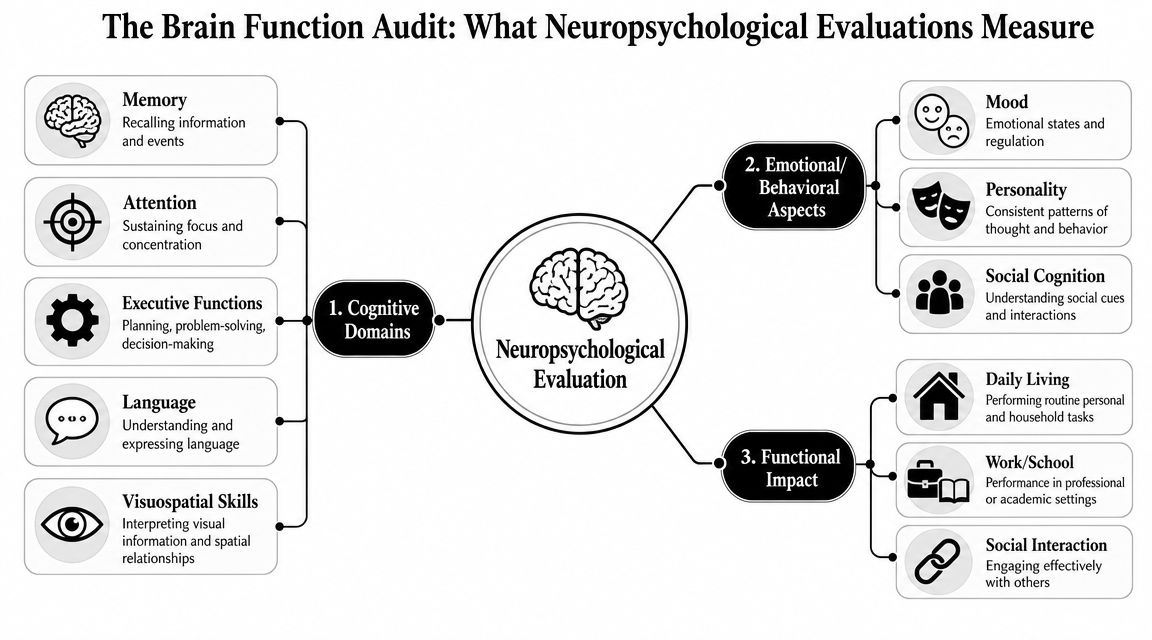
Think of a detailed neuropsychological evaluation as a brain function audit. It does not scan the brain. It does not produce a single magic score. It examines how the person performs across multiple systems that lawyers care about when a case depends on functioning, consistency, vulnerability, or capacity.
This is also why it takes time. A thorough evaluation is a multi-stage process that usually includes record review and an in-depth interview lasting about 1 to 2 hours, followed by direct testing that can range from less than 1 hour to 6 to 8 or more hours, depending on the referral question and the person's stamina, according to the NCBI overview of neuropsychological evaluation structure.
It measures performance, not just complaint
A standard psychological interview may tell you that a client feels overwhelmed, dissociative, depressed, or hypervigilant. A brief cognitive screener may tell you whether gross impairment is obvious. A thorough neuropsychological evaluation goes further. It samples performance across domains such as memory, attention, executive functioning, language, visuospatial skills, reasoning, and motor abilities, then interprets those results against demographic norms.
That matters because the legal question is rarely "Does this person feel bad?" It is usually closer to one of these:
| Legal concern | What performance testing can clarify |
|---|---|
| Inconsistent testimony | Whether memory processes are weak, disorganized, or trauma-affected |
| Hardship severity | Whether cognitive or emotional symptoms interfere with ordinary daily functioning |
| Vulnerability | Whether the person can plan, problem-solve, organize, and protect themselves |
| Differential explanation | Whether the pattern fits trauma, neurological injury, psychiatric illness, or some combination |
It looks for patterns
Single scores mislead. Neuropsychological work becomes persuasive because the evaluator examines a pattern across tasks, history, behavior during testing, and collateral records. Cleveland Clinic describes this as a battery-based, norm-referenced assessment that identifies intra-individual strengths and weaknesses and supports pattern analysis across etiologies such as traumatic brain injury, dementia, stroke, learning disorder, ADHD, and psychiatric or medical conditions, as described by Cleveland Clinic's overview of neuropsychological testing and assessment.
That pattern approach is essential in immigration cases. A client may present as depressed, but the deeper issue may be executive dysfunction that undermines judgment and adaptation. Another client may report poor memory, but testing may show intact retention and a different problem in attention or retrieval. Those distinctions change how you argue hardship, credibility, and functional limitation.
What it does not do
A thorough neuropsychological evaluation is powerful, but it has limits. It doesn't replace legal analysis. It doesn't prove every asserted fact in a declaration. It doesn't diagnose a condition by itself in the abstract. It provides structured evidence about performance and function, then places that evidence in a clinical framework.
The strongest reports don't just say the client has symptoms. They show where performance breaks down, why that breakdown is clinically coherent, and how it affects real-life demands relevant to the case.
That is why good referrals start with a precise legal question. When the attorney knows what must be proven, the evaluation can be built to answer it.
The Core Components of the Evaluation Battery
Most lawyers see the final report long after the testing is done, which can make the process look opaque. It isn't. The evaluation battery is a set of targeted measures chosen to answer a referral question. Its strength comes from being battery-based and norm-referenced, which allows pattern analysis across multiple cognitive domains rather than overreading one score, as explained in this discussion of neuropsychological assessment and ADHD.
The main domains and what they show
Below is the practical version lawyers need.
| Cognitive domain | Plain-English question | Real-world legal relevance |
|---|---|---|
| Attention and concentration | Can the person stay focused long enough to take in information? | Missed details, distractibility, inability to follow instructions |
| Learning and memory | Can the person encode, retain, and retrieve information? | Inconsistent recall, forgetting appointments, poor testimony detail |
| Executive functioning | Can the person plan, organize, shift strategies, and self-monitor? | Trouble adapting, parenting, managing paperwork, staying safe |
| Processing speed | How efficiently can the person take in and respond to information? | Slow completion, overload under stress, poor performance in complex settings |
| Language | Can the person understand and express information accurately? | Misunderstandings, word-finding problems, weak narrative structure |
| Visuospatial and perceptual skills | Can the person interpret visual information and spatial relationships? | Navigation difficulty, poor environmental awareness |
| Motor and psychomotor functions | Can the person coordinate mental and physical output efficiently? | Slowed work pace, reduced task completion, fatigue effects |
Why the battery matters more than any single result
A client with trauma may score poorly on one task because of anxiety, poor sleep, distractibility, or language burden. That single result means little by itself. A coherent pattern across multiple tasks means much more.
For example, if attention is weak, immediate learning is inefficient, and executive control is inconsistent, the evaluator may conclude that apparent memory failure is partly driven by poor encoding and disorganization. That is a very different legal story from saying, "The client has bad memory." One is clinically reasoned. The other is generic.
Norms are what make the findings defensible
Norm-referenced means the person's performance is interpreted against appropriate comparison standards rather than the evaluator's impression. In forensic contexts, that matters because opinions must rest on something more durable than intuition. The argument is not, "She seemed forgetful in my office." The argument is, "Her performance shows a pattern of weaknesses relative to expected functioning, and that pattern is consistent with the history and observed limitations."
A strong battery also helps with differential explanation. Similar complaints can arise from different causes. Trauma, major depression, neurological injury, chronic stress, developmental conditions, and neurodegenerative processes can all affect cognition. The evaluator's job is to sort through those possibilities and explain which pattern best fits the data.
A report becomes useful in court when test selection, behavioral observations, record review, and interpretation all point in the same direction.
For attorneys, the practical takeaway is simple. Don't ask only whether the client has a diagnosis. Ask what the battery showed about specific functional weaknesses, whether the pattern is internally consistent, and how clearly the report explains causation and consequence.
How Evaluation Findings Strengthen Immigration Cases
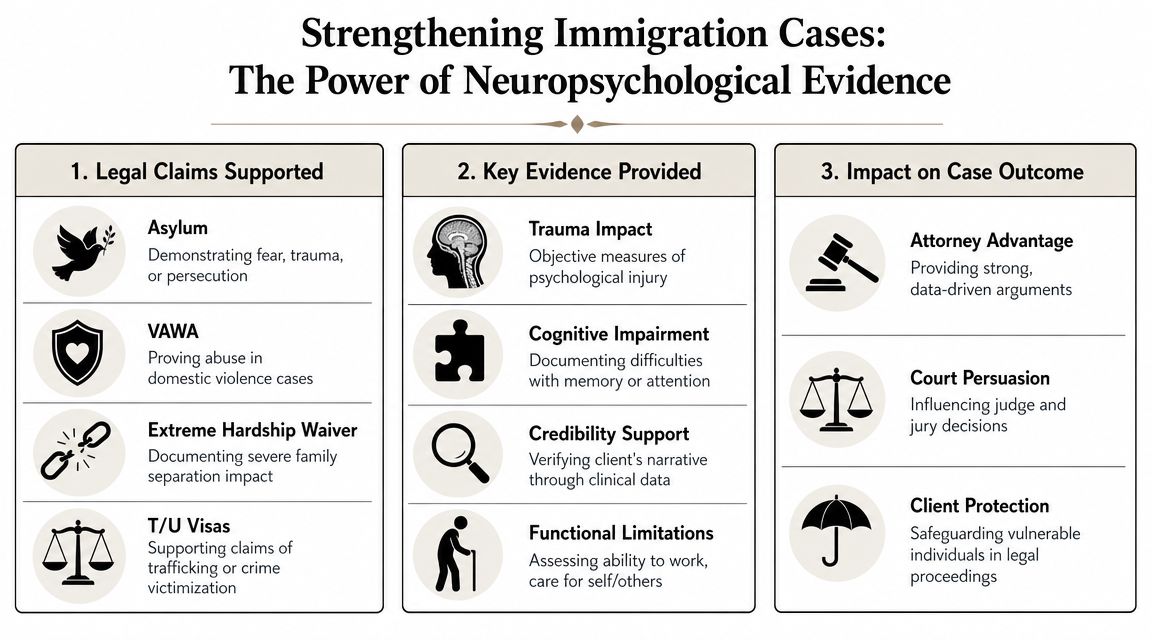
The evaluation secures its place in the file. Clinical detail matters only if it can be translated into legal significance. The best neuropsychological reports do exactly that. They connect measured deficits to credibility issues, hardship claims, vulnerability, dependency, and the likely effects of trauma or abuse on daily functioning.
Early in this section, it's useful to see the framework at a glance.
Asylum cases and credibility support
In asylum work, inconsistencies can sink a claim even when the underlying account is true. Trauma does not always produce a neat chronological narrative. Some clients fragment. Some avoid. Some recall the worst moments vividly while losing sequence, dates, or peripheral detail.
A thorough neuropsychological evaluation can help distinguish between intentional inconsistency and clinically understandable limits in encoding, retrieval, attention, and executive organization. That doesn't excuse every contradiction. It does provide a scientifically grounded explanation when the record otherwise invites a credibility attack.
Use the findings carefully:
- If memory encoding is weak: Argue that initial intake gaps or inconsistent details may reflect poor registration under high stress, not fabrication.
- If retrieval is inconsistent: Explain why the client may recall some events only with prompts or in non-linear form.
- If executive organization is impaired: Frame disorganized testimony as a function of poor sequencing and mental control rather than evasiveness.
Extreme hardship waivers and functional consequence
Hardship cases often fail because lawyers prove emotional pain but not operational impairment. Adjudicators expect separation to be painful. What moves the analysis is evidence that the qualifying relative or applicant cannot reasonably function, adapt, or manage essential life demands under the proposed conditions.
Executive dysfunction, processing inefficiency, trauma-related concentration deficits, and severe mood-related cognitive slowing can matter. The legal point is not abstract suffering. It is reduced ability to handle relocation, childcare, health management, employment demands, complex planning, and self-care.
A useful perspective:
| Finding | Stronger legal framing |
|---|---|
| Poor concentration | Reduced capacity to manage complex tasks consistently |
| Slowed processing | Difficulty functioning under ordinary time and stress demands |
| Executive weakness | Impaired planning, adaptation, and problem-solving in unstable settings |
| Memory weakness | Difficulty retaining instructions, appointments, and treatment demands |
VAWA and abuse-related impairment
In VAWA cases, lawyers often document the abuse thoroughly but underdevelop the cognitive and functional aftermath. Abuse can leave lasting effects on concentration, memory, judgment, emotional regulation, and day-to-day effectiveness. A neuropsychological report can show that the damage is not merely emotional in a broad sense. It is measurable in the client's current functioning.
That matters when the defense theme is minimization. "She left eventually." "He still works." "There are no medical injuries." Those arguments become weaker when objective testing and clinical integration show persistent impairment consistent with chronic abuse effects.
Here is a useful evidentiary point. Methodologically rigorous neuropsychological assessment gains force because it triangulates standardized testing with history and collateral information, and clinical sources note that this can help distinguish neurologic from psychiatric conditions and link trauma and mood to observable functional impairment rather than self-report alone. That same source also notes accuracy rates near 90% for distinguishing dementia from psychiatric conditions in relevant contexts, as discussed in this clinical review of comprehensive neuropsychological testing and evaluations.
A short explainer can help clients and counsel frame the role of mental health evidence in legal proceedings:
T and U visa matters
T and U cases often involve severe trauma, coercion, victimization, fear, and prolonged instability. A neuropsychological evaluation can support these cases by documenting the downstream effects of trauma on cognition and functioning. That can help explain delayed reporting, confusion, fragmented narrative, difficulty cooperating, and dependence on others.
When a case turns on "substantial harm," don't stop at diagnosis. Show what the person can no longer do reliably, safely, or independently.
The most persuasive reports in immigration practice don't just describe impairment. They give the attorney usable language for briefing and testimony. That is the difference between a clinical document and a forensic asset.
The Pro Psychological Analysis Process for Law Firms
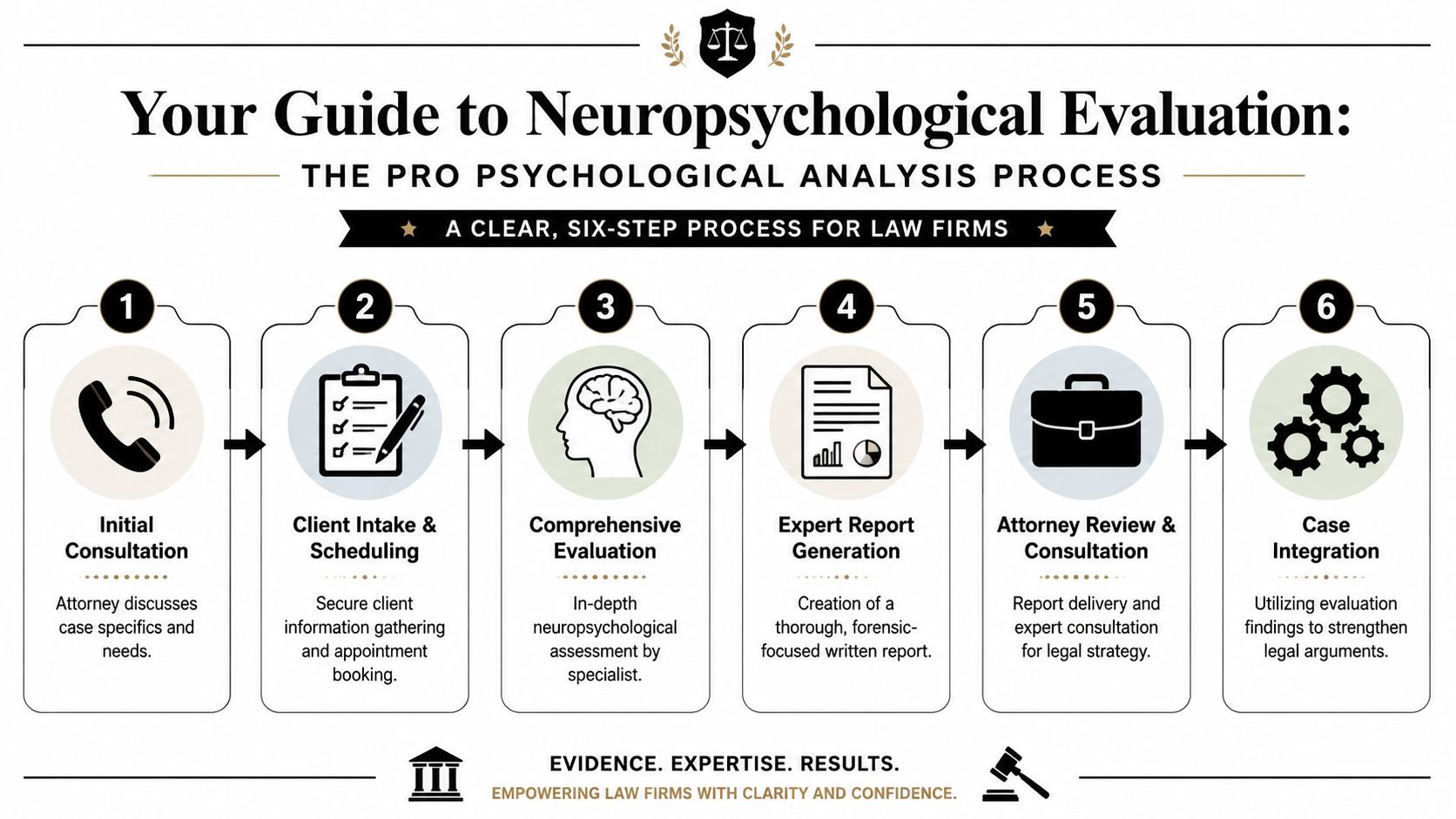
From a law firm's perspective, the biggest operational question isn't whether neuropsychological evidence can help. It's whether the process will be organized, legally useful, and manageable for the client. The right workflow reduces friction for everyone involved.
What attorneys need from the process
Law firms usually need five things from an evaluator:
- Clear intake expectations: What records matter, what legal question is being addressed, and whether the case is appropriate for a thorough neuropsychological evaluation.
- Client-friendly scheduling: Trauma-affected clients often need flexibility, reminders, language support planning, and realistic preparation.
- Secure document handling: Sensitive medical, psychiatric, family, and legal records have to move through a HIPAA-conscious process.
- A legally focused report: Not generic treatment prose. The opinion should answer the referral question in plain, defensible language.
- Reliability under deadline: Court and filing calendars don't tolerate avoidable delays.
Why hybrid options matter
Not every client can travel easily. Some clients live far from major evaluation centers. Others have mobility limits, childcare barriers, or safety concerns. Modern neuropsychology has adapted to that reality. Telehealth-enabled and hybrid models can allow certain components of a thorough evaluation to occur virtually, improving access without abandoning rigor, as described in this review of telehealth-enabled neuropsychology and tiered care models.
That does not mean every measure should be administered remotely. Good practice requires judgment about which parts can be done virtually, which should remain in person, and how to preserve interpretive integrity. For attorneys, the practical point is this: access and validity are not opposites if the evaluator understands the limits of remote administration.
A streamlined law-firm workflow
A forensic-ready process usually looks like this in practice:
Referral question first
The attorney identifies the legal issue. Credibility support, hardship severity, abuse impact, trauma sequelae, capacity, or functional limitation.Targeted record collection
The evaluator reviews declarations, treatment notes, school or work records, prior assessments, relevant medical material, and collateral documents.Interview and testing plan
The structure of the evaluation is matched to the legal question and the client's presentation.Testing with flexibility
Breaks, pacing, and trauma-informed handling matter. Stamina is part of validity, not an inconvenience.Forensic interpretation
The report connects findings to function and to the case theory.Attorney consultation
Counsel should have the chance to clarify language, ask follow-up questions, and understand how best to use the report.
The process works best when the attorney sends a focused referral letter. A vague request for "evaluation for immigration case" usually produces a less useful product than a request tied to precise legal questions.
For law firms, that level of structure is what turns a clinical service into dependable litigation support.
Preparing Your Client for a Successful Evaluation
The quality of the evaluation depends partly on client preparation. Not coaching the answers. Not rehearsing symptoms. Preparing the person to participate fully and understand the purpose of the process.
Clients often arrive worried that they are being tested for honesty. That framing is counterproductive. The better explanation is simple: the evaluator is trying to understand how the client functions, where difficulties appear, and how those difficulties relate to the history in the case.
What to tell the client beforehand
Use plain language. I often recommend something close to this:
"The evaluation is not a pass-fail test. It is a structured way to understand how stress, trauma, or cognitive problems may be affecting your daily life."
That lowers defensiveness and reduces performative responding. It also helps clients stop trying to guess the "right" answer.
A few practical instructions improve participation:
- Sleep as well as possible: Fatigue can affect attention, speed, frustration tolerance, and effort.
- Eat beforehand: Hunger makes long testing sessions harder.
- Bring needed aids: Glasses, hearing aids, medication lists, and any device required for ordinary functioning.
- Expect breaks: Clients should know it's acceptable to say when they need one.
- Avoid rehearsing details: Reviewing a declaration is fine. Memorizing phrases is not.
- Be candid about limitations: Shame causes underreporting. Exaggeration causes different problems. Accuracy is the goal.
What attorneys should not do
Well-meaning lawyers sometimes damage the process by overpreparing the client. Don't tell the client which diagnoses might help. Don't suggest that poor performance is desirable. Don't frame the appointment as an exam they need to "pass," even if the client has read advice online about how to pass a psychological evaluation.
That kind of coaching can distort the presentation and weaken the report.
A better attorney script
If you want a useful script, use one that keeps the client grounded:
| Say this | Avoid this |
|---|---|
| "Answer based on your actual experience." | "Make sure they understand how bad it is." |
| "If you don't know, say you don't know." | "Try to remember every detail perfectly." |
| "Ask for clarification if needed." | "Don't ask too many questions." |
| "Take breaks when necessary." | "Push through no matter what." |
Clients who understand the process usually perform more naturally. That leads to cleaner data, better interpretation, and a stronger final opinion.
Anatomy of a Persuasive Report What to Look For
Not every neuropsychological report is useful in immigration court. Some are clinically competent but legally thin. Others are heavy on diagnosis and light on function. The report you want is one that answers the referral question in a way an adjudicator or judge can use.
The opening sections should establish foundation
A persuasive report starts with the basics done well. It should identify who was evaluated, why the referral was made, what records were reviewed, and what methods were used. If the report doesn't clearly state the legal or forensic question, the rest of the document often wanders.
Look for these foundational pieces:
- Referral question: The report should say exactly what issue it was asked to address.
- Records reviewed: Declarations, treatment records, medical materials, school or work records, and collateral data should be listed with enough specificity to show real review.
- Clinical interview summary: This should synthesize history, not be a mere transcription of complaints.
- Behavioral observations: How the client presented, persisted, responded to frustration, and handled tasks can matter.
Test data should be interpretable, not dumped
A common weakness in reports is score dumping. Pages of raw or semi-raw data without synthesis do not help the court. A good report presents testing results in an organized way and explains what they mean in plain English.
The evaluator should translate findings such as these:
| Raw clinical area | Useful forensic translation |
|---|---|
| Reduced attention | Misses details, loses track, struggles with sustained tasks |
| Poor verbal learning | Has difficulty taking in and later recounting complex verbal information |
| Executive dysfunction | Cannot reliably plan, organize, adapt, or self-monitor under stress |
| Slow processing speed | Needs more time, becomes overwhelmed, works inefficiently |
If you can't read the interpretation without specialized training, the report may still be clinically valid, but it isn't doing enough forensic work.
Differential reasoning is where quality shows
The strongest reports explain why the observed pattern fits one formulation better than another. That means addressing alternative explanations rather than ignoring them. If the client has trauma history, depression, possible neurological insult, limited education, language complexity, or medical confounds, the evaluator should discuss those variables.
This is also where the report shows intellectual honesty. A court-ready document doesn't overclaim. It identifies limitations, explains the basis for conclusions, and distinguishes between what is well supported and what remains provisional.
A persuasive report does not sound certain about everything. It sounds careful about the right things.
The most important section is the nexus opinion
For immigration lawyers, the critical portion is the opinion that links findings to the legal issue. Sometimes this appears under forensic opinion, clinical formulation, impressions, or recommendations. Whatever the heading, it should answer questions such as:
- How do the test findings relate to the client's trauma, abuse history, or cognitive complaints?
- What functional limitations were demonstrated?
- How do those limitations affect testimony, adaptation, daily living, parenting, work, or safety?
- How does the clinical picture support the legal theory of hardship, victimization, vulnerability, or credibility explanation?
A report without a clear nexus section may still be informative, but it leaves too much inferential work for counsel.
Signs the report will help rather than sit in the file
The best reports share a few traits:
- They are specific. They don't hide behind general mental health language.
- They are restrained. They avoid advocacy masquerading as science.
- They are functional. They explain consequences, not just symptoms.
- They are readable. A non-clinician can follow the logic.
- They are aligned. The clinical reasoning matches the legal issue presented.
When attorneys know what to look for, they can choose evaluators more intelligently, ask better referral questions, and use the finished product far more effectively.
If your case needs more than a symptom summary, Pro Psychological Analysis provides immigration-focused psychological evaluations that translate trauma, cognitive findings, and functional impairment into clear, evidence-based reports for asylum, VAWA, T visa, U visa, and hardship matters. Their work is built for attorney use, with secure handling, timely delivery, and opinions designed to answer the legal question that actually matters.