
You have a client with a real physical problem and thin documentation. The treating doctor wrote “unable to work” or “limited by pain,” but the file doesn't tell a judge, officer, or adjudicator what that means in functional terms. Can the client sit through a shift. Lift a child. Carry groceries. Climb stairs. Sustain posture. Use their hands reliably. Legal decision-makers often need more than diagnosis and sympathy. They need observable, structured evidence.
That's where a Functional Capacity Evaluation, or FCE, becomes useful. For attorneys, the value isn't that it produces a dramatic conclusion. The value is that it converts complaints into measured task performance under controlled conditions. In the right case, that can tighten a record that otherwise relies too heavily on narrative statements.
Immigration lawyers should also keep one distinction in mind from the start. An FCE is about physical function. It does not do the work of a trauma-focused psychological evaluation, and it shouldn't be asked to. Those tools answer different legal questions, and strong cases usually get stronger when each expert stays in their lane.
Table of Contents
- When a Doctor's Note Is Not Enough
- Defining Functional Capacity Evaluation
- Inside the FCE What Tests Are Performed
- Interpreting the FCE Report
- FCE vs Psychological Evaluation A Critical Distinction
- Uses of FCEs in Medical-Legal Cases
- Strengths Limitations and What to Expect
When a Doctor's Note Is Not Enough
A familiar file crosses your desk. Your client has a back injury, chronic pain, neuropathy, post-surgical weakness, or another condition that plainly affects daily life. The chart is thick with treatment notes, but the key statement is still vague: “patient should avoid work” or “patient has difficulty with physical activity.”
That language may be clinically understandable, but it often has weak evidentiary value. It doesn't tell the reader what the client can do safely, how long they can do it, or whether performance is consistent.

An FCE fills that gap. It is not treatment, and it is not just a routine office exam. It is a structured assessment of work-related physical ability. Instead of stopping at diagnosis, it asks a more useful legal question: what can this person perform, safely and repeatedly, in a work-like setting?
Why legal readers care about function
A court or agency usually reads medical evidence through a practical lens. Functional proof tends to carry more weight than broad conclusions. “Lumbar radiculopathy” matters, but “cannot safely lift from floor to waist on a sustained basis” often matters more when someone is evaluating employability, restrictions, or hardship.
That distinction is especially important when lawyers work across disciplines. A psychological evaluator may document trauma symptoms, concentration problems, fear responses, or depressive impairment. A useful definition of evaluation in psychology shows how different that process is from a physical capacity exam. One assesses mental and emotional functioning. The other measures observable physical performance.
Practical rule: If your legal theory depends on what the body can or cannot do, a conclusory doctor's note is often too thin by itself.
What an FCE adds to the record
In practice, an FCE can help answer questions like these:
- Safe lifting tolerance: Can the client lift, carry, push, or pull within the demands of a real job.
- Postural endurance: How long can the client sit, stand, walk, or maintain a position before mechanics break down or symptoms escalate.
- Consistency: Does observed performance line up with reported limitations across multiple tasks.
- Job relevance: Can the findings be compared to actual work demands or modified duty options.
That's why attorneys use FCEs when they need more than “patient reports pain.” They need a document that shows how pain and impairment translate into work function.
Defining Functional Capacity Evaluation
The shortest accurate answer to what is functional capacity evaluation is this: it's a standardized, performance-based assessment of physical work capacity. It compares what a person can do in testing with what a job requires in the real world.
Think of it as a physical work-readiness audit. It does not primarily answer why a person hurts. It answers what that person can demonstrate safely and consistently despite the condition.
What the evaluation is designed to measure
A credible FCE asks concrete questions:
- Can the person meet the physical demands of a specific job.
- What are the person's tolerances for tasks such as lifting, carrying, or sustained standing.
- Is the demonstrated performance reliable enough to support restrictions, accommodations, or return-to-work planning.
That standardized structure is part of why FCEs became important in medical-legal settings. A review indexed in PubMed Central noted that Functional Capacity Evaluations were widely discussed by the early 2000s as tools intended to reliably measure a person's ability to perform work-related tasks, with core psychometric expectations including intra-rater, test-retest, and inter-rater reliability. That same review describes modern FCE sessions as commonly involving job-simulated activity and lasting about 4 to 8 hours, often over one or two days, to capture more than a brief snapshot of function (PubMed Central review of Functional Capacity Evaluation).
What an FCE is not
It is not a generic fitness test. It is not a treating physician's narrative letter with more pages. It is not a vocational opinion by itself. And it is not a legal conclusion.
That matters because attorneys sometimes ask an FCE to do too much. The examiner can document capacity, tolerances, movement quality, and observed limitations. The examiner cannot decide the case.
An FCE is most useful when the legal issue turns on measurable physical performance, not when the file needs diagnosis, causation analysis, or psychiatric formulation.
Why standardization matters
A non-structured office exam may identify pain, tenderness, weakness, or reduced range of motion. Those findings can still be important. But an FCE has a different evidentiary posture because it uses a defined battery of tasks performed under controlled observation.
For legal readers, that makes the report easier to defend and harder to dismiss as conclusory. It gives the record a structured answer to questions like: what can the claimant do repeatedly, how safely, and under what restrictions?
That is the distinction. A doctor's note often states an opinion. An FCE shows the underlying functional basis for one.
Inside the FCE What Tests Are Performed
Attorneys who haven't seen one often assume an FCE is a glorified strength test. It isn't. A proper evaluation is a battery of work-related tasks, observed carefully and interpreted against job demands.
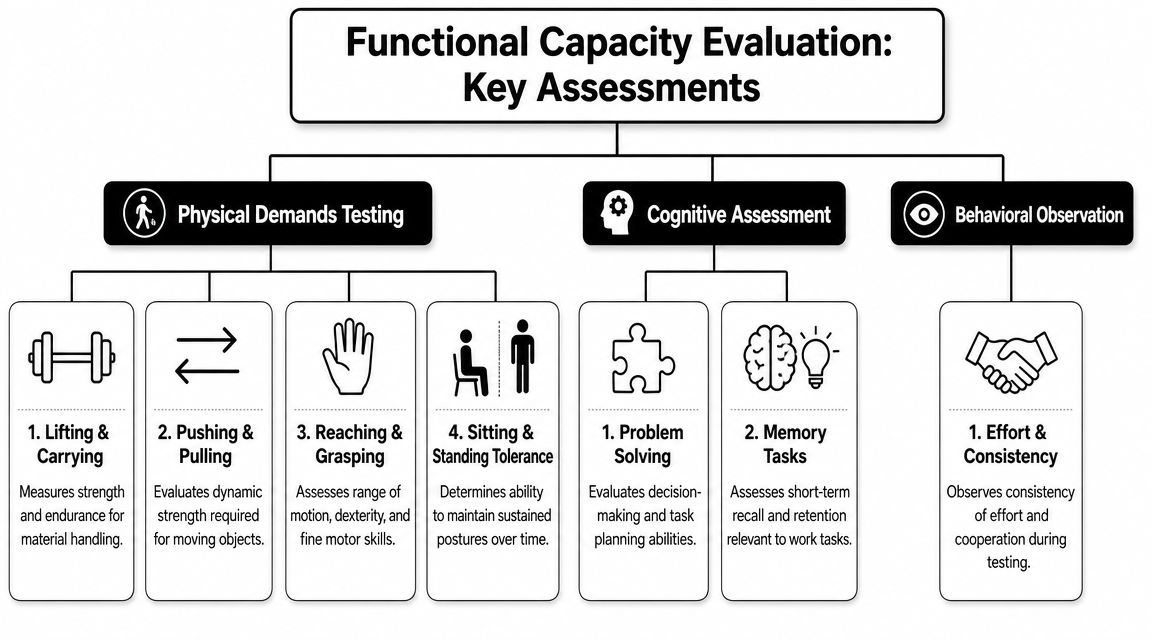
A practical summary from Physio-pedia describes an FCE as a performance-based battery of tests comparing a person's abilities to specific job demands. It identifies common domains such as lifting, carrying, pushing/pulling, balance, fine motor function, and cardiovascular tolerance, and notes that results are often interpreted against occupational standards such as the U.S. Department of Labor's Dictionary of Occupational Titles (Physio-pedia overview of Functional Capacity Evaluation).
Material handling and posture tolerance
The first category is usually what lawyers expect. The client may lift from floor to waist, waist to shoulder, carry weighted objects, or perform pushing and pulling tasks. The evaluator observes not just whether the task gets done, but how it gets done. Mechanics, compensation patterns, pacing, guarding, and symptom response all matter.
Another major category is postural tolerance. Some clients can perform a task once but cannot sustain it. Sitting, standing, walking, reaching, bending, balancing, or repeated positional change may tell you more about employability than a one-time lift.
Here is how those findings often become legally relevant:
- Lifting and carrying: Useful when the issue is warehouse work, caregiving, food service, construction support, or any job with material handling.
- Standing and walking tolerance: Often central in retail, cleaning, hospitality, delivery, and manufacturing roles.
- Reaching and positional change: Important in assembly, clerical tasks, stocking, housekeeping, and home care work.
Fine motor demands and observed behavior
Some files rise or fall on hand use rather than gross strength. Fine motor testing may examine grasp, dexterity, repetitive hand use, and coordination. For a client whose work involves keyboarding, sorting, packaging, or instrument handling, this part of the exam can matter a great deal.
Evaluators also watch the client's performance pattern across tasks. That includes safety, movement consistency, pacing, and whether effort appears reproducible. Many attorneys, however, overread the process. The evaluator is not acting as a fraud investigator. The evaluator is documenting whether observed performance forms a coherent functional picture.
The most useful FCEs don't just record whether a box moved from one shelf to another. They document the quality, safety, and repeatability of the movement.
Why the test battery matters to lawyers
If you read an FCE report closely, the individual tasks are less important than the pattern they create. A client may show limited lifting but decent carrying. Or decent single-task performance with poor tolerance across time. Or adequate strength with unsafe mechanics.
Those distinctions matter because legal claims often turn on sustained capacity, not isolated capability. A person who can do something once under supervision may still be unable to meet the essential physical demands of competitive work.
Interpreting the FCE Report
The report is where the value of the exam either sharpens or gets lost. Attorneys who read only the conclusion miss the full impact. The stronger approach is to track how the evaluator got there.
A typical report usually includes the referral question, relevant history, the tasks performed, observed behavior during testing, and a functional summary. The heart of it is the comparison between demonstrated ability and expected job demand.
What to read first
Start with the plain-language summary. Identify the examiner's key opinions about safe performance, restrictions, and reliability. Then read backward into the testing details to see whether those opinions are well supported.
Pay special attention to these sections:
- Functional tolerances: Sitting, standing, walking, lifting, carrying, reaching, hand use, and positional activity.
- Safety observations: Whether movement quality suggests risk of reinjury or inability to perform essential tasks safely.
- Job match analysis: Whether the report compares capacity to a real job description, a modified-duty proposal, or a general occupational category.
- Consistency discussion: Whether performance remained stable across tasks or varied in ways that need interpretation.
The consistency issue
This is the part lawyers often quote too aggressively. An FCE may evaluate consistency of effort and note discrepancies between reported symptoms and observed abilities. That can be important. It can also be misunderstood.
An inconsistency does not automatically mean deception. It may reflect pain fluctuation, fear, poor mechanics, misunderstanding, deconditioning, or a mismatch between expectation and tested performance. The legal use of the observation depends on context.
If a report notes inconsistent effort, don't turn that sentence into an accusation unless the evaluator actually supports that interpretation.
How conclusions become admissible arguments
The report becomes useful when you translate findings into the legal question in dispute. That usually means moving from raw observations to a statement about function.
For example:
| Report finding | Legal use |
|---|---|
| Limited tolerance for sustained standing | Supports inability to perform jobs requiring prolonged upright posture |
| Reduced safe lifting capacity | Supports restriction from material-handling work |
| Difficulty with repetitive hand tasks | Supports limits in clerical, sorting, or production roles |
| Performance declined across testing | Supports argument that isolated ability does not equal sustained work capacity |
A weak argument says the client is “disabled because the FCE was bad.” A stronger argument says the evaluator documented specific task limits that conflict with the essential physical demands of the relevant work.
That is the difference between attaching an exhibit and using it.
FCE vs Psychological Evaluation A Critical Distinction
Immigration attorneys regularly use clinical evidence, but not all clinical evidence serves the same function. An FCE and a psychological evaluation may both look like “expert assessments” from the outside. In substance, they are very different tools.
An FCE addresses physical performance. A psychological evaluation addresses mental, emotional, cognitive, and trauma-related functioning. When lawyers confuse them, they either ask the wrong expert the wrong question or submit evidence that only partially answers the adjudicator's concern.
Different questions, different evidence
If your client says, “I can't keep a job because I panic, dissociate, can't concentrate, and shut down around authority,” that is not an FCE issue. If your client says, “I can't safely lift, carry, stand, or use my hands for sustained work,” that is not primarily a psychological evaluation issue.
A useful clinical assessment overview for attorneys helps frame the broader point. Clinical assessments are designed around the question being asked. Good legal strategy starts there.
Here is the practical comparison.
FCE vs. Psychological Evaluation at a Glance
| Aspect | Functional Capacity Evaluation (FCE) | Psychological Evaluation |
|---|---|---|
| Primary focus | Physical ability to perform work-related tasks | Mental health, trauma, cognition, emotional functioning |
| Core question | What can the body do safely and consistently | How do symptoms affect thought, mood, behavior, and functioning |
| Typical methods | Performance-based physical tasks and observed movement | Clinical interview, records review, psychological testing, symptom analysis |
| Common outputs | Restrictions, accommodations, job-demand comparison | Diagnoses, trauma formulation, functional mental-health impact |
| Best use | Return-to-work, disability, physical hardship documentation | Asylum, VAWA, T visa, U visa, hardship waivers, trauma evidence |
| Example question answered | Can the client safely lift and carry within job demands | Does the client's PTSD impair concentration, judgment, or social functioning |
Why this matters in immigration practice
In immigration matters, psychological evaluations are often more central because the legal theory frequently turns on trauma, abuse, coercion, fear, emotional harm, or psychiatric impairment. Those are outside the scope of an FCE.
That said, there are cases where physical function matters. A hardship record may depend partly on showing that a qualifying relative has a serious physical limitation affecting daily tasks or dependence on the applicant. In that setting, an FCE can complement the file. It cannot replace the psychological evidence when the issue is trauma or mental health.
Use an FCE when the body is the issue. Use a psychological evaluation when the mind, trauma history, or emotional functioning is the issue. In some cases, you need both.
The cleanest records separate those roles. They don't blur them.
Uses of FCEs in Medical-Legal Cases
FCEs are most at home in systems that ask concrete work-capacity questions. Workers' compensation is the classic example, but the same logic appears in disability and injury litigation.

A practical clinical summary from MeasurAbilities explains that FCEs are typically administered by a trained evaluator, often a physical therapist, to document capacity for return-to-work, disability, or claim-related decisions, with reports comparing measured abilities against job demands to support work restrictions, accommodations, or disability eligibility (MeasurAbilities on comprehensive Functional Capacity Evaluation).
Where they fit naturally
In workers' compensation, the FCE often addresses whether the injured worker can return to full duty, modified duty, or no duty. The central issue is not diagnosis alone. It is safe performance.
In personal injury litigation, the report can help quantify functional loss in concrete terms. If the plaintiff alleges reduced earning capacity because physical tasks are no longer sustainable, an FCE may provide a more disciplined foundation than a broad self-report.
In disability claims, the exam can reinforce restrictions with observed task data. It does not decide entitlement, but it can make the physical impairment discussion more specific.
For attorneys handling these records in adversarial settings, expert testimony support in medical-legal matters often becomes important when the report must be explained, defended, or integrated with other expert opinions.
The narrower role in immigration cases
For immigration lawyers, the FCE is usually a supporting document, not the centerpiece. Most USCIS and immigration court matters turn more often on trauma, abuse dynamics, psychiatric symptoms, fear, or hardship in a broader psychosocial sense.
Still, there are situations where an FCE can matter:
- Hardship involving a physically disabled relative: The record may need objective proof that daily tasks are limited and assistance is necessary.
- Cases involving inability to work due to physical impairment: The issue may require more than a physician's diagnosis.
- Mixed physical and psychological hardship records: An FCE can address bodily limitations while another evaluator addresses trauma or psychiatric impact.
A brief visual overview can help if you're explaining the concept to clients or colleagues before deciding whether to order one.
The strategic point is simple. In immigration practice, an FCE is rarely the first evaluation you think of. But in the right fact pattern, it can turn vague physical hardship into evidence with sharper edges.
Strengths Limitations and What to Expect
The strongest feature of an FCE is objectivity about function. It gives you observed performance, not just diagnosis and complaint. That makes it useful when the dispute is practical: can this person safely do the physical things the job or daily life requires?
Its limits matter just as much. An FCE is still a snapshot of performance on the day of testing. It does not measure every variable that affects employability. It does not tell you whether a person is motivated, place them in a labor market, or replace a detailed job analysis. And it does not settle a psychiatric question.
What it can and cannot prove
One frequent misunderstanding deserves a direct answer. An FCE may assess consistency of effort and identify discrepancies between reported symptoms and observed ability, but it does not establish malingering on its own. That point is addressed clearly in Enlyte's discussion of FCE practice, which notes that these observations must be interpreted within broader clinical context and should not be treated as definitive judgments about exaggeration (Enlyte on Functional Capacity Evaluation limitations and consistency findings).
What to tell clients
Clients usually do best when they understand three basics:
- Wear practical clothing: The exam involves movement, posture, and physical tasks.
- Give honest effort: Overperformance and underperformance both make the report less reliable.
- Report symptoms accurately: The evaluator needs clear communication, not stoicism and not dramatics.
The best preparation advice is simple. Show up ready to perform honestly, not to impress and not to fail.
For attorneys, the bottom line is straightforward. Use FCEs when you need disciplined evidence of physical capacity. Don't use them as a substitute for psychological evaluation, vocational analysis, or legal argument. They are strongest when they answer a narrow question well.
If your case needs mental health evidence rather than physical capacity testing, Pro Psychological Analysis provides immigration-focused psychological evaluations for asylum, VAWA, T visa, U visa, and hardship matters, with reports designed to meet USCIS and immigration court expectations.