
A prospective client sits down, gives a coherent account of force, fraud, coercion, threats, and control, then tells you they never called police, never kept records, and can't remember dates in sequence. On paper, the file looks thin. In practice, that fact pattern is common in strong T visa cases.
That's where many attorneys get stuck on visa T requirements. They know the legal elements, but the case doesn't arrive in the neat format the statute seems to assume. Trauma scrambles memory, shame suppresses disclosure, and exploitation rarely leaves clean documentary trails. If you treat the case like a checklist problem, you'll underbuild the evidence and invite credibility concerns.
The stronger approach is evidentiary translation. You take the client's lived experience, identify which legal element each part supports, and then build support around the places where trauma makes the story look incomplete, delayed, inconsistent, or sparse. In many cases, a targeted psychological evaluation isn't supplemental. It's the document that ties the record together.
Table of Contents
- The T Visa Strategy Beyond the Checklist
- The Three Pillars of T Visa Eligibility
- Proving Trafficking with Any Credible Evidence
- Navigating the Law Enforcement Cooperation Requirement
- Demonstrating Extreme Hardship Clinically
- The Filing Process and Common Pitfalls
- Attorney's Checklist for a Strong T Visa Case
The T Visa Strategy Beyond the Checklist
The file usually looks weakest at intake. The client may describe commercial sex, domestic servitude, debt coercion, document confiscation, threats against family, isolation, and fear of removal. Yet there's no arrest report, no labor records, no confirming witness willing to sign anything, and no prior therapy chart to lean on.
That doesn't mean the case is weak. It means the evidence has to be organized around how trafficking survivors present.
A checklist approach tends to ask the wrong first question: “What documents do we have?” A better first question is: “What facts can this client testify to credibly, and where will USCIS need help understanding trauma-driven gaps?” That shift changes everything. Instead of waiting for ideal corroboration, you start building a record that explains delayed disclosure, fragmented recall, fear of authority, and behavior that otherwise looks puzzling.
Why the usual intake method misses strong cases
Many attorneys were trained to treat documentary corroboration as the center of the file. In T visa work, that instinct can backfire. If you overfocus on third-party records, you may underdevelop the client declaration, miss the relevance of trauma symptoms, and fail to document why the client didn't report sooner or cooperate more fully.
Practical rule: In a trauma case, the missing document is often less important than the reason it's missing.
That's the opening for strategic clinical evidence. A well-scoped evaluation can explain memory fragmentation, dissociation, avoidance, shame, hypervigilance, and fear responses in terms USCIS can use. It can also anchor the declaration by showing that the client's presentation is consistent with trauma and coercive control rather than fabrication.
Where strong T visa cases are usually won
Not in dramatic exhibits. In alignment.
You want the declaration, chronology, hardship narrative, and any clinical report to reinforce the same theory of the case. When they do, even a sparse record becomes legible. When they don't, even a thick filing feels unstable.
The attorneys who do this well don't merely prove that something bad happened. They prove why the client's evidence looks the way it does.
The Three Pillars of T Visa Eligibility
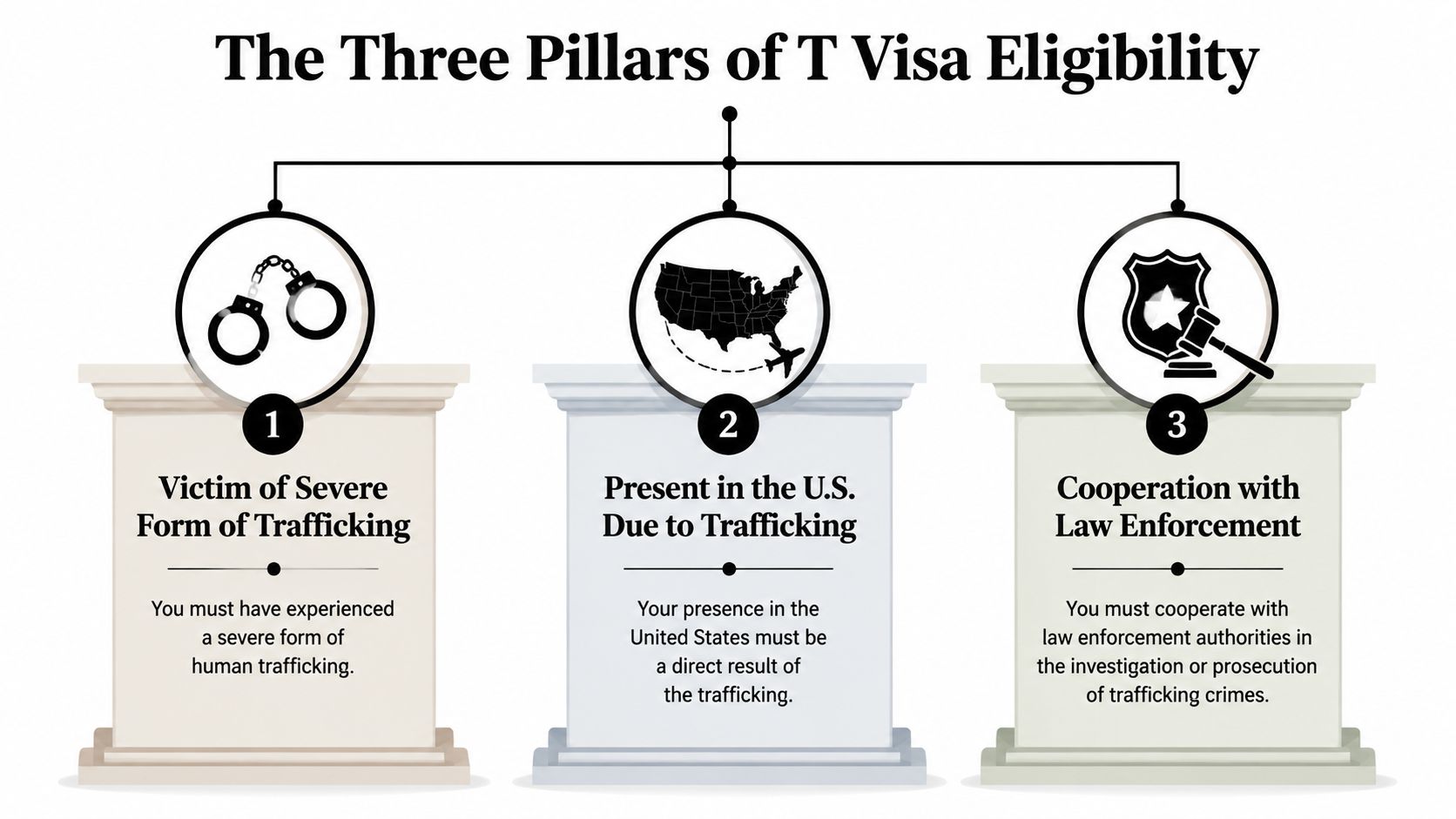
At the practical level, most visa T requirements can be organized around three pillars. If the record answers these clearly, the filing is usually much easier to defend.
What USCIS is really testing
First pillar: severe form of trafficking.
You need a record showing exploitation through force, fraud, or coercion in a form that fits the statute. The mistake here is to argue labels. The stronger move is to document conduct. Who controlled movement, money, housing, identification, work, sexual access, communication, or threats? Concrete facts beat abstract descriptors.
Second pillar: presence in the United States on account of trafficking.
This element often gets underdeveloped because attorneys assume it's obvious. Don't assume that. Spell out the causal chain. Show how the trafficking brought the client here, kept the client here, or shaped continued presence here after escape.
Third pillar: cooperation with law enforcement, unless an exception applies.
Many otherwise viable cases get mishandled concerning this pillar. Some lawyers overstate cooperation when there was little actual contact. Others give up when there was none. Both approaches miss the core issue, which is whether the applicant assisted when reasonably able or qualifies for an exception.
A useful comparison for clients and junior associates is the distinction between T and U practice. A comparison of T visa requirements and U visa requirements helps clarify why the T filing doesn't rise or fall on a certification alone.
A practical framing point
Use these pillars as drafting categories, not just legal elements. For each one, ask:
| Pillar | Core question | Typical proof |
|---|---|---|
| Severe trafficking | What happened and how was control maintained? | Declaration, texts, photos, third-party observations, clinical explanation of coercion |
| Presence on account of trafficking | Why is the client here because of the trafficking? | Timeline, movement history, escape narrative, post-trafficking vulnerability |
| Cooperation or exception | What did the client do, or why couldn't they do more? | Contact history, outreach attempts, counsel declaration, psychological evaluation when trauma impaired cooperation |
The strongest filings don't recite elements. They answer the adjudicator's likely doubts before USCIS has to ask.
Proving Trafficking with Any Credible Evidence
A client sits for the declaration prep and gives a fragmented account. She remembers the threats clearly but not the sequence. She went back after one escape attempt. She never called police. On paper, that can look weak to an adjudicator who expects a linear victim narrative. In a well-built T filing, it is often enough, if counsel proves why the story presents that way and ties each fact to a trafficking element.
The phrase “any credible evidence” is useful only if the record is built for credibility. The standard gives room to prove trafficking through the client's own account, even where third-party documents are limited or absent. What matters in practice is not volume. It is whether the filing explains control, compulsion, and harm in a way that makes the whole record hang together.
Credibility is built, not assumed
I see two recurring mistakes. One is overcorroborating with a stack of exhibits that do not prove force, fraud, or coercion. The other is submitting a bare declaration and assuming the low evidentiary threshold will carry the case. Both approaches miss the essential task. USCIS still has to believe the story, understand the trafficking dynamics, and reconcile the parts of the record that look inconsistent at first glance.
That is where evidentiary strategy matters.
A good declaration does more than recount abuse. It shows how the trafficker maintained control. Spell out the recruitment, the promises made, the shifts in working or living conditions, the threats, the isolation, the debt pressure, the confiscation of documents, the monitoring, and the consequences of disobedience. Then place those facts in time as precisely as the client can manage without forcing false certainty.
Precision helps. False precision hurts.
The strongest proof often comes from linking trauma to the record
Trauma regularly distorts the features adjudicators use as informal credibility markers. Clients may disclose in fragments. They may confuse dates, minimize exploitation, protect the trafficker, or return after leaving. If counsel leaves those facts unexplained, USCIS may read them as weakness. If counsel explains them clinically and factually, the same facts can support the case.
That is why I treat the psychological evaluation as a core evidentiary tool in many T cases, not an attachment added for sympathy. A sound clinical report can explain why memory is patchy, why reporting was delayed, why affect seems flat, or why the client remained compliant under conditions that look externally avoidable. Those are not side issues. They often sit at the center of whether the declaration will be read as credible.
The report should do real work. It should identify symptoms, describe functional impact, connect those symptoms to the coercive environment, and explain how trauma affects recall, disclosure, and decision-making. A report that repeats the client's allegations adds little. A report that translates trauma into adjudicative context can close the gap between the statute and the way survivors present.
Use corroboration selectively
Targeted corroboration usually outperforms a document dump. The question is not whether every exhibit is dramatic. The question is whether each exhibit proves a specific point that matters.
- Weak file: hundreds of pages of screenshots, unrelated treatment records, and generic support letters with no tie to the trafficking narrative.
- Stronger file: a declaration with a clear chronology, a few exhibits tied to key events, and a clinical evaluation that explains presentation issues an officer might otherwise treat as credibility problems.
Useful exhibits often include payroll anomalies, hotel receipts, ride logs, texts showing threats or control, photos of living conditions, intake notes from service providers, shelter records, or declarations from people who observed fear, restriction, exhaustion, or injuries. Even modest documents can matter if counsel explains exactly what each one proves.
A persuasive T filing does not try to prove everything with paper. It shows why the available evidence is credible and why the missing evidence is missing.
That last point is often overlooked. In trafficking cases, the absence of police reports, formal employment records, or contemporaneous complaints is common. Explain the absence directly. Fear, language barriers, dependency, immigration status, dissociation, shame, and trafficker surveillance all affect what gets documented and when.
Draft for the officer's doubts
Most Requests for Evidence in these cases are predictable. Why did the client stay? Why return? Why disclose late? Why are dates inconsistent? Why is there no report to law enforcement? Why is the declaration stronger now than at first contact with services? Good drafting answers those questions before USCIS asks them.
That requires discipline. Keep the declaration coherent. Use corroboration with a purpose. Use the clinical evaluation to explain trauma-related behavior that would otherwise be misread. Under an any-credible-evidence standard, the attorney's job is not to produce the most paper. It is to produce a record that makes psychological reality legible as legal proof.
Navigating the Law Enforcement Cooperation Requirement
A common intake problem looks like this. The client never made a clean police report, missed calls from an investigator, and now says she would have helped if she had been able to speak without shutting down. Counsel who treat that record as fatal usually make the case worse. Counsel who build the record around function, timing, and trauma often still have a viable T filing.
Cooperation is a factual record, not a document hunt
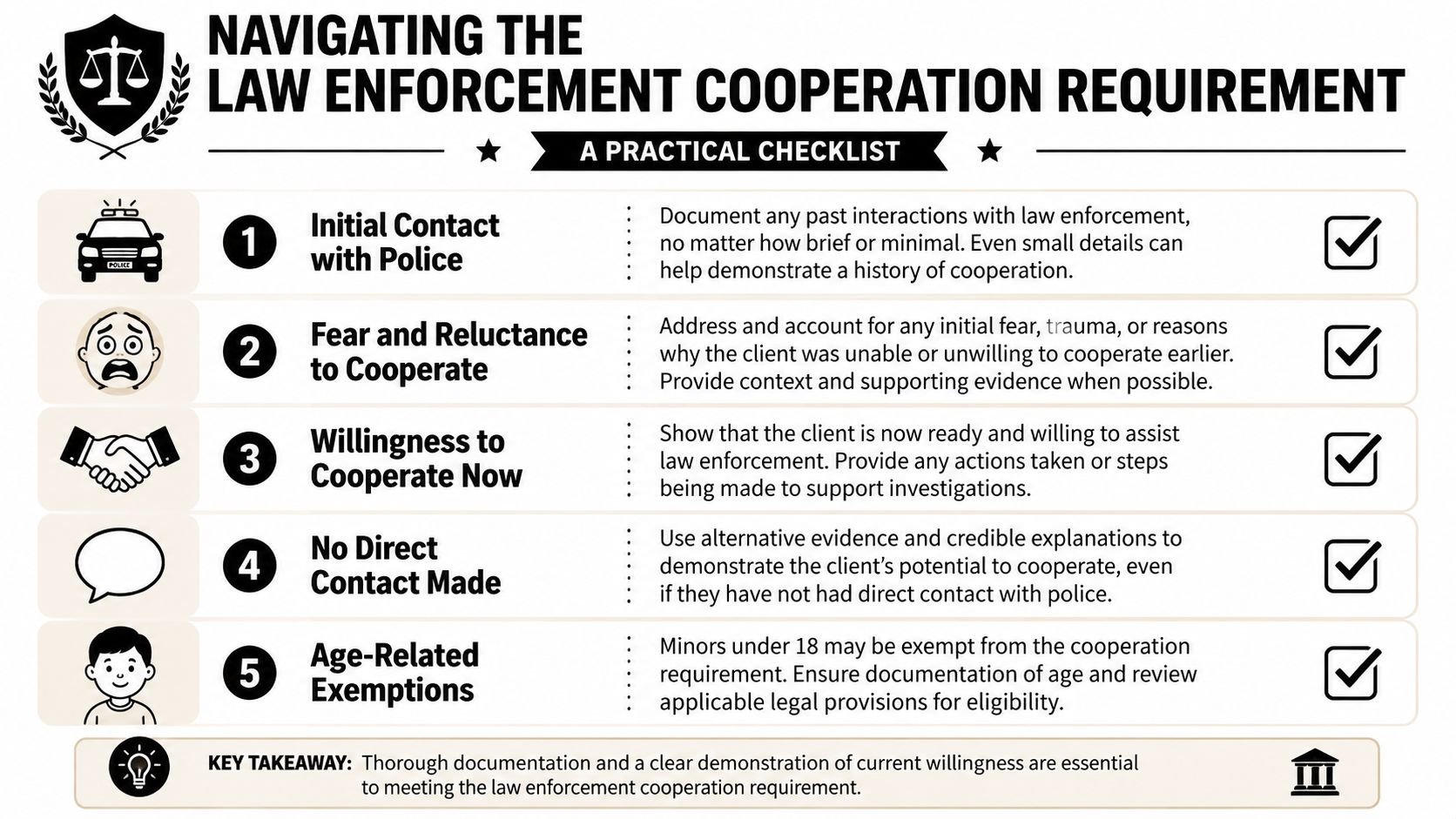
Attorneys often overfocus on Form I-914B. It can help, sometimes a great deal, but the legal question is broader. USCIS is asking whether the applicant complied with reasonable law enforcement requests, or whether a recognized exception explains why that did not happen.
That framing matters because many trafficking survivors do not present as ideal witnesses. They may disclose partially, go silent after initial contact, or avoid authorities altogether until they have some safety and regulation. Those facts can support the case if the record is drafted with discipline.
Several patterns can work:
- Limited contact with law enforcement: The client gave some information but held back details because of fear, shame, or confusion.
- No meaningful contact: No officer or investigator sought the client's help, so the record should focus on willingness, availability, or an applicable exception.
- Initial contact followed by withdrawal: The client engaged, then stopped responding when trauma symptoms intensified or trafficker pressure resumed.
The strategic mistake is simple. Do not turn a weak cooperation record into an inflated one. If the facts support inability rather than actual cooperation, prove inability carefully and directly.
Build the exception the same way you would prove disability
The gap here is usually evidentiary, not legal. The regulation may allow an exception where trauma impaired the applicant's ability to cooperate, but USCIS still needs a record that shows what that impairment looked like in practice. Fear alone is too abstract. The file should connect symptom to function.
Start with three questions.
What happened during attempted cooperation?
Identify the missed interview, the incomplete statement, the inability to answer chronologically, the panic response, the refusal to return to the station, or the shutdown during questioning.What symptoms explain that failure?
Specify dissociation, fragmented recall, panic, avoidance, hypervigilance, shame, sleep deprivation, or terror of retaliation.What ties those symptoms to the trafficking history?
Show how threats, coercive control, repeated abuse, debt manipulation, confinement, or punishment conditioned the client's response to authority and disclosure.
That is where a clinical evaluation stops being filler and becomes a core piece of strategy. A targeted T visa psychological evaluation for trauma-related cooperation issues can explain why a client who appeared evasive or inconsistent was functionally unable to participate in the way officers expected. For this requirement, diagnosis alone is not enough. Ask the evaluator to address recall, communication, avoidance, physiological arousal, authority-related fear, and the likely effect of trafficking trauma on the client's capacity to respond to investigative requests at the relevant time.
Draft for the officer who assumes noncooperation
USCIS will often read silence as refusal unless the record gives them a better explanation. The declaration, any police or service-provider notes, and the clinical report should work together on a tight timeline. If the client missed an interview after a trafficker threat, say so. If she answered only yes-or-no questions because narrative recall triggered dissociation, say so. If a detective called while she was still living under the trafficker's control, make that fact impossible to miss.
A short intake framework helps:
| Scenario | Primary strategy |
|---|---|
| Supplement B available | File it, then still explain what cooperation occurred and when |
| No certification, some contact | Document willingness, actual responses, and any limits on disclosure |
| No meaningful contact | Show why contact never developed and preserve evidence of willingness or exception |
| Trauma blocked cooperation | Use a clinically focused record to connect symptoms to inability |
Strong filings on this issue do not ask USCIS to excuse a vague reluctance. They show, with specifics, why the client's trauma history changed what cooperation was realistically possible at the time.
Demonstrating Extreme Hardship Clinically
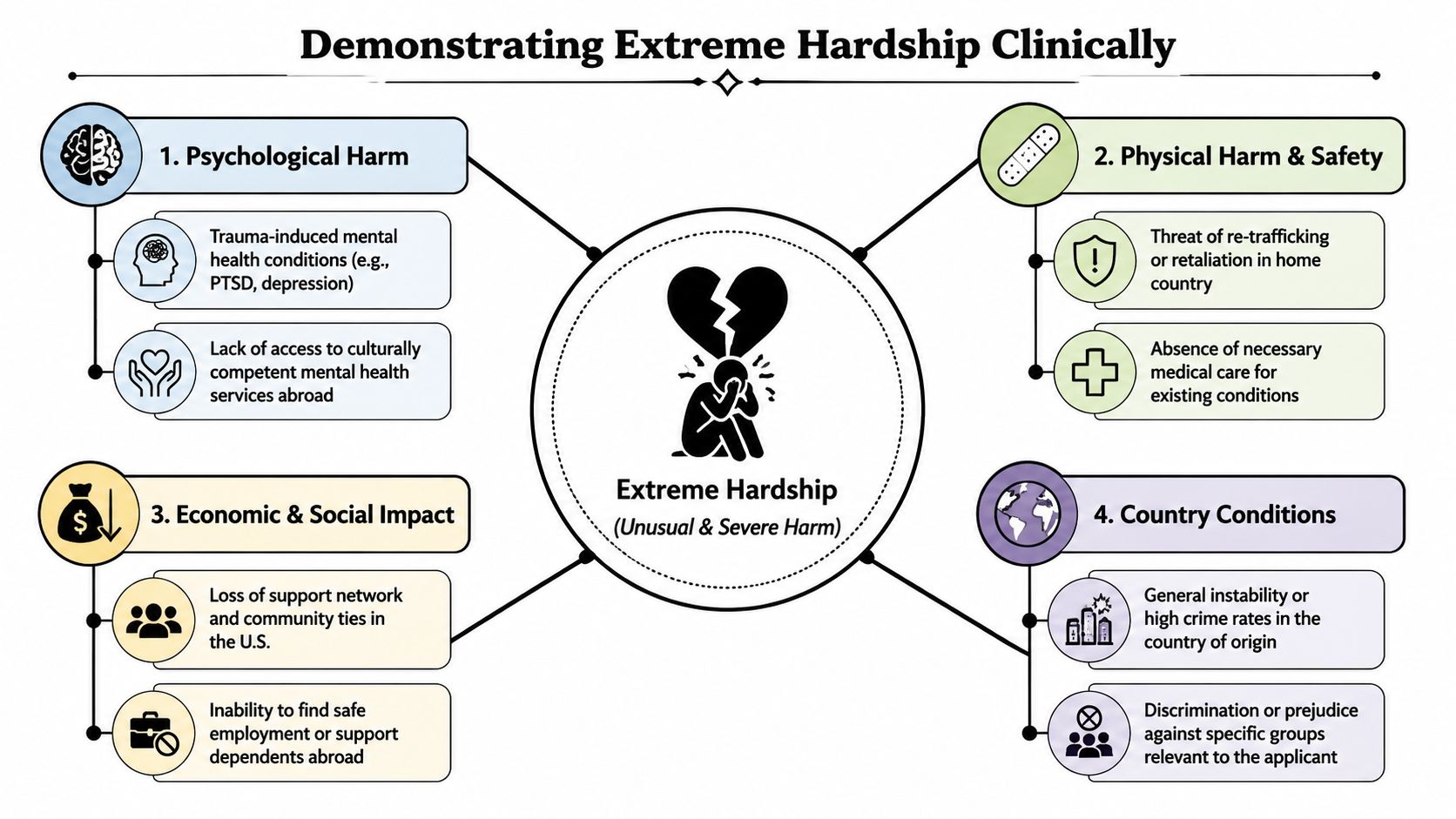
Many T filings lose force here because the hardship section reads like a closing paragraph instead of an evidentiary argument. “Removal would be devastating” is true in many cases, but USCIS needs a record showing why the harm would be unusual and severe for this applicant.
A visual framework can help you organize that proof.
The legal phrase needs a clinical record
Verified guidance for this article allows one point that should shape how you draft: a psychological evaluation can document specific vulnerabilities that turn hardship from abstraction into medically and psychologically concrete harm. It can also support how severe PTSD increases risk of suicide or re-trafficking upon removal, which is the kind of specific future-harm analysis USCIS increasingly expects.
That's why generic hardship affidavits underperform. They often describe fear, economic difficulty, and lack of support in broad terms but don't document the applicant's current psychiatric state, prognosis, triggers, coping limitations, or likely deterioration if removed.
A stronger hardship section usually integrates four domains:
- Psychological vulnerability: Current trauma symptoms, depression, dissociation, suicidality, relapse risk.
- Safety risk: Threat from traffickers, retaliation, or re-exploitation patterns tied to documented vulnerability.
- Access to treatment and support: Whether removal would interrupt ongoing care or eliminate stabilizing supports.
- Economic survival as hardship evidence: The 2024 rule also recognizes that documented inability to survive economically can matter, particularly when paired with trauma-related impairment.
For attorneys who want a focused example of how these reports are used in practice, this overview of T visa psychological evaluations shows the type of case alignment you should be aiming for.
This short video is also a useful prompt for thinking about how clinicians frame immigration hardship:
What to ask the evaluator to address
Don't send a one-line referral that says, “Please evaluate for hardship.” That usually produces a clinically competent but legally underpowered report.
Ask for analysis on points like these:
- Diagnosis and symptom severity: What conditions are present, and how do they impair daily functioning?
- Trafficking nexus: Which symptoms are linked to the trafficking experience and abuse dynamics?
- Removal prognosis: What is the likely psychological impact of forced return?
- Protective factors and their loss: What supports exist in the United States, and what happens if they are removed?
- Risk narrative: How do symptoms and circumstances increase vulnerability to self-harm, coercion, homelessness, or re-trafficking?
A hardship argument gets stronger when the evaluator addresses foreseeable consequences, not just current suffering.
The Filing Process and Common Pitfalls
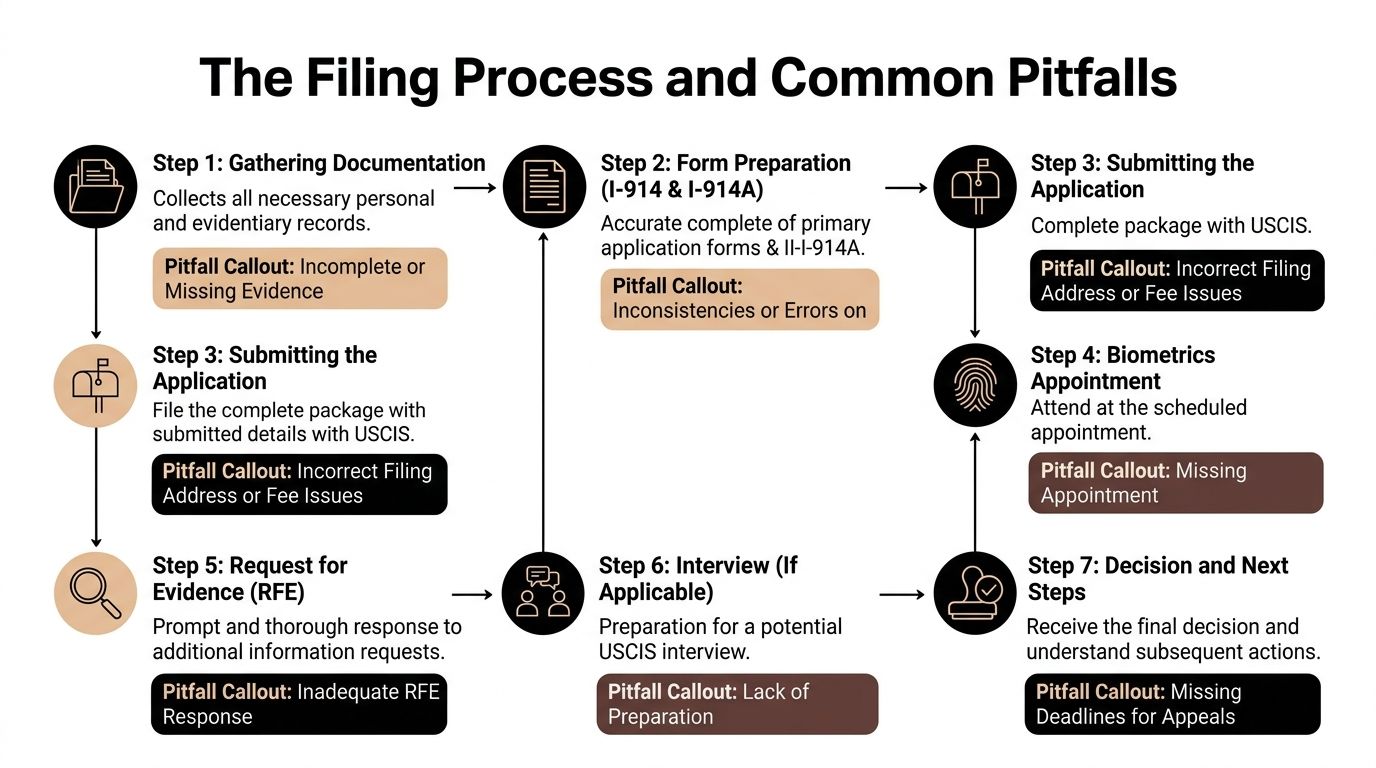
Even a well-developed evidentiary theory can get undermined by assembly errors. T filings reward careful packaging. The forms, declarations, supplements, and supporting evidence should read like one coordinated record, not a set of separate submissions stapled together.
Build the package in a deliberate order
A practical filing sequence usually works better than collecting everything at once:
Lock the theory of the case
Decide early whether the cooperation element will be proven through actual assistance, trauma exception, age-related exception, or another supported path.Draft the declaration before final exhibit selection
The declaration should tell you what evidence is needed. Otherwise, you'll gather documents that don't advance any element.Resolve inadmissibility issues before filing
Don't let a strong trafficking record obscure a waiver problem that should have been addressed upfront.Use supplements carefully
If there are derivatives, make sure family-member evidence aligns with the principal's chronology and facts.Prepare the client for process, not just filing
Biometrics, RFEs, and possible interview preparation all affect case stability after submission.
Attorneys often ask clients about timeline expectations immediately. It's better to give measured, process-based guidance and point them to practical resources such as this overview of how long a T visa application may take to process, while emphasizing that case complexity and evidence quality affect what happens after filing.
Mistakes that trigger avoidable problems
Some recurring filing errors are procedural. Others are strategic.
| Pitfall | Why it hurts |
|---|---|
| Generic hardship statement | It sounds advocacy-driven instead of evidence-driven |
| Inconsistent dates across forms and declaration | It creates avoidable credibility concerns |
| Overclaiming police cooperation | USCIS may view the whole record with more skepticism |
| No explanation for missing corroboration | Silence invites adverse assumptions |
| Clinical report with no legal nexus | Diagnosis alone doesn't prove the immigration element |
Case handling note: The cleaner the initial filing, the easier it is to respond if USCIS later tests a weak point.
Attorney's Checklist for a Strong T Visa Case
This is the pre-filing review I'd want on every T matter involving trauma, sparse corroboration, or a difficult cooperation record.
Pre-filing review points
- Trafficking theory is fact-based: The declaration identifies force, fraud, coercion, control mechanisms, and consequences in concrete terms.
- Presence is causally explained: The record shows why the client is in the United States on account of the trafficking, not merely present after unrelated events.
- Cooperation position is chosen deliberately: The case does not drift between “my client cooperated” and “my client couldn't cooperate.” Pick the supported theory and draft to it.
- Clinical evidence is element-specific: If you use a psychological evaluation, it addresses credibility-related trauma effects, the cooperation issue if relevant, and future hardship if relevant.
- Inadmissibility has been screened: Any waiver issue has been identified and incorporated into the filing strategy.
- Exhibits are mapped to elements: Every exhibit earns its place. Remove papers that add bulk without proof value.
Sample prompts for counsel and evaluators
For the cover letter, useful framing often sounds like this:
- On credibility: “The applicant's declaration should be read in light of trauma-related symptoms that affect recall, sequencing, and disclosure, as documented in the enclosed evaluation.”
- On cooperation: “The record demonstrates that any limitation in law enforcement participation arose from trauma-related functional impairment, not refusal to assist.”
- On hardship: “Removal would expose the applicant to documented psychological destabilization and specific vulnerability factors that increase the severity of future harm.”
For the evaluator referral, be explicit:
- Request a nexus analysis: Ask the clinician to connect symptoms to trafficking events and abuse dynamics.
- Request functional findings: Ask how symptoms affected communication, decision-making, memory, and ability to engage law enforcement.
- Request a removal prognosis: Ask what is likely to occur psychologically and functionally if the client is returned.
A strong T filing usually isn't the one with the most paper. It's the one where every piece of paper answers the right question.
If your case needs a psychological evaluation that is specific to T visa issues such as trauma-related inability to cooperate, credibility concerns tied to memory fragmentation, or clinically documented extreme hardship, Pro Psychological Analysis provides immigration-focused evaluations designed for attorney use and filing support.