
A typical immigration psychological evaluation cost for a standard case is often between $1,500 and $3,500. That range shifts materially based on what the case needs, including record review, interview depth, testing, language access, and how much evidentiary weight the final report must carry.
If you're an immigration attorney pricing out a hardship, asylum, VAWA, U visa, or T visa case, you've probably seen quotes that don't line up. One provider gives a number that looks manageable. Another comes in much higher. A client asks why the spread is so wide, and the honest answer is that these aren't interchangeable services.
A forensic immigration evaluation isn't just a meeting and a letter. It's a case-built clinical document that has to match legal theory, survive scrutiny, and help the adjudicator understand facts that raw records often don't capture well. Cost follows that reality. The central question isn't just what the evaluation costs. It's what level of documentation the case can justify, and what level of documentation it can survive without.
Table of Contents
- Why Is There No Simple Price for an Immigration Evaluation?
- Decoding the Price Tag What a Standard Evaluation Includes
- The 7 Key Factors That Drive Evaluation Costs
- Payment Strategies How to Make an Evaluation Affordable
- How Cost Connects to Case Strategy and Admissibility
- Essential Questions to Ask a Provider About Cost
- Frequently Asked Questions About Evaluation Costs
Why Is There No Simple Price for an Immigration Evaluation?
The most common frustration is simple. An attorney tries to budget the case, asks for a fee quote, and gets numbers that differ by thousands of dollars. That feels arbitrary until you look at what each evaluator is being asked to do.
One published benchmark places immigration psychological evaluations at about $1,500 to $3,000, while a broader national average is roughly $1,200 to $5,000. The same source notes that assessments for hardship, asylum, or VAWA matters commonly fall between **$1,500 and $3,500 **, which is consistent with the reality that price rises with report depth and case complexity (published pricing benchmarks for immigration evaluations).

The fee reflects the evidence you need
A low quote may reflect a narrower scope. That can mean fewer interviews, limited record review, less testing, a shorter report, or less attorney coordination. Sometimes that's appropriate. Sometimes it creates a report that doesn't do enough work for the filing.
A higher quote often reflects a different assignment entirely. The evaluator may be building a document that links symptoms, history, corroborating records, and functional impact to the legal claim in a way that is much closer to a forensic opinion than a treatment note. This is how you find the definition of evaluation in psychology. It is structured, reasoned, and built for a decision-maker.
Practical rule: If two quotes are far apart, compare scope before you compare price.
Standardized pricing doesn't fit forensic work
Immigration cases don't arrive with equal evidentiary demands. A concise hardship matter with clean records is not priced the same way as a trauma-heavy case involving multiple incidents, conflicting records, interpreter use, and the need to address credibility concerns carefully.
The better way to think about cost is this. You are not buying a session. You are buying a level of analysis. When attorneys frame the conversation that way with clients, the pricing discussion becomes much easier because the question shifts from "Why is this expensive?" to "What does this case need to be persuasive?"
Decoding the Price Tag What a Standard Evaluation Includes
Many clients think they're paying for interview time. They aren't. They're paying for a complete forensic work product.
A standard immigration evaluation usually includes intake review, one or more clinical interviews, review of relevant records, diagnostic and functional analysis when appropriate, and preparation of a written report specific to the legal issue. The report is the center of the assignment. It is not a generic support letter and it should not read like one.
What the client is actually paying for
The visible part is the interview. The invisible part is where much of the cost sits.
That behind-the-scenes work often includes:
- Case framing: Reviewing the referral question and identifying what the legal theory requires the report to establish.
- Clinical interviewing: Gathering psychosocial history, symptom history, trauma narrative, family context, and current functioning.
- Record integration: Comparing the client's account with medical, school, police, legal, or treatment records when available.
- Testing decisions: Deciding whether psychological instruments add clarity or only add cost.
- Forensic writing: Producing a report that is organized, supportable, and useful to counsel.
Why the report matters more than the meeting
Attorneys feel the difference quickly. A weak report recites distress in broad language. A strong report explains how the evaluator reached conclusions, identifies clinically relevant patterns, addresses corroborating material, and ties findings to the issues the adjudicator must evaluate.
That distinction matters because immigration filings often rise or fall on whether the documentary evidence feels specific and grounded. A report that says someone is anxious or traumatized rarely carries the same weight as a report that explains symptom course, functional impairment, consistency across sources, and why those findings matter in the legal posture of the case.
A good evaluation reads like evidence. A weak evaluation reads like advocacy without foundation.
What doesn't work
Two shortcuts usually create problems.
First, firms sometimes shop for the lowest number and assume all licensed clinicians produce equivalent forensic reports. They don't. Clinical licensure alone doesn't guarantee immigration-forensic skill.
Second, some providers keep fees down by limiting record review or attorney coordination. That can work in a narrow case, but it often fails when the legal team later needs clarification, tighter language, or better integration with the filing theory.
If you want cleaner budgeting, ask a simple question at intake: what is included in the fee besides the interview? The answer usually tells you more than the number itself.
The 7 Key Factors That Drive Evaluation Costs
Some cost drivers are obvious. Others are hidden until the matter gets underway. The largest fee changes usually come from time-intensive work that the attorney doesn't see directly.
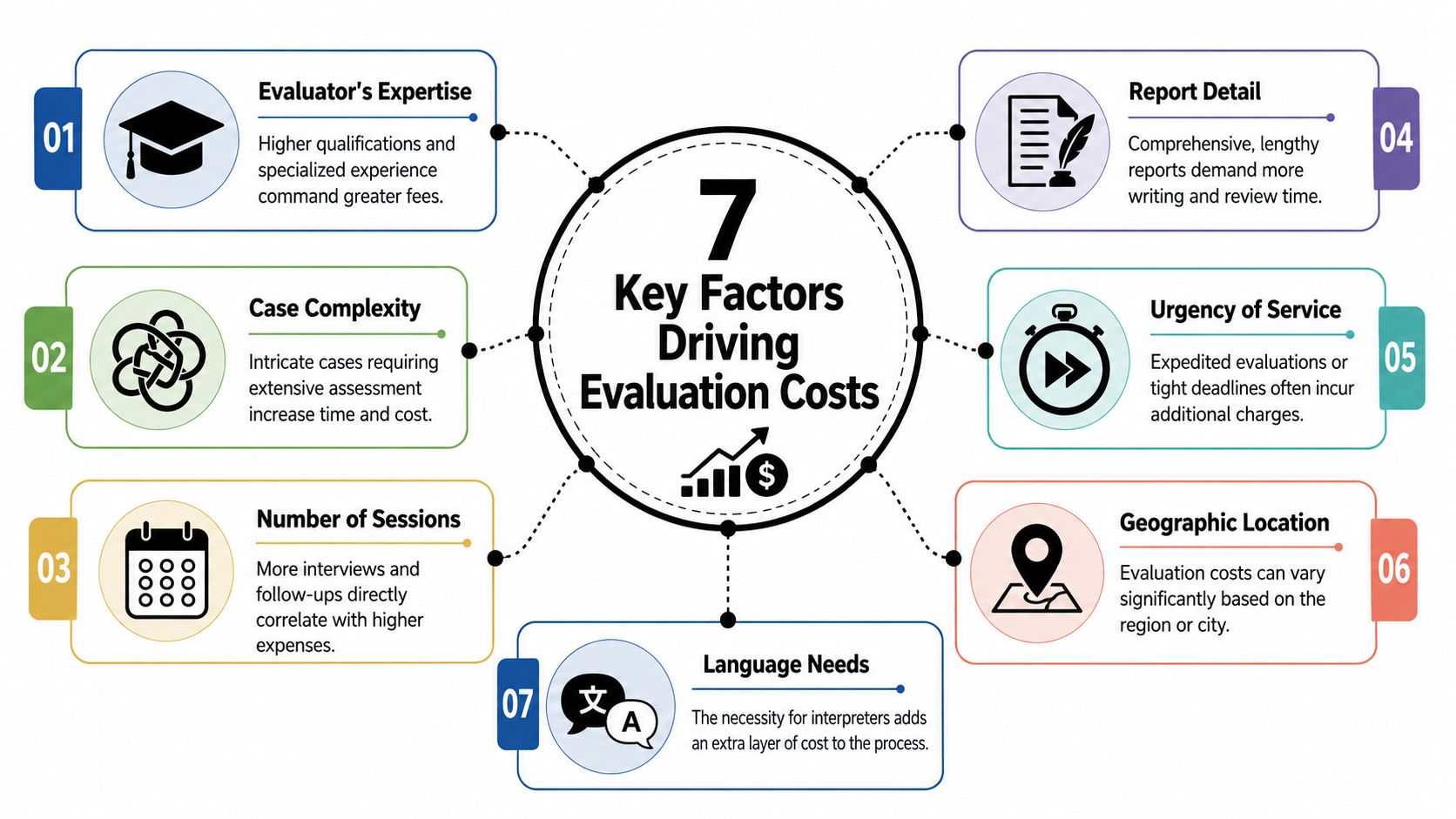
Published provider guidance identifies case complexity and documentation burden as the main technical cost escalators. It also notes that repeated interviews, extensive record abstraction, and specialized assessment instruments can move fees from about $800 to $2,000 into the $3,000 to $5,000 range in some markets. Geography also matters, with California postings often showing $800 to $2,500, while some nationwide practices use $1,500 to $3,000 as a benchmark (provider guidance on complexity and pricing).
Where fees rise
Here are the seven factors I see most often behind quote variation:
Evaluator expertise
Clinicians with deeper forensic experience usually charge more because they spend more time on case formulation, report discipline, and legal relevance.Case complexity
Cases involving layered trauma, multiple stressors, prior treatment, or inconsistent records take longer to evaluate responsibly.Number of interviews
Some cases can be handled in a compact format. Others require repeated sessions because memory, trauma reactions, or family dynamics need slower development.Report depth
A short letter and a detailed forensic report are different products. If the case may face higher scrutiny, detail usually matters.Urgency
Rush scheduling compresses clinical and writing time. That almost always changes pricing or availability.Geographic market
Local overhead and market norms affect fees. That's one reason quotes differ across states and metro areas.Language needs
Interpreters, bilingual scheduling constraints, and translation-related workflow all add operational complexity.
A growing share of this work is also done remotely, which can help with access and scheduling when handled properly through a virtual psychological evaluation process.
Where firms can control spend
Cost control is possible, but only if you control the right variables.
- Match the evaluator to the assignment: A highly credentialed specialist may be essential in a heavily contested case, but unnecessary in a straightforward one.
- Send focused records: Dumping hundreds of pages without sorting them increases review time and cost.
- Clarify whether testing is necessary: Testing can strengthen some cases, but it shouldn't be automatic.
- Ask about included services: Rush delivery, follow-up attorney calls, affidavits, and testimony should be discussed before retention.
The cheapest way to manage cost is not to buy less evaluation than the case needs. It's to stop paying for work the case doesn't need.
Payment Strategies How to Make an Evaluation Affordable
Cost becomes a crisis when the legal team treats it as a surprise. It becomes manageable when the team treats it as part of early case design.

Why clients usually pay directly
Immigration evaluations are usually private-pay because insurance generally doesn't cover services performed for legal documentation rather than medical treatment. A California-focused summary describes this as a consistent pattern and notes that, since the early 2020s, these evaluations have been treated as specialized forensic services with U.S. pricing anchored roughly in the $1,000 to $3,000 range (forensic private-pay pattern in immigration evaluations).
That point matters for attorney counseling. Clients often assume a mental health service will be billed like treatment. It won't. This is forensic work prepared for a legal file.
What actually helps
The most effective payment strategy is early planning. If the case may need an evaluation, discuss it before the client has already committed funds elsewhere in the matter.
A few approaches tend to work better than others:
- Installment arrangements: Many providers offer staged payments. That can make a substantial fee workable if the conversation happens early.
- Narrow scope where appropriate: Not every case needs the longest report or the broadest set of interviews.
- Legal aid coordination: Nonprofit and community-based matters sometimes have funding channels for expert services, but those need lead time.
- Transparent comparison shopping: Compare what's included, not just the quoted number.
- Published payment options: Some practices, including Pro Psychological Analysis payment plans, make installment structures available for immigration evaluations.
One more practical point. Ask whether the provider requires full payment before release of the report, whether a retainer is needed to schedule, and what happens if the client misses an interview. Those details often matter more than the headline fee.
For clients who need a straightforward explanation of the budgeting side, this overview is useful:
When cost is addressed at intake, clients usually experience it as planning. When it's raised near filing, they experience it as pressure.
How Cost Connects to Case Strategy and Admissibility
Attorneys sometimes ask the wrong question first. They ask what the evaluation costs before asking what the report must accomplish.
That order should be reversed. In immigration practice, the price of an evaluation often reflects the level of evidentiary work needed to make the report useful. If the case depends heavily on psychological hardship, trauma impact, abuse dynamics, or functional consequences, the report has to do more than confirm distress. It has to support the legal narrative in a way that is coherent, clinically grounded, and hard to dismiss.

Cheap is not the same as efficient
A very low-cost report can become expensive later. The legal team may need clarifications, rewrites, additional corroboration, or even a replacement evaluation if the original document is too thin to carry meaningful weight.
That doesn't mean every case needs the most expensive option. It means the report has to be fit for purpose. If counsel expects a filing to receive close review, a superficial report creates strategic risk.
Fit the report to the scrutiny level
The best budgeting decisions come from matching scope to exposure.
Consider the difference:
| Case posture | Evaluation approach that usually fits |
|---|---|
| Narrow factual issue, lighter record set | Focused evaluation with disciplined scope |
| Trauma-heavy history with corroborating records | More detailed clinical integration and fuller report |
| Likely challenge on credibility or causation | Greater emphasis on methodology, record reconciliation, and reasoning |
| Potential hearing or testimony risk | Clear discussion up front of affidavit and testimony availability |
The admissibility side is practical. Decision-makers give more weight to reports that show method, clinical reasoning, and factual grounding. A bare conclusion without visible support may still be admitted, but it often persuades less.
The right question isn't "How little can we spend?" It's "What report can this case stand on?"
Essential Questions to Ask a Provider About Cost
A good intake call should reduce ambiguity, not create it. If an evaluator can't explain the fee structure clearly, that usually predicts trouble later.
Use direct questions. Ask them before the retainer is signed, not after the interview is complete.
Provider Vetting Checklist Cost and Scope
| Question Category | Sample Questions to Ask |
|---|---|
| Fee structure | Is this a flat fee or does any part of the work bill separately? |
| Scope of services | Does the fee include interviews, record review, and the written report? |
| Attorney coordination | Are follow-up calls or emails with counsel included? |
| Revisions | If I need factual corrections or clarifying edits, are those included? |
| Testing | Do you expect psychological testing in this case, and is that already in the quoted fee? |
| Collateral interviews | If family members need to be interviewed, is that included or added later? |
| Interpreter needs | If the client needs language support, how is that arranged and billed? |
| Rush timeline | What happens to pricing and availability if the filing date moves up? |
| Final deliverables | Will I receive a forensic-style report, a short summary, or something in between? |
| Court-related services | If testimony or an affidavit becomes necessary, how is that handled? |
| Payment terms | When is payment due, and is the report held until the balance is paid? |
| Cancellation policy | What happens if the client reschedules, no-shows, or withdraws? |
A strong provider usually answers these questions without hesitation. A weak one often stays vague, especially around revisions, rush work, and whether the report is specifically customized for the case type.
One more question belongs on every call: "What kind of case is this quote designed for?" That single question often reveals whether the evaluator understands the legal context or is offering a generic psychological report under an immigration label.
Frequently Asked Questions About Evaluation Costs
Can a remote evaluation reduce cost?
Sometimes, but not automatically. Remote work can improve scheduling and reduce logistical friction, especially when the client and evaluator are in different locations. It doesn't remove the need for careful interviewing, record review, or report writing.
Are rush fees worth it?
Only when the filing posture leaves no realistic alternative. Rush work can be necessary, but it compresses a process that usually benefits from reflection, document collection, and attorney input. If you can avoid building the case on emergency timing, do.
What are red flags in a suspiciously cheap evaluation?
Very brief intake, unclear scope, promises of a fast letter without discussing records, little attention to the legal issue, and no explanation of what the final report includes. If the provider sells speed and simplicity more than method, look closely.
Can a client get a refund if the case is denied?
Usually, the fee pays for the evaluator's time and work product, not the legal outcome. The report may still be competently prepared even if the petition is denied for reasons outside the evaluation.
Should every case buy the most extensive option?
No. Overbuilding a simple case wastes client resources. The better approach is proportionality. Spend where the evidence has to carry real weight.
What should the attorney do first?
Define the role of the evaluation in the case. If the report is central to hardship, trauma, or abuse documentation, retain with enough time for proper work. If it is supplemental, keep the assignment narrow and targeted.
If your firm needs a report that is built for legal use rather than treatment, Pro Psychological Analysis provides immigration psychological evaluations for asylum, VAWA, U visa, T visa, and extreme hardship cases, with payment options, virtual scheduling, and attorney-aligned report preparation designed to support USCIS and immigration court submissions.