
The advice clients hear most often is too blunt to be useful: VAWA protects you, and the abuser will not know. That answer misses the part that usually drives case strategy. Clients want to know what the filing changes in practice. Will it provoke retaliation, create immigration consequences for the abuser, trigger police involvement, or give the abuser a new way to interfere?
A VAWA self-petition does not automatically punish the abuser. Its power operates differently. It cuts the abuser out of the victim’s immigration process, which matters most in cases where control was exercised through status, sponsorship, documents, financial dependence, and threats tied to deportation or exposure.
That legal shift also has a psychological effect. In forensic work, I often see the same pattern. An abusive partner is less focused on the petition itself than on the loss of access, the loss of information, and the loss of influence over the victim’s choices. For many perpetrators, that loss of control is the event that matters. For the petitioner, it is often the first meaningful disruption of an entrenched coercive system.
Attorneys should use that distinction. A strong VAWA case does not present the filing as a vehicle for punishing the abuser. It presents the filing as a lawful way for the survivor to proceed without the abuser’s participation, while documenting how the abuser used immigration status and related threats as tools of abuse. That is where a well-prepared psychological evaluation can add real evidentiary value, especially in extreme cruelty cases where the core harm involves coercion, intimidation, surveillance, degradation, and control rather than a single police-documented assault.
The practical objective is straightforward. Remove the abuser from the immigration pathway, document the abuse dynamics with specificity, and give USCIS a record that stands on the petitioner’s evidence alone.
Table of Contents
- Understanding VAWA's True Impact on Abusers
- How VAWA Severs an Abuser’s Control
- Debunking Myths What VAWA Does Not Do to an Abuser
- Indirect Legal Consequences for the Abuser
- Evidentiary Standards and the Abuser's Non-Involvement
- The Role of Psychological Evaluations in Documenting Abuse
- Conclusion Protecting Your Client and Building an Approval-Ready Case
Understanding VAWA's True Impact on Abusers
Attorneys often hear the wrong question first. Clients ask whether VAWA will get the abuser arrested, deported, or exposed. That framing can distort the case from day one.
VAWA is an immigration protection process for the survivor. Its immediate effect on the abuser is usually not direct punishment. Its immediate effect is the loss of tools the abuser has used to keep the victim dependent, silent, and unsure of what the government can do.
That distinction shapes case strategy. If a client expects instant retaliation through the legal system, fear can stop disclosure or delay filing. If counsel promises consequences that a self-petition does not produce, credibility suffers later. In my experience, accurate expectations improve both safety planning and the quality of the affidavit.
The primary effect is a loss of leverage for the abuser
In many VAWA cases, the abuse pattern is organized around control, not just assault. The abuser may threaten to withdraw papers, hide passports, intercept mail, block access to money, monitor communications, or insist that any contact with immigration authorities will end in the victim's deportation. Those tactics matter because they show how immigration dependency became part of the coercive system.
A VAWA self-petition interrupts that system by giving the survivor a path to lawful status that does not depend on the abuser's signature, cooperation, or continued relationship. The legal dependence weakens. The psychological effect often follows. Abusers who relied on immigration status as a coercive tool may escalate threats, shift to surveillance, or intensify blame when they sense control slipping.
That reaction is not a side issue. It can be evidence.
A careful psychological evaluation can document how the abuser used uncertainty, fear of deportation, humiliation, and isolation to maintain dominance, and how the survivor's symptoms developed within that pattern. For an attorney building an extreme cruelty case, that link is often more persuasive than a generic statement that the relationship was "toxic" or "controlling."
Practice point: Answer the safety question before the consequence question. Then document exactly how the abuser used immigration status, documents, finances, and intimidation to control behavior.
Broad deterrent effects are different from what one filing does
VAWA has been associated with long-term reductions in intimate partner violence. As noted earlier in the article, reported rates declined substantially in the years after the statute's enactment. That broader public effect matters, but it should not be confused with what happens in one self-petition.
An individual VAWA filing is not a police report. It is not a charging document. It does not automatically trigger arrest, removal proceedings, or notice to the abuser. The attorney's job is to separate systemic impact from case-level consequences and explain both with precision.
For case preparation, three points usually matter most:
- Reduce fear early: Explain that the filing is for the petitioner's immigration relief, not automatic punishment of the abuser.
- Name the control tactics with specificity: Threats about deportation, document withholding, financial restriction, stalking, and degradation often support extreme cruelty even without severe physical injury.
- Build the record without waiting for the abuser: A credible declaration, corroborating records, and a well-grounded psychological evaluation can carry the case without any admission from the abuser.
A persuasive VAWA case shows how abuse operated, how it affected the petitioner, and why the petitioner needed an independent path to safety and status.
How VAWA Severs an Abuser’s Control
The legal feature that matters most in these cases is confidentiality. Attorneys sometimes explain it only as privacy. That understates its practical and psychological effect. Confidentiality is what cuts off one of the abuser’s strongest tools: information control.
Confidentiality is the mechanism that matters
VAWA cases operate under a strict confidentiality framework. 8 U.S.C. § 1367(a)(2) requires USCIS to seal petition documentation and prohibits disclosure of case details to third parties, including the named abuser, as explained in this discussion of VAWA confidentiality protections.
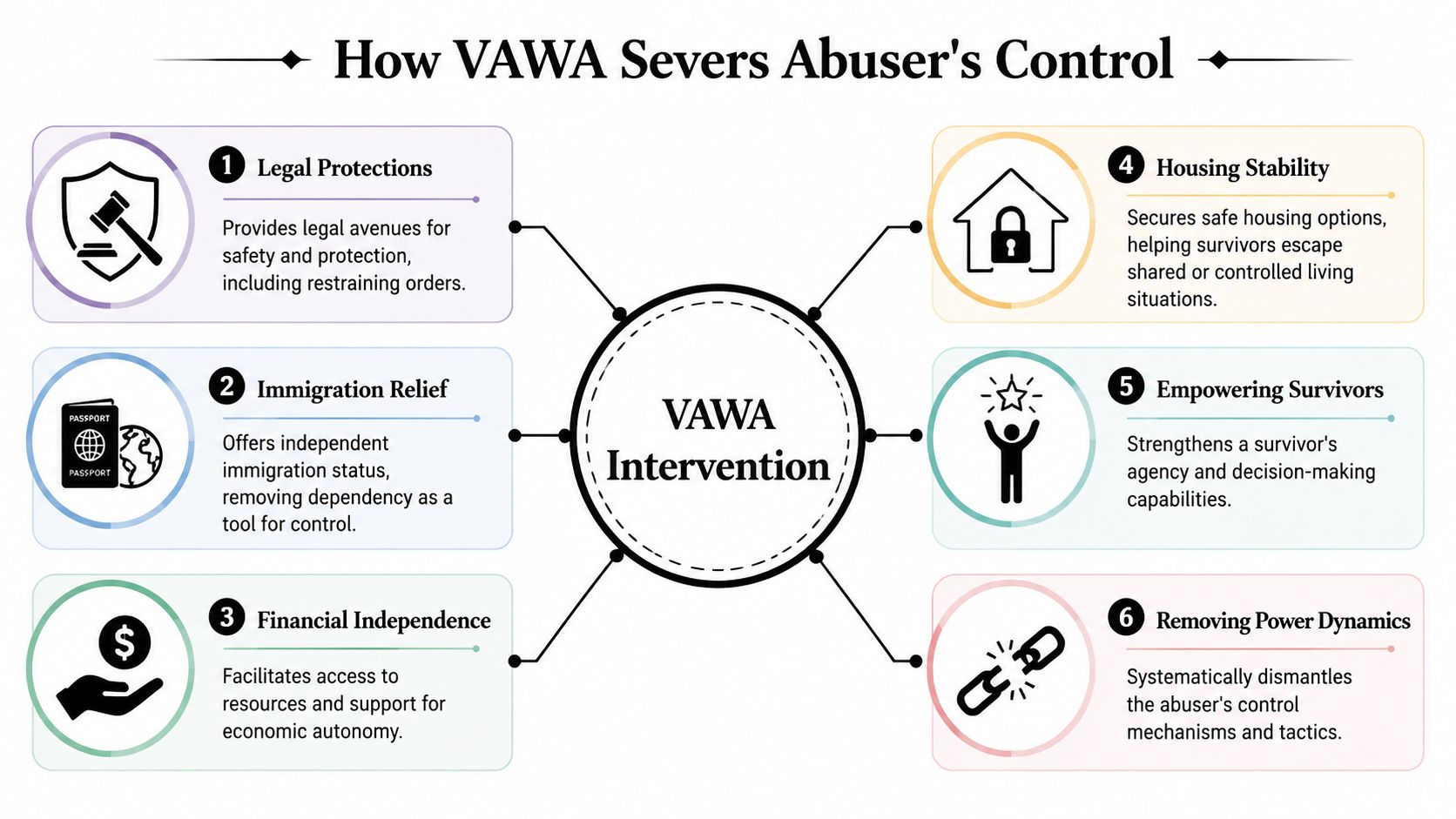
Think of many abusive relationships as a system of strings. One string is immigration sponsorship. Another is access to mail, records, and official notices. Another is the threat that “if you leave, I’ll have you deported.” VAWA cuts those strings by placing the petition inside a protected process the abuser can’t monitor through USCIS.
That legal architecture matters clinically as well. Survivors often disclose more clearly when they understand the abuser cannot obtain the filing, the evidence, or the status updates through the agency. More complete disclosure usually leads to a more coherent affidavit, more accurate chronology, and better corroboration.
What this changes in the abuse dynamic
Once the abuser loses access to immigration information, several common control tactics become weaker:
- Status weaponization loses force: Threats tied to sponsorship or exposure no longer control the entire future.
- Information asymmetry narrows: The abuser can’t use USCIS updates as a way to monitor or frighten the victim.
- Dependence starts to erode: The survivor can make legal and practical decisions without asking permission.
- Psychological coercion becomes more visible: Once immigration control is removed, the broader pattern of domination often stands out more clearly in evidence.
The filing is strongest when it treats confidentiality as both a legal shield and an evidentiary opportunity.
In evaluations, the phrase “battery or extreme cruelty” becomes more than a checklist. Many clients have endured years of coercive control that never produced a neat police file. The confidentiality structure lets them describe how abuse operated: threats, intimidation, status manipulation, isolation, and retaliatory behavior. That detail often becomes central to case strength.
For attorneys, the practical use is immediate. If a client says, “He’ll find out,” you can answer with precision. USCIS is barred from disclosing the case to the named abuser. If the client says, “He controls my papers,” you can explain that the petition is designed to move without his participation. If the client says, “He said he can stop me,” you can explain that his power is often psychological, not legal.
That is how does VAWA affect the abuser in the most important sense. It strips out the immigration-based control he expected to keep using.
Debunking Myths What VAWA Does Not Do to an Abuser
Fear thrives in these cases when lawyers or advocates answer too generally. The fastest way to reduce that fear is to separate what VAWA does from what it does not do.
One fact anchors the analysis: filing a VAWA self-petition creates zero automatic legal consequences for the abuser. It does not trigger criminal investigation, prosecution, or deportation proceedings through the VAWA mechanism itself, as explained in this legal overview of VAWA adjudication.
Myth one automatic deportation
This is the fear clients often voice first, especially when the abuser is undocumented, has a complicated status history, or has used immigration threats inside the relationship.
A VAWA self-petition does not automatically place the abuser into removal proceedings. USCIS is evaluating the self-petitioner’s eligibility for humanitarian immigration relief. It is not using the filing itself as an immigration enforcement referral against the named abuser.
That doesn’t mean the abuser is insulated from every immigration consequence forever. It means the VAWA filing is not the trigger. If some separate agency action, independent investigation, or unrelated immigration issue arises, that is a different legal track.
Myth two automatic criminal charges
Clients also worry that filing under VAWA is the same as making a criminal complaint. It isn’t.
A VAWA petition is not a charging instrument, not a police report, and not a referral for prosecution. If no separate report is made to police, filing alone does not automatically generate an arrest, prosecution, or criminal case. That’s one reason some survivors feel safe enough to pursue status relief even when they are not ready to involve law enforcement.
What works: Explain the separation between immigration relief and criminal enforcement in one sentence. Then repeat it as needed in plain language.
What doesn’t work is telling clients “nothing will happen to him” without qualification. That can be misleading. Filing alone doesn’t trigger charges. Separate actions by the client or separate evidence in another forum can.
Myth three the abuser will be notified
This myth often survives even after attorneys mention confidentiality because survivors have lived in environments where the abuser seemed to know everything.
The legal answer is clear. The government does not notify the abuser about the VAWA self-petition through the ordinary adjudication process. The petition is designed to proceed without giving the abuser access or standing in the case.
A practical warning is still necessary. Government confidentiality and real-world safety are not the same thing. An abuser may infer that something is changing if the survivor leaves, secures counsel, changes mail handling, moves, or stops responding to status-based threats. That is a safety-planning issue, not a breach by USCIS.
A short explainer can help clients who need to hear the distinction in another format:
What attorneys should say instead
When clients ask how does vawa affect the abuser, the most accurate response is usually this:
- No automatic deportation: The self-petition itself doesn’t start removal action against the abuser.
- No automatic criminal case: USCIS is not filing charges by adjudicating the petition.
- No agency notice to the abuser: The process is structured to protect the petitioner’s confidentiality.
That answer lowers panic, improves decision-making, and lets you focus the case where it belongs: on proving the abuse and its impact.
Indirect Legal Consequences for the Abuser
The fact that VAWA does not directly punish the abuser does not mean the abuser faces no risk at all. It means the risk comes from parallel legal systems, not from the filing itself.
That difference matters because attorneys should neither minimize nor exaggerate it. Survivors deserve a realistic explanation. The abuser may face consequences, but only if separate actions occur through state courts, law enforcement, family court, or other channels outside the VAWA adjudication itself.
Parallel systems create the real exposure
VAWA’s broader framework has been associated with changes in reporting and access to remedies. One source states that intimate partner violence rates fell 67% from 1993 to 2010 after VAWA’s enactment, and that the framework facilitates access to state-level remedies like protective orders and encourages reporting, which can lead to arrest and accountability through separate legal systems, as discussed in this overview of VAWA’s broader effects.
For practice purposes, think of three lanes operating at once:
Immigration lane
The self-petition moves forward based on the survivor’s eligibility and evidence.Safety lane
The survivor may seek emergency planning, shelter, address protection, or relocation.Enforcement lane
Police reports, protective orders, custody litigation, or criminal complaints may create direct consequences for the abuser.
Those lanes can overlap in real life, but they are not the same proceeding.
Direct versus indirect consequences
| Consequence | Direct Result of VAWA Filing? | How It Can Happen |
|---|---|---|
| Deportation of the abuser | No | A separate immigration matter or independent enforcement action would have to arise outside the VAWA filing |
| Criminal charges | No | Police investigation, prosecutor review, or criminal complaint based on separate reporting and evidence |
| Protective order restrictions | No | Survivor files in state court and the court issues relief based on the applicable standard |
| Family court consequences | No | Abuse evidence is presented in custody, visitation, or related proceedings |
| Social and practical loss of control | Indirectly, yes | The survivor gains an independent immigration path and access to support, reducing the abuser’s leverage |
The last row is where legal analysis and psychological analysis meet. The abuser may not be arrested because of the petition, but he may still lose power. That often changes behavior. Some become more frantic. Some escalate threats. Some begin charm offensives, apology cycles, or efforts to regain informational access.
A VAWA filing should prompt a safety review whenever the abuser has relied on surveillance, document control, or immigration threats as part of the abuse pattern.
What works in legal strategy
Strong representation usually does three things at once.
First, counsel separates the immigration filing from any decision about reporting to police. That preserves client agency. Some survivors are ready for both tracks. Others are not.
Second, counsel documents whether the client needs parallel relief. If there are recent assaults, stalking, child safety concerns, or credible retaliatory threats, immigration strategy alone may be too narrow.
Third, counsel avoids speculative threats. Don’t tell a client the abuser “will be deported,” “will be arrested,” or “will lose everything.” None of that follows automatically from a self-petition. Overstating consequences can increase fear, invite retraction, and complicate trust.
Where attorneys often miss the opportunity
A common mistake is treating indirect consequences as outside the scope of case preparation. They are not. They shape risk assessment, affidavit drafting, and corroboration.
For example, if the client obtained a protective order, that can matter not because it proves every allegation by itself, but because it may corroborate the timeline, the severity, and the client’s fear. If the client never went to police, that absence is not fatal. Many victims do not report while the abuser still controls status, money, transportation, or children.
Another frequent mistake is ignoring post-separation conduct. In many cases, the abuser’s behavior after losing their hold reveals the original abuse pattern more clearly than earlier incidents did. Repeated calls, threats about immigration, attempts to retrieve documents, pressure through relatives, and smear campaigns can all support the theory of coercive control if they are documented carefully and presented in context.
Indirect consequences are therefore not a side issue. They are part of the factual ecosystem around the case. The attorney’s job is to explain the limits of VAWA’s direct effect while using parallel facts to strengthen credibility, protect the client, and anticipate retaliation.
Evidentiary Standards and the Abuser's Non-Involvement
One reason attorneys sometimes over-focus on the abuser is that they assume every strong case needs direct proof from the perpetrator or a formal finding against him. VAWA practice doesn’t work that way. The absence of the abuser’s participation is not a weakness by itself.
In fact, in many cases, non-involvement is exactly what makes candid evidence possible. A survivor who no longer has to coordinate with, appease, or fear the abuser can finally describe the relationship with coherence.
Why non-involvement often helps the case
The abuser does not need to sign anything, attend anything, or respond to anything for the self-petition to proceed. From an evidentiary standpoint, that matters because it shifts the case away from confrontation and toward corroborated narrative.
USCIS evaluates whether the record credibly shows the qualifying relationship, the abuse, and the petitioner’s eligibility. In practice, that means the adjudicator often sees a mosaic rather than a single decisive record. The question becomes whether the pieces fit together in a persuasive, internally consistent way.
The strongest VAWA records usually read like a verified chronology, not a collection of random sympathetic documents.
Evidence that carries weight
A useful record often includes several kinds of material, especially when each one covers a different part of the story:
Petitioner declaration
This is the core document. It should identify specific incidents, recurring tactics, immigration-related threats, and the effect on functioning. Dates matter, but sequence and context matter just as much.Witness affidavits
Friends, relatives, clergy, neighbors, coworkers, advocates, and case managers can corroborate demeanor changes, visible injuries, disclosures, isolation, threats, or controlling behavior.Contemporaneous documents
Text messages, emails, voicemails, photos, screenshots, journal entries, and records showing document withholding or financial control can help establish pattern.Institutional records
Police reports, medical records, counseling notes, shelter records, school records, and family court filings can support timeline and severity when available.
Not every case will have every category. That is normal. Abusive relationships often produce fragmented evidence because the abuse itself blocks reporting, treatment, and disclosure.
Why expert evidence often becomes decisive
When the abuser is not part of the record, an expert can help USCIS understand what otherwise looks inconsistent. Delayed reporting, continued contact, recantation, fragmented memory, and fear of police or immigration are often misread by adjudicators unless someone explains them clinically.
That is where a psychological evaluation becomes more than a supporting letter. It can organize the case theory. A good report can connect the abuse pattern to symptoms, behavior, and functional impact. It can explain why the survivor stayed, why disclosure was delayed, and how coercive control operated even without constant physical violence.
Attorneys sometimes treat expert evidence as optional when there are no police reports. I would reverse that presumption. In cases with limited official documentation, expert analysis often does the most important interpretive work in the file.
The abuser’s non-involvement, then, is not an evidentiary void. It is a condition the case can be built around. The task is to replace confrontation with a reliable record that shows what happened, how it happened, and why the survivor’s account fits known abuse dynamics.
The Role of Psychological Evaluations in Documenting Abuse
A psychological evaluation can do something the rest of the file often cannot. It can show USCIS how the abuser’s conduct functioned as a system of control, what happened when that control was threatened, and how those dynamics support a finding of extreme cruelty.

In practice, the strongest reports do more than list symptoms or attach a diagnosis. They translate the petitioner’s account into a forensic narrative with clinical support. For VAWA purposes, that means identifying the abuser’s methods of domination, documenting the petitioner’s trauma response, and explaining the connection between the two in language that is useful to adjudicators.
One source notes that while VAWA imposes no direct penalties, abusers often experience significant loss of control and social isolation, and batterer intervention programs partly funded by VAWA can reduce recidivism. It also states that a psychological evaluation can document the abuser’s specific control tactics and psychological profile, evidencing the need for such interventions and substantiating the victim’s claim of extreme cruelty, as discussed in this review of what happens to the abuser under VAWA.
What a strong evaluation documents
A solid VAWA evaluation does not try to prove criminal liability. Its job is to assess whether the petitioner’s reported history is clinically consistent with coercive control, battery, or extreme cruelty, and to explain the psychological impact with enough precision that USCIS can follow the theory of the case.
That usually includes:
Pattern analysis of the abuse
The report should trace recurring tactics over time, including immigration-related threats, humiliation, surveillance, intimidation, sexual coercion, financial restriction, confiscation of documents, and retaliation after separation or disclosure.Trauma symptoms in clinical terms
The evaluation should record symptoms such as hypervigilance, nightmares, anxiety, depression, dissociation, panic, shame, impaired concentration, and sleep disruption, then place those symptoms in context rather than listing them mechanically.Functional impact
Adjudicators often understand a case more clearly when the report explains how the abuse affected work performance, parenting, medical care, daily tasks, decision-making, and the petitioner’s ability to seek help.A clear nexus opinion
The clinician should explain why the symptoms are attributable to the abuse history described, while addressing other stressors or prior vulnerabilities if they exist. That differential analysis often makes the report more credible, not less.
For attorneys building the filing, a useful visual reference appears in our clinical framework for VAWA evaluations.

Why this evidence carries so much weight in extreme cruelty cases
Many extreme cruelty cases are weak on physical evidence and strong on control. That distinction matters. USCIS may receive declarations describing threats, isolation, monitoring, or immigration-based intimidation, but without expert interpretation, those facts can be misread as marital conflict instead of abuse.
A forensic evaluation helps correct that problem.
If a petitioner remained in the relationship after repeated threats, the report can explain fear conditioning, dependency, trauma bonding, and the realistic calculation that resistance would make things worse. If disclosure came late, the report can explain avoidance, shame, loyalty conflicts, and fear of retaliation. If the abuser used the petitioner’s status, children, finances, or language barriers to maintain dominance, the report can explain why those tactics were effective in this relationship and how the petitioner adapted to survive them.
That psychological picture also speaks to the abuser’s experience of losing control. In many VAWA cases, the escalation is not random. It follows moments when the petitioner sought work, contact with family, medical care, legal advice, or any step toward independence. A careful evaluation can document that sequence. That gives the attorney more than a trauma summary. It gives a theory of coercive control tied to observable behavior and clinical impact.
“Extreme cruelty” is often established through pattern, impact, and domination, not a single dramatic event.
Attorneys also gain a practical advantage in drafting. A good evaluation sharpens chronology, identifies missing incidents, distinguishes central abuse mechanisms from background facts, and gives precise language for the declaration and legal brief. It can also assist with current risk assessment by documenting ongoing fear responses, triggers, and post-separation vulnerability if the abuser is reacting to lost control.
Weak reports tend to be short, conclusory, and diagnosis-heavy. Strong reports are detailed, trauma-informed, and forensically focused. They show how the abuser’s conduct operated, how the petitioner responded, and why that history meets the legal standard in clinically grounded terms.
Conclusion Protecting Your Client and Building an Approval-Ready Case
The cleanest answer to how does vawa affect the abuser is also the most useful one for practice. VAWA usually does not punish the abuser directly. It removes the abuser’s control over the victim’s immigration future. For many clients, that is the most consequential shift in the entire case.
That is why accurate counseling matters so much at intake. Clients need to hear that filing a self-petition does not automatically trigger deportation, criminal charges, or government notice to the abuser through the VAWA process. They also need a realistic explanation that separate legal systems, such as state court or law enforcement, can create consequences if they pursue those options independently.
From a case-building standpoint, the goal is not to engage the abuser. The goal is to make the abuser unnecessary. A strong filing does that by creating a coherent record through the petitioner’s declaration, corroborating documents, witness statements, and, where appropriate, expert psychological evidence that explains coercive control and trauma in legally useful terms.
For attorneys, the practical takeaway is simple. Don’t frame VAWA as a weapon against the abuser. Frame it as a protected route to autonomy, then document the abuse dynamics with enough precision that USCIS can approve the petition on the strength of the survivor’s evidence alone.
If you need a forensic psychological evaluation that documents coercive control, trauma symptoms, and the clinical impact of abuse for a VAWA filing, Pro Psychological Analysis works with immigration attorneys to produce clear, evidence-based reports that meet USCIS standards. Their evaluations are confidential, trauma-informed, and designed to strengthen the record without requiring the abuser’s involvement.