
Most advice about cancellation of removal success rate starts in the wrong place. It starts with a number.
That number doesn't tell a family whether their case is weak, winnable, or competing in a brutally constrained system. It doesn't tell counsel whether the actual problem is statutory eligibility, discretionary concerns, missing corroboration, thin hardship proof, or a record that never gave the judge a concrete reason to use limited relief on this case instead of another one.
In practice, the better question is not “What is the cancellation of removal success rate?” The better question is, “What facts can we prove, how credibly can we prove them, and does the record give the judge a disciplined basis to grant relief?” That is where cases are won or lost. A generic approval percentage can't answer that.
Table of Contents
- Why the 'Success Rate' is a Misleading Question
- Understanding the Two Paths for Cancellation of Removal
- The Statistics Behind the Success Rate
- Beyond the Stats Key Factors in Judicial Decisions
- Actionable Strategies to Strengthen Your Case
- The Power of a Psychological Evaluation to Prove Hardship
- Frequently Asked Questions About Cancellation of Removal
Why the 'Success Rate' is a Misleading Question
A single cancellation of removal success rate sounds useful, but it hides the issues that matter in court. Non-LPR cancellation is shaped by a hard statutory bottleneck, local court conditions, the quality of legal briefing, the respondent's record, the strength of corroboration, and the judge's discretionary assessment. Roll all of that into one percentage and you get a headline, not a strategy.
That headline also collapses very different cases into one bucket. A legally eligible respondent with a well-documented hardship record is not in the same position as someone with major evidentiary gaps, unresolved criminal record questions, or testimony that doesn't line up with the documents. Yet “success rate” talk often treats them as if they were interchangeable.
Practical rule: If you use a success-rate figure to set expectations, use it only as system context. Don't use it to predict the outcome of an individual case.
The backlog issue makes the number even more slippery. Cases don't move in a vacuum, and families often need to understand not just whether relief exists, but how delay and inventory affect timing and pressure. For a grounded discussion of that broader context, see this overview of the immigration court backlog and current trends.
A realistic approach asks different questions. Is the person clearly eligible on paper? Is hardship documented in a way that is specific, corroborated, and tied to qualifying relatives? Does the record give the judge confidence in the respondent's credibility, character, and equities? Those questions are far more useful than chasing one number.
Understanding the Two Paths for Cancellation of Removal
Cancellation of removal is a defense raised in removal proceedings. But attorneys and clients often talk about it as if there were only one form of relief. There are two distinct paths, and they differ in both legal requirements and litigation strategy.
One path is for lawful permanent residents under INA § 240A(a). The other is for non-LPR respondents under INA § 240A(b). If you confuse the two, your case theory starts off on the wrong footing.
Cancellation of Removal Eligibility At a Glance
| Requirement | LPR Cancellation (INA § 240A(a)) | Non-LPR Cancellation (INA § 240A(b)) |
|---|---|---|
| Immigration status | Lawful permanent resident | No lawful permanent resident status |
| Residence or presence requirement | Must show the required period of lawful permanent residence and residence after admission | Must show continuous physical presence for the required statutory period |
| Moral character | Criminal and discretionary issues still matter, even though the structure differs from non-LPR cases | Must establish good moral character for the statutory period |
| Hardship requirement | No qualifying-relative hardship showing required in the same way | Must prove exceptional and extremely unusual hardship to a qualifying relative |
| Criminal bars | Certain convictions can foreclose eligibility | Disqualifying convictions can foreclose eligibility |
| Result if granted | Removal is canceled and LPR status is retained | Removal is canceled and the person may obtain LPR status |
For a focused breakdown of threshold issues, this guide on cancellation of removal requirements is a useful companion.
Why the distinction matters strategically
LPR cases often turn on record analysis, admissions history, and the discretionary weight of adverse facts. Counsel usually spends substantial time on criminal screening, record cleanup, and framing rehabilitation.
Non-LPR cases are different. The hardship showing becomes central, and generic family-separation language won't carry the case. You need a record that shows why this qualifying relative will suffer at a level beyond ordinary disruption.
A cancellation case is rarely won by reciting the statute. It is won by proving how this family will be affected, with evidence the judge can trust.
That difference affects witness prep, exhibits, declarations, and expert use. In many non-LPR matters, the hardship section of the record deserves the same planning discipline lawyers usually reserve for contested merits issues.
The Statistics Behind the Success Rate
Inquiries about cancellation of removal success rate typically seek a clear answer. The system doesn't offer one. What it does offer is a structural explanation for why non-LPR cancellation is so difficult to win.
What the cap really means
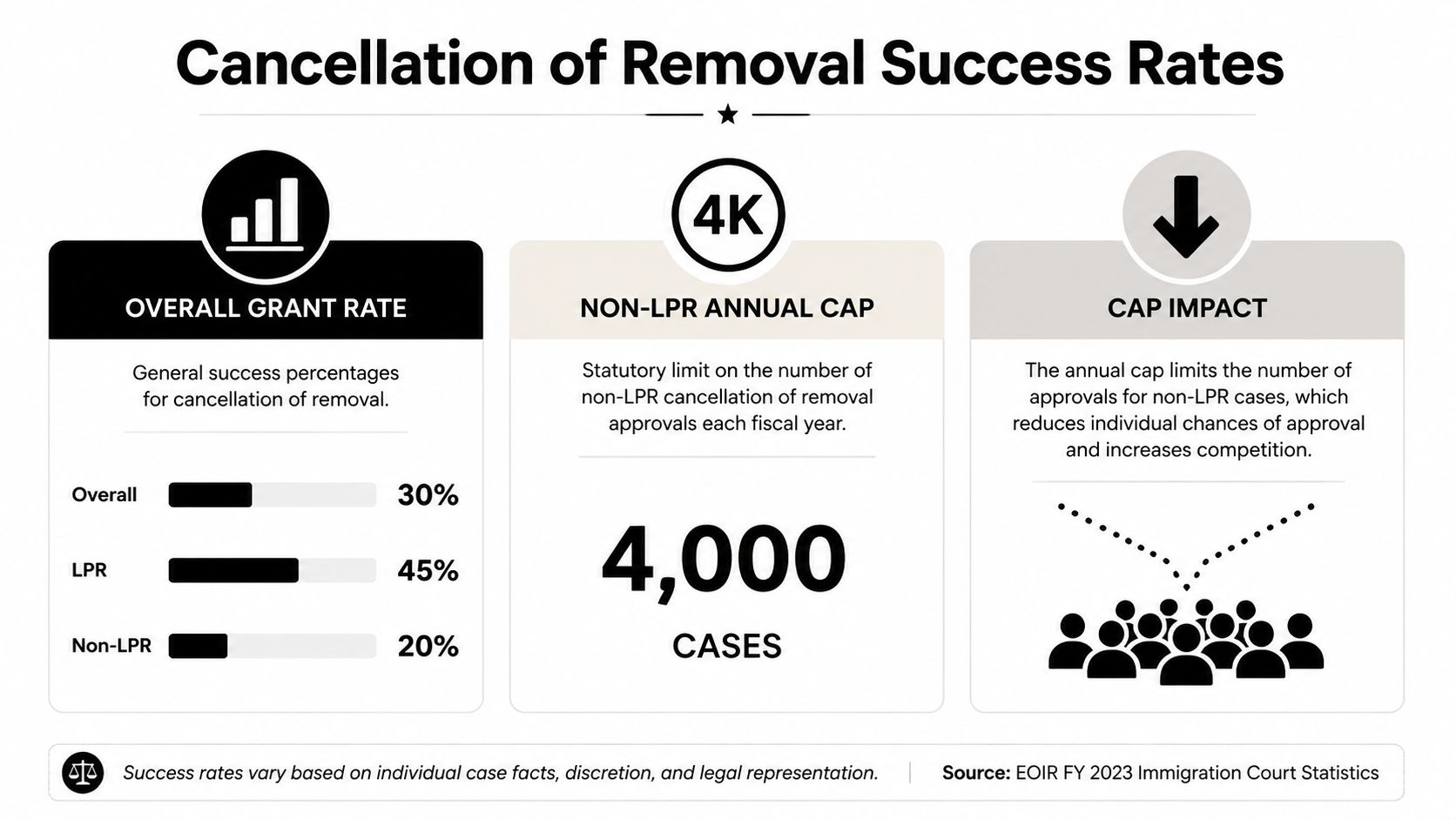
For non-LPR cancellation, the decisive statistical reality is the 4,000-grant annual cap. One report notes roughly 9,000 to 10,000 applications filed annually, and another states that between 2017 and 2019, immigration judges reviewed 60,588 applications total, averaging about 20,196 per year. Against the same 4,000-cap ceiling, that creates a theoretical maximum grant rate of about 19.8% before the court even reaches the merits of any individual case, as discussed in this analysis of cancellation of removal and deportation defense statistics.
That point matters because it changes how you interpret “low approval rates.” A constrained outcome may reflect scarcity built into the statute, not just poor lawyering or weak facts.
Why a low rate does not always mean a weak case pool
If a court reviews far more cases than the statute allows it to grant, many approvable or near-approvable cases still compete in a narrow channel. That makes cancellation different from relief categories where the main question is only whether the applicant met the legal standard.
For non-LPR cancellation, the practical benchmark isn't just “good enough.” It is “strong enough, documented enough, and credible enough to stand out in a scarce form of relief.”
Consider what attorneys often do wrong with these statistics:
- They use the rate as a prediction tool. It isn't. A structural cap says something about the system, not enough about your evidentiary record.
- They treat all denials as merits denials. Some losses reflect threshold eligibility defects. Others reflect discretion. Others happen in a field where demand exceeds available grants.
- They underinvest in proof. When relief is scarce, marginal evidence problems become outcome problems.
A better reading of the numbers is simple. The non-LPR applicant is competing in a forum where relief has long been limited by design. That reality should make lawyers more exacting, not more fatalistic.
Beyond the Stats Key Factors in Judicial Decisions
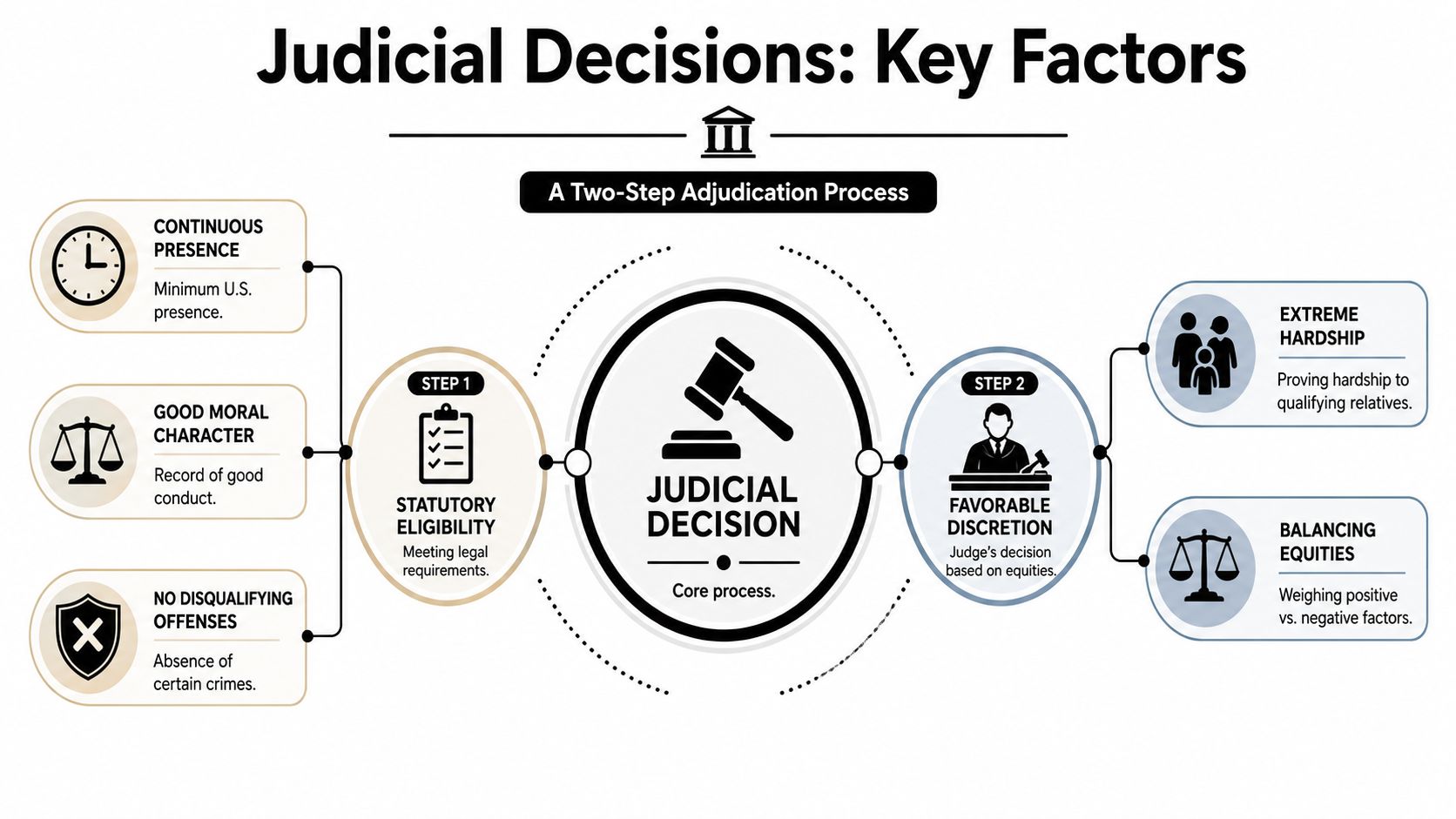
A cancellation case usually turns on two separate questions. First, has the respondent established statutory eligibility? Second, if eligible, should the judge grant relief as a matter of discretion?
Those questions overlap in practice, but they aren't the same. Lawyers who blur them often prepare uneven records.
Eligibility gets you in the door
Eligibility is where counsel proves the statutory elements with discipline. In a non-LPR case, that often means continuous presence, good moral character, absence of disqualifying bars, and hardship to a qualifying relative. In an LPR case, the emphasis shifts, but the same principle applies. Sloppy threshold proof can sink the case before discretion even matters.
Here, records matter more than rhetoric. Dates must line up. Addresses must line up. Work history, tax filings, school records, medical records, and family relationships should support each other rather than create new questions.
A few recurring problems weaken otherwise viable cases:
- Chronology gaps: missing periods in residence or family history that force the judge to guess.
- Unscreened criminal issues: counsel assumes a disposition is harmless without a full immigration analysis.
- Boilerplate declarations: the statement sounds polished, but it doesn't answer the legal standard.
- Weak corroboration: the central claim appears only in testimony, even though documents were available.
Discretion decides who actually gets relief
Even a legally eligible respondent can lose if the record doesn't justify a favorable exercise of discretion. Judges weigh positive equities against negative factors, and they do it in a courtroom environment shaped by scarcity, delay, and difficult line-drawing.
CLINIC reported more than 250,000 cancellation applications pending in a system that still grants only 4,000 per year, and EOIR says applicants may have to “wait your turn” for years. The same CLINIC discussion also notes that immigration court removals fell from 79.6% of outcomes in FY 2019 to 40% in FY 2024, which signals broader changes in adjudication patterns without eliminating the scarcity problem for cancellation itself, as described in CLINIC's analysis of why cancellation of removal is becoming even more important.
Case-building insight: In a crowded docket, meeting the minimum standard rarely feels sufficient. Judges need a clean, coherent record that explains why this case warrants one of the limited grants available.
What tends to help in discretionary analysis is not theatrics. It is disciplined equity proof. Stable caregiving. Tax compliance. Community ties. Rehabilitation where needed. Credible testimony. Hardship evidence tied to specific qualifying relatives rather than generalized family sadness.
What doesn't help is overclaiming. If every inconvenience is labeled catastrophic, the judge stops trusting the narrative. The strongest records are sober, specific, and heavily corroborated.
Actionable Strategies to Strengthen Your Case

The statutory cap is out of your hands. The court calendar is largely out of your hands. The quality of the record is not.
The attorneys who consistently improve case posture do the same few things well. They don't wait for the merits hearing to discover weaknesses. They build the case early, test it for contradictions, and translate facts into proof that maps onto the legal standard.
Build the record like trial counsel
Start with chronology. Every cancellation case should have a master timeline that includes entry, residence, work, family developments, schooling, medical events, arrests if any, prior filings, and major hardship facts. If the declaration says one thing and the exhibits suggest another, fix that before testimony prep.
Then gather evidence by element, not by convenience.
- For physical presence or residence: collect documents across the full relevant period, not just the strongest years.
- For moral character: don't stop at support letters. Add tax records, proof of caregiving, community involvement, compliance history, and any rehabilitation evidence if there are adverse facts.
- For family ties: use birth records, school records, caregiving schedules, and third-party corroboration from people who observe the family system.
- For hardship: collect medical records, educational documentation, financial records, and evaluations where clinically indicated.
Good records don't just prove facts. They reduce the number of inferences the judge has to make in your favor.
Organize hardship so the judge can use it
One common mistake is submitting a large stack of hardship exhibits without a theory of the case. Judges don't have time to build your argument for you.
A better approach is to separate hardship into distinct lanes and support each with targeted proof:
| Hardship area | Useful evidence |
|---|---|
| Medical | Treatment records, provider letters, medication history, care plans |
| Psychological | Forensic evaluation, counseling records where appropriate, school counselor observations |
| Educational | Attendance records, special services documentation, teacher letters, academic history |
| Financial | Income records, household expenses, dependency proof, caregiving impact |
| Functional | Evidence showing who provides transportation, supervision, language support, or medical coordination |
Use declarations carefully. A spouse's declaration should not read like the child's declaration, and neither should duplicate counsel's brief. Each statement should answer a different evidentiary question.
Attorneys should also decide early whether expert evidence is needed. In some cases, a treating provider can confirm a diagnosis or care plan. In others, a forensic evaluator is better positioned to connect clinical findings to the legal hardship standard. One option attorneys sometimes use is Pro Psychological Analysis for cancellation of removal evaluations, where the report is designed to document hardship in immigration cases rather than function as a generic therapy note.
What doesn't work is assembling evidence at the last minute and hoping volume will compensate for weak framing. It won't. Cancellation cases get stronger when every exhibit has a job.
The Power of a Psychological Evaluation to Prove Hardship
In many non-LPR cancellation cases, the hardest issue isn't whether the family will suffer. The family almost always will. The hard issue is proving that the suffering rises above ordinary disruption and is serious enough, specific enough, and reliable enough for the court to weigh heavily.
That is where a forensic psychological evaluation can become strategically important.

What a forensic evaluation does that a support letter cannot
A strong evaluation does more than say a child is upset or a spouse is anxious. It documents symptoms, functioning, history, stressors, and likely consequences in a way that gives the court a professional framework for understanding hardship.
That matters because many records submitted in cancellation cases are too vague to carry real weight. A brief counseling note may show that someone attended therapy. It often doesn't explain severity, causation, functional impairment, or the likely impact of separation or relocation. A family declaration may be heartfelt, but it is still partisan evidence.
A forensic evaluation can help translate subjective suffering into objective evidence. Used correctly, it can connect the dots between family structure, mental health, caregiving dependence, developmental vulnerability, trauma history, educational disruption, and foreseeable deterioration if the respondent is removed.
The court doesn't need more adjectives. It needs a disciplined explanation of how hardship will operate in this family.
Later in the case-building process, video can also help attorneys and clients understand how these evaluations fit into immigration strategy:
When to involve the evaluator
Bring in the evaluator early enough to shape the evidence plan. If counsel waits until declarations are finished, witness prep is done, and the filing deadline is close, the evaluation often becomes reactive instead of strategic.
The best timing usually allows counsel to identify the qualifying relative, define the hardship theory, gather collateral records, and prepare the client for a focused assessment. That gives the evaluator a fuller picture and reduces the risk of a thin report.
Not every case needs an evaluation. But when hardship depends heavily on mental health effects, developmental impact on children, trauma reactivation, caregiving disruption, or the likely consequences of separation, expert psychological evidence often carries far more weight than generic letters.
Frequently Asked Questions About Cancellation of Removal
Can someone apply for cancellation of removal with a criminal record
Sometimes, yes. Sometimes, no. The answer depends on the exact statute, the disposition, the wording of the offense, the sentence, and whether the issue creates a statutory bar or a discretionary problem. Never rely on a client's summary of the case. Get the records and analyze them before building the cancellation strategy.
How long does a cancellation case take after filing
There isn't a universal timeline. Many applicants wait a long time because immigration court calendars are crowded and cancellation cases require individualized hearings. Delay can help if counsel uses the time to strengthen the record, but it can hurt if the file remains underdeveloped.
Is hardship to the respondent enough
For non-LPR cancellation, the central hardship issue focuses on the qualifying relative, not the respondent alone. That means the evidence must show what the U.S. citizen or lawful permanent resident spouse, parent, or child will face. Lawyers lose cases when they present the respondent's hardship as if that were the legal endpoint.
What if the family would stay in the United States
That can still support a strong hardship case. The question isn't limited to relocation abroad. Separation inside the United States can create severe emotional, financial, developmental, and caregiving consequences for qualifying relatives. Those consequences need proof, not assumption.
What if the application is denied
Counsel should evaluate appeal issues immediately. Preserve the record, identify whether the problem was legal, factual, evidentiary, or discretionary, and advise the client on the procedural posture without delay. Denial analysis is not clerical cleanup. It is part of representation.
What is the most common mistake in cancellation cases
Underdeveloped evidence. Lawyers often know the family has a compelling story, but the filing doesn't convert that story into admissible, organized, persuasive proof. In cancellation work, “the judge will understand” is not a strategy.
If your firm is preparing a cancellation case and needs clinically grounded hardship evidence, Pro Psychological Analysis provides immigration-focused psychological evaluations designed to support legal arguments with organized, court-usable findings.