
You may be reading this right after an attorney told you that your case needs a psychological evaluation. That moment often brings two fears at once. First, the legal fear: “What if this hurts my case?” Second, the human fear: “How am I supposed to talk about the worst parts of my life to a stranger?”
Those fears are understandable. In immigration matters, the phrase how to pass a psychological evaluation gets searched for the same way people search for job screening tips, but the immigration context is different. You are not trying to look flawless. You are trying to produce a clinically credible, ethically sound account of what happened to you and how it has affected your life.
For attorneys, the challenge is similar. You want to prepare your client well without crossing the line into coaching. The strongest evaluations don't come from polished scripts. They come from organized records, clear referral questions, and honest symptom reporting that fits the person's history.
Table of Contents
- Reframe Passing from Deception to Authenticity
- The Evaluation Blueprint What Clinicians Actually Assess
- How to Prepare Your Story and Your Documents
- Communicating Your Experience Effectively and Honestly
- Navigating the Logistics and Your Rights
- Frequently Asked Questions for Attorneys and Clients
Reframe Passing from Deception to Authenticity
When people search for how to pass a psychological evaluation, they usually picture a test where the goal is to avoid saying anything that sounds “bad.” That model fits some employment-related content online, but it does not fit immigration practice. In asylum, VAWA, T visa, U visa, and hardship contexts, “passing” means something else entirely. It means presenting an account that is authentic, consistent, clinically grounded, and useful to the legal standard.

That distinction matters because immigration evaluations often document trauma, coercion, fear, shame, dissociation, sleep disturbance, concentration problems, and functional impairment. Trying to appear unusually composed or unusually perfect can weaken the clinical picture. Existing “how to pass” content overwhelmingly targets job applicants, while immigration cases require credible, trauma-consistent narratives for USCIS. The same source notes that USCIS approves only 37% of asylum claims overall, that psychological reports can boost success by 25-40% when they use validated tools, and that attorneys report 50% higher success rates when clients review case-specific prep guides before the evaluation, according to this discussion of immigration-specific psychological test preparation.
What authentic reporting looks like
Authentic reporting is not dramatic reporting. It's not a performance.
It looks like this:
- Clear limits on memory: “I remember the room and the smell, but I don't remember the exact date.”
- Concrete symptom examples: “I avoid buses because I panic when men stand behind me.”
- Mixed functioning: “I still go to work, but I don't sleep well and I startle easily.”
- Honest uncertainty: “I'm not sure whether it happened before or after I moved, but it was during that period.”
Practical rule: The best answer is usually the most accurate one, not the most persuasive-sounding one.
What does not work
Two habits usually create problems. One is minimizing because the client feels embarrassed, culturally reluctant, or afraid of judgment. The other is embellishing because someone believes stronger wording will make the case stronger.
Both create the same risk. The history stops sounding like a lived experience and starts sounding shaped for an audience. Good forensic work is built to notice that difference.
Attorneys can help by framing the evaluation correctly: this is not a test of worth, intelligence, or morality. It is a structured clinical process that translates psychological harm into a form that courts and agencies can understand. Clients usually do better when they know that the evaluator is not looking for perfection. The evaluator is looking for a dependable account.
The Evaluation Blueprint What Clinicians Actually Assess
A forensic clinician does not assess whether someone is “normal enough.” The work is narrower and more disciplined than that. The evaluator examines whether the person's reported symptoms, observed presentation, testing results, and documented history fit together in a believable clinical pattern.
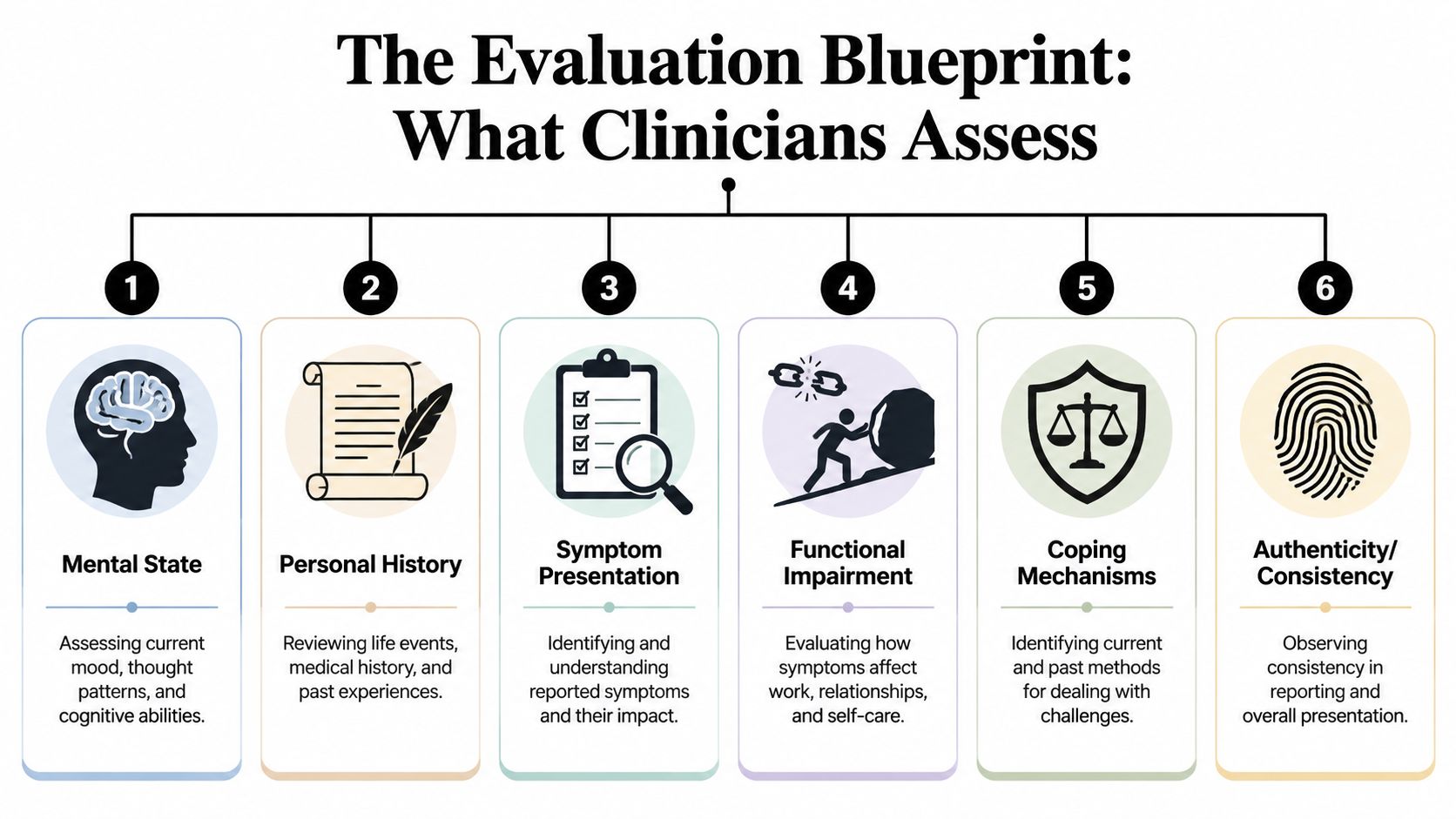
In practical terms, clinicians pay attention to six broad areas: current mental state, personal history, symptom presentation, functional impact, coping style, and consistency across sources. That last piece matters more than many clients realize. A report becomes persuasive when the narrative, records, behavior in interview, and test findings all support the same core picture. A simple visual reference can help attorneys explain the process to clients, including a brain and assessment graphic used in educational materials.

The role of validity scales
Many people hear “validity scale” and assume it means a machine that catches lies. That's too simplistic. Validity scales are better understood as dependability checks. They help the clinician evaluate whether the test results reflect a usable response style.
Modern instruments such as the MMPI-3 and PAI include scales designed to detect patterns like over-reporting, under-reporting, inconsistent responding, and highly unusual combinations of answers. According to this review of validity testing in modern psychological evaluations, these tools can detect manipulation attempts with over 90% accuracy. The same source explains that validity systems refined over 80+ years can detect coached or rehearsed answers, and that such answers trigger inconsistency flags in 75% of cases.
What clinicians are trying to answer
A strong immigration evaluation usually addresses questions like these:
- What happened: abuse, persecution, trafficking, crime victimization, family separation, or hardship conditions.
- How the person responded psychologically: fear, nightmares, avoidance, panic, intrusive memories, depressed mood, concentration problems, dissociation, or somatic symptoms.
- How symptoms affect daily functioning: work, school, parenting, relationships, self-care, sleep, and decision-making.
- Whether the presentation is clinically coherent: the symptoms make sense in light of the history and available records.
Common misunderstandings
Clients often think they need to choose the “right” answer on tests. That usually creates trouble. These instruments are designed for spontaneous, honest responding, not strategy.
A different misunderstanding happens with highly resilient clients. They may think, “If I admit I'm struggling, I'll seem weak.” In immigration work, resilience and suffering can both be true. A person may keep working, care for children, attend church, and still have significant trauma symptoms.
The evaluator is not looking for a perfect victim. The evaluator is looking for a clinically credible person.
That's why the best preparation is not memorizing answers. It's understanding that the evaluation has a structure, and that structure rewards consistency over polish.
How to Prepare Your Story and Your Documents
Preparation helps most when it reduces confusion, not when it creates a script. Clients should spend time organizing the basic timeline of their life and the key events tied to the legal case. Attorneys should make sure the referral question is clear and that the clinician receives the documents that anchor the interview.
A simple way to prepare is to think in chapters. Before the meeting, the client can review major periods: childhood, important relationships, migration, episodes of harm, contact with police or medical providers, changes in mood or sleep, and current functioning. That kind of preparation helps memory. It does not turn the evaluation into rehearsal.
Document checklist for your evaluation
| Document Category | Examples |
|---|---|
| Legal filings | Declaration, affidavit, attorney referral letter, notice to appear, prior applications |
| Identity and timeline records | Passport, country documents, entry records, key date list, address history |
| Medical records | Primary care notes, hospital records, emergency treatment, medication lists |
| Mental health records | Therapy summaries, psychiatric evaluations, prior diagnoses, counseling discharge notes |
| School or work records | Attendance problems, performance decline, disciplinary records, accommodations |
| Police or court records | Police reports, protection orders, criminal case records related to victimization |
| Supporting statements | Letters from family, friends, clergy, advocates, case managers, shelter staff |
| Social service records | Shelter intake, trafficking support documentation, case management notes |
Bring records that help anchor dates, treatment, and changes in functioning. Even partial records can be useful if they clarify chronology.
How attorneys can help without coaching
The attorney's role is to support accuracy and reduce avoidable stress. That usually means practical preparation such as:
- Clarify the legal purpose: Identify whether the evaluation is for asylum, VAWA, T visa, U visa, or hardship.
- Share relevant filings: The clinician should understand the core allegations and the legal theory.
- Flag language needs: Tell the evaluator early if an interpreter is necessary.
- Address record gaps: If dates are uncertain or records are missing, say so in advance rather than trying to smooth it over later.
How clients can prepare mentally
Some clients benefit from writing a private outline before the appointment. Not a script. Just a list of major events, symptoms, and names of people involved.
That outline can include prompts such as:
- When did things start to change?
- What do you avoid now that you didn't avoid before?
- How do you sleep?
- What happens in your body when you remember the event?
- Who noticed changes in you?
This preparation often makes the interview feel less chaotic. It also helps clients talk about painful experiences in a way that is anchored in memory rather than fear.
Communicating Your Experience Effectively and Honestly
Talking about trauma is hard even when the listener is kind and experienced. Some people become very emotional. Others go flat, detached, or confused. Both responses are common in forensic settings, and neither means you are doing the evaluation “wrong.”

The most useful approach is simple, but not easy. Describe what happened as accurately as you can. Then describe what changed in your mind, body, relationships, and daily life after that.
Use concrete examples instead of general labels
Clients often say, “I have anxiety,” or “I'm traumatized.” Those statements may be true, but they are more helpful when tied to lived examples.
For instance:
- “I check the lock three times before bed.”
- “I sit near the exit in any waiting room.”
- “I forget conversations and then feel ashamed.”
- “When my phone rings from an unknown number, my chest tightens.”
Those details help the evaluator connect symptoms to functional impact. They also sound like real life, which is what credible testimony usually does.
If you don't remember something, say that plainly
Trauma does not always produce neat, linear memory. A person may remember sensory fragments, body sensations, or a sequence of fear without remembering exact dates. That is not unusual.
Good testimony can sound like this: “I don't remember the date, but I know it was after my child was born and before I moved.” That kind of answer is often stronger than guessing.
Some of the most credible answers in an evaluation begin with “I'm not sure,” followed by what the person does remember.
The broader evaluation process in immigration matters follows a standardized 7-step structure, and factors such as sleep, anxiety, and overthinking can affect performance. According to this explanation of psychological evaluation results and recommendations, adequate sleep improves cognitive scores by 15-20%, anxiety can distort results in 25% of high-stakes cases, and overthinking drops validity by 18%. That is why calm, honest participation usually serves the case better than trying to manage impressions.
Show both suffering and strength
A common mistake is believing that a strong case requires total collapse. It doesn't. Many survivors continue parenting, working, studying, praying, or caring for others while carrying severe symptoms.
If that is true for the client, it should be said. A balanced account often sounds more believable because human beings are rarely all one thing.
Here is a brief educational resource some clients find grounding before an appointment:
What coached stories often miss
Fabricated or over-rehearsed stories tend to lose the natural irregularities of lived experience. They may be too tidy, too uniform, or too emotionally one-note. Genuine accounts often contain uncertainty, mixed feelings, sensory fragments, and practical details.
That's why the best advice on how to pass a psychological evaluation in immigration practice is not “sound convincing.” It's “be accurate enough that your real story can be clinically understood.”
Navigating the Logistics and Your Rights
Many clients feel better once they know what the day itself will look like. Most immigration-focused forensic evaluations include informed consent, a detailed interview, and testing that may occur in one sitting or across more than one session. Some appointments are virtual. Others are in person. The right format depends on the clinician's method, the client's language needs, privacy, technology access, and the complexity of the case.
A virtual format can work well if the client has a quiet private space, stable internet, and freedom to speak candidly. If privacy is not possible at home, that should be addressed before the appointment. A client discussing domestic violence, trafficking, or persecution should not have to worry that someone unsafe can overhear the session.
Confidentiality and forensic limits
Clients need a clear explanation of confidentiality. In a therapeutic relationship, privacy usually serves treatment. In a forensic immigration evaluation, privacy still matters, but the purpose is different. The report is prepared for the legal matter, which means the information gathered may be included in a written opinion for counsel and, depending on the case, for filing.
That's why informed consent matters. Before the evaluation begins, the client should understand who the evaluator is, who requested the evaluation, how the information will be used, and who may receive the report. A visual overview of a provider's practice model, such as this about-the-practice image, can help attorneys explain process expectations before scheduling.

Rights clients should use during the appointment
Clients often forget they are allowed to participate actively in the process. They can and should do the following:
- Ask for clarification: If a question is confusing, ask the evaluator to repeat or rephrase it.
- Request a break: This is especially important if the client becomes overwhelmed, dissociative, or physically distressed.
- Say “I don't know” or “I don't remember”: Guessing is usually less helpful than acknowledging uncertainty.
- Flag interpreter concerns: If translation feels inaccurate or incomplete, the client should speak up.
If a client is confused, flooded, or exhausted, slowing down is usually better than pushing through.
Practical pitfalls
The process itself can interfere with performance if clients arrive depleted. According to this overview of strict forensic evaluation protocols, overthinking can create invalidity flags in 40% of cases, poor sleep can reduce cognitive performance by 10-15 IQ-equivalent points, and honest, calm clients achieve 90% validity pass rates compared with 55% for highly anxious clients.
Those numbers support advice that seems basic but matters: sleep the night before if possible, eat something, log on early for virtual appointments, bring glasses or medication lists, and don't rush. In this setting, logistics are not separate from credibility. They support it.
Frequently Asked Questions for Attorneys and Clients
Questions attorneys ask
How do I prepare a client without coaching them?
Prepare the process, not the content. Explain the purpose of the evaluation, review the type of relief at issue, make sure the client understands confidentiality and report use, and help gather records. Encourage the client to think about chronology and symptoms, but don't script language or suggest what diagnoses would be “helpful.”
What makes a report persuasive in an immigration case?
A persuasive report is clinically careful and legally useful. It connects the facts of the case to observed symptoms, testing, and functional impact. It also addresses inconsistencies directly rather than ignoring them.
Should I send the evaluator my legal theory?
Yes. A forensic clinician should know the referral question and the relevant context. The report is strongest when the evaluator understands what issue needs clinical clarification, while still maintaining independent judgment.
What if my client minimizes everything?
That is common, especially with shame, cultural stigma, or trauma bonding. The best response is not pressure. Encourage accurate examples from daily life, changes over time, and corroborating records or statements where available.
Questions clients ask
What if I cry during the evaluation?
That is okay. Many people cry when discussing painful experiences. Tears do not harm credibility, and neither does emotional numbing.
What if I can't remember dates or details?
Say what you do remember, and be honest about what you don't. Trauma memory is often uneven. Accuracy matters more than precision you cannot provide.
What if the evaluator asks personal questions?
That is normal in this kind of assessment. The evaluator may ask about family, mental health, abuse, medical issues, sleep, work, or daily functioning because those details help form a reliable clinical opinion.
What if I'm afraid I'll sound inconsistent?
Focus on telling the truth in your own words. If something changed over time, say that. If your memory is partial, say that. Real experiences are not always neat.
Can I use an interpreter?
Often, yes. If you are more comfortable in your first language, tell your attorney or evaluator as early as possible so the process can be set up correctly.
Will this affect my life outside the immigration case?
The evaluation is typically prepared for the legal matter identified in informed consent. Ask directly who will receive the report and how it will be used. If you don't understand that answer, ask again until you do.
What is the most important thing to remember?
This is not a contest to appear flawless. In immigration practice, the best answer to how to pass a psychological evaluation is to show up rested, organized, and truthful enough that your experience can be documented with clinical integrity. Helpful client communication across languages can also reduce confusion, especially for multilingual families and legal teams using tools like GTranslate for website accessibility.
If you need an immigration-focused evaluation that is careful, humane, and legally useful, Pro Psychological Analysis works with attorneys and clients on Asylum, VAWA, T Visa, U Visa, and Extreme Hardship cases. Their practice provides HIPAA-compliant, evidence-based reports designed to document trauma clearly, protect client dignity, and support filing deadlines with dependable forensic rigor.