
You likely have a case where the facts are strong, the declaration is detailed, and the client's suffering is obvious, yet the record still feels incomplete. That usually happens when trauma, fear, coercion, or family hardship are central to the claim, but the file doesn't yet translate those experiences into evidence that fits a legal standard. A psychological evaluation often fills that gap, but only if the attorney and clinician are using the same words to mean the same thing.
In immigration practice, that distinction matters more than is often realized. A vague request for a “psych eval” can produce a clinically sincere document that still misses the legal question, the forensic structure, or the evidentiary function of the report. One cited example is especially telling: a Journal of Forensic Psychology finding summarized here reported that 68% of immigration case rejections involving psychological documentation were linked to terminological mismatches, including reports that failed to distinguish assessment data from evaluative judgments.
Table of Contents
- The Core Definition of a Psychological Evaluation
- The Anatomy of a Comprehensive Evaluation
- Synthesizing Data into a Clinical Formulation
- Upholding Legal and Ethical Standards in Evaluations
- Applying Evaluations in High-Stakes Immigration Cases
- How to Read and Use a Psychological Evaluation Report
- Partnering for Stronger Immigration Cases
The Core Definition of a Psychological Evaluation
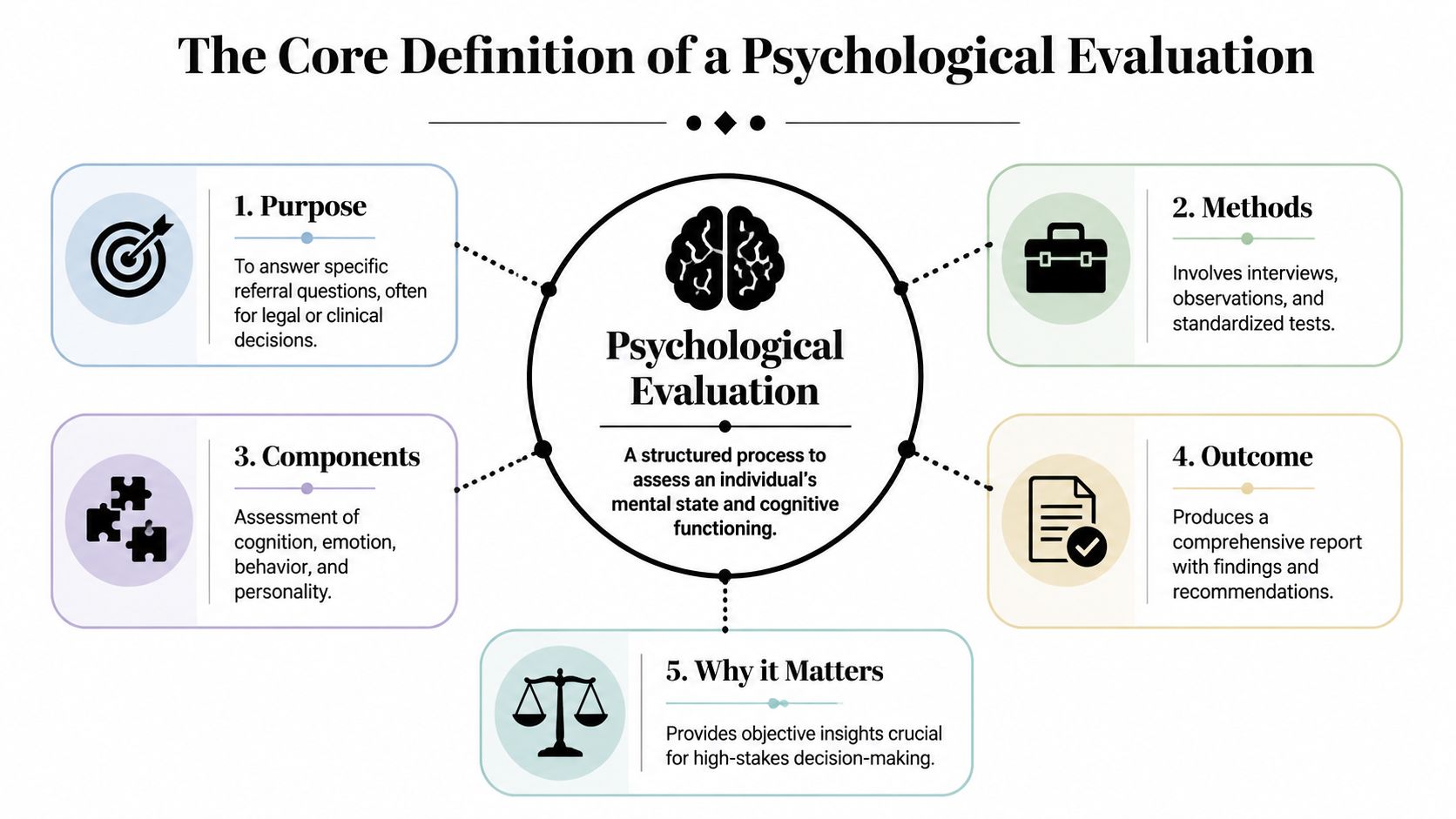
The definition of evaluation in psychology is narrower and more useful than most referral emails suggest. In practice, an evaluation is not just a conversation with a client, and it is not just test administration. It is a structured professional judgment based on multiple sources of information, assembled to answer a specific question.
That's where attorneys often run into avoidable trouble. Assessment is the gathering of data. Evaluation is the interpretation of that data into a conclusion. A psychiatric evaluation is different again. It often focuses more directly on diagnosis, medication needs, medical history, and biological contributors to symptoms.
Assessment gathers facts, evaluation answers the referral question
A useful comparison is a detective file. Witness statements, photos, call logs, and physical evidence are all pieces of information. None of those items alone is the final conclusion. The detective's job is to weigh them, reconcile inconsistencies, and explain what most likely happened.
A psychologist does the same thing in a legal referral. The interview, records, standardized measures, and behavioral observations are the clues. The evaluation is the reasoned conclusion that connects those clues to a clinical opinion relevant to the case.
For a busy attorney, the practical difference looks like this:
| Term | What it does | Why it matters legally |
|---|---|---|
| Psychological assessment | Collects data through interviews, tests, and observations | Useful, but incomplete if it doesn't reach a formal opinion |
| Psychological evaluation | Interprets the data and forms conclusions | Creates the report that can address hardship, trauma, credibility-related symptom patterns, or abuse dynamics |
| Psychiatric evaluation | Reviews mental health with attention to medical and medication issues | May help treatment planning, but may not answer a forensic immigration question |
Why wording affects admissibility and usefulness
When an attorney asks for a “psych eval,” the question should usually be more specific. Is the case trying to document trauma sequelae? Explain delayed disclosure? Show coercive control in a VAWA matter? Establish the psychological impact of family separation for an extreme hardship waiver?
Practical rule: Don't refer for “a psych eval.” Refer for an evaluation that answers a legal question.
That's the point where clinical language becomes legal evidence. The report must do more than say the client is distressed. It needs to explain how symptoms were identified, what methods were used, how the clinician reached the opinion, and why the findings matter to the immigration standard at issue.
Even a visual shorthand can help keep the distinction straight. Think of the brain symbol used in psychological materials as representing the subject matter, not the end product. The end product is the documented expert judgment that translates mental health findings into a legally usable report.

The Anatomy of a Comprehensive Evaluation
Once the referral question is framed correctly, the work becomes methodical. An in-depth evaluation isn't one interview dressed up as a report. It is a layered process designed to answer whether the client's presentation is consistent with the claimed history, how symptoms affect functioning, and what conclusions can be supported responsibly.

The interview does more than collect history
The intake interview starts with context. The psychologist identifies the referral source, the legal posture of the case, language needs, trauma sensitivity issues, and the specific psychological questions that the report will need to answer.
The clinical interview then goes deeper. It explores symptom history, trauma exposure, mood, cognition, sleep, concentration, fear responses, avoidance, shame, memory gaps, daily functioning, and prior treatment. In immigration matters, it also helps identify whether a symptom pattern may explain facts that would otherwise look inconsistent on paper.
What works is careful, paced interviewing. What doesn't work is forcing a linear narrative from a client whose trauma history is fragmented, dissociative, or shaped by years of survival-based avoidance.
Standardized testing adds structure
Standardized instruments are useful because they give the evaluation objective anchors. Depending on the referral question, a psychologist may use trauma measures, personality inventories, symptom validity tools, or broad clinical screening instruments.
That doesn't mean tests replace judgment. They don't. A score without context is just a number. But a properly selected measure can support or challenge impressions from the interview, which is exactly what you want in a defensible report.
A sound evaluation often includes these components:
- Referral-focused interviewing that ties the clinical inquiry to the legal issue.
- Behavioral observations that note presentation, affect, thought process, and consistency during the meeting.
- Standardized measures that help evaluate trauma, depression, anxiety, or personality functioning.
- Collateral review of declarations, medical records, prior evaluations, police reports, or affidavits when available.
Records matter because they test the story against the file
Collateral documents are where legal and clinical work often meet most effectively. A declaration may describe abuse. A medical record may show panic, insomnia, or somatic symptoms. A police report may document a qualifying crime. The evaluation doesn't merely repeat those materials. It checks whether they fit the client's symptom profile and current functioning.
A strong report shows its work. It doesn't ask the reader to trust the conclusion without seeing the path that led there.
What fails in practice is overreliance on a single data source. If the report reads like an affidavit rewritten in clinical language, opposing counsel or an adjudicator can discount it. If it reads like a test printout with no narrative meaning, it won't help much either. The best evaluations integrate lived history, observed behavior, standardized data, and records into one coherent evidentiary picture.
Synthesizing Data into a Clinical Formulation
The most valuable part of an evaluation is often the part attorneys don't see happen. After the interview is done, the tests are scored, and the records are reviewed, the psychologist has to decide what the whole pattern means. That step is called clinical formulation.
A formulation is not a summary. It is an explanation. It answers questions such as: Why does this client function the way they do? Which symptoms are central and which are secondary? How does trauma history relate to current fear, memory gaps, hypervigilance, avoidance, or depressive collapse? Which diagnosis fits best, and which alternatives fit less well?
Where legal relevance is built
A clinically useful formulation becomes legally useful when it ties functioning to the referral issue. In an asylum matter, that may mean explaining why the client recounts events in a fragmented way without concluding that the history is fabricated. In a VAWA case, it may mean describing coercive control and trauma bonding in terms that make the abuse pattern legible to a non-clinical reader.
This is also where diagnosis has to be handled carefully. A diagnosis should emerge from the full record, not from sympathy, assumption, or one intense interview. The report should explain the basis for the diagnosis in plain language and then connect that diagnosis to actual impairments, symptoms, and behavior.
Formulation separates evidence from advocacy language
Attorneys understandably want reports that support the case. Psychologists have a different obligation. The report has to remain independent, methodical, and clinically grounded. That independence is not a weakness. It is part of what gives the report weight.
A strong formulation usually does three things at once:
- Explains symptom patterns in a way that fits the client's history.
- Rules in and rules out possibilities where clinically appropriate.
- Answers the referral question in language a legal decision-maker can use.
The report becomes persuasive when the reasoning is visible. A conclusion with no formulation sounds hired. A careful formulation sounds credible.
When attorneys read the formulation section closely, they usually find the most usable language for declarations and briefs. That's where the evaluation stops being a set of clinical notes and becomes an expert explanation of why the client's presentation matters in the case.
Upholding Legal and Ethical Standards in Evaluations
A report can be compassionate, articulate, and still be weak evidence if the methods are sloppy. In immigration work, legal usefulness depends on whether the evaluation was conducted with standards that can withstand scrutiny. Reliability, validity, confidentiality, informed consent, and referral-fit are not academic side issues. They are the structure that keeps the report from collapsing when someone challenges it.
Reliability and validity are not optional
In plain English, reliability asks whether a tool produces consistent results. Validity asks whether the tool is measuring what the evaluator claims it measures. If either one is weak, the report becomes vulnerable.
One verified benchmark matters here. This summary of evaluation standards states that modern APA Ethical Principles updated in 2017 mandate 95%+ validity and reliability for tests used in forensic and immigration evaluations, and notes that the PCL-5 has a 0.94 test-retest reliability. For an attorney, the practical takeaway is simple: if the clinician can't explain why a tool was chosen and whether it is appropriate for the referral question, the report may not carry much weight.
The legal file shapes the clinical method
A legally sound evaluation starts before the first interview question. The psychologist should know the case type, the issues in dispute, the filing posture, and whether the report is intended for USCIS, immigration court, or supporting negotiations within the case. That doesn't mean the clinician becomes an advocate. It means the clinician understands the question to be answered.
Here's a quick screening table attorneys can use when reviewing a provider's process:
| Hallmark | What you want to see | Warning sign |
|---|---|---|
| Tool selection | Measures tied to trauma, functioning, or personality questions in the case | Generic testing with no explanation |
| Forensic structure | Clear referral question, methods, findings, and opinions | Therapy-style narrative with no evaluative framework |
| Confidentiality practice | HIPAA-conscious consent, release handling, and record boundaries | Casual sharing or unclear limits of disclosure |
| Cultural attention | Recognition of language, migration history, and context | Overconfident conclusions without context |
Confidentiality has to be handled deliberately
Immigration evaluations often involve sexual assault, torture, trafficking, domestic violence, suicidality, and undocumented family history. Clients may disclose facts they have never said out loud before. That creates a dual obligation. The evaluator must gather enough detail to support the opinion, while protecting the client's privacy and dignity throughout the process.
What works is explicit informed consent, careful discussion of the purpose of the report, and clear explanation of who will receive it. What doesn't work is treating the meeting like therapy and only later deciding to repurpose the notes for litigation.
Bottom line: If the evaluation wasn't built for legal scrutiny from the start, fixing the report afterward is often harder than starting over.
For attorneys, this is often the difference between evidence that strengthens the case and paper that merely occupies a tab in the filing.
Applying Evaluations in High-Stakes Immigration Cases
The value of a psychological evaluation becomes clearest when the legal standard requires proof of subjective experience, trauma consequences, abuse dynamics, or the likely impact of separation. Those issues appear constantly in immigration practice, but they don't prove themselves.

One verified data point captures why these reports matter in case strategy. A cited report described here states that, in a USCIS FY2025 Q1 report from May 2026, immigration cases that included a forensic psychological report documenting PTSD or trauma had a 42% higher approval rate, while only 15% of applicants were accessing these evaluations. Since that report is future-dated relative to current practice, it should be treated as a cited report rather than a present-tense universal baseline. Still, it reflects what many attorneys already see firsthand: well-targeted psychological evidence can change how the record is understood.
Asylum cases
In asylum matters, the report often helps explain fear responses, trauma sequelae, and the way persecution affects memory and disclosure. A client may omit details in an early interview, speak flatly about horrific events, or remember fragments out of sequence. Without clinical context, those features can be misread as inconsistency.
A strong evaluation can document whether the client's presentation is consistent with trauma-related symptoms such as avoidance, hyperarousal, intrusive recollections, or emotional numbing. It can also distinguish fear-based fragmentation from deliberate fabrication, while staying within proper clinical limits.
T, U, and VAWA matters
These cases often turn on coercion, control, victimization, and the psychological aftermath of abuse or exploitation. The legal file may already contain police contact, declarations, or service-provider records. The evaluation gives those materials depth by identifying how the abuse affected the client's functioning and decision-making.
For example, in a VAWA matter, the central issue is rarely just whether violence occurred. The harder question is why the client stayed, minimized the abuse, delayed disclosure, or returned after prior incidents. Clinical formulation can explain learned helplessness, trauma bonding, shame, dependency, and fear in a way that makes behavior understandable rather than suspicious.
A short educational resource can help orient clients and counsel to how these reports operate in legal settings:
Extreme hardship waivers
In hardship cases, the legal question often concerns the likely emotional and psychological impact on a qualifying relative if separation, relocation, or loss of support occurs. General distress won't usually move the needle. The report has to identify why this family's circumstances produce hardship that is psychologically significant in a concrete, individualized way.
That may involve preexisting mental health vulnerabilities, caregiving burdens, trauma history, developmental concerns, or the likely destabilizing effect of disrupted medical, educational, or family systems. A useful evaluation doesn't just say separation would be painful. It explains the mechanism of harm and the likely effect on functioning.
The most effective report in immigration practice is usually the one that answers the exact legal question the file is already struggling to prove.
How to Read and Use a Psychological Evaluation Report
Attorneys don't need to read a psychological report the way psychologists do. They need to read it for utility. The goal is to identify the findings that can be translated into declarations, briefs, exhibits, and oral argument without overstating what the clinician concluded.

Start with the referral question and final opinions
Read the first page, then skip ahead to the diagnostic impressions, formulation, and conclusion. Those sections usually contain the most legally usable language. You're looking for three things: what question the evaluator was asked to answer, what methods were used, and what conclusions were reached.
If the report is well written, the conclusion won't float free from the facts. It should point back to the interview, records, observations, and standardized findings that support the opinion. That connection matters because it gives you a basis for citing the report confidently in a brief.
Pull the language that links symptoms to the legal standard
The history of standardized assessments runs deep. This overview of psychological evaluation history notes that their use dates back to Alfred Binet's 1905 intelligence scale, was scaled dramatically when the U.S. Army tested 1.7 million recruits during World War I, and that today such tools are used in 95% of clinical diagnoses per APA guidelines. For legal practice, the point isn't historical trivia. It's that modern reports often carry weight because they combine clinical judgment with structured methods.
That means the most valuable passages are usually not the raw scores. They are sentences such as these kinds of conclusions:
- Symptom-to-history language that ties current PTSD, depression, or anxiety symptoms to the client's reported trauma history.
- Functioning language that shows how symptoms impair concentration, sleep, parenting, work, daily living, or testimony.
- Case-specific language that explains abuse dynamics, delayed disclosure, fear of authorities, or hardship consequences.
Use the report as a building tool, not a standalone exhibit
A good report should feed multiple parts of the case file. It can strengthen the client declaration, support an affidavit from a family member, sharpen direct examination, and help explain facts that otherwise look weak or confusing.
A practical reading sequence looks like this:
- Find the clinician's ultimate opinions.
- Underline the basis for each opinion.
- Match each opinion to an element or pressure point in the case.
- Pull concise quotations or paraphrases into your draft filings.
- Check that your legal argument doesn't stretch beyond what the report says.
If you work with a provider repeatedly, ask for reports that make this easy. Some attorney-facing practices, including the visual identity used by Pro Psychological Analysis, structure reports so that diagnosis, formulation, and legal relevance are easy to locate quickly. That kind of organization saves time and reduces the risk of misquoting the clinical opinion.

Partnering for Stronger Immigration Cases
The definition of evaluation in psychology becomes much more practical once it's placed inside immigration law. An evaluation is not just a mental health document. It is a structured, evidence-based professional judgment that can translate trauma, abuse, fear, and hardship into findings that fit a legal framework.
For attorneys, the main trade-off is speed versus precision. A rushed letter may be easier to obtain, but it often lacks the forensic structure, methodological support, and referral focus that legal cases demand. A properly built evaluation takes more care, yet it gives you something far more useful: a report that can carry clinical credibility and legal relevance at the same time.
What strong collaboration looks like
The best attorney-clinician partnerships are specific from the beginning. The referral identifies the relief sought, the evidentiary problem, the filing deadline, the available collateral records, and any language or trauma-access concerns. The psychologist then evaluates within those boundaries without becoming an advocate disguised as an expert.
That collaboration usually produces better work because each professional stays in the right lane. The attorney defines the legal issue. The psychologist answers the clinical question that bears on that issue.
Here are the habits that tend to produce stronger reports:
- Send targeted referral questions instead of asking generally for a psych evaluation.
- Provide relevant records early so the clinician can test impressions against the file.
- Flag inconsistencies directly if there are weak spots the report may help explain.
- Ask for clarity, not spin when reviewing draft conclusions or final language.
- Choose evaluators who understand immigration contexts and write for legal readers.
A concise overview of the practice context can help when choosing a provider. The about page image used by PPA reflects the kind of immigration-focused evaluation setting where legal and clinical coordination is part of the workflow.

When the report is done well, it does something declarations and treatment notes often can't do on their own. It turns symptoms into evidence, behavior into context, and lived experience into a defensible clinical opinion that a legal decision-maker can use.
If you need a psychological evaluation that is built for immigration litigation rather than general treatment, Pro Psychological Analysis provides attorney-facing evaluations for Asylum, T Visa, U Visa, VAWA, and Extreme Hardship matters, with reports designed to translate clinical findings into legally usable evidence.